





Data governance has become a foundational pillar for the modern enterprise—not just in regulated industries, but across any organization striving for enterprise AI readiness, analytics maturity, and trusted decision-making processes.
In a world awash with data, automation, and machine learning models, the challenge isn’t whether to govern data—it’s how to focus governance where it matters most.
One of the most effective ways to sharpen your data governance framework is to center it around Critical Data Elements (CDEs)—the specific data assets most essential to your business processes, regulatory reporting, and data strategy.
This blog outlines what CDEs are, why they’re vital to data integrity and compliance in 2026, how to apply a proven CDE methodology, and how modern data catalogs bring automation and scalability to your governance program. It draws from a wbinar featuring DGX, which you can also view below:

Key takeaways
Critical Data Elements (CDEs) are the strategic backbone of governance, analytics, and AI readiness—they help you prioritise what truly matters.
A structured CDE methodology—from identification to definition to monitoring—ensures your governance program is repeatable, scalable, and business-aligned.
Because CDEs tie directly to risk, regulatory compliance, and business value, they elevate governance from policy to practice.
A modern data catalog equipped with CDE-focused automation transforms how you document, steward, and operationalise essential data.
Strong relationships with subject matter experts, plus measurable metrics and hybrid governance models, ensure your CDE initiative delivers tangible results.
What are Critical Data Elements?
Critical Data Elements (CDEs) are the pieces of enterprise data that, if inaccurate, unavailable, or mismanaged, would materially affect an organization’s operations, compliance, or strategic outcomes. They’re not just any records—they’re the essential data that powers your business processes, analytics, and reporting.
CDEs typically include personal data protected under privacy laws such as GDPR, financial data used in regulatory submissions, or other information that directly influences customer outcomes, executive reporting, or automated decisions.
What are some examples of CDEs?
The examples vary by industry—but all share a high impact on accuracy, trust, and performance:
Financial services: account balance, customer risk rating, transaction timestamp, instrument identifier, date of birth.
Retail: SKU code, unit cost, customer loyalty tier, store-operating region.
Manufacturing: material lot number, supplier lead time, quality test result, and machine uptime percentage.
AI and analytics: model confidence score, feature-set version, or data-product identifier—critical to model accuracy and explainability.
The key is not the number of elements—it’s the impact. As one data leader from Aware Super put it, “[CDEs] have got to be business-critical, they’ve got to be high-impact—the most sensitive, most important bits of data.”
Why are CDEs important?
In 2026, data-driven organizations face mounting regulatory expectations, increasing complexity in data pipelines, and growing dependence on AI and automation. Amid this, CDEs have evolved from a governance best practice into a non-negotiable foundation for compliance, collaboration, and responsible innovation.
Supporting regulatory compliance
In regions like Australia, regulators have gone beyond guidance—they’ve mandated the identification and management of CDEs. The Australian Prudential Regulation Authority (APRA), for example, includes CDEs in its Prudential Standard CPS 230, requiring banks and insurers to identify and control the data elements most critical to operations and compliance.
One of APRA’s six key factors for data management is explicit: “Identify critical data elements and create a consistent set of data controls.”
Globally, similar principles are embedded in GDPR, BCBS 239, and CCPA, all of which emphasise data integrity, data security, and the management of high-quality, auditable information. Organizations must be able to prove how specific data—such as customer data or personal identifiers—flows through systems, how it’s validated, and how errors are corrected.
CDEs make that possible. By formally identifying, documenting, and controlling essential data, organizations can prove compliance faster and respond to audits with confidence.
Driving collaboration and business value
Compliance is the starting line, not the finish. Once organizations establish their CDEs, they uncover broader operational and strategic advantages:
Prioritization of governance and master data management efforts—resources focus on the data that matters most.
Improved collaboration between data engineers, analysts, and subject matter experts, aligning technical and business definitions.
A foundation for data-driven innovation, including machine learning and predictive analytics, built on trusted, standardised inputs.
Greater confidence in reporting, analytics, and decision-making processes, powered by verified, high-quality information.When CDEs become the shared language between teams, data governance shifts from enforcement to enablement—fueling cross-functional trust and accelerating innovation.
Identifying and managing CDEs doesn’t just help you comply—it helps your organization communicate, innovate, and scale data initiatives more effectively.
Enabling effective, focused data governance
When CDEs are prioritised, governance becomes more targeted and efficient:
Scope narrows to data that delivers measurable outcomes.
Data stewards and owners have clear accountability.
Data quality efforts focus where they matter most.
Visibility improves through dashboards tracking defined CDEs.
Governance becomes operational—anchored in process, not policy.
By aligning risk management, data strategy, and governance through CDEs, enterprises build a scalable governance engine—fit for the realities of AI and regulatory oversight in 2026.
How CDEs support responsible AI
CDEs aren’t just about passing audits—they’re how organizations de-risk AI at scale.
Explainability
When AI models are trained on governed inputs with documented lineage, decisions become explainable and defensible. Teams can trace model outcomes back to the certified data elements that informed them, satisfying both internal governance and external regulators.
Model risk management
Baseline quality metrics and drift indicators can be directly tied to CDE definitions and thresholds. If data begins to deviate from established standards, automated monitoring detects and flags it—protecting downstream machine learning models from silent failure.
Compliant by design
When policies are codified and mapped to critical elements in a data catalog, evidence of compliance can be produced in minutes—not months. That’s the power of automation and declarative governance.
By extending CDE principles into AI governance, organizations build systems that are transparent, traceable, and trustworthy—where compliance, quality, and ethics are engineered into every model from the start.
What’s the CDE framework for data governance?
Having established why CDEs matter, let’s explore how to manage them systematically.
A CDE framework provides a repeatable methodology to identify, formalise, and monitor CDEs—embedding governance directly into data pipelines, processes, and technology.
Phase 1: Identify
Objective: Determine which data elements are truly critical—those with the highest risk, value, and frequency of use in business processes, reporting, and analytics.
Execution:
Conduct a data inventory across systems, domains, and reports.
Collaborate with business leaders, risk teams, and analysts to pinpoint which data would cause major operational or regulatory impact if compromised.
Use risk-based criteria: If 10–20 percent of this element were wrong, would it affect compliance, operations, or customer outcomes?
Keep the list manageable. The goal is precision, not quantity.
Phase 2: Define & formalise
Objective: Create clear definitions, metadata, ownership, and controls for every CDE.
Execution:
Standardise metadata: name, business definition, domain owner, steward, data type, regulatory relevance, lineage, and quality rules.
Document each CDE in a data catalog as the single source of truth.
Assign ownership and stewardship roles—business accountable, operational responsible.
Define controls for data creation, transformation, and consumption.
Apply classifications: PII, financial, operational, or customer data.
Link each CDE to related data pipelines, analytics, and machine learning models for visibility and traceability.
Phase 3: Monitor & operate
Objective: Continuously manage CDEs across their lifecycle, using data lineage, monitoring, and governance automation.
Execution:
Track data lineage end-to-end to maintain transparency and auditability.
Define data quality metrics (e.g., completeness > 98 percent, accuracy, timeliness).
Automate exception alerts for deviations.
Choose a governance model—centralised, federated, or hybrid—based on data culture.
Use dashboards to report on coverage, quality incidents, and control maturity.
Periodically reassess and refine criticality as business priorities evolve.
Additional considerations
Set a clear definition of done for each domain (e.g., CDEs identified, mapped, monitored).
Use a risk-based prioritization approach to focus limited resources.
Invest in training and culture so subject matter experts and stewards feel empowered.
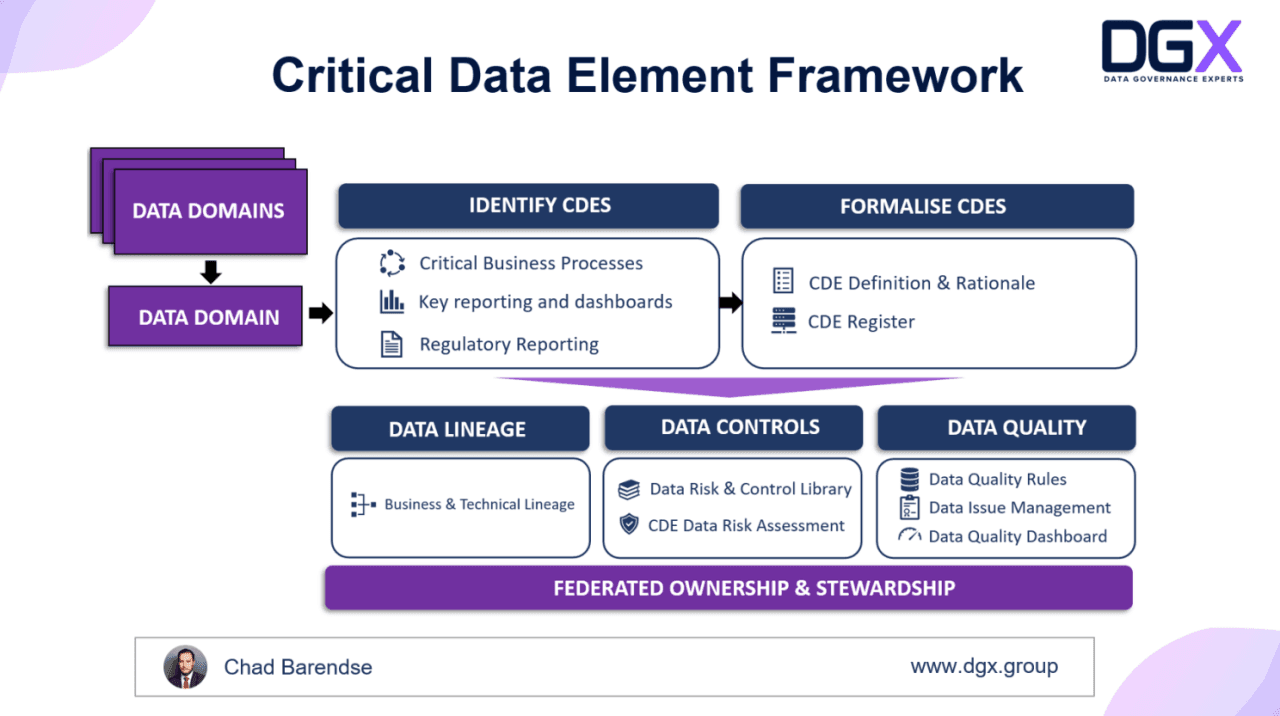
Together, these steps form a pragmatic, repeatable methodology that unites compliance, operational efficiency, and business value. See an example framework from DGX below:
How does a data catalog improve CDE management and governance?
A modern data catalog is more than metadata storage—it’s an automation layer that operationalises data governance at scale. It streamlines governance by integrating metadata, lineage, policy, and workflow into a unified system.
For a successful CDE program, seek out a catalog that offers the following features:
Automated behavioral intelligence: Captures definitions, lineage, and controls—maintaining data integrity and transparency.
CDE-specific templates and workflows: Streamlines steward reviews, regulatory reporting, and approvals.
Lineage and data flow visualization: Enables impact analysis from source to dashboard to model.
Quality monitoring and alerts: Tracks metrics automatically, notifying owners when data quality or compliance thresholds slip.
Governance model enablement: Supports hybrid governance—balancing central standards with domain-level control.
Business-driven context: Connects CDEs with business glossaries, data products, and analytics outputs, linking governance to outcomes.
These capabilities bring structure and visibility—turning governance from documentation into daily practice.
Using Alation CDE Manager to deliver consistent compliance
The Alation CDE Manager is the foundation of Declarative Governance—helping organizations govern by outcome, not procedure. It enables teams to identify and maintain the data most critical to business success, linking each element to its policies, standards, and quality measures.
By focusing on CDEs, organizations can demonstrate trust, compliance, and value where it matters most, without trying to “boil the ocean.”
Powered by intelligent agents, the CDE Manager automates the most time-consuming aspects of governance:
Drafting and mapping agents interpret standards, build CDE definitions, and align metadata automatically.
Validation and remediation agents monitor compliance and data quality continuously—ensuring governance keeps pace with change.
Alation’s CDE Manager unifies catalog, data quality, and policy frameworks into a single operating system. Executives gain a real-time, measurable view of trust, data security, and compliance across their most valuable assets. The result: a living, automated governance framework that drives clarity, accountability, and sustainable business impact.
"One of the standout capabilities of Alation CDE Manager is how effortlessly it extracts and formats the information we need. It's streamlined our workflows and saved a huge amount of time."
- Data Governance Analyst, Global Bank
Getting started: How to kick off CDEs
To operationalise your CDE program with a data catalog:
Start with your CDE inventory and ingest it using the catalog’s CDE templates.
Define ownership, lineage, and quality rules for each CDE.
Link CDEs to business reports, analytics, and machine learning models.
Use automation to validate definitions and flag data integrity issues.
Leverage dashboards for executive visibility and regulatory reporting.
Encourage self-service governance, where domains proactively maintain their own CDEs.
Together, these steps bring your governance framework to life—anchored in measurable outcomes and continuous improvement.

Final thoughts
At its core, a Critical Data Elements program is about focus, business alignment, and operational excellence. In 2026, governance must evolve from static policies to automated, business-driven frameworks.
By identifying, cataloging, and continuously improving the essential data that powers analytics, AI, and compliance, enterprises can ensure data integrity, data security, and trust at scale.
You don’t need to get it perfect—just start, measure, and improve. As one customer shared, “Don’t wait for perfect—chunk it down and learn as you go.”
With CDEs as your foundation and a modern catalog as your engine, you’ll transform governance from obligation to advantage—and unlock the true power of your data.
The Alation data intelligence platform helps organisations manage and integrate CDEs seamlessly into data governance workflows. It provides a repository for data element descriptions, classifications like for personally identifiable information (PII), risk levels, and other attributes, creating a library of data definitions for a shared, transparent view of your organisation’s CDEs. Alation also enables workflows for data governance approvals to ensure definitions, categorizations, and other attributes are properly inputted and vetted. Watch the webinar on-demand: Mastering Critical Data Elements: A Blueprint for Modern Data Governance. Or, schedule a personalised Alation demo today.
- Key takeaways
- What are Critical Data Elements?
- Why are CDEs important?
- What’s the CDE framework for data governance?
- How does a data catalog improve CDE management and governance?
- Using Alation CDE Manager to deliver consistent compliance
- Getting started: How to kick off CDEs
- Final thoughts
Contents
FAQs
What is a critical data element (CDE)?


Critical Data Elements, also known as CDEs, are the data that informs and enables an organisation’s operations, decision-making processes, risk management, reporting accuracy, and compliance with regulatory requirements.
How do critical data elements (CDEs) improve data governance efforts?
By prioritising important data, ensuring regulatory compliance, and improving data quality, CDEs help businesses focus their risk management strategies and assign accountability. This systematic approach not only increases the visibility of essential data but also fosters a more efficient and effective data management framework.
What is the Critical Data Element (CDE) framework for data governance?
Identify Critical Data Elements (CDEs) related to critical business processes, key reports and dashboards, and regulatory reporting requirements.
Formalise those CDEs through definitions and a repository of resources.
Work CDEs into effective data governance efforts by creating processes to manage:
Data lineage to understand where data is created, how it moves through the organisation and systems, and any transformations along the way.
Data controls to assess and reduce risks.
Data quality for data completeness, conformity, consistency, timeliness, and validity.
How does a data catalog improves critical data element (CDE) management and data governance?
A data catalog, like Alation's, provides a repository for data element descriptions, classifications like for personally identifiable information (PII), risk levels, and other attributes, creating a library of data definitions for a shared, transparent view of your organisation’s CDEs.
Why are regulators focusing on Critical Data Elements?
Regulators increasingly recognize that effective data governance requires prioritization—organizations cannot govern all data with the same level of rigor. By focusing on CDEs, regulators like APRA aim to ensure organizations properly manage the data most critical to financial stability, operational resilience, and regulatory compliance. This targeted approach acknowledges the practical constraints organizations face while still ensuring appropriate controls for essential data. APRA's 2019 pilot with financial services firms, which directed them to identify their 100 most critical data elements, exemplifies this pragmatic regulatory approach that balances comprehensive governance with implementation feasibility.
How do you identify which data elements qualify as CDEs?
Identifying CDEs requires evaluating data against clear criteria focused on business impact and regulatory requirements. Ask whether specific data elements are essential for critical business processes, key reports and dashboards, or regulatory reporting. Consider whether unavailability or inaccuracy of the data would severely impact operations, decision-making, or compliance. The identification process should involve both business and technical stakeholders to ensure all perspectives are considered. While the specific CDEs will vary across departments and business units, using consistent identification criteria creates a coherent approach to CDE management across the organization.
What role does data lineage play in CDE governance?
Data lineage is fundamental to effective CDE governance, providing visibility into how critical data flows through your organization. For CDEs, understanding lineage means tracking where data originates, how it moves between systems, what transformations it undergoes, and where it ultimately appears in reports or dashboards. This visibility enables impact analysis (understanding what would be affected by changes), supports audit requirements by documenting data provenance, and helps identify potential quality issues by revealing transformation points where errors might be introduced. A data catalog like Alation automates much of this lineage tracking, making it practical to maintain even in complex data environments.
How do different governance models affect CDE implementation?
Your governance model significantly influences how you implement CDE management. Traditional centralized governance places control with a central team that defines and enforces standards for CDEs across the organization. Federated governance distributes responsibility to domain experts while maintaining coordination through shared standards. Hybrid approaches combine elements of both models. The right choice depends on your organization's size, complexity, and culture. Regardless of model, successful CDE governance requires clear accountability, documented processes, and technology support through platforms like data catalogs to ensure consistency and visibility across the organization.
What benefits can unregulated businesses gain from implementing a CDE framework?
While regulatory requirements often drive CDE adoption in regulated industries, unregulated businesses can realize significant benefits from this approach. By identifying and properly managing critical data, these organizations can improve decision quality, reduce operational risks, enhance efficiency, and build stronger data cultures. The CDE framework provides a structured methodology for data prioritization that helps any organization focus limited resources where they'll deliver the greatest value. As data volumes continue to grow, even unregulated businesses need systematic approaches to identify what matters most—making the CDE framework valuable across all sectors.
How does Alation support the implementation of a CDE framework?
Alation's data intelligence platform provides comprehensive support for implementing and maintaining a CDE framework. The platform serves as a centralized repository for CDE definitions, classifications, and attributes, creating a shared understanding across the organization. Governance workflows enable proper vetting of changes to critical data definitions. Stewardship capabilities allow clear assignment of accountability for CDEs. Lineage tracking provides visibility into how critical data flows through systems. These capabilities move organizations beyond manual, spreadsheet-based approaches to create sustainable, scalable CDE governance programs that can adapt as data landscapes evolve and regulatory requirements change.
Tagged with
Loading...