




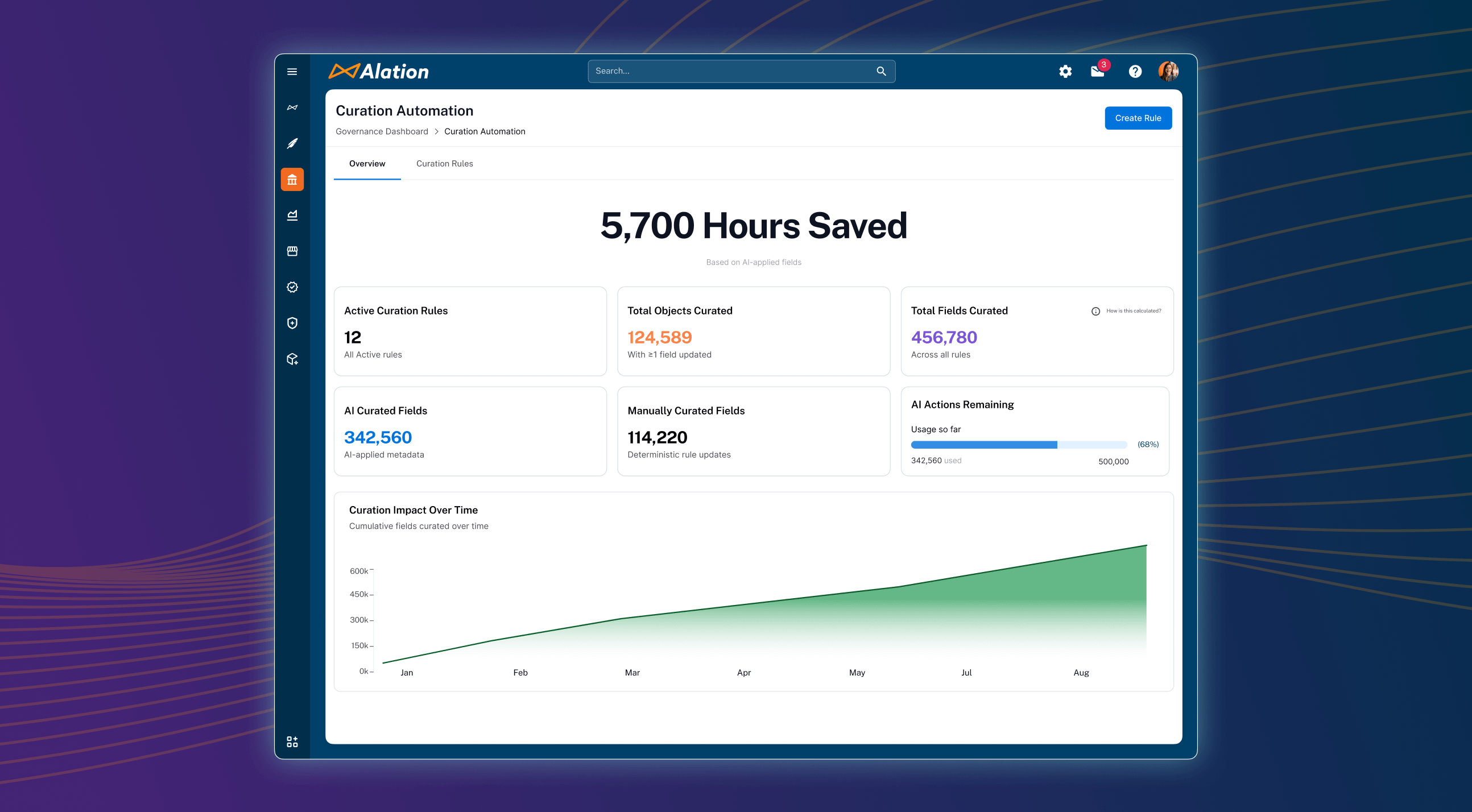
Introducing Curation Automation — and the operating system that makes governance something you can actually stake your reputation on.
Somewhere right now, a data steward is copy-pasting a definition from a policy document into a catalog field.
They’re cross-referencing a spreadsheet to check whether someone remembered to tag a column as PII. They’re updating the same metadata in three different places because no single system enforces the standard. They’re sending a follow-up message asking a data owner to confirm that yes, this is still the canonical definition of “customer.”
Meanwhile, three floors up, an executive is telling the board that the company has a “mature data governance program.”
Both of these things are true. And that’s the problem.
The audit that exposes you is already scheduled
Data governance has always been a process problem disguised as a technology problem.
Organizations hire stewards, write policies, stand up committees, and build elaborate workflows. Then they measure success by how many policies they’ve written and how many tasks they’ve closed, not whether the governed data actually meets the standard it’s supposed to meet.
For years, this was tolerable. Regulations were stable enough that annual audits felt sufficient. Analytics moved slowly enough that humans could mostly keep up. Metadata gaps, while annoying, rarely broke anything critical.
That era is over.
Regulatory expectations have shifted from aspirational to provable. Organizations need to demonstrate continuous compliance, not produce annual attestations. The cost of falling short is rising: fines, failed audits, stalled initiatives.
At the same time, AI is raising the stakes on data trust. AI systems don’t tolerate metadata gaps the way a human analyst might. Every missing description, inconsistent classification, or outdated owner becomes a failure mode in systems making decisions autonomously. And the volume of data entering the enterprise has long since outpaced what any team of humans can manually curate.
Governance used to be a team of people. In the age of AI, the question becomes: what should it be now?
Stop managing governance. Start guaranteeing it.
Today we’re introducing outcome-based governance and launching Alation Curation Automation, now generally available.
Together, they represent a fundamentally different approach to how organizations govern data.
The shift is structural. Instead of governing through process - writing policies, assigning tasks, routing approval - and hoping humans execute consistently, outcome-based governance starts with the result you need: reduce regulatory risk, ensure AI-readiness, achieve continuous compliance. You declare the outcome once, and the system interprets, enforces, and maintains it through purpose-built agents and automation.
This isn’t governance with AI bolted on. It’s governance rebuilt as an operating system: a unified, automated layer that connects business intent to execution at scale.
Outcome-based governance connects three products within Alation’s platform: CDE Manager, which identifies and governs business-critical data elements; Data Quality, which enforces automated validation and monitoring; and the newest addition, Curation Automation, which enriches metadata with business context to drive meaning, usability, and compliance.
The end of the metadata backlog
Curation Automation is what makes outcome-based governance operational. To understand why, consider the cost of the problem it solves.
Metadata is the context that makes data usable. It tells your organization what a dataset contains, who owns it, whether it’s sensitive, and whether it meets your quality standards. Without it, analysts can’t self-serve and have to ask the data team what a table means. AI systems make decisions on data they don’t understand. Compliance teams can’t prove what’s governed. Data products stall because nobody trusts the underlying assets.
Incomplete metadata doesn’t just slow governance down. It blocks AI and analytics initiatives from generating revenue, increases risk exposure, drives up the cost of compliance, and forces organizations to throw headcount at a problem that grows faster than any team can handle.
Curation Automation changes the model. Instead of relying on humans to author and maintain metadata asset by asset, administrators declare what good metadata looks like once: required fields, quality expectations, classifications, ownership, et cetera. AI agents then generate and apply that metadata across thousands of assets automatically, using catalog context, query patterns, and admin-provided instructions to ensure quality and consistency.
Every suggestion is previewable before it’s applied. Existing values are preserved by default. All actions are fully auditable. And as new data enters the catalog, rules re-enforce automatically so metadata stays complete and compliant without ongoing manual effort.
The business impact is direct. AI initiatives ship on trusted data instead of stalling on gaps. Compliance becomes continuous instead of periodic. Governance teams shift from production work to strategic oversight. And organizations stop scaling headcount to keep up with data growth, because the system handles enforcement at machine speed.
What you tell the board when governance actually works
With Curation Automation completing the outcome-based governance system:
Governance teams become strategists, not typists. Stewards shift from manually curating metadata to validating outcomes. The work that consumed entire teams now runs continuously in the background.
Compliance becomes continuous, not periodic. Standards are enforced automatically as data changes. When auditors ask for evidence, you have it in real time.
AI and analytics initiatives stop stalling. Metadata is consistently complete and contextual. AI systems, data products, and self-service analytics get the trusted foundation they require to deliver business value.
Governance scales with data growth, not headcount. New data sources are governed by default when they enter the catalog. The race between data volume and stewardship capacity is over.
This is what governance was always supposed to be
The data governance industry has spent a decade helping people do manual work slightly faster. Better workflows. Smarter suggestions. More dashboards. And still, the gap between governance intent and reality gets wider every year.
Outcome-based governance is our answer. Not another tool that makes manual governance more efficient. An operating system that makes it automatic. Declare what good looks like. Let agents and automation make it real. Measure the outcome, not the activity.
Governance used to be a team of people. Now it’s an operating system. And the team? They’re finally free to focus on what actually matters.
See it in action
Curation Automation is generally available now
We’re at the Gartner Data & Analytics Summit this week. Come meet us at Booth #221.
- The audit that exposes you is already scheduled
- Stop managing governance. Start guaranteeing it.
- The end of the metadata backlog
- What you tell the board when governance actually works
- This is what governance was always supposed to be
- See it in action
Contents
Tagged with
Loading...