SOLUTION · AGENTIC COMPLIANCE
Compliance isn’t a question.
The question is: What does compliance cost you — day in, day out?
Staying audit-ready shouldn’t mean you spend your week chasing evidence. Alation’s governed agents do the continuous proving across your regulated data — lineage, policy, and proof already attached — so compliance stops being a sunk cost.
WHAT ALATION CAN DO FOR YOU
True agentic compliance starts with what matters most — the regulator.
Every other tool starts with the data and hopes it adds up to a defensible report. Alation starts with the report and works back — governed agents tracing, documenting, monitoring, and proving every element a regulator could question.
- Data Consumptions
- Critical Data Manager
01
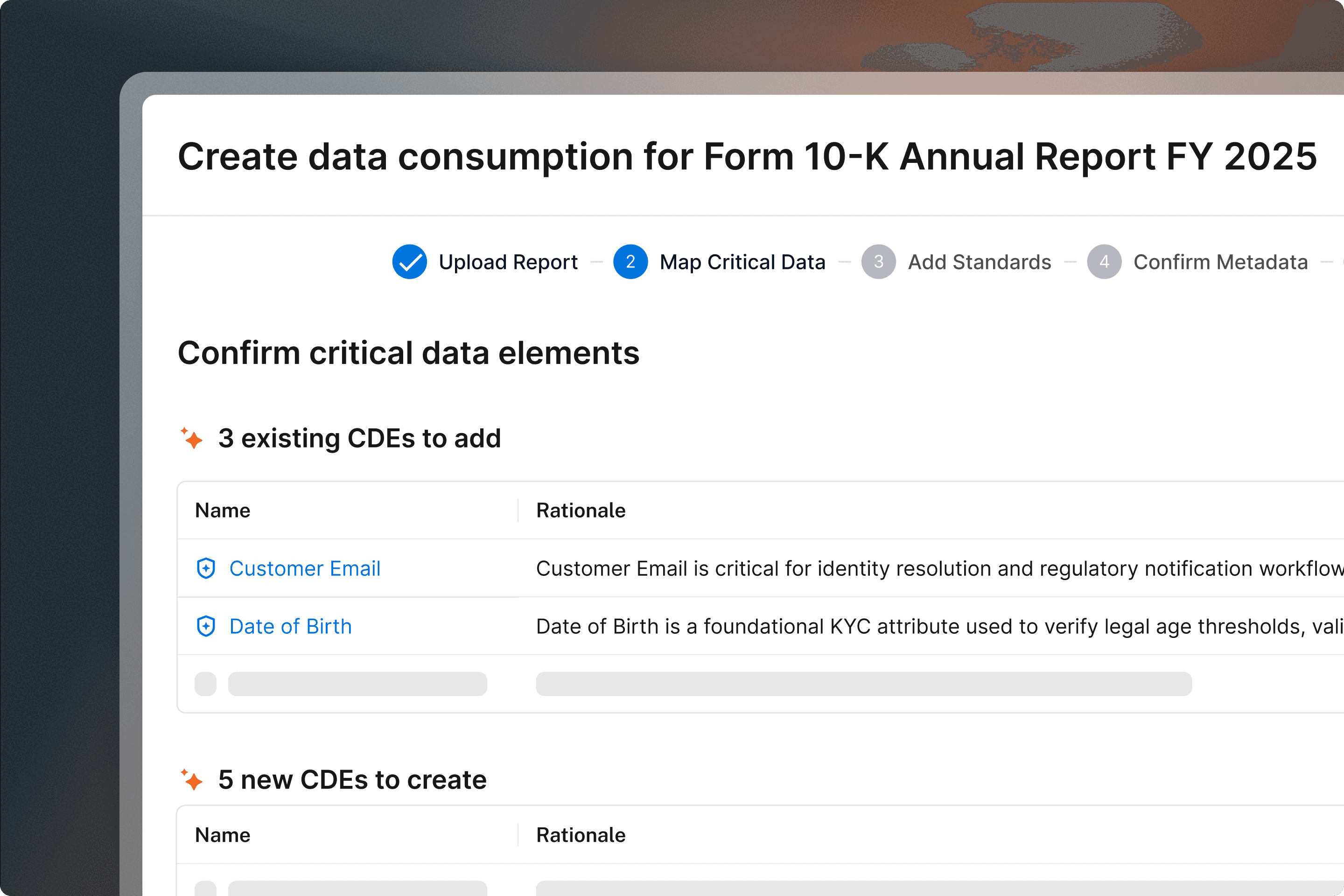
Work backward from the report, not the data.
Upload the filing the regulator actually asked for — a 10-K, a Pillar 3, a CCAR submission. Alation identifies, ranks, and traces every critical figure to its source — through each join, transformation, and staging layer, back to the system of record. The report stops being the work and starts being the map.
- Policy to Code Agent
- Data Mapping Agent
- Drafting Agent
- Critical Data Manager
02
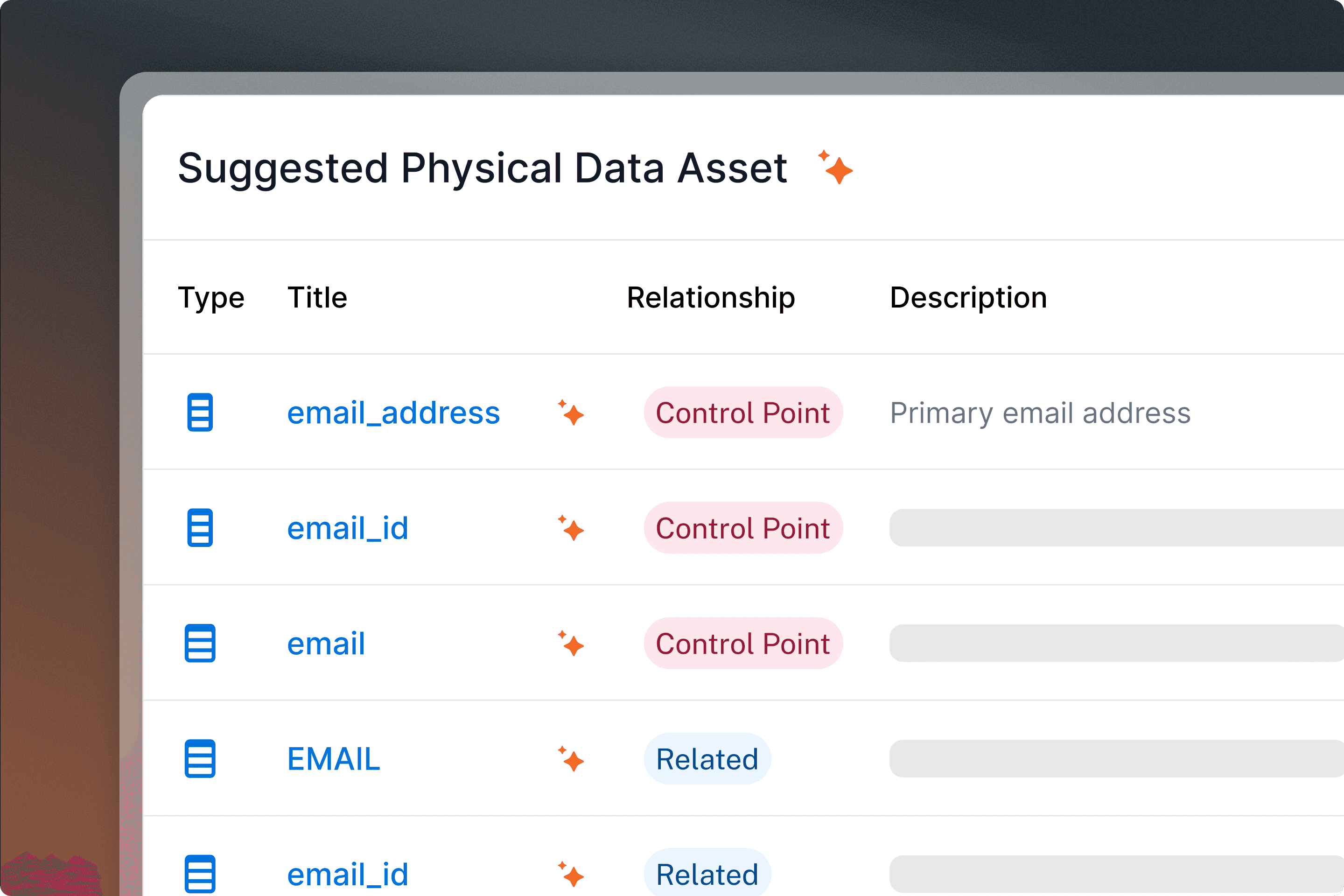
Agents draft. People sign off.
Documentation written. Policies attached. Every element mapped to its catalog source. The case assembles itself. Data owners review and approve.
- Data Governance Standards
- Data Quality Standards
- Critical Data Manager
- Data Quality Agent
03
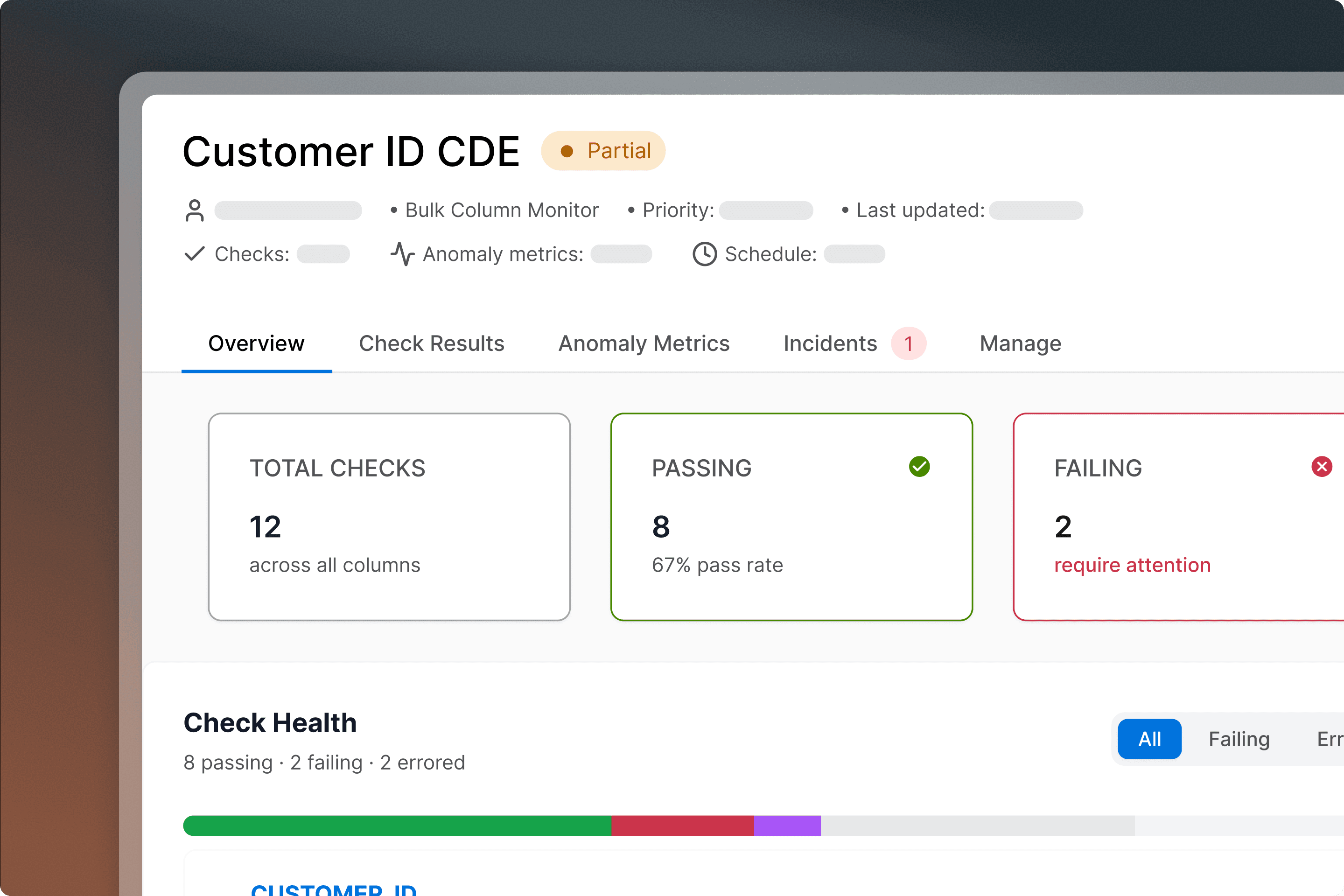
Catch drift before it becomes a finding.
Every critical data element comes monitor-ready. Agents monitor continuously against approved standards. When something drifts, they surface where it’s failing and propose a fix. Before auditors find it.
- Critical Lineage
- Application Registry
- End User Computing Registry
- Critical Data Manager
04
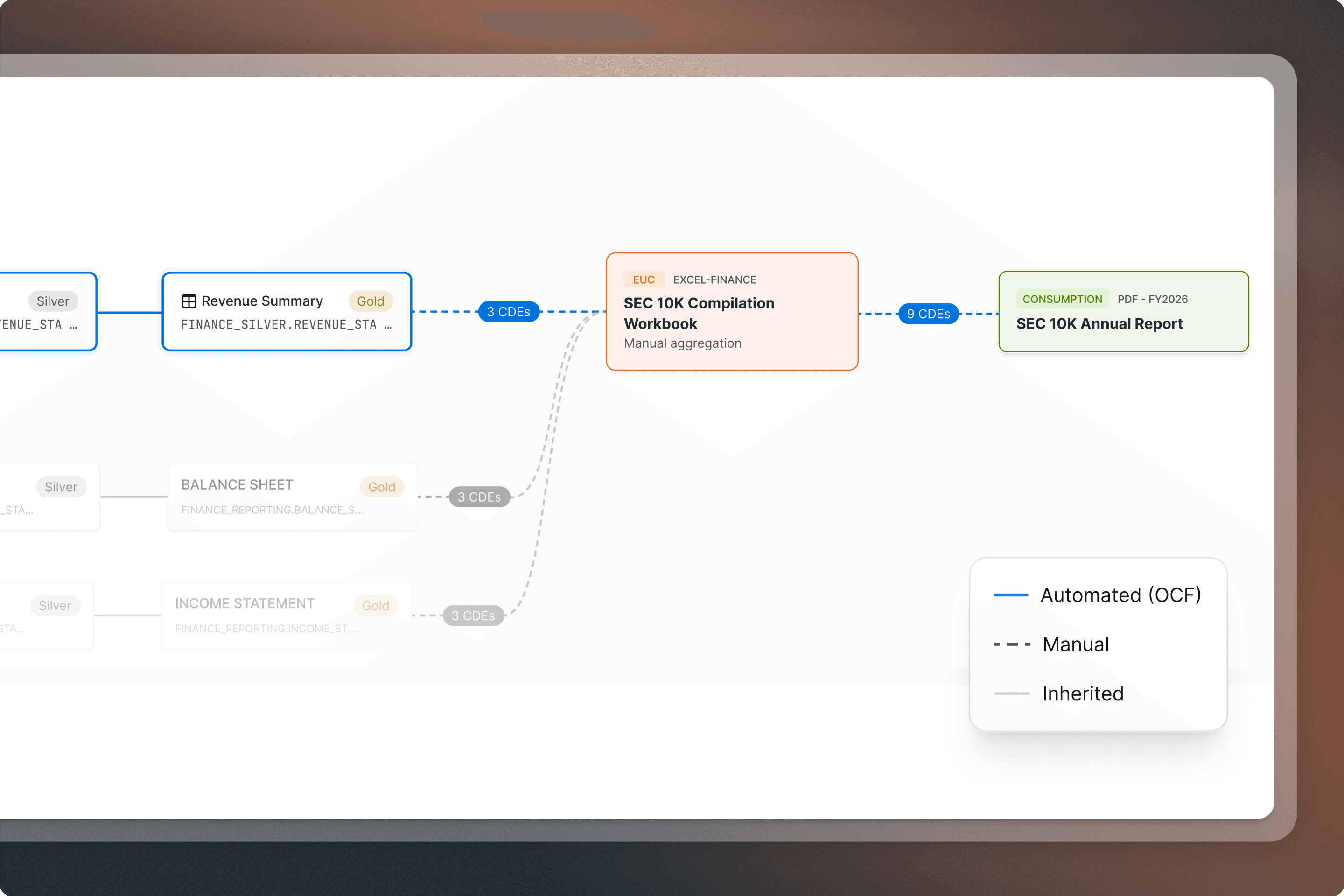
The proof is already assembled.
Critical Lineage blends automated lineage with policy, ownership, quality, EUC spreadsheets, and source into one connected record. The proof is already assembled. When auditors ask, you already have the answer.


“Critical Data Manager is a powerful, intuitive tool that helps us govern the data that drives our business, bringing key indicators for our most important data into one place.”

Global Data Governance Lead
WHERE THIS GETS YOU
The compliance obligation doesn’t change. But what it demands from you does.
Same rules, same audits, same proof.
Alation changes how much time and resources it takes.
What does Alation do for critical data elements (CDEs)?
Alation automates the four core stages of critical data element management—finding, labeling, enforcing, and proving compliance for CDEs—replacing manual, spreadsheet-based processes with continuous, automated workflows. Instead of teams spending months surveying the business by hand, Alation validates existing CDEs and identifies net-new ones directly from the critical reports and filings they support.
How does Alation find critical data elements?
Alation automatically validates existing CDEs and identifies new ones by analyzing the critical reports and regulatory filings they feed into. Agents further help map the Critical Data Elements to relevant data assets in the catalog. This replaces the traditional approach of spending months in spreadsheets asking business teams to identify which of their thousands of columns are critical—an exercise that previously had to be repeated every year. With Alation, this process is collapsed from months of work into minutes, so organizations always know what data is critical and where it lives.
How does Alation label and define critical data elements?
Alation automatically converts an organization's policies into codified standards that define how each critical element must be owned, defined, and measured. Traditionally, teams document critical elements by hand after the fact, resulting in definitions that vary depending on who wrote them. Alation removes this inconsistency by producing standardized documentation that can be measured against, rather than ad hoc, person-dependent definitions.
How does Alation enforce data quality standards on an ongoing basis?
Alation continuously checks every critical data element against its defined standards and closes gaps as they surface, rather than waiting for quarterly reviews. In a manual process, gaps between checks can go unnoticed until an auditor finds them at quarter-end. Alation's continuous enforcement model gives organizations ongoing assurance that their standards are being met at all times, not just at the moment of a scheduled review.
How does Alation help prove compliance during an audit?
Alation's Critical Lineage capability keeps audit evidence current by tracing data from its original source all the way to the report it appears in, with lineage certified and re-attested on every refresh. This eliminates the common last-minute scramble to manually assemble evidence packs and rebuild lineage documentation the week of an audit. With Alation, proof of data integrity is ready on demand, giving organizations continuous confidence in their reported numbers.