

MIT research has found that only 5% of enterprise AI pilots from 2025 delivered P&L impact in production. At the same time, Gartner predicts that by end of 2026, AI agents will be embedded in approximately 40% of enterprise applications, a near-tenfold increase in a single year.
That gap between aspiration and outcome is where most AI strategies break down. The organizations on the wrong side of it are not, for the most part, using inferior models or spending too little. They are building on foundations that cannot support production AI: ungoverned data, unclear business definitions, fragmented access controls, and knowledge that lives inside vendor infrastructure rather than inside the organization itself.
The organizations on the right side have figured something out that is not yet common knowledge: the quality of your AI outputs is a downstream function of the quality of your data foundation. Getting the foundation defines the AI journey and the strategy that undergirds that journey.
This post lays out the framework enterprise leaders are using to identify the right AI opportunities, build the right foundations, and move from pilots to production with measurable results.
Why most enterprise AI strategies stall in pilot
Building an AI prototype is genuinely easy. An agent that retrieves data from a warehouse and generates an answer can be assembled in hours. Getting that agent to work reliably, safely, and at scale in production is a different problem, and one most organizations underestimate until they are already inside it.
Three failure modes account for the vast majority of production breakdowns:
Accuracy. Large language models do not inherently understand your business. Ask a generic model to identify suppliers where delayed shipments exceed 5% of total orders, and it will generate an answer. But without knowing which table contains valid shipment data, how your organization defines a "delay," or which supplier records are current, that answer is likely wrong. The model produces confident outputs from flawed inputs. Prototypes tolerate this because no decision depends on them. Production environments cannot.
Data exposure risk. In a prototype, access controls are typically absent or approximated. In production, an agent that can query financial data, customer records, or personnel files must respect the same access boundaries as the humans it serves. In regulated industries, failure here is a compliance risk, not just an operational one.
Integration complexity. Building an agent that connects to a single data warehouse is straightforward. Building one that synthesizes data across Snowflake, Databricks, a BI platform, and unstructured documents — while maintaining accuracy, governance, and performance — requires a unifying data foundation that most organizations haven't yet built.
The question is not whether your models are capable. They are. The question is whether the knowledge foundation underneath them is ready.
"Shadow LLM usage is real. Everyone thinks they can build on the side of their desk — and they can — but the data is garbage. You're not going to get the deterministic results you want."
— Data Leader, major commercial insurance carrier
The foundation that separates AI leaders from laggards
For years, data governance was positioned as a compliance function: something organizations did because they had to, not because it accelerated anything. That framing is now actively harmful to AI programs. Data governance for AI is the infrastructure that makes AI outputs trustworthy enough to act on.
The governance models that failed in the past shared the same characteristics: they were push-based, compliance-driven, and designed for business intelligence rather than business enablement. They required teams to document data rather than derive value from it. Predictably, people bypassed them.
What's replacing that model is fundamentally different. Modern governance emerges from behavior rather than mandates: through auto-captured metadata, automatic classification, usage-driven curation, and risk surfacing at the point of need. Rather than asking people to feed the catalog, it gives people something valuable in return for their engagement with it.
The strategic implication is significant. Governance done right accelerates AI. And in this way, the data catalog has evolved into an operating system for AI — the central layer through which agents access, interpret, and act on enterprise knowledge.
"You cannot scale AI without clear, trusted, contextualized, and controlled data. Metadata is the DNA of AI." — Chief Data Officer, major commercial insurance carrier
What an AI-ready data foundation actually looks like
The concept worth anchoring here is the Knowledge Layer: a unified, metadata-driven foundation that enables AI agents to access, understand, and act on enterprise knowledge with accuracy, accountability, and trust.
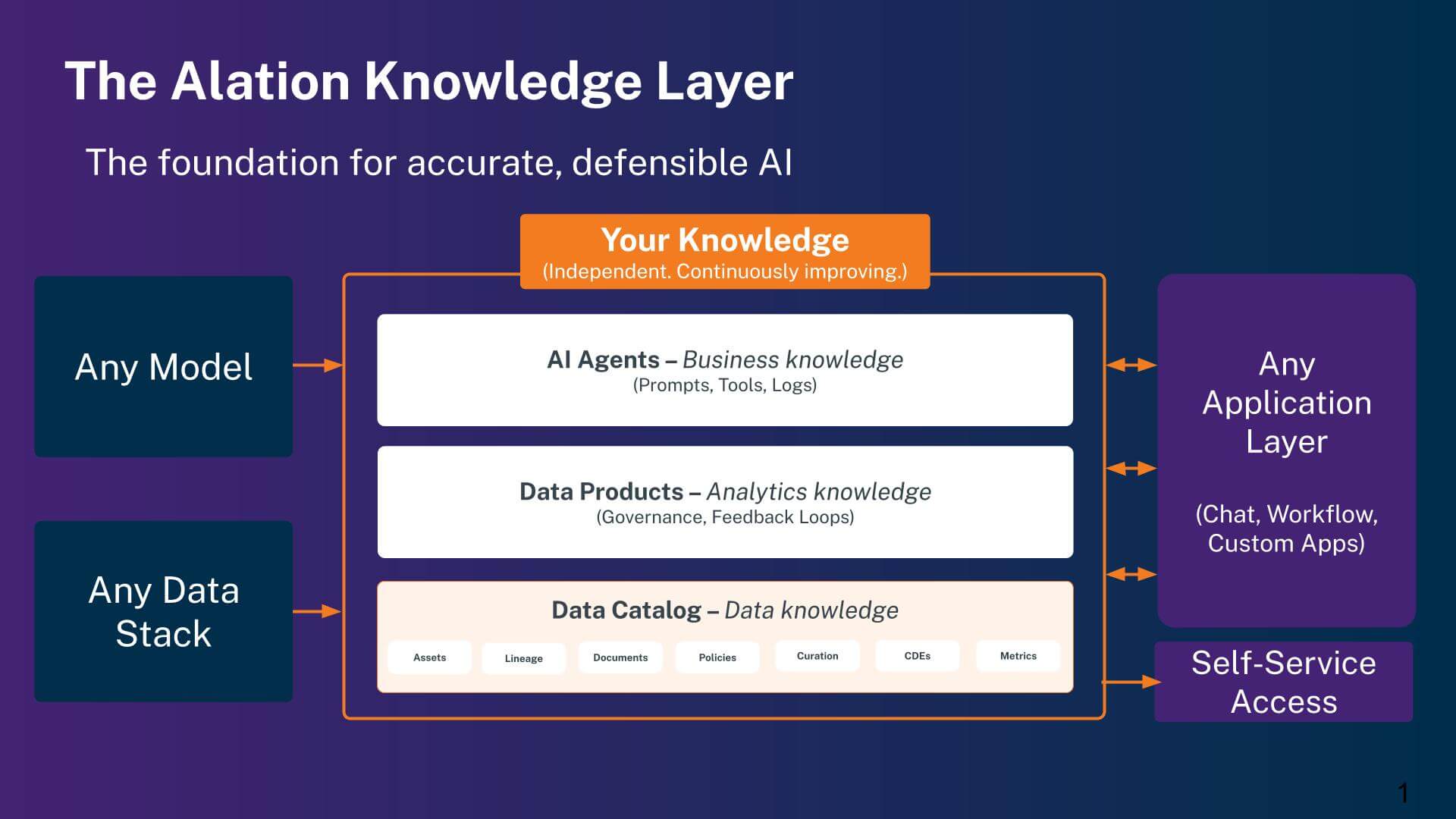
The Knowledge Layer is three-tiered:
The data catalog forms the foundation, capturing data-level knowledge: assets, lineage, policies, and metadata.
Data products sit above it, packaging analytics knowledge: metrics definitions, governance controls, and business context.
AI agents sit at the top, carrying business knowledge: process logic, decision rules, and institutional context.
This architecture has a practical test. If you replaced your current model provider tomorrow, would your agents still know what your organization means by "churn"? How you define your fiscal year? Which customers are active versus dormant? Which data sets are authoritative?
If the answer is no, your knowledge is currently renting space inside someone else's infrastructure. Standard LLMs consistently fail on something as fundamental as fiscal year calculations, because a model trained on public data applies calendar-year assumptions unless explicitly told otherwise. For a CFO reviewing AI-generated revenue analysis, that is not an edge case. It is a systematic error in every output.
Metadata is the mechanism that solves this, and data products provide the system of delivery. They encode your organization's definitions, lineage, and governance controls in a form that agents can apply consistently, regardless of which model is running underneath.
The architecture also has a strategic dimension. A Knowledge Layer tied to a cloud data warehouse vendor is likely optimized to drive compute consumption. One tied to a model provider is optimized to drive token spend. Neither incentive aligns with your actual goal: better, faster decisions. A Knowledge Layer that is independent of vendors remains portable, governed, and compounding as your data and processes evolve. It is institutional IP, and it must remain sovereign if you seek to preserve your unique competitive advantage in the form of your data.
How to find AI opportunities that will actually deliver ROI
Identifying promising AI opportunities is a strategic exercise, not a technical one. The goal is to locate where operational friction intersects with business value: which recurring processes are the most painful, repetitive, and consequential?
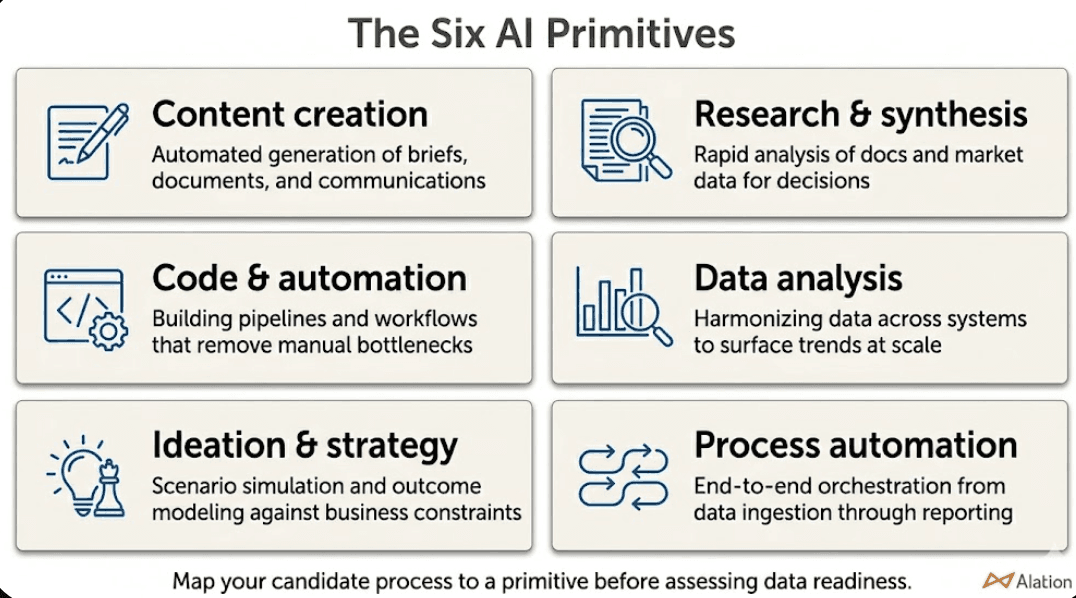
A useful starting point is mapping candidate processes against the six AI primitives — the foundational capabilities that underlie virtually every enterprise AI use case.
AI primitive | Enterprise application |
Content creation | Automated generation of strategy documents, executive briefs, and internal communications in a consistent organizational voice |
Research & synthesis | Rapid analysis of internal documentation, competitive benchmarks, and market reports to surface decision-relevant insights |
Code & automation | Building data pipelines, scripts, and automated workflows that eliminate manual technical bottlenecks |
Data analysis | Harmonizing data across disparate systems to identify performance trends and surface anomalies at scale |
Ideation & strategy | Simulating scenarios, stress-testing assumptions, and modeling outcomes against defined business constraints |
Process automation | End-to-end orchestration of multi-step workflows, from data ingestion through to reporting delivery |
When evaluating a candidate process, ask: which primitives does this map to, and does the organization have the data foundation required to support it reliably? A research-and-synthesis use case with no governed metadata layer will produce hallucinated or inconsistent outputs. A process automation initiative built on ungoverned, siloed data will fail to generalize beyond its initial configuration.
Four factors guide opportunity assessment in practice.
Impact. Where will AI deliver the most measurable business value? The answer is rarely where technology is most novel; it is where delays, errors, and manual effort are most costly. Consider a Fortune 500 commercial real estate firm managing more than 4.6 billion square feet across 80 countries. Lease renewal decisions carried multi-million dollar stakes, yet required days of analyst time — pulling data from lease administration systems, workplace management platforms, market benchmarks, and unstructured PDFs — before a single strategic judgment could be made. A multi-agent AI system built on governed, trusted data compressed that workflow from days to hours.
Commitment. Which teams have the appetite to iterate? Early AI pilots fail not because the technology underperforms, but because the business hasn't identified a process owner willing to refine, test, and champion the solution. Start where the pain is most acute and the people closest to it are most motivated to see it change.
Experience. What does the ratio of time spent gathering information versus time spent deciding look like across your organization?
"Those are the roles that are really conducive to an agentic solution — roles where professionals spend 70% or more of their time collecting and consolidating information before they can make a single decision. That's how we started finding the opportunities." — AI transformation lead, global technology supply chain company
Prioritization. What can actually be built, governed, and trusted? Data governance for AI agents — data quality, lineage, and access controls — are prerequisites for agentic AI, not afterthoughts. Initiatives that depend on ungoverned or fragmented data will stall in production, and in regulated industries, ungoverned data is a compliance risk.
What separates the programs that scale
Beginning with quick wins is not a hedge against ambition. It is the most reliable path to transformational change. Small, tightly scoped pilots accomplish three things that large programs cannot: they build technical and operational know-how under low-stakes conditions; they generate proof points required to earn executive confidence for larger investments; and they surface data and governance gaps before they become production failures.
The shift that AI agents are driving across data operations follows a consistent pattern: what was reactive and manual becomes proactive and automatic. Monitoring becomes an alert. Investigation becomes a prepared report. The decision — the part that requires human judgment — arrives faster and based on more complete information, without the overhead that previously made speed impossible.
"The real secret to our success wasn't the agents themselves. It was the foundation they run on. The catalog encodes business definitions so agents know what each metric actually means."
— Enterprise AI leader, Global 2000 company
Organizations at this stage are also applying agentic AI to data quality management — automating the enforcement of standards so that humans responsible for quality focus on exceptions, not routine checks. And they are building evaluation sets to test agents against known benchmarks, requiring confidence above 90% before moving anything into production. That discipline transforms AI agents from fragile prototypes into tools the organization can trust at scale.
Building this kind of enterprise AI operating model — where governance, data quality, and agent orchestration are treated as integrated rather than siloed — is what determines whether an AI program becomes a competitive advantage or a collection of impressive demos. The strategic shifts this demands of CIOs in 2026 are real, but navigable for organizations that start with the right foundation.
Frequently asked questions
What is an enterprise AI strategy? An enterprise AI strategy is a structured plan for identifying, prioritizing, and deploying AI capabilities across a business in ways that generate measurable, durable value. It covers use-case selection, data readiness, governance, change management, and ROI measurement — not just model selection or technology procurement.
Why do most enterprise AI pilots fail to deliver ROI? MIT research found that only 5% of enterprise AI pilots from 2025 delivered ROI in production. The most common failure modes are accuracy problems caused by ungoverned data, data exposure risks from absent access controls, and integration complexity that exceeds the organization's data foundation. The model is rarely the bottleneck.
What is data governance for AI? Data governance for AI is the set of policies, processes, and technologies that ensure AI systems access accurate, trustworthy, and appropriately controlled data. It includes metadata management, data lineage, access controls, and business glossaries — the components that allow AI agents to interpret data correctly and act on it consistently.
What is the Knowledge Layer in agentic AI? The Knowledge Layer is a metadata-driven foundation — typically built on a data catalog — that enables AI agents to access, understand, and act on enterprise knowledge with accuracy and accountability. It encodes business definitions, data lineage, governance controls, and institutional context that models cannot derive from training data alone.
What is agentic AI and how is it different from traditional AI? Agentic AI refers to AI systems capable of taking sequences of actions — retrieving data, reasoning over it, executing tasks, and producing outputs — with minimal human intervention. Unlike single-turn AI interactions, agentic systems orchestrate multi-step workflows, connect to multiple data sources, and adapt based on intermediate results. Understanding what this shift means for data catalogs and governance is increasingly important for enterprise leaders planning AI investments.
How do you measure ROI from an enterprise AI program? The most reliable approach ties AI outcomes to specific business process metrics: time saved per decision cycle, error rates before and after automation, cost of manual effort replaced, and downstream business impact. Starting with tightly scoped quick wins — where success criteria are defined before the pilot begins — makes ROI measurement tractable from day one.
The bottom line: Governance isn't a constraint; it's the catalyst
The organizations successfully moving AI agents into production share a consistent enabler: a data catalog functioning as an agentic knowledge layer — a unified source of business context, data lineage, and governance controls that allows agents to do more than retrieve data. It allows them to interpret data correctly, apply it consistently, and respect the access boundaries that regulated enterprises require.
The quick wins matter. The governance matters. The catalog matters. Executive conviction to treat all three as prerequisites — not afterthoughts — is what determines whether your AI program becomes a competitive advantage or a collection of impressive demos.
Ready to build your AI opportunity backlog? Download the Agentic AI Opportunity Discovery Guide — a structured framework for identifying, qualifying, and prioritizing the AI initiatives most likely to deliver production-grade results in your organization.
- Active Data Governance
- Data Culture
- Data Intelligence
- Digital Transformation
- Engineering
- Enterprise Data Catalog
- AI
- Data Governance
- Data Quality
- Modern Data Stack
Keep reading
More from the data desk