




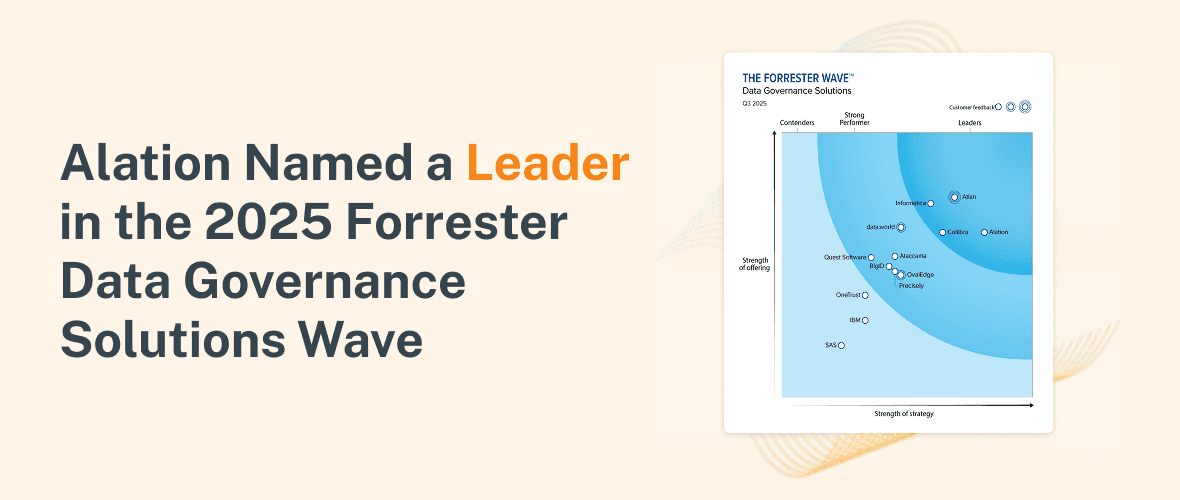
Artificial intelligence is transforming how organizations operate, compete, and innovate. As machine learning models mature and generative AI expands across business functions, enterprises face new challenges in managing the sheer volume, complexity, and diversity of data fueling these systems. The stakes are higher than ever, and AI is only as reliable as the data behind it. Yet, despite the rise of formal data governance programs—now adopted by 71% of organizations—many companies still struggle to find, understand, trust, and responsibly use their data at the speed AI requires.
A machine learning data catalog (MLDC) bridges this gap. MLDCs combine modern metadata management with machine learning algorithms, intelligent automation, and behavioral insights to make data easier to discover, govern, and use responsibly across the enterprise. They empower data engineers, data stewards, analysts, and AI teams with the context and control needed to build high-performing, trustworthy AI systems.
This guide defines what an MLDC is, explores key capabilities, outlines enterprise use cases, and provides actionable guidance for adopting MLDCs to support modern data management and AI readiness in 2026 and beyond.
Key takeaways
Machine learning data catalogs combine metadata management, behavioral intelligence, and AI automation to streamline data discovery, governance, and analytics at enterprise scale.
MLDCs improve data quality, security, lineage tracking, and accessibility—enabling both humans and machine learning models to rely on trusted, well-governed data.
Common use cases include ML feature reuse, impact analysis, compliance automation, and accelerating data product development.
Adoption challenges such as integration with MLOps pipelines and driving user engagement can be mitigated through change management, targeted onboarding, and selecting MLDCs with strong workflow automation and open APIs.
MLDCs are becoming foundational to responsible AI programs, equipping organizations with the intelligence and governance required to build accurate, explainable, and trustworthy AI systems.
What is a machine learning data catalog?
A machine learning data catalog (MLDC) is the AI-powered evolution of the modern data catalog—one that continuously learns from data patterns, user behavior, and organizational context to automate metadata curation, discovery, governance, lineage tracking, and quality management. The MLDC sits at the center of the enterprise data ecosystem, unifying information across data lakes, data warehouses, cloud platforms, and on-premises environments, while providing contextual intelligence that enables fast, safe, data-driven decisions.
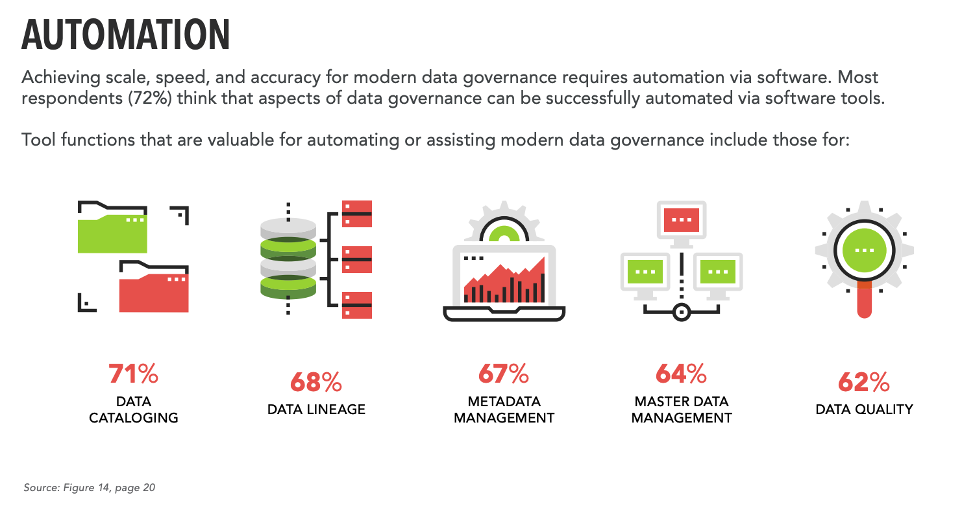
Traditional data catalogs rely heavily on manual tagging, documentation, and stewardship. MLDCs replace this friction with dynamic intelligence. They observe how data consumers search, query, reuse, document, and collaborate, using algorithms to:
Improve search relevance
Suggest related assets
Enrich metadata
Classify new data types
Detect anomalies
Identify data relationships
Recommend governance workflows
This adaptive approach transforms the catalog from a static repository into a living knowledge system that becomes more accurate, comprehensive, and valuable with every interaction.
The core capabilities of a machine learning data catalog
MLDCs deliver a wide range of capabilities rooted in AI and automation. These features streamline governance, improve data integrity, and accelerate analytics and AI development.
Search and discovery
Search is the most visible and frequently used capability within any data catalog—and MLDCs dramatically improve it. Machine learning algorithms analyze behavioral signals such as:
SQL query patterns
Popularity trends
Endorsements and certifications
Peer usage
Documentation completeness
Domain stewardship actions
This enables ranking models that surface high-quality datasets and dashboards before lower-value or outdated ones. Semantic search and natural language interfaces allow users to query the catalog the way they think, not the way metadata is structured. Autocomplete intelligence, synonym detection, and contextual recommendations help data consumers find what they need—even when they aren’t sure what it’s called.
The result is a consumer-grade discovery experience that grows more accurate as more people use it.
Intelligent recommendations
Recommendations are now a defining characteristic of MLDCs. Machine learning models analyze relationships across datasets, fields, reports, and people to suggest:
Datasets that are frequently joined together
Columns relevant to a specific analysis
Related BI dashboards
Popular SQL queries
Reusable ML features
Potential data stewards or subject-matter experts
These recommendations accelerate analytics and strengthen collaboration across data teams. They also reduce redundancy and improve model development by making it easier to identify existing features, established datasets, and trusted sources before creating new ones.
Automated data stewardship and workflow orchestration
Stewardship is essential to data governance—but manual stewardship at enterprise scale is unsustainable. MLDCs streamline stewardship with automated classification, sensitivity labeling, policy recommendations, and data profiling–based quality checks.
Alation’s Documentation Agent and Workflow Automation capabilities illustrate this transformation:
Documentation Agent uses natural language processing and AI-powered summarization to draft asset documentation, dramatically reducing the time required for stewards to produce complete, accurate descriptions.
Workflow Automation orchestrates governance processes through intelligent triggers—from new data arriving to quality anomalies appearing—ensuring stewards receive guided tasks at the right moment.
Automated workflows make governance more consistent, proactive, and scalable. Stewards can focus on high-value judgment work, not repetitive metadata tasks.
Business glossary and semantic enrichment
A business glossary is foundational to any data governance program, providing standardized definitions, terminology, and business context across domains. MLDCs strengthen glossaries with machine learning capabilities that:
Detect similar or redundant terms
Recommend new glossary entries
Map glossary concepts to datasets, queries, and dashboards
Identify inconsistencies across domains
As organizations evolve toward AI-powered ecosystems, glossaries and policies form part of an emerging Agentic Knowledge Layer. This layer aggregates business definitions, governance rules, metadata, lineage, and stewardship context so AI systems can interpret enterprise data accurately. When machine learning models or AI agents query this layer, they understand not just the data itself, but its meaning, constraints, and appropriate usage.
Semantic enrichment ensures both humans and algorithms can make sense of data in consistent, governance-aligned ways.
Machine learning–enhanced lineage tracking
Lineage tracking is critical for root-cause analysis, impact assessment, and ML model lifecycle management. MLDCs automatically build lineage maps across:
Table-level relationships
Column-level transformations
SQL logic
BI dashboards and reports
Cross-system data flows
Machine learning algorithms compare ingestion patterns, query structures, and transformation logic to detect new relationships or anomalies. As a result, lineage maps become more complete and reliable without constant manual maintenance.
This visibility is essential when retraining machine learning models, evaluating schema changes, or analyzing how upstream pipeline disruptions will affect downstream analytics and AI products.
Intelligent policy enforcement and access controls
Responsible data use requires governance that is both thorough and frictionless. MLDCs embed governance within daily workflows by automatically detecting sensitive attributes, recommending policy assignments, enforcing access controls, and masking data when appropriate.
Advanced MLDCs can:
Detect personal data and classify PII
Identify regulated attributes for frameworks like GDPR, HIPAA, and CCPA
Trigger stewardship workflows for policy review
Alert users attempting to access restricted data
Provide justification-based access workflows
This “governance where work happens” approach dramatically improves regulatory compliance without slowing innovation. Instead of restricting access unnecessarily, MLDCs optimize it—providing secure, policy-aligned access tailored to user roles and business context.
Modern social proof
Organizations today look for proven, enterprise-grade data catalog solutions validated by industry adoption. Platforms like Alation are deployed across global enterprises—including the Fortune 500—to operationalize governance, enhance data security, accelerate analytics, and prepare data ecosystems for AI.
Industry analysts now recognize MLDCs and broader data intelligence platforms as critical to AI readiness, data reliability, and regulatory compliance—underscoring their rising importance in modern data strategy.
Common enterprise use cases for machine learning data catalogs
MLDCs enable a wide range of analytics, governance, and AI initiatives. Common use cases include:
ML feature discovery and reuse: MLDCs surface reusable features, reduce duplication, and improve model reproducibility.
Accelerating data product development: By highlighting trusted, high-quality datasets, MLDCs support scalable data product operating models.
Governance at scale: Automated classification, sensitivity detection, and workflow orchestration reduce governance burden.
Impact analysis: Lineage provides clarity into how schema changes or pipeline disruptions affect downstream models and dashboards.
Operationalizing compliance: MLDCs help ensure data classification, retention, and usage rules remain consistently applied.
Data quality monitoring: Machine learning–based anomaly detection helps identify issues before they affect analytics.
Managing multi-cloud and hybrid ecosystems: MLDCs unify metadata from SaaS, cloud, and on-prem systems to simplify enterprise governance.
Enterprises increasingly rely on MLDCs as foundational infrastructure for scaling AI responsibly and efficiently.
The benefits of using a machine learning data catalog
MLDCs increase operational efficiency, improve data trust, and support AI accuracy. Key benefits include:
Automating data discovery and reducing time to insight
Data analysts and scientists often spend more time searching for data than analyzing it. MLDCs reduce this friction by surfacing relevant assets based on behavioral intelligence and metadata completeness. As more users engage with the catalog, its ranking models become even more accurate.
This reduces duplicate work, prevents misuse of outdated assets, and dramatically accelerates data-driven decision-making.
Simplifying data accessibility while improving data security
Organizations must democratize access without compromising security. MLDCs help balance openness and control through automated policy enforcement and dynamic access controls. Instead of manual provisioning, MLDCs streamline:
Data classification
Masking
Policy assignments
Access reviews
Audit readiness
By understanding both data context and business context, MLDCs ensure the right users access the right data at the right time—securely and efficiently.
Strengthening lineage and improving operational resilience
Machine learning–powered lineage transforms root-cause analysis and impact assessment. Instead of manually tracing dependencies, teams can instantly visualize how changes propagate across systems.
This helps data engineers identify upstream pipeline failures, data analysts validate trustworthiness, and data scientists evaluate whether machine learning models require retraining.
Elevating data quality for analytics and AI
High-quality, consistent data is essential for AI accuracy. MLDCs improve data quality by:
Detecting anomalies and unusual patterns
Identifying duplicates or inconsistent formatting
Prioritizing high-quality datasets in search
Surfacing quality checks within user workflows
Triggering stewardship tasks when issues appear
Better data quality directly enhances machine learning models and reduces the risk of unintended algorithmic bias.
Using enterprise data to drive business results
Beyond operational efficiency, MLDCs help leaders quantify and expand the ROI of their data programs. By centralizing metadata, usage patterns, stewardship activity, and data lineage, MLDCs illuminate how data is truly used across the business.
Tools like Alation Analytics allow leaders to track:
Catalog adoption
Top users and subject-matter experts
Most-used datasets
Domain engagement
Search trends
Metadata completeness
Popular SQL queries
These insights help optimize data investments, identify governance gaps, prioritize improvements, and refine enterprise AI strategies.
Ultimately, MLDCs transform data from an underutilized asset into a strategic driver of business performance.
Challenges of adopting a machine learning data catalog
Despite their value, MLDCs introduce technical and organizational challenges. Proactive planning ensures smoother adoption.
Integrating with existing MLOps pipelines
MLDCs must integrate with complex environments involving ETL pipelines, feature stores, orchestration tools, ML lifecycle platforms, and operational analytics systems.
Solution: Select an MLDC with open APIs, flexible ingestion frameworks, and deep integrations with modern data stacks—cloud warehouses, transformation platforms, version control systems, and BI tools. Start with core systems and expand gradually.
Driving adoption among data scientists
Some data scientists prefer code-centric environments and may not perceive immediate value in catalog engagement.
Solution: Integrate the MLDC directly into notebooks, IDEs, and pipelines. Highlight high-value features such as feature discovery, lineage analysis, and impact assessment to demonstrate clear time savings.
Balancing security with accessibility
Over-restriction discourages adoption; overexposure increases risk.
Solution: Use MLDC-driven automated classifications, access controls, and risk alerts to operationalize a balanced “trust but verify” governance model.
Best practices for deploying a machine learning data catalog
Following best practices ensures faster time to value and greater organizational impact.
Start with high-value, high-impact domains
Instead of cataloging all enterprise data at once, prioritize domains that deliver measurable business value, such as:
Data powering AI model development
Regulatory compliance-sensitive data
Customer experience and revenue-driving datasets
This approach accelerates wins and builds organizational momentum.
Automate metadata management with AI and workflow automation
Metadata is the backbone of a functional MLDC. Prioritize features that support automated tagging, classification, assignment, and relationship discovery. Workflow Automation capabilities help orchestrate stewardship tasks based on triggered events, ensuring metadata remains complete, accurate, and current.
Event-driven governance reduces manual overhead while strengthening data integrity across formats and data types.
Establish success metrics upfront
Organizations should define KPIs early, such as:
Metadata completeness
Reduction in data incidents
Time saved in discovery
Percentage of accurately classified sensitive data
User search adoption metrics
Stewardship engagement
Alation Analytics provides the monitoring foundation required for continuous improvement, showing how users interact with the catalog and where investments will yield the highest return.
How enterprises use MLDCs
From financial services to telecommunications, enterprises are using MLDCs to unify fragmented data, strengthen governance, accelerate analytics, and power AI initiatives with trusted, high-quality data. The following real-world examples illustrate how leading organizations have operationalized MLDCs to drive significant improvements in productivity, data trust, compliance, and AI readiness.
Sallie Mae: Building the “front door” to trusted data
As Sallie Mae expanded beyond its core lending business into a broader education-solutions provider, the company faced significant fragmentation in its data environment. They had hundreds of data users across silos, managing over 250 TB of data and cataloging more than 350,000 database fields — all spread across various platforms. In a regulated financial context, ensuring that customer data was accessible, accurate, and compliant was essential.
To address this complexity, Sallie Mae adopted Alation as their enterprise ML data catalog. Rather than simply cataloging datasets, they leveraged Alation to unify data governance, metadata management, collaboration, and stewardship. The goal was to make Alation the “front door” for all data queries — a central, trusted source for data discovery and context.
As part of the rollout, the organization:
Defined a stewardship program, assigning domain experts to curate datasets and document business-critical data.
Built an “Analytics Academy” to promote data literacy: over 100 employees attend bi-weekly sessions covering analytics, governance, and best practices.
Prioritized critical assets — beginning with financial reporting — to ensure high-value data was immediately governed and discoverable, then expanded gradually.
Results & Impact: The transformation delivered strong business impact: the data catalog significantly reduced time spent on search and discovery, replaced scattered metadata documents and informal “phone-a-friend” processes with a central, accessible knowledge base, and strengthened data governance across the enterprise. As their Senior Director of Data Governance put it: “If people are thinking data, I want them to think Alation.”
Sallie Mae now operates with a shared, well-governed data environment — enabling teams to find and trust data for analytics and AI, ensuring compliance, and embedding a culture of data-driven decision-making across the company.
NTT DOCOMO: Scaling Self-service with trusted, governed data
As Japan’s largest mobile communications provider — serving tens of millions of subscribers and offering a variety of services including credit, lifestyle, and digital content — NTT DOCOMO (DOCOMO) managed a vast, complex, and fragmented data estate. With thousands of data engineers and analysts, locating the right data assets often took excessive time; many data requests depended on knowledge held by individual subject-matter experts. This limited scalability, slowed down analytics, and introduced risk for their planned generative AI and customer-digital-twin initiatives.
DOCOMO implemented Alation (in conjunction with Snowflake) to unify metadata, streamline data discovery, capture institutional knowledge, and encourage collaboration across business units. The implementation was carefully managed via a structured rollout — including a “Right Start Program” to define scope, establish processes, and prepare for enterprise-wide deployment.
The platform enabled DOCOMO to:
Make metadata and catalog information easily searchable, so analysts no longer needed to rely on tribal knowledge or manual documentation.
Reuse SQL queries and analytics definitions across teams, encouraging collaboration and reducing duplicated effort.
Facilitate communication between data users and data owners through built-in collaboration tools — streamlining discovery, usage, and trust verification.
Results & Impact: Following adoption, DOCOMO realized a ~10× increase in analyst productivity and a ~30% reduction in analyst workload. Over 7,000 employees were registered as Alation users, with thousands actively using the catalog each month — transforming the data environment from “entangled” to “harmonized.”
Importantly, DOCOMO’s generative AI and customer-digital-twin programs now rely on governed, quality data — reducing risk of errors and ensuring data used in AI models is consistent, well-understood, and compliant across business domains.
Lesson | Insight |
Start with high-value, regulated or mission-critical domains | Sallie Mae prioritized financial reporting and regulatory-sensitive data before rolling out catalog to other domains — yielding early wins and building trust. |
Combine technology with data culture & stewardship efforts | Both organizations paired MLDC deployment with stewardship programs, training (e.g., data literacy academy), and cross-functional governance teams — vital for long-term success. |
Prioritize usability, discoverability, and collaboration | Tools that make metadata searchable, query reuseable, and collaboration easy significantly reduce friction and increase adoption — leading to productivity gains and better governance. |
Empower AI/ML and analytics with trusted, governed data | For DOCOMO, governed data underpinned scalable AI/ML initiatives (digital twins, customer personalization). For Sallie Mae, reliable data enabled consistent analytics across a regulated, data-intensive business. |
Measure impact — not just adoption | Outcomes like reduced search time, increased self-service analytics, governance consistency, and workload reduction are essential to justify investment and guide further scale. |
Unlock the power of Alation’s machine learning data catalog
Machine learning data catalogs represent the future of enterprise data management—unifying metadata, behavior signals, automation, and governance to support AI at scale. Alation’s MLDC brings these capabilities together, embedding intelligence into every stage of the data lifecycle.
By learning from how people work with data, automating stewardship, enriching metadata, and providing deep lineage visibility, Alation empowers organizations to build high-quality, trustworthy AI systems. Analysts find trusted data faster. Stewards govern more effectively. Leaders gain confidence that decisions—and machine learning models—are built on accurate, well-managed data.
The outcome is simple: more trust, more clarity, and far more business value from your data.
Accelerate your AI journey: Book a demo with us today.
- Key takeaways
- What is a machine learning data catalog?
- The core capabilities of a machine learning data catalog
- Common enterprise use cases for machine learning data catalogs
- The benefits of using a machine learning data catalog
- Challenges of adopting a machine learning data catalog
- Best practices for deploying a machine learning data catalog
- How enterprises use MLDCs
- Unlock the power of Alation’s machine learning data catalog
Contents
Tagged with
Loading...