

If an auditor walked into your office today and asked which AI systems you have in production, which regulations apply to each, and whether the evidence is complete, how long would it take your team to answer?
For most enterprises, the honest answer is weeks. Maybe longer. Not because no one cares about AI governance, but because the process for proving compliance was never designed to keep pace with how fast AI is actually being deployed.
Today, Alation is introducing AI Governance, a new offering that gives enterprises the system of record they have been missing for AI compliance. The launch addresses a gap that has become impossible to ignore: as AI deployment accelerates and regulatory obligations multiply, the tools most organizations rely on to govern AI are not keeping pace.
The problem with AI governance today
Here is what AI governance looks like at most enterprises today: a SharePoint page listing AI models, maintained by whoever remembers to update it. An approval process that lives in email threads and Slack channels. A risk classification that someone assigned manually, based on their interpretation of the regulation, in a spreadsheet that hasn't been touched in two quarters.
This is not negligence. It is the status quo for organizations that were building data governance programs long before anyone asked them to govern AI. But the regulatory environment is no longer waiting for internal processes to catch up. The EU AI Act is binding. NIST AI RMF is becoming a U.S. procurement baseline. ISO 42001 is a growing certification target. And U.S. state-level AI acts are arriving one jurisdiction at a time, each adding another set of requirements to track.
The result: every new regulation compounds the problem. And the manual process that worked well enough for ten models cannot hold as you grow. Governance treated as box-checking rather than outcome-proving was never going to hold as AI deployment scaled.
The fundamental issue is not a lack of effort. It is a structural mismatch. Most organizations treat AI governance as documentation: register the model, fill out a card, get a signoff, file it away. Regulations are translated into internal rules by hand. Evidence is assembled manually for each audit.
That model breaks the moment governance has to be continuous, not periodic. When the board asks, "Are we compliant?" the answer should not require a fire drill. It should be live, drillable, and honest. And the organizations that answer it well will be the ones that treated governance as an operating system: one that declares outcomes and delivers evidence continuously, not a process assembled under pressure each time an auditor arrives.
Introducing Alation AI Governance
Today at the Gartner Data & Analytics Summit in London, Alation is introducing AI Governance, a new offering that provides enterprises with the system of record they need for AI compliance.
"The question in every boardroom has shifted from 'are we using AI?' to 'can we prove we're using it responsibly?'" said GT Volpe, Head of Product at Alation. "That proof does not come from policy documents filed in SharePoint. It comes from a system that knows every AI asset you have, which regulations apply to each one, and whether the evidence is complete."
Alation AI Governance combines five capabilities into a single, auditable foundation:
AI Asset Registry - A single inventory of every model, agent, and asset across the enterprise. Assets are ingested from connected platforms or submitted via the SDK. Each asset gets a searchable profile with lineage to its upstream data dependencies.
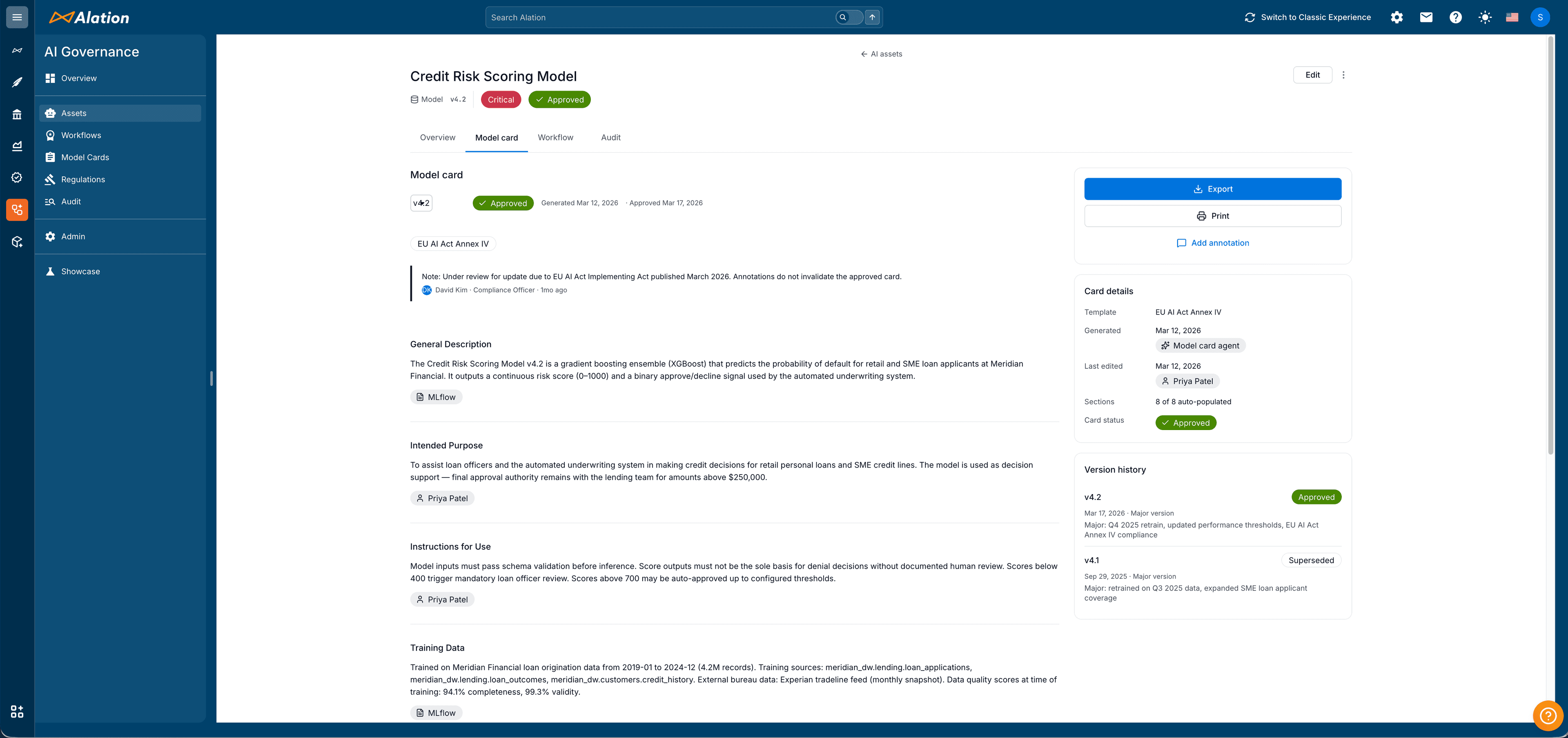
AI-Native Model Cards - Model cards generated from asset metadata, data dependencies, and applicable regulatory requirements, with every field citing its source. Evidence-based completeness replaces field-count completeness: a card shows which regulatory requirements have evidence and which still need human verification.
Agentic Governance Workflow - Approval routing driven by regulation applicability. A high-risk EU AI Act asset routes to Legal and CISO. A NIST-only asset follows the standard chain. Missing evidence creates remediation tasks linked directly to the gap. Every action is logged in an append-only audit trail.
Regulation Registry - Alation AI Governance includes built-in support for key frameworks, including the EU AI Act, GDPR (AI-relevant subset), NIST AI RMF, and ISO 42001, helping teams connect regulatory guidance to AI asset requirements. Enterprises can extend this with additional regulations, with AI-assisted suggestions to accelerate requirement mapping.
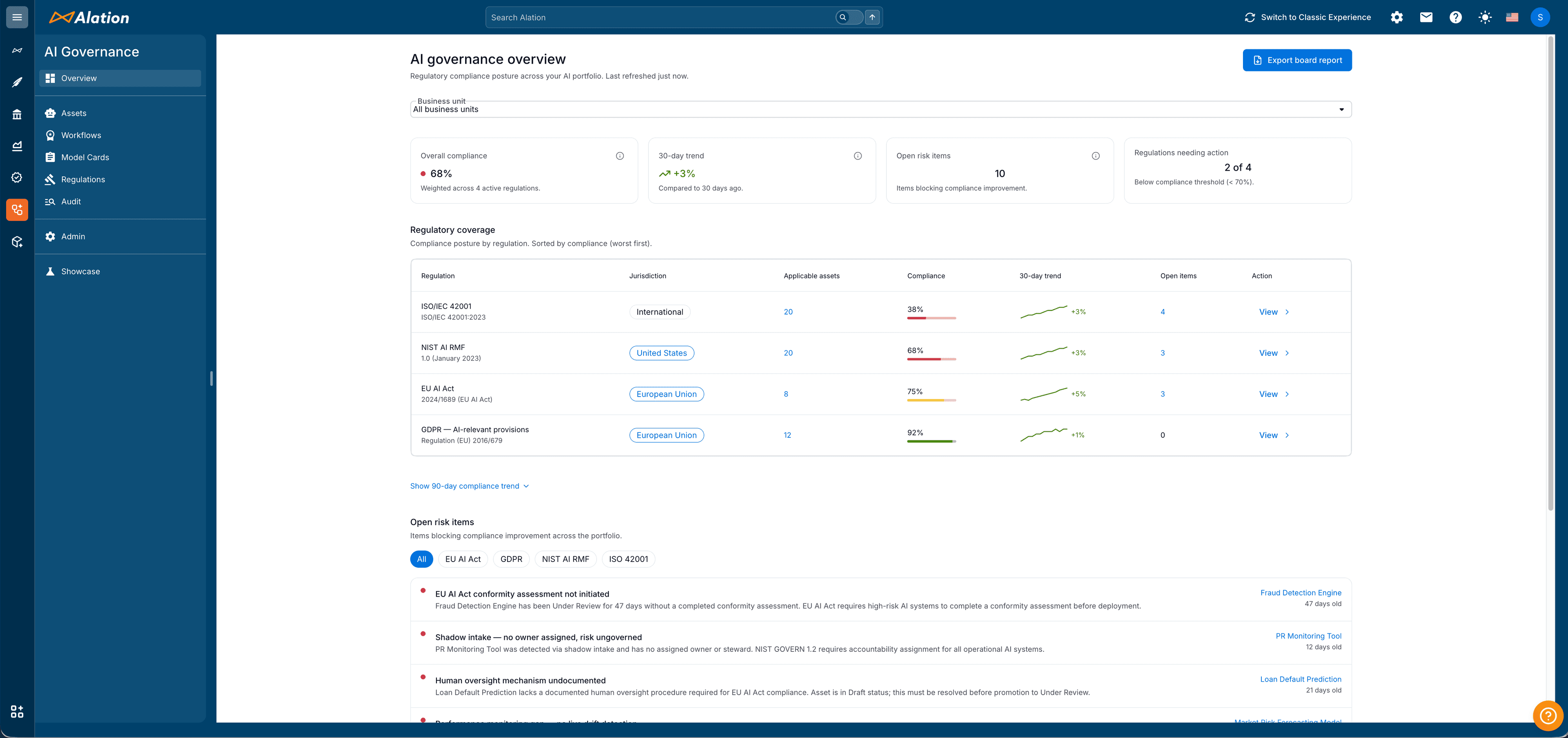
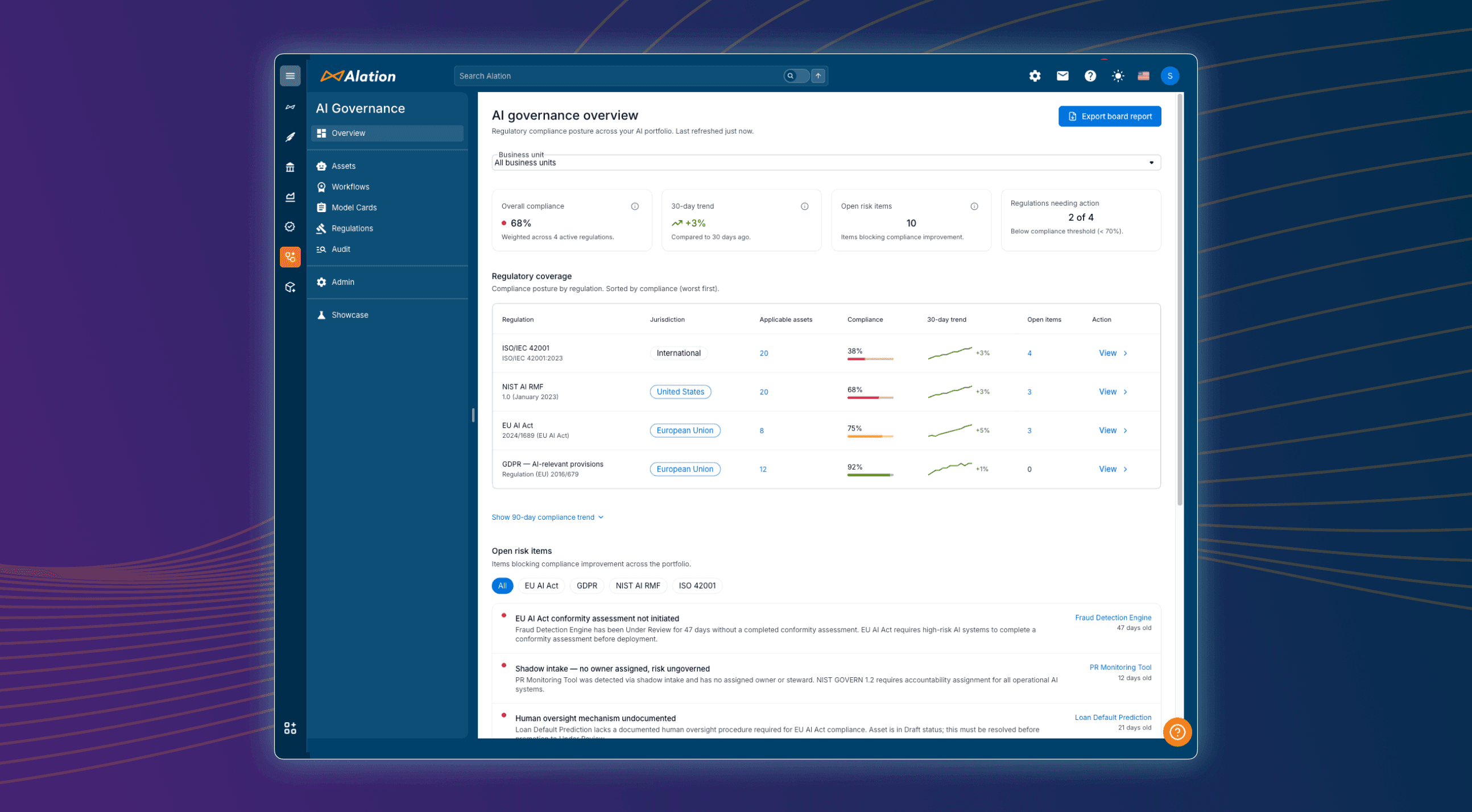
Executive Dashboard - A live compliance posture available on demand for CDOs, CIOs, CROs, and Chief Compliance Officers. The dashboard shows the overall compliance score, a per-regulation breakdown with trend lines, and the top open risk items blocking compliance, all drillable to the underlying assets and evidence. A board-ready PDF exports in seconds with live metrics.
Alation was recently included in the Forrester Responsible AI Solutions Landscape (Q2 2026), an acknowledgment of the company's expanding role in AI governance alongside its established position in data governance.
What changes for the enterprise
When the board asks "Are we compliant?", the answer should come from the system, not from a team scrambling to assemble evidence. Alation AI Governance closes the gap between deploying AI and proving it is compliant.
The initial release targets an approved, evidence-backed model card in under two hours – down from the days or weeks most teams spend assembling documentation manually. The Executive Dashboard produces a board-ready compliance PDF on demand with live metrics, not cached numbers.
Because AI Governance extends the Alation platform, every AI asset's data dependencies are surfaced with live data quality scores. Model cards cite data-dependency evidence. Approval workflows evaluate whether data dependencies are certified. This is the structural advantage pure-play AI governance vendors cannot replicate: governed data is the foundation of governed AI.
The board will ask. The system should answer.
The question "Are we compliant?" is not going away. If anything, it is going to be asked more often, by more stakeholders, under more regulatory frameworks. The organizations that answer it well will be the ones that built a system for it, not a process around it.
Curious to learn more?
Stop by the Alation booth #206 at the Gartner Data & Analytics Summit in London to see a live demo.
Explore our AI Governance product page.
- Active Data Governance
- Data Culture
- Data Intelligence
- Digital Transformation
- Engineering
- Enterprise Data Catalog
- AI
- Alation News
- Data Governance
- Data Quality
- Modern Data Stack
Kyle Johnson is the Product Lead for Data Quality at Alation. He’s passionate about building AI-powered solutions that help enterprises trust their data. At Alation, Kyle is focused on simplifying data quality by embedding intelligence, automation, and governance into the data catalog experience. He’s helped define and launch Alation’s native DQ solution, aligning product strategy with customer needs across industries.
Keep reading
More from the data desk