

Forty officials from a foreign government sat in a conference room in Washington, already committed to automating 80% of their citizen calls. Dave Wright, Chief Innovation Officer at ServiceNow, asked them why. They weren't fielding more calls than they could handle. As a government agency, they weren't permitted to cut headcount. "It was obvious it was the first time they'd been asked that question," Wright says. Forty people looked at each other.
Then Wright started peeling back the layers. What the agency actually wanted was to drive up satisfaction and build a reputation beyond its own borders, to become the government that others travel from Washington to study. None of that was on the agenda. Automating 80% of citizen calls was.
Wright and Brian Solis, ServiceNow's Head of Global Innovation, spend most of their working lives in rooms like that one. Solis is a nine-time bestselling author and one of the more widely cited authorities on corporate innovation and AI business reinvention, and he studies the questions executives are not asking. Wright has four decades in technology, by his own count, and has watched ServiceNow run a decade-long AI buildout on itself, data centers and all. Their new book, Infinite: How Visionary Leaders Transform Today's Businesses into AI-Forward Companies,¹ grew out of the pattern they kept hitting: customers deploying AI, missing the return they expected, and having no framework for figuring out why.
Why the ROI question shows up in the wrong place
One of the most common questions Solis and Wright field is also one they think is misplaced. "Dave and I will always say that AI is not the strategy," Solis explains. "If it does become the strategy, it very much limits the impact it's going to have on the organization and how you can measure its success."
The trouble starts when a leader asks which use cases to pursue. "Even in that question, we're already narrowing the potential of artificial intelligence, because it's a reflection of the bias that an executive is bringing to that moment," Solis says. The better version, in his framing, works backward from competitive position rather than forward from available technology: what could we not do without this, does this workflow deserve to exist, and does this question help you compete more effectively in 2030?
For a lot of companies, the measurement problem is even more literal than that. Gartner found that roughly 11% of organizations had no idea what their own function spent on AI in 2025, while the high performers that track returns and reallocate away from underperforming initiatives reported positive returns on 81% of the AI work they funded.² The discipline, in other words, is doing more of the work than the technology is.
Wright has a blunter question he puts to customers. "What is it you've always wanted to do as a company that you've never been able to do?" Once a leadership team can name that, the conversation turns into a resourcing problem, and AI becomes one of the ways to free up the resources. That sequencing determines whether AI investment attaches to strategy or floats beside it, which is also why a data product operating model starts with business outcomes rather than tooling.
He also offers a useful piece of evidence that demand follows capability rather than leading it. "I've been in technology for 40 years. No one asked for summarization until two years ago, when a piece of technology that was really good at summarization came out."
What IKEA learned from the tickets Billie couldn't close
IKEA's story is well known, and Solis suspects it is not famous for all the reasons it should be. The company deployed a customer service agent named Billie, after its Billy bookcase. Billie handled about 47% of the customers who used it in its first two years, which is close to half the queue. Today, that figure is 74%.³
At that point, most companies run the arithmetic and cut heads to pay for the agent. IKEA looked at the residue instead. "What IKEA also did was they analyzed the inbounds. What could Billie not handle would be a good example of this conversation," Solis says. A large share of what the agent could not resolve turned out to be interior design questions, residential and commercial both.
So IKEA re-skilled its human agents, roughly 8,500 of them, retraining them on its digital room-planning tools and standing up two teams, resolutions and sales, across 24 remote-sales centers covering all 31 countries where Ingka Group operates.³ That channel has been IKEA's fastest-growing for three years, at 15% to 20% annual growth, and booked €1.25 billion last fiscal year, up from €1.08 billion the year before.³ Cost takeout and a growth story from the same program. Solis is precise about what drove it: the outcome was "all driven not by AI as the strategy, but customer experience as the strategy, and also tying that strategy to business outcomes."
The human side kept growing as the bot got better, which is the part most retellings miss. Billie now assists nearly three-quarters of the customers who use it, and IKEA's in-house customer happiness score sits at 89%, up from 60% before the rollout.³
Host Satyen Sangani, CEO of Alation, named the transferable method inside the anecdote: Customer service and coding are the two obvious places enterprises are pointing AI, and in both, the standard measure of success is tickets burned down. But the unresolved tickets are the more interesting artifact. As they are a demand signal about what customers want and cannot get. (This is the same logic that makes a well-governed data products marketplace valuable: the requests nobody can fulfill tell you what to build next.)
Solis adds a measurement caveat that most deflection dashboards skip. You have to track how many deflected cases get reopened rather than solved. A case that comes back was never handled.
Mode one, mode two, and the 90% problem
Solis offers the sharpest diagnosis in the conversation. "Essentially, they're scaling yesterday with artificial intelligence," he says of most enterprises, "and looking at how we can optimize that work, how we can make it more efficient, more cost-effective." Those projects are necessary. They are also not competitive on their own.
The book's operating framework splits the work in two. Mode one asks which of yesterday's workflows deserve to live and scale into tomorrow, making workflow evolution a deliberate choice rather than an inheritance. Mode two asks where new value can be created and what AI makes newly possible. Wright estimates where enterprises actually sit when he says: "Most people are stuck in mode one. I'd say 90% of people are in mode one. But the interesting thing is it's not a sequential process, so you should be doing both of them at the same time."
Wright's estimate has independent support. Gartner reported in September 2026 that only 22% of organizations have successfully scaled AI across multiple business units or adopted an AI-first approach, and that productivity (not new revenue, not transformation) is a key target outcome for 75% of functional leaders.² That is mode one with a budget line.
Inside mode one, Wright argues for one substitution that changes the output entirely. "The real benefit you're going to get is not asking, 'How do I automate this workflow? It's asking, why should I automate this workflow?" Most workflows were designed around a constraint, namely the number of people available to do the job. Remove that constraint and the design premise disappears with it. Automating the old shape locks in a limitation that no longer exists.
Then there is the question Solis says almost nobody has an answer for: If AI saved you 10,000 hours, what are you doing with them? "They might not say it, but I get that face or that look like, I hadn't thought about that." He treats that gap as a leadership discipline problem rather than a technology one, and Wright adds the precondition: without a trust framework, employees cannot say a deployment is underperforming, and "you create this emperor's new clothes scenario where no one questions it."
AI governance and the case for putting AI in the asset register
Sangani pushed on what people actually mean when they say AI governance. Wright starts with a single control plane covering everything from machine learning through agentic AI: which models are deployed, which vendors supply them, when agents execute, and what parameters bound them. He is upfront that this is very much a ServiceNow perspective. Policy then defines what agents may do alone, what requires human intervention, and what is never permitted.
The payoff he cares most about is anomaly detection. "Once you can start to understand the trend of how often an agent runs, if it normally runs 50 times an hour and suddenly it's running 8,000 times an hour, you know you've got a problem." Prompt length drifting where it never drifted before is another signal. Governance and security stop being separate conversations at that point, which is why AI agents fail without enterprise context and traceable behavior rather than only good prompts.
Solis draws the line for everyone who isn't a ServiceNow customer. The control plane conversation is foundational if you are one. For a business generally, he says governance can start as a structured framework of policies, procedures, and controls that work as guardrails and as the lens Wright describes, so that if customer data starts leaving at speed and scale, something detects it and someone acts on it.
That leads to Wright's central guidance: Manage AI as an asset rather than as an employee, and you inherit the whole control apparatus: compliance, risk, lifecycle from onboarding through deprecation, and the relationship map showing which workflows depend on which agent. Ownership is the part he refuses to compromise on. "It seems to be a perfectly good explanation to say, oh, it was just a rogue agent. And you're like, wow, is that where we're at now, that we just hold up our rogue agent card, and that's like a get out of jail free card? That's not acceptable."
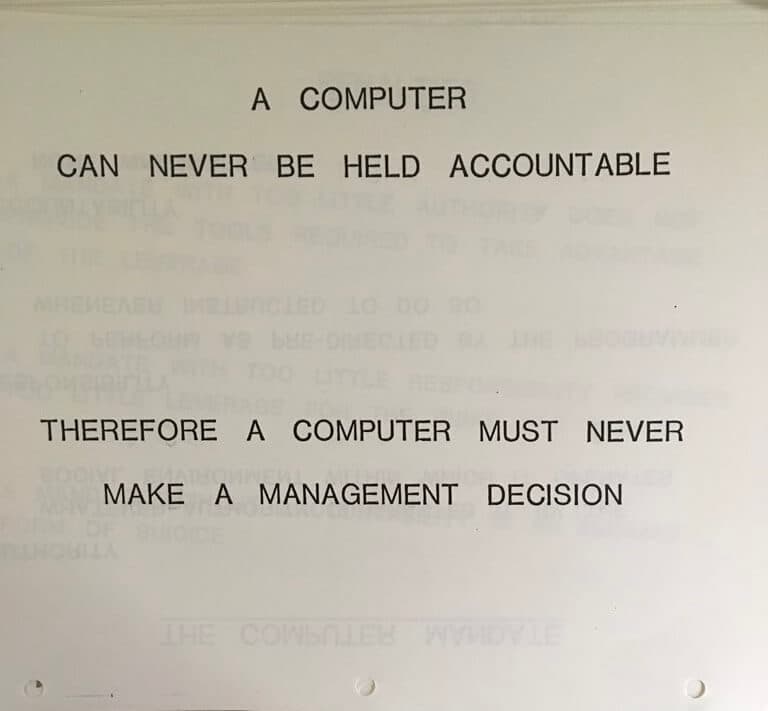
Solis reaches back for the underlying principle to a photographed slide widely attributed to a 1979 IBM training session — an artifact IBM's own corporate archives have searched for and been unable to locate⁴ — that a computer can never be held accountable, therefore a computer must never make a management decision.
He also argues the control tower belongs in the C-suite rather than only in IT, since AI now powers operational workflows across the business. (For teams starting from first principles, Alation's overview of what data governance is and its work on critical data elements cover the foundations that agent governance sits atop.)
Wright's counterintuitive read on adoption runs thus: enterprises are not waiting for assurance before they deploy. "I think people are deploying with no governance." He compares it to the early cloud years, when policy committees deliberated while someone in finance bought compute on a credit card. He has been on the receiving end too: He tried to deploy OpenClaw internally and got shut down within seconds.
What ServiceNow has done with AI
ServiceNow told investors it generated $500 million in annualized AI-driven value in 2025, of which $100 million was OpEx savings, and that it expects a further $200 million in incremental OpEx savings in 2026 while holding headcount flat.⁵ By Wright's account, the gains concentrate in customer service and IT support. Headcount roughly doubled over the same stretch, from about 17,000 in 2021 to 29,187 full-time employees at the end of 2025,⁶ while the number of people staffing IT and HR support went down, and the freed capacity went into employee experience work, recreating workflows, and financing acquisitions. He is candid about the timeline: a 10-year journey that started with machine learning for event correlation, in a company that runs its own managed infrastructure, co-located in third-party data centers alongside public-cloud capacity,⁶ under its own software, and that by Wright's account operates at a scale of exabytes of data and trillions of workflows.
Both guests closed with a 12-month prediction. Solis wonders whether bring-your-own-agents will erode the individual contributor role, since employees fluent in agent delegation will pull far ahead of their peers. Wright thinks we may see the first AI advisor working with a company board, digesting a digitized company and answering questions in real time. He hedges the timing deliberately: maybe 12 months, maybe only one or two companies get there, and 24 months at the outside. Data and analytics leaders tracking that shift will recognize the dependency immediately, because a board-grade AI advisor needs data lineage and a trustworthy data catalog beneath it, or its answers are confident guesses.
The through-line Sangani drew at the close: AI is an amplifier, and most companies are still pointing it at yesterday. IKEA did not lose those call center jobs to automation. The work moved somewhere more valuable, which happened only because someone looked at what the AI could not do and treated it as an opportunity. Leaders looking for more of this thinking can also browse lessons from data leaders across the AI Radicals archive and Alation's approach to AI governance.
Curious how governed, AI-ready data can support the reinvention you have in mind? Book a demo with us today.
Sources & notes
Every external claim on this page is independently verifiable. The public sources are listed here.
Infinite: How Visionary Leaders Transform Today's Businesses into AI-Forward Companies, Brian Solis and Dave Wright, ISBN 978-1-394-43903-4, 320 pages. The publisher's author biography is also the source for Solis's role as head of global innovation at ServiceNow and for his nine bestselling titles. — Wiley, May 2026 ↗ https://www.wiley.com/en-us/infinite-how-visionary-leaders-transform-today's-businesses-into-ai-forward-companies-p-9781394439034
Only 22% of organizations have successfully scaled AI across multiple business units or adopted an AI-first approach; productivity is a key target outcome for 75% of functional leaders; roughly 11% of organizations were unaware of what their function spent on AI in 2025; high performers that track returns and reallocate reported positive returns on 81% of AI initiatives. Based on a survey of 1,303 respondents at organizations with at least $50 million in enterprise-wide annual revenue in fiscal year 2025, fielded January to April 2026. — Gartner, 1 September 2026 ↗ https://www.gartner.com/en/newsroom/press-releases/gartner-survey-finds-only-22-percent-of-organizations-have-successfully-scaled-ai-across-multiple-business-units
Billie, named after IKEA's Billy bookcase and introduced in 2021, assisted 47% of the customers who used it in its first two years and 74% today; roughly 8,500 call center employees were retrained; the resolutions and sales teams operate from 24 remote-sales centers covering all 31 countries where Ingka Group has a presence; the remote-sales channel booked €1.25 billion in the last fiscal year, up from €1.08 billion the year prior, and has grown 15% to 20% annually over three years; IKEA's in-house customer happiness score is 89%, up from 60% before Billie's rollout. — Fortune, Claire Zillman, 30 July 2026 ↗ https://fortune.com/2026/07/30/ikea-ai-workforce-reskilling-jobs-billie-chatbot-global-500/
Provenance of the slide reading "a computer can never be held accountable, therefore a computer must never make a management decision": IBM Corporate Archives searched its collection and was unable to locate the presentation; the physical original was destroyed in a 2019 flood; the image was first published online in February 2017. — Simon Willison, 3 February 2025 ↗ https://simonwillison.net/2025/Feb/3/a-computer-can-never-be-held-accountable/
ServiceNow-reported figures presented at the company's Financial Analyst Day: $500 million in annualized AI-driven value in 2025, including $100 million in OpEx savings, with a further $200 million in incremental OpEx savings expected in 2026 and flat headcount for the full year. — Fortune, Nick Lichtenberg, 6 May 2026 ↗ https://fortune.com/2026/05/06/servicenow-30-billion-revenue-not-crazy-why/
29,187 full-time employees as of 31 December 2025 (14,601 in the United States, 14,586 international); services delivered primarily using company-managed equipment co-located in third-party data centers alongside public cloud infrastructure-as-a-service. — ServiceNow, Inc., Annual Report on Form 10-K for the fiscal year ended 31 December 2025 ↗ https://www.sec.gov/Archives/edgar/data/1373715/000137371526000007/now-20251231.htm
ANALYST ATTRIBUTIONS & DISCLAIMERS
Gartner, Gartner Survey Finds Only 22% of Organizations Have Successfully Scaled AI Across Multiple Business Units, Tina Nunno, 1 September 2026.
Gartner does not endorse any vendor, product or service depicted in its research publications and does not advise technology users to select only those vendors with the highest ratings or other designation. Gartner research publications consist of the opinions of Gartner's research organization and should not be construed as statements of fact. Gartner disclaims all warranties, expressed or implied, with respect to this research, including any warranties of merchantability or fitness for a particular purpose. GARTNER and Magic Quadrant are registered trademarks and service marks of Gartner, Inc. and/or its affiliates in the U.S. and internationally and are used herein with permission. All rights reserved.
- AI
- Data Catalog
- Data Governance
- Data Products
- Digital Transformation
- Modern Data Stack
Keep reading
More from the data desk