

Every data governance program eventually hits the same wall. The catalog exists. The policies are written. Stewardship roles are assigned. And still, at the end of the quarter, half the tables in your production environment have empty description fields, PII classifications vary by team, and no one is quite sure whose job it is to keep all of it current.
This isn't a failure of effort. It's a failure of the model. The traditional approach to metadata curation relies on distributing work to human stewards who must prioritize, interpret, and execute against an ever-growing backlog… while the data estate keeps expanding and the gap between what your catalog should contain and what it actually contains keeps widening.
Automated data curation is built for exactly this problem. This article explains what it is, what it replaces, and how AI is enabling organizations to govern metadata at a scale that manual processes were never designed to handle.
What is data curation in a data catalog?
Data curation is the act of enriching data assets with business context inside a data catalog: documenting what a table contains, flagging sensitive fields, recording who is responsible for an asset, and keeping all of that information accurate as data changes. Done well, it transforms a raw inventory of database objects into a trusted, self-service resource that analysts, data scientists, and AI systems can rely on.
The gap between a catalog and a useful catalog almost always comes down to curation. See our primer on what a data catalog does for a fuller picture of why cataloging and curating are distinct activities, and why both matter for making data truly discoverable and trusted.
What is automated data curation?
Automated data curation is the use of AI agents and rule-based systems to populate, classify, and maintain metadata across large volumes of data assets, all without requiring a human steward to act on each one individually.
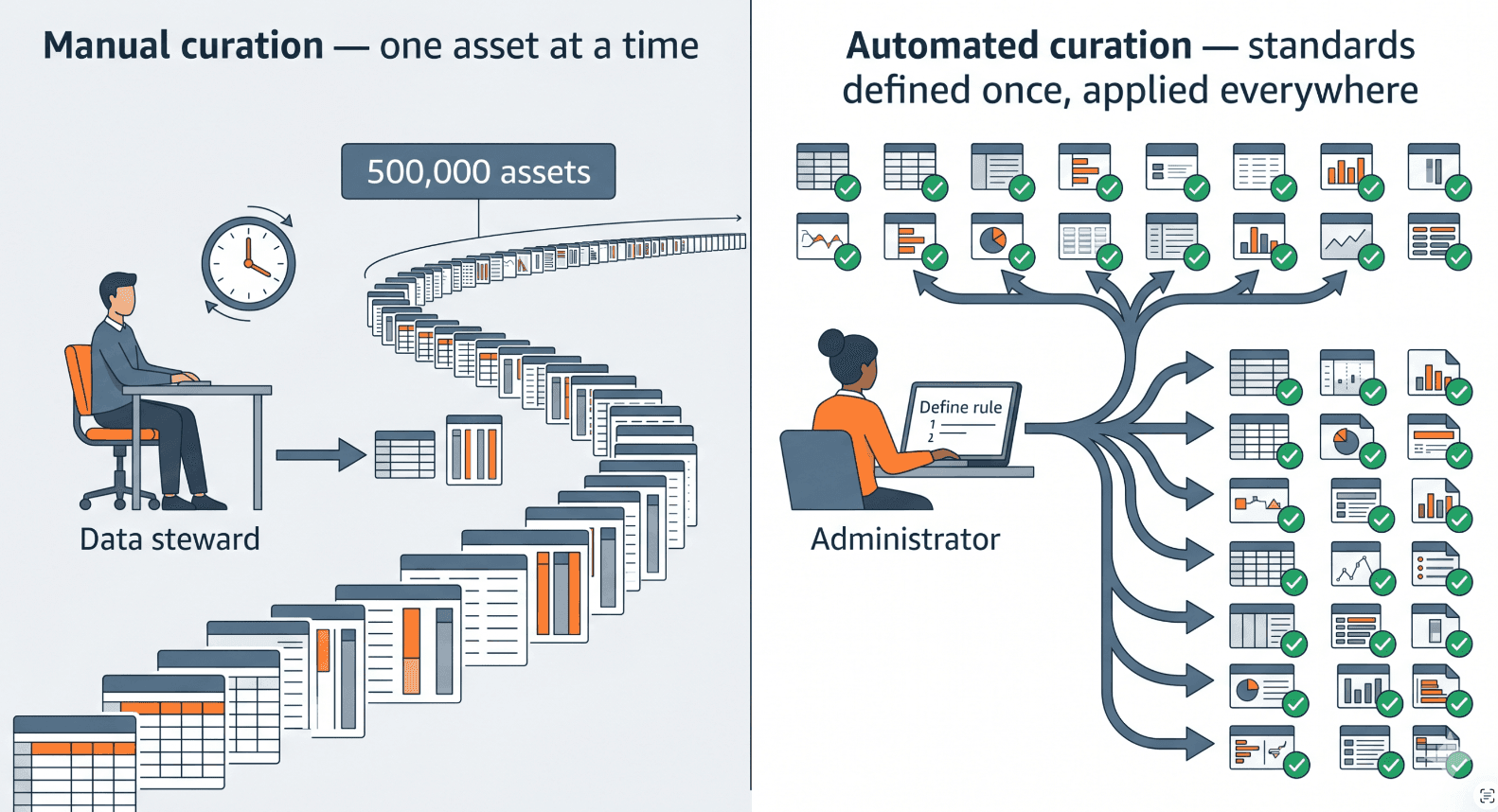
The mechanism is declarative rather than procedural. Instead of asking stewards to work through a queue of assets, an administrator defines a standard: which metadata fields matter, which assets should fall within scope, and what logic should govern how each field gets populated. AI agents then carry that standard into execution — drawing on catalog context, query history, source annotations, and admin-supplied instructions to generate field-level values for every asset in scope. Each proposed result is reviewed before being committed to the catalog. Anything a steward has already filled in is left untouched. A full record of every change is automatically produced.
What distinguishes this from earlier AI-assisted metadata tools is the shift from suggestion to execution. The admin defines the outcome; the system delivers it.
Why manual metadata curation doesn't scale
The mismatch between data volume and steward capacity isn't new, but in the age of AI, it's become untenable.
A typical enterprise today maintains hundreds of thousands of catalog objects spread across dozens of data sources. Even at five minutes per object, bringing a catalog to full curation coverage represents years of uninterrupted stewardship labor. That estimate doesn't account for the continuous refresh required as schemas evolve, new sources come online, and existing assets change.
In practice, teams do what any rational group would: they prioritize the highest-visibility assets and let everything else accumulate. The result plays out in three predictable patterns:
Coverage becomes uneven. The tables powering your most-watched dashboards get documented. Everything else sits empty. When analysts venture beyond familiar territory, they find a catalog that provides no guidance — and they stop relying on it.
Standards fragment across teams. Without a system enforcing a shared interpretation, different stewards classify and describe similar fields differently. Sensitivity labels drift. Terminology diverges by domain. What was designed as an organizational standard becomes a loose collection of local conventions.
Degradation outpaces maintenance. Columns get added, renamed, and deprecated. Manual curation has no built-in mechanism for detecting and responding to that drift — it only addresses what someone happens to notice and decides to act on.
The downstream stakes are rising fast. According to a Q3 2024 Gartner survey of 248 data management leaders, 63% of organizations either do not have or are unsure they have the right data management practices for AI. The same research predicts that through 2026, organizations will abandon 60% of AI projects unsupported by AI-ready data. Incomplete metadata isn't just a catalog maintenance issue; it's a direct threat to the AI initiatives most organizations are banking on.
Adding headcount to a manual curation program can't resolve this. The math doesn't work at scale. A different approach is required.
How AI is changing metadata management
The meaningful change AI brings to metadata management is much more than speed alone; it's the elimination of the human as the per-asset execution bottleneck.
Earlier generations of catalog tooling moved the needle incrementally: AI surfaces a suggested description, a steward reviews it, approves or edits it, and moves to the next asset. Humans remained the rate-limiting factor. For a catalog with 10,000 frequently accessed tables, that workflow was manageable. For a catalog with 500,000 objects (most of them rarely visited, all of them needing documentation), a new approach is needed.
The architecture behind modern automated curation reassigns that work. Using Alation Curation Automation as an illustration, the workflow functions as follows:
An administrator creates a rule with a purpose statement, a defined scope (specific data sources, schemas, tables, or columns), and per-field instructions for each metadata field to be populated.
The purpose statement is passed as context to each AI agent, so that domain-specific framing like "this environment contains financial data subject to SOX" directly shapes the output the agent produces.
For each asset in scope, the agent reads the object's name, existing metadata, source system annotations, and (for tables) the names and descriptions of child columns, then generates a field value along with a confidence score.
High-confidence results are staged for writing. Lower-confidence results are flagged for admin review without being committed.
Before any execution runs, the admin previews output across a representative sample of objects, refining the instructions until results meet the required standard.
Post-run, a complete report captures every field updated — with before and after values and a direct link to each modified object in the catalog.
Throughout this process, nothing happens sight-unseen. No pre-existing value is overwritten. Every automated action produces a traceable record. The system is designed to be verifiable at each step, not just at the end.
Key use cases for automated data curation
Four patterns appear consistently in real-world deployments:
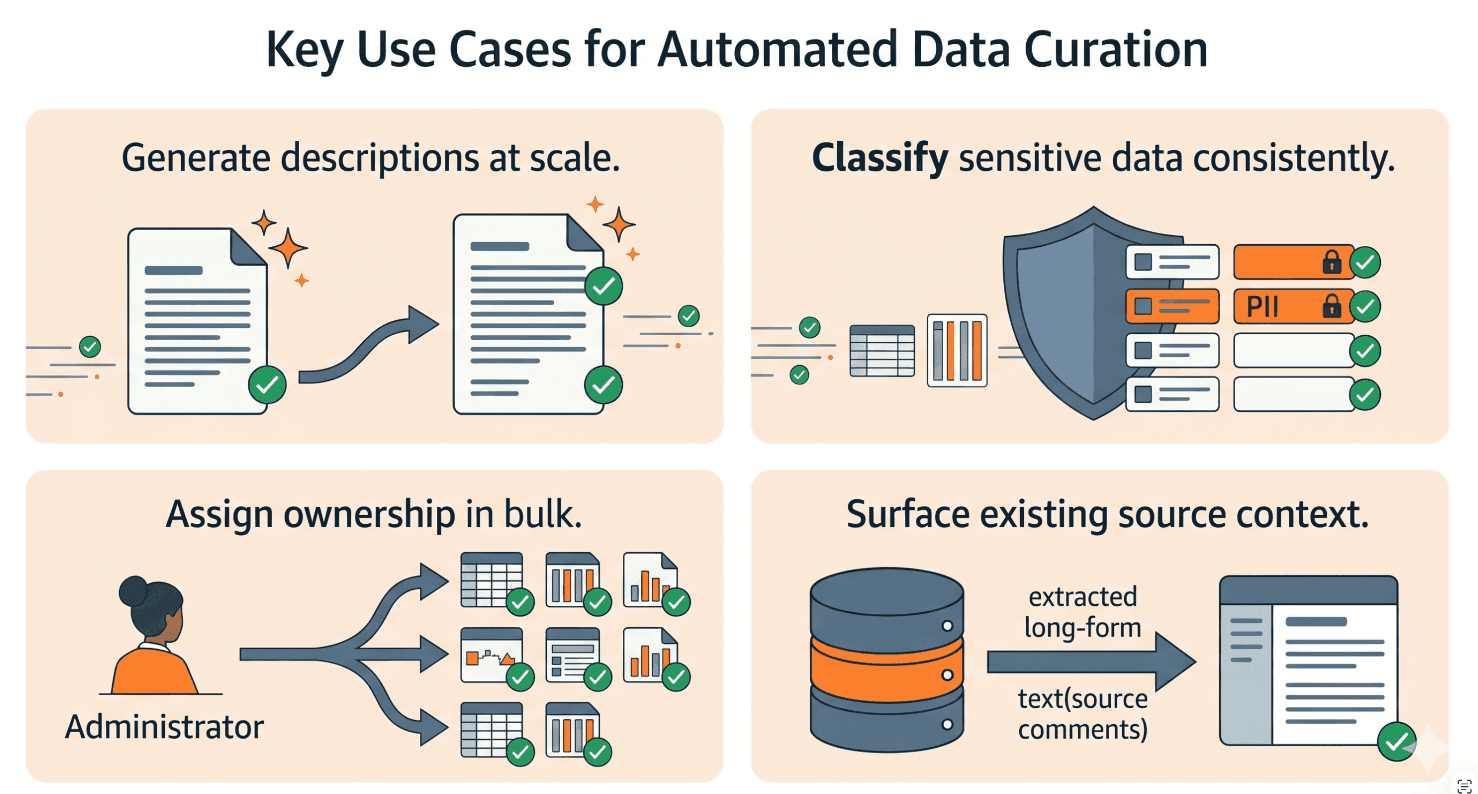
Generating descriptions for production schemas at scale. This is typically the first rule an organization builds. Scope it to a critical schema, write a clear instruction that captures your domain context, and the system generates descriptions for every table and column in scope.
One large utility company took this approach to document SAP tables whose column names consisted of German-language abbreviations that had gone unexplained anywhere in the catalog. The work (which the governance team had estimated at roughly six weeks of manual effort) was complete in approximately 15 minutes. Technical subject-matter experts reviewed the output and confirmed the descriptions were accurate.
Applying consistent sensitivity classification. Automated curation is particularly well-suited to classification tasks because the governing logic can be encoded precisely in the field instruction. Rather than relying on individual steward judgment, you specify exactly when a field qualifies: for instance, drawing a clear line between fields that directly identify a person and those that merely correlate with identity. The consistency this produces matters directly for organizations managing obligations under privacy and data protection frameworks.
Assigning ownership and stewardship in bulk. Not every curation task requires AI generation. Fixed-value rules let admins assign a steward, data owner, or domain classification to every asset within a defined scope in a single operation, no AI interpretation needed, no per-object effort required.
Surfacing structured content already present in source systems. Some source environments contain useful metadata that never reaches the catalog — long-form annotations, retention codes, policy references embedded in source comments. Automated rules can extract and promote that existing content directly into catalog fields, recovering value that was always there but effectively invisible to catalog users.
What good automated metadata curation looks like
Not all automated curation tools are built with governance requirements in mind. These six criteria separate implementations worth deploying from those that introduce new risks:
It writes only to empty fields by default. Any system capable of silently overwriting steward-authored content is a liability, not an asset. Automation should fill gaps — not override human judgment.
You can inspect proposed values before committing. The ability to sample AI output across a range of objects and refine instructions before anything is written is what turns automation from a liability into a controlled capability. Without a meaningful preview step, you're accepting outputs on faith.
It enforces confidence thresholds. Well-designed systems distinguish between results the model is confident in and those where uncertainty is higher, routing the latter to human review rather than committing everything indiscriminately.
You can write custom instructions per field. A description instruction and a sensitivity classification instruction require entirely different logic. Effective tools let admins encode domain knowledge, regulatory requirements, and organizational terminology directly into the instruction for each field.
Every change is logged with before/after context. The audit record isn't an afterthought — it's central to governance value. Admins should be able to see exactly what was changed, on which object, when, and navigate directly to each asset to verify or correct.
It connects to the rest of your governance program. Curation in isolation has limited staying power. Does the tool connect to your critical data elements framework so you can direct automation where business risk is highest? Does it feed into data quality monitoring so that completeness and accuracy reinforce each other over time?
How automated data curation fits into an outcome-based governance system
Curation automation addresses a real and immediate problem, but its value compounds when it operates as part of a broader governance architecture rather than as a standalone feature.
Outcome-based governance provides that architecture. The core shift it represents is from measuring governance by activity — policies written, tasks completed, reviews conducted — to measuring it by whether intended outcomes are being maintained continuously. Business and regulatory requirements aren't documented in the hope that people will follow them; they're encoded into systems that enforce them automatically and generate evidence that they're working. For a grounding in what this model requires organizationally, see what data governance actually means in practice.
In Alation's implementation, three capabilities work as a unified system:
CDE Manager establishes the foundation by identifying which data elements are genuinely critical to operations and regulatory compliance. It translates policy intent into structured, executable standards — ensuring automation is directed at the assets where gaps carry the most risk.
Curation Automation takes those standards and applies them across the data estate, ensuring that every relevant asset carries complete, consistent, and accurate metadata without requiring a steward to act on each one individually.
Data Quality monitors whether data continues to meet the standards that have been set, detecting drift and generating the continuous evidence that auditors and AI systems both require.
The integration matters because metadata completeness and data quality are not separate problems — they're two dimensions of the same one. For organizations deploying AI agents on top of enterprise data, both dimensions have to be addressed. A 2024 survey of 500 enterprise data leaders conducted by Forrester Research found that 73% identified data quality and completeness as the primary barrier to AI success. Metadata is not documentation overhead — it's the context layer that determines whether data can be used at all.
Getting started with automated metadata curation
Adopting automated data curation doesn't require automating everything at once, and the organizations that see the fastest results typically start with a very specific scope.
Choose one production schema, or a data domain where metadata gaps are creating measurable friction for downstream users. Build a rule for it: write a purpose statement that captures your domain context, define the scope, specify per-field instructions. Run a preview on a representative sample of objects. Adjust the instructions where the output falls short. Then execute.
After the first run, expanding is straightforward. Add schemas to the existing rule's scope, or create new rules for additional fields or domains. Re-runs only process assets that are new or still empty — anything previously curated, by automation or by a steward, is skipped. Each execution builds on the one before it.
What teams typically discover after even a single well-scoped rule is that the combination of scale and consistency changes the internal conversation around governance. It stops feeling like a maintenance problem and starts looking like a repeatable, demonstrable capability. For more on how automation fits the full picture of modern metadata practice, Alation's overview of automated metadata management is a useful companion read.
Closing the curation gap requires a different model, not more effort inside the existing one.
Ready to see automated data curation in action?
- Active Data Governance
- Data Intelligence
- Digital Transformation
- Engineering
- Enterprise Data Catalog
- AI
- Data Catalog
- Data Quality
Keep reading
More from the data desk