

AI-ready data infrastructure requires five things before models go live: a governed catalog, verified lineage, business context agents can actually reason over, agent-specific governance, and a feedback loop that catches drift after launch. Most checklists stop at the first two. This one doesn't — because most AI failures aren't model failures. They're infrastructure failures that surface long after the pilot looked like a success. That pattern shows up at the macro level too: MIT's Project NANDA found that 95% of enterprise generative AI pilots fail to deliver measurable P&L impact, and traced the gap to organizational and integration failure rather than model quality.8
The numbers back this up. In a recent survey of data and AI leaders, 61% reported experiencing "silent failures" in their data systems, and only 18% had managed to scale AI across multiple teams (CDO Magazine, in partnership with Monte Carlo).¹ Gartner has separately estimated that 60% of AI projects lacking proper data management practices will be abandoned.² The model isn't usually the problem. What's underneath it is.
Why most "AI-ready" checklists stop too early
Search "AI data readiness checklist" and you'll find dozens of thorough, well-intentioned frameworks: schema consistency, freshness monitoring, PII classification, lineage, ownership. All necessary. All table stakes. And all built around a single implicit assumption — that readiness is something you achieve once, verify, and check off.
That assumption doesn't survive contact with production. Data drifts. Ownership changes hands. A metric definition that was correct when a checklist was signed off six months ago can quietly stop describing anything real, and nothing about a static checklist will tell you when that happens. MIT's research on the same GenAI Divide reaches the same conclusion from a different angle: the pilots that stall are disproportionately the ones running on tools that can't retain feedback or adapt to context — the exact document-vs-system gap this checklist is built around.8
The real failure mode is a confident, incorrect answer
When software breaks, it throws an error. When an AI agent breaks, it produces a confident, incorrect answer — and most organizations have no system of record to catch that before the answer drives a decision. That distinction is the reason a one-time audit isn't enough: an error stops a process. A wrong answer that looks right doesn't stop anything. It just quietly makes its way into a board deck, a customer response, or a compliance filing.
Three ways every agent fails
In production, that failure shows up in three places, and each one deserves its own line on the checklist:
A failure from below: an agent acts with total confidence on data that's wrong, stale, or that it should never have used that way in the first place.
A failure in the context itself: the agent reaches for a definition or business rule that no longer holds, because the rule changed and nothing told it.
A failure from above: the agent drifts out of sync with its own tools and instructions as the environment moves on beneath it.
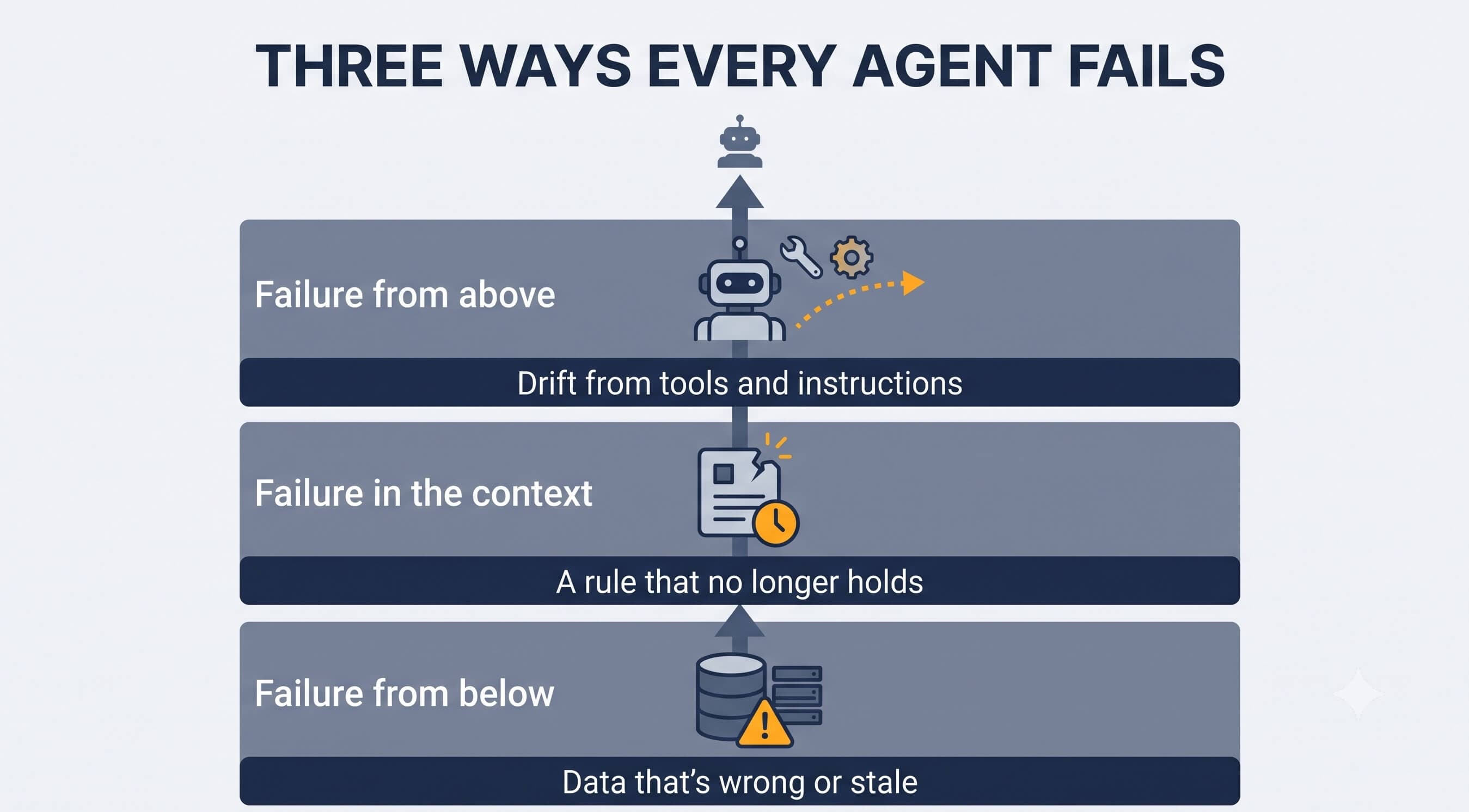
Two of those three failure modes originate entirely outside the model. That's the core argument for why a data-infrastructure checklist — not a model-evaluation checklist — is where AI readiness actually starts.
A context layer is not the same thing as a system
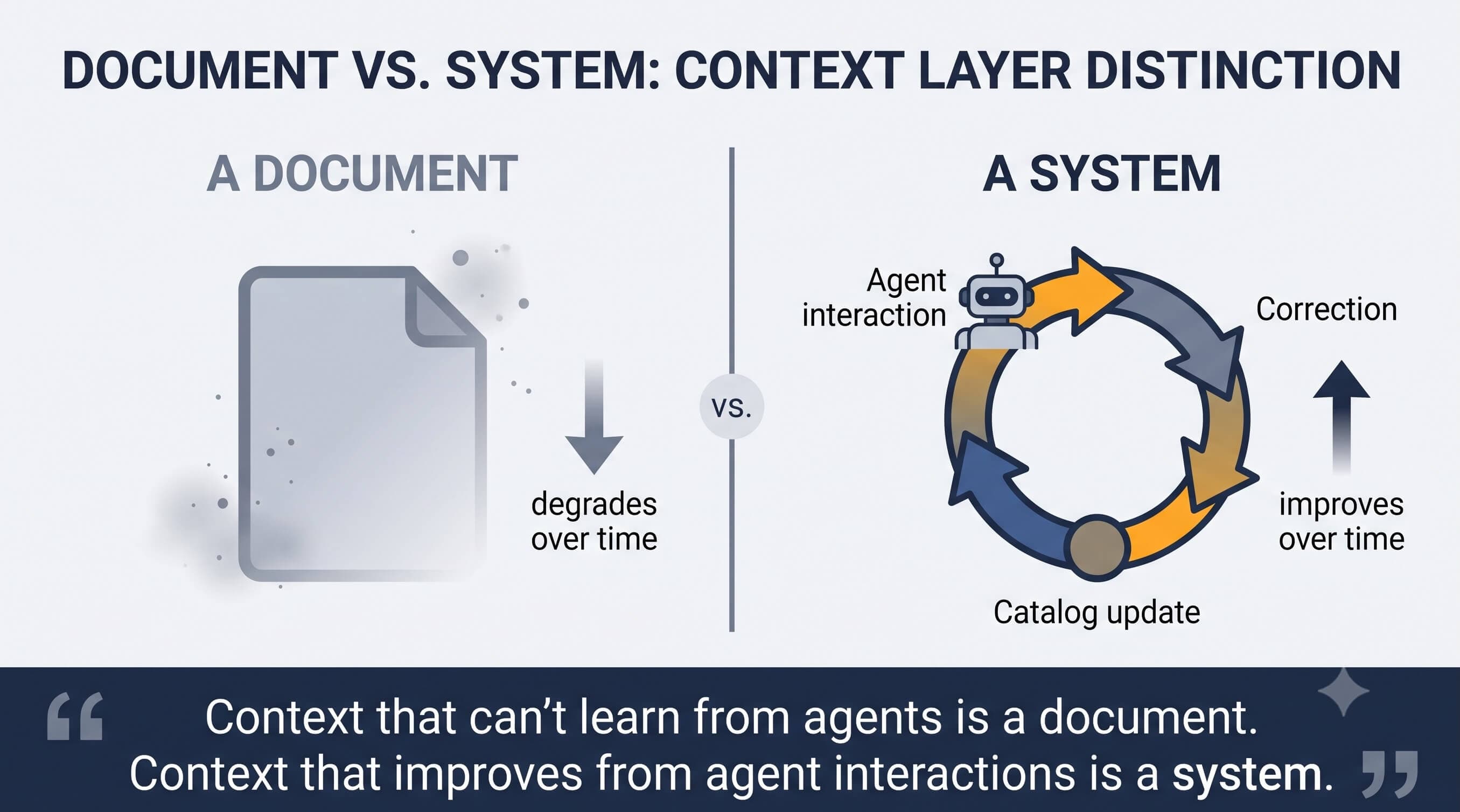
There's a popular middle step between "raw data" and "AI-ready": hand an agent a context layer — a catalog plus some curated definitions — and call it done. This is necessary, but treating it as sufficient creates what's known as the headcount trap³: every use case deployed without a mechanism to keep its context current requires a human team to keep it alive. You're not saving work. You're shifting headcount into a permanent maintenance function, and you'll be stuck maintaining the first use case instead of shipping the next one.
The distinction worth holding onto through the rest of this checklist: context that can't learn from agents is a document. Context that improves from agent interactions is a system. A document degrades from the day it's published. A system gets more accurate the longer it runs.
The checklist, pillar 1: Data foundations
Before anything else, confirm the ground truth is actually solid.
Catalog coverage
Is every data asset an agent might touch actually inventoried — not just the tables analysts already know about? A data catalog that ranks by trust and real usage, not just name match, is what lets an agent find the right starting point instead of the closest-sounding one.
Lineage depth
Can you trace any number back to its source, column by column, through every transformation? When someone asks where a figure came from, column-level lineage means the answer is already on the screen instead of requiring a week of detective work.
Quality scoring at the point of decision
Is trust surfaced before a deprecated or degraded source reaches an agent — not discovered after the agent has already used it to answer a question? Quality has to be a gate, not a dashboard someone checks after something goes wrong.
Curation velocity
Does documentation keep pace with how fast the data estate actually changes, or does it fall permanently behind the moment a project ships?
Checklist — data foundations
Every data asset an agent could reach is cataloged and ranked by trust, not just proximity
Lineage traces to the source, column by column, for any figure an agent might cite
Quality is scored and surfaced before consumption, not after
Documentation/curation keeps pace with the rate of change in the underlying data
The checklist, pillar 2: Context agents can actually reason over
Cataloged data isn't the same thing as business intelligence an agent can reason over. This pillar is where most competing checklists stop — and where the real differentiation starts.
Definitions, not just data
Does "customer" or "active account" mean one thing company-wide, or does it mean something slightly different in the CRM than in billing? An agent that inherits ambiguity will resolve it with a guess, and the guess will look exactly as confident as a correct answer.
Governed data products, not ad hoc exports
Is business context packaged into certified, reusable data products with lineage, contracts, and policy attached — discoverable in one place for both people and agents — or is it scattered across spreadsheets and one-off extracts nobody owns?
Where your semantic layer actually lives
Can agents reach your existing semantic models — wherever they live, in whatever BI tool built them — without forcing a rewrite?
Two mechanisms that keep context alive
A catalog and a set of data products are necessary, but they're only the middle of the system. What most vendors are missing is what sits on either side of them: feedback loops that capture agent corrections and failed queries and route them back into the catalog automatically, and data quality checks that flag a degraded source before an agent ever builds an answer on top of it. Without both, context is a snapshot from the day it shipped — not a system that improves.
Prompts are context, too
Metric definitions and filter rules embedded in prompts are part of the context an agent reasons with. When those prompts live outside a governed system, they become an ungoverned source of drift that no data-quality check will ever catch.
Checklist — context
Business definitions are governed and consistent across every system that touches them
Context is packaged as certified, reusable data products — not one-off exports
Agents can reach the existing semantic layer without a rewrite
A feedback loop routes agent corrections back into the catalog automatically
Prompts containing business logic are governed, not scattered outside the system
The checklist, pillar 3: Agent-ready governance and specialization
Data and context can be perfect and an agent can still fail — because it isn't evaluated properly, or because it's the wrong kind of agent for the job.
A registry of every model and agent
Is there a system of record for every model, agent, and AI tool in production, mapped to the regulations that apply to it? CDE Manager-style governance for your highest-stakes data elements means agent-assisted identification and continuous monitoring aren't things you build from scratch for every new use case.
Audit-ready evidence on demand
Can you produce a compliance posture and a decision trail the moment someone asks for one — or does "prove it" mean a week of manually reconstructing what happened?
Evaluations before production, not vibes
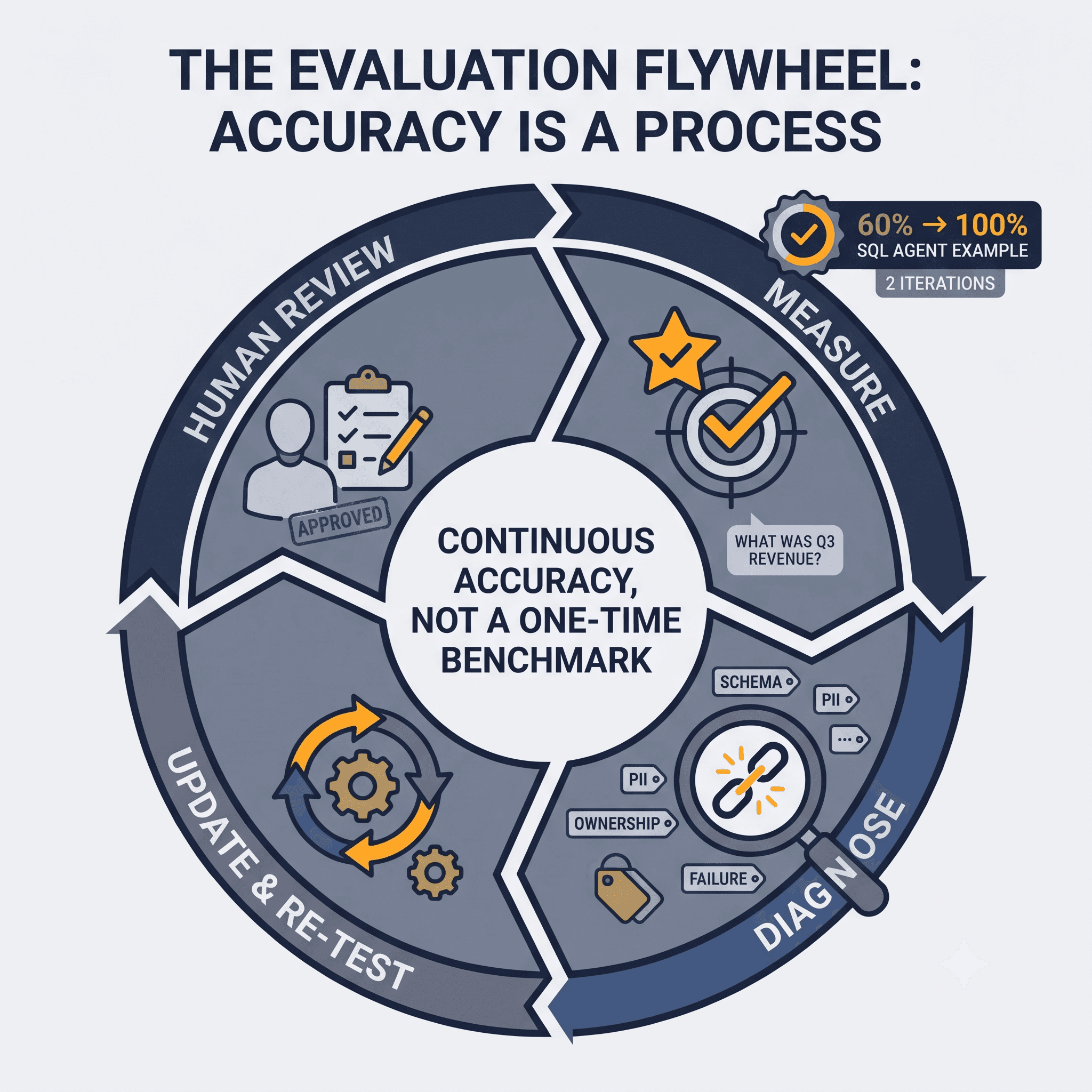
Does an agent get tested against real business questions before it reaches production, with a defined "gold standard" for what a correct answer looks like — or does it get shipped after a demo that happened to go well? Evaluations⁴ built directly into the agent-creation workflow — define the expected output, run the test, diagnose exactly which metadata caused a failure, fix it, re-test — are what took one SQL agent from 60% to 100% accuracy in two iterations, starting from a data product with no metadata at all. That's not a one-time benchmark; it's a repeatable loop, with every change surfaced for human review.
Specialized agents vs. one generalist
Is the plan one general-purpose assistant expected to handle every question across every domain, or purpose-built agents tuned to each domain's terminology and edge cases? In a head-to-head test using the same underlying knowledge layer, a specialized agent built in Agent Studio⁵ was 20 points more accurate (80.39% vs. 58.82%) and 40% faster (93 seconds vs. 160 seconds) than a general-purpose agent given every configuration advantage. The gap wasn't effort — it was architecture. A generalist hedges across every possible question; a specialist knows exactly what "correct" looks like for its domain.
Checklist: Governance and specialization
Every model, agent, and AI tool in production is registered and mapped to applicable regulations
Compliance evidence and decision trails can be produced on demand, not reconstructed after the fact
Agents are evaluated against defined, real business questions before reaching production
High-stakes use cases use specialized agents, not a single general-purpose assistant
The checklist, pillar 4: What happens after launch
This is the pillar every other checklist skips, and it's the one that actually determines whether an AI initiative survives its first year.
Data drifts, ownership changes, definitions expire quietly
Six months after launch, is there a system that catches a definition that's stopped holding... or does someone have to notice the number looks wrong first?
Feedback loops that compound, not just correct
When an agent gets something wrong, does the correction fix just that one output, or does it improve every agent that touches that same piece of context? A fix that doesn't propagate isn't a system fix — it's a patch.
Accuracy is a process, not a promise
True accuracy improvement requires four things working together: a way to measure agent performance against real business questions, a way to diagnose failures down to the metadata level, a workflow to update and re-test, and human oversight of what changed and why. Any checklist that treats accuracy as something you configure once, rather than something you continuously measure, is describing a demo — not a production system.
Proof from production: Three data leaders who closed the gap
Georgia-Pacific⁶ — trust was the challenge. Across over 200 manufacturing sites pooling spare parts inventory data from 30 different sources, nobody trusted the numbers enough to act on them; a figure would look one way one day and double the next. Once data quality signals, context, and lineage were wired directly into the catalog platform people already worked in (internally branded as GP Data Pulse), trust returned. Instead of unnecessarily purchasing new parts from outside vendors, site managers could finally see what already existed, driving roughly $25 million in intercompany transfers in a single year.
Euromonitor7 — customer-facing trust in AI was the challenge. For a market research firm with a 50-year reputation staked on uncompromising accuracy, deploying conversational AI directly to their clients meant every response had to be perfectly grounded. By integrating AI agents into their Passport platform, they ensured every answer was reasoned through established business definitions. Furthermore, they made the logic fully transparent, providing the underlying SQL and data lineage alongside the answer so users can clearly see exactly how the result was created.
At Euromonitor, our data empowers companies to shape critical decisions in markets around the world. By integrating ‘Chat with Your Data’ into our Passport AI platform, we are making it easier than ever for our clients to interrogate that data. They can now uncover strategic insights on local and global trends through simple conversation, all while maintaining the trust, accuracy, and control they expect from us.
— Lamine Lahouasnia
Director of Gen AI, Euromonitor
Each of these is a different pillar of the checklist above, closed in production, not in a lab.
A note on open infrastructure
None of this should assume a single-vendor stack. Agents built in Copilot, Snowflake, Gemini, a homegrown framework, or a dedicated environment like Agent Studio should all be able to draw on the same governed context — through open standards like MCP and OpenLineage, not a proprietary format that locks you into one ecosystem. The checklist works the same regardless of where your agents run or where your semantic layer already lives.
Turning the checklist into a system
A checklist is a snapshot. It tells you whether your infrastructure was ready on the day you ran it. The organizations closing the gap between AI pilots and AI in production aren't the ones with the most thorough one-time audit — they're the ones running a system that keeps re-answering "yes" to every item on this list as the business changes underneath it. That's the difference between a context layer and an operating system built to keep data, context, and agents in sync — governed, open, and self-improving — long after day one.
Frequently asked questions
What does "AI-ready data infrastructure" actually mean? It means a governed catalog, verified lineage, business context agents can reason over, agent-specific governance, and a feedback loop that catches drift after launch — evaluated together, not as a one-time checklist.
What's the difference between a data catalog and a context layer? A catalog is the trusted record of what data exists and what it means. A context layer turns that cataloged data into business intelligence — definitions, rules, and relationships — that an agent can actually reason over. Neither is sufficient without a mechanism to keep it current.
What's the difference between a context layer and a knowledge layer with built-in evaluations? A context layer hands an agent metadata at the time of a query. That's necessary, but it doesn't tell you whether the context actually produces correct answers. Evaluations test that context against real business questions, diagnose exactly where it breaks, and improve it — turning a static layer into a system you can measure.
Why do AI agents fail even when the underlying model works fine? Because most failures happen in the layers around the model: bad data an agent trusts, a definition that changed without anyone updating it, or an agent that's drifted out of sync with its own tools and instructions. The model rarely fails on its own.
Do specialized AI agents really outperform general-purpose ones? In a controlled comparison using identical underlying metadata, a specialized agent was 20 accuracy points ahead of a general-purpose one and answered in 40% less time. The gap came from architecture, not effort — a specialist knows exactly what a correct answer looks like for its domain.
What is the "headcount trap" in enterprise AI? It's what happens when a context layer is deployed without a mechanism to keep it current: every use case requires a dedicated human team to manually update definitions as the business changes. Instead of scaling AI, you end up scaling a maintenance function.
How often should data infrastructure be re-checked once AI agents are in production? Continuously, not on a fixed schedule. The infrastructure that holds up in production has a feedback loop that surfaces drift as it happens — a correction, a failed query, a definition that stopped matching reality — rather than waiting for a scheduled re-audit to catch it.
Sources & notes
Every external claim above is verifiable. Sources are listed below, in order of first appearance.
61% of data and AI leaders report "silent failures" in their data systems; only 18% have scaled AI across multiple teams. — CDO Magazine, in partnership with Monte Carlo, The State of AI Reliability: Perspectives from Data & AI Leaders (report published March 2026; CDO Magazine coverage dated April 14, 2026) ↗ https://www.cdomagazine.tech/aiml/the-state-of-ai-reliability-why-trust-is-becoming-the-biggest-barrier-to-scaling-ai
60% of AI projects lacking proper data management practices will be abandoned. — Gartner, "Lack of AI-Ready Data Puts AI Projects at Risk," February 26, 2025 ↗ https://www.gartner.com/en/newsroom/press-releases/2025-02-26-lack-of-ai-ready-data-puts-ai-projects-at-risk
The headcount trap, feedback loops, data quality gates, and "context as a document vs. a system." — Alation, "Your Context Layer Is Already Wrong (And How to Fix It)," April 29, 2026 ↗ https://www.alation.com/blog/perspective-context-gets-stale/
SQL agent evaluation mechanism and 60% → 100% accuracy in two iterations. — Alation, "AI Agent Evaluations: How to Build Reliable SQL Agents," March 2026 ↗ https://www.alation.com/blog/ai-agent-evaluations/
Specialized vs. general-purpose agent comparison: 80.39% vs. 58.82% accuracy, 93s vs. 160s response time. — Alation, "One Size Fits None: Why General-Purpose Agents Fail in the Enterprise," March 18, 2026 ↗ https://www.alation.com/blog/general-vs-specialized-enterprise-ai-agents/
Georgia-Pacific: 200+ sites, 30 data sources, ~$25M in intercompany transfers, Matt Robuck (VP of Data). — Alation, "The $25 Million Reason Georgia-Pacific Rebuilt Its Data Foundation," April 6, 2026 ↗ https://www.alation.com/blog/georgia-pacific-data-transformation-matt-robuck/
Euromonitor: 50-year research reputation, traceable definitions. — Alation, "Trust at Scale: Euromonitor's AI Transformation with Alation," case study, August 26, 2025 ↗ https://www.alation.com/blog/euromonitor-alation-chat-data-case-study/
95% of enterprise generative AI pilots fail to deliver measurable financial return; researchers attribute the gap to organizational and integration failure rather than model quality. — MIT Project NANDA, The GenAI Divide: State of AI in Business 2025, July 2025 ↗ https://nanda.media.mit.edu/ai_report_2025.pdf
- Active Data Governance
- Data Culture
- Digital Transformation
- Engineering
- Enterprise Data Catalog
- AI
- Data Catalog
- Data Governance
- Data Quality
- Modern Data Stack
Keep reading
More from the data desk