



The hardest problem in enterprise AI is not giving agents context. It is keeping that context current as the business changes underneath it.
Context is exactly right. Keeping it current is the hard part.
Everyone in enterprise AI has converged on the same insight: agents need business context to produce answers you can trust. They need to know which definition of "revenue" applies, which tables are certified, how metrics are calculated, and what policies govern their use. This is not in dispute. Every serious vendor in the space delivers this, or claims to.
The problem is what happens the minute after you deploy. The business changes. A metric definition gets updated. A table gets deprecated. A new data source comes online. A team reorganizes and ownership shifts. The context you shipped yesterday is already drifting from reality today.
Most architectures treat this as a maintenance problem: someone notices the drift, manually updates the definition, and re-deploys the context. That works for one use case with a dedicated team. It does not work for ten use cases, or fifty, or the hundreds that a company operating at enterprise scale will need.
Without a mechanism to keep context current automatically, you are not building an AI capability. You are staffing a maintenance operation.
This is the headcount trap. Every use case you deploy without automated context maintenance requires a human team to keep it alive. You are not saving work. You are shifting headcount from the business to the context maintenance function. And you will be stuck maintaining one use case, unable to scale to the next, because all your capacity is consumed by keeping the first one accurate.
Two mechanisms keep context alive. Most vendors rely on manual processes for both.
Every vendor in this space has a catalog and some form of data products: curated, scoped subsets of the catalog with instructions for how to use the data. Think of a data product as a page in an internal Wikipedia, a self-contained reference with links to the broader catalog.
These are table stakes. The question is what sits on either side of them.
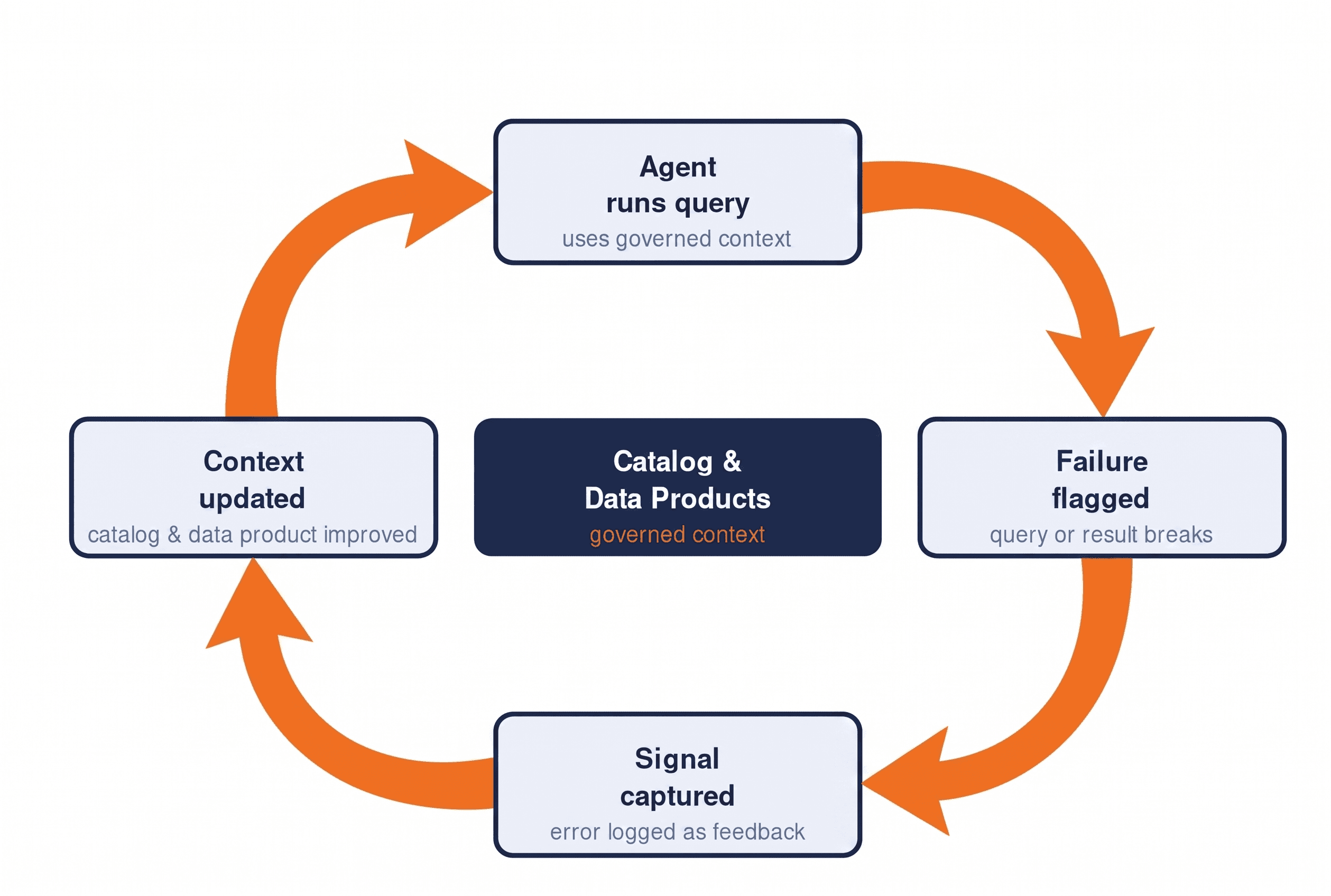
Most vendors operate on the two core layers only. They can assemble context and deliver it. But they have no mechanism above or below to keep it current.
Feedback loops sit above the core layers. When agents interact with users, the system captures what worked and what did not. User corrections, failed queries, ambiguous questions that exposed a definition gap: all of these become signals. Those signals are used to update the catalog and data products automatically. The context improves from use, without a human manually editing definitions.
This is not a theoretical capability. It is the mechanism that takes an agent from 60% accuracy to near-100% in production deployments, through structured evaluation cycles where failures are diagnosed, metadata is updated, and the agent is re-tested. Each cycle compounds accuracy. And critically, this works regardless of where the agent is built. The feedback loop improves the context, which improves every agent that consumes it, whether that agent runs on your platform or someone else's.
Data quality sits below the core layers. It continuously monitors the raw data underneath the catalog: freshness, completeness, conformance to business rules. When a table's data quality degrades, that signal propagates up to the catalog and the data products that depend on it, before any agent consumes the stale data. This is not a monitoring dashboard. It is a gate: data that fails quality checks is flagged before an agent builds an answer on top of it.
Together, these two mechanisms create something most context architectures lack: a system where the context improves from the top (through agent feedback) and is validated from the bottom (through data quality), continuously, without requiring a dedicated maintenance team.
Context in a vacuum is not enough. You have to build to learn what context is needed
There is a tempting simplification: treat the context layer as a standalone product. Build the catalog, assemble the data products, hand them to whatever agents need them, and call it done. This treats context as a deliverable. Ship it once, let agents consume it, move on.
The problem is that context assembled in isolation has no mechanism to improve. It captures what the business knew at the time it was written. It does not capture what agents discover when they actually try to use it. And agents discover a great deal: ambiguous definitions that only surface under real queries, edge cases where two metrics conflict, tables that are technically certified but practically unreliable for certain question types.
These discoveries are valuable. They represent the gap between what the business thinks its data means and what it actually means in practice. If those discoveries remain trapped within the agent interaction and never flow back into the context layer, the context never improves. It remains a static snapshot, accurate on the day it was written and degrading from that point forward.
Context that cannot learn from agents is a document. Context that improves from agent interactions is a system.
This is why the idea of a standalone context layer, one that is built independently and handed to agents as a finished product, does not survive contact with production. It assumes you can know in advance what context agents will need, how they will interpret it, and where it will break. You cannot. You discover those things by building agents, running them against real questions, watching them fail, and feeding the failures back into the context. The iteration is the product.
Agents require constant tuning. Evaluations require feedback loops. Every cycle of agent usage surfaces something the context did not anticipate, and the context has to absorb it. This is not a maintenance burden to be minimized. It is the mechanism by which the system gets smarter. Over time, this feedback accumulates into something deeper than individual corrections: patterns of user behavior, recurring failure modes, and team-specific edge cases that become institutional knowledge. This cumulative learning is what separates a system that fixes errors from a system that compounds.
And the context that needs to be governed is broader than most vendors acknowledge. Prompts themselves contain business logic: metric definitions, filter rules, output constraints. When prompts are authored outside the governed system, they become an ungoverned source of drift. When any piece of context changes, whether it lives in the catalog, the data product, or the prompt, the behavior of the agent changes. All of it can get stale. All of it needs to be kept current.
Maybe a standalone context layer will exist someday. But that is not the world enterprises operate in today. Today, the organizations making real progress are the ones building agents, encountering the friction, and using that friction to improve the context that feeds every agent across every platform. They are not waiting for a perfect layer. They are building the system that makes the layer work.
The question is not whether you need context. Everyone agrees you do. The question is whether your context can learn. If it cannot, it is not a layer. It is a snapshot.
Curious to learn how Alation can deliver improving context for accurate AI? Book a demo with us today.
Key takeaways
Context drift is the central unsolved problem in enterprise AI. AI agents need accurate business context: metric definitions, certified tables, governance policies, et cetera. But that context begins decaying the moment it ships. Architectures that cannot keep context current are maintenance operations, not AI capabilities.
Without automated context maintenance, you are staffing a headcount trap. Every AI use case deployed without a feedback mechanism requires human effort to stay accurate. At scale, the maintenance burden consumes the capacity needed to build the next use case. Organizations get stuck due to a lack of automation, not a lack of ambition.
Two mechanisms separate a living context layer from a static one. Feedback loops capture agent failures and corrections, then automatically update the catalog, improving context over time. Data quality monitoring validates raw data for freshness and conformance, flagging problems before any agent consumes them. Most vendors deliver neither.
Context assembled in isolation degrades from day one. Without agents testing it, a context layer only captures what the business thought its data meant when initially written. Real queries will surface the gaps. Those discoveries must flow back into the context, or the layer remains a snapshot from a past moment in time.
The distinction that matters: context as a document vs. context as a system. A document degrades over time. A system improves from use and compounds corrections into institutional knowledge. Enterprises making real progress are building the latter.
Prompts are context, too, and they drift. Metric definitions and filter rules in prompts are part of the context layer. When prompts live outside governed systems, they become an ungoverned source of drift. When context changes, agent behavior changes, and all of it must be kept current.
- Active Data Governance
- Data Culture
- Data Intelligence
- Digital Transformation
- Engineering
- Enterprise Data Catalog
- Alation AI Labs
- Data Products
- AI
I am a geek who is currently building a high growth sustainable business at Numbers Station AI and making the dream of driven decisions a reality for all enterprises. I actively tinker and contribute to fun side projects for myself and for Non Profit Organizations. I also spend time with founders guiding them through their product, connecting them to strategic customers / partners and also help them fund raise.
I enjoy sharing my learnings and experiences at tech talks and conferences. Sharing experiences helps me connect and varied experiences broadens my perspective.
Prior, I have started the Communication Mining business at UiPath and led the Reinfer acquisition. I have also built AI Platforms and Solutions at Salesforce (Metamind, acquired) and have optimized bike distribution in urban cities at Lyft (Motivate, acquired). Further, I have taught programming, mathematics, algorithms and business to collectively over 200 students.