


TL;DR
What it is: Alation Critical Lineage is a capability within Alation Critical Data Manager that traces any metric in a regulatory filing from report back to authoritative source in a single, version-controlled lineage graph.
What it solves: It closes the gaps automated scanning can't reach — spreadsheets feeding critical numbers, applications with no connector, and hops where the SME isn't available — by blending manual, placeholder, and automated lineage into one governed graph instead of separate business and technical diagrams that regulators increasingly question.
Who it's for and when: Built for governance, compliance, and data stewards addressing BCBS 239, OSFI Guideline E-21, APRA CPS 230 and CPG 235, ECB RDARR, and SEC reporting obligations. Generally available August 13, 2026 for Alation Cloud Service customers.
Critical Lineage gives governance and compliance teams a single, version-controlled lineage graph that traces any metric in a regulatory filing from report to source. Generally available through Critical Data Manager, it closes the gaps that automated scanning can't reach: spreadsheets that feed critical numbers, applications with no connector, and lineage hops where the subject-matter expert isn't available. Where other tools stop at the automated perimeter, Critical Lineage blends manual, placeholder, and automated lineage into one governed graph. For organizations that need to answer an auditor's question about how a number was calculated, the trace is now complete.
Every gap in the lineage chain is an audit risk
Automated lineage has come a long way. Modern platforms can scan connected systems and trace data flows across databases, warehouses, and BI tools. But every organization has gaps in that chain: spreadsheets that feed critical numbers, applications too old or too niche to justify a connector, and systems where a steward knows data flows through but can't resolve the exact mapping because the subject-matter expert isn't available. Indeed, such gaps are nearly universal: Of the 31 global systemically important banks the Basel Committee assessed, only two were fully compliant with all the BCBS 239 principles, and supervisors specifically noted that several banks still lacked a common taxonomy and complete data lineage.1
Each gap breaks the trace. When an auditor picks a random metric in a regulatory filing and asks "how was this calculated?", a broken chain means the organization can't answer with confidence. The workarounds are familiar: virtual data sources, manual lineage templates, API scripting, and hours of effort for a single node in the graph.
Regulators are also increasingly questioning hand-drawn business lineage diagrams because they aren't tied to any automated source of truth and go stale immediately. For example, the European Central Bank (ECB)'s RDARR Guide expects complete, up-to-date lineage at the data-attribute level, tracing from data capture through extraction, transformation and loading — and requires manual workarounds to be documented, controlled, and migrated over time.3
Separate lineage diagrams are what regulators are questioning
Fragmentation is the fundamental problem with lineage evidence today. Organizations that maintain separate business lineage diagrams and technical lineage views are maintaining two versions of the truth: one drawn by hand, the other scanned by automation. They rarely agree, and regulators have started questioning the hand-drawn version because it isn't connected to any automated source of truth.
Critical Lineage closes those gaps. Governance teams can register spreadsheets as governed catalog objects, capture applications that don't have connectors, and create placeholder lineage when subject-matter experts aren't available. Manual, placeholder, and automated lineage share the same graph rather than living in separate views that need to be reconciled. Provenance tracking makes the distinction between how each node was sourced transparent rather than hidden.
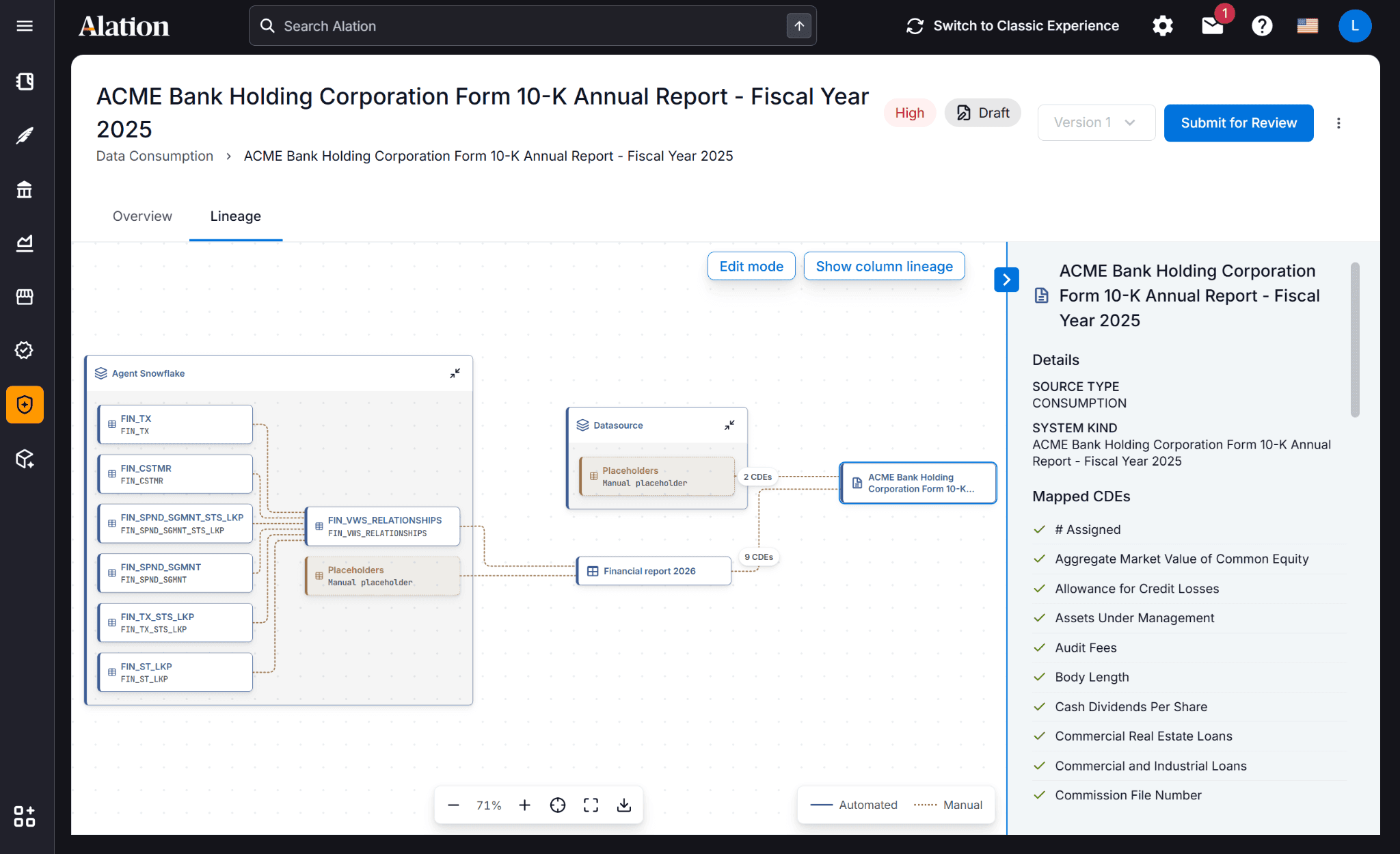
There's a practical efficiency case as well. Hand-drawn business lineage is out of date the moment you finish drawing it. Critical Lineage lets you do it once: build the lineage, certify it, and compare the current state against that snapshot when the next attestation is due. One effort maintained continuously instead of being rebuilt from zero every year.
Governed lineage from report to source, built for stewards
For stewards and governance leaders curious to learn about the process, here’s how it works:
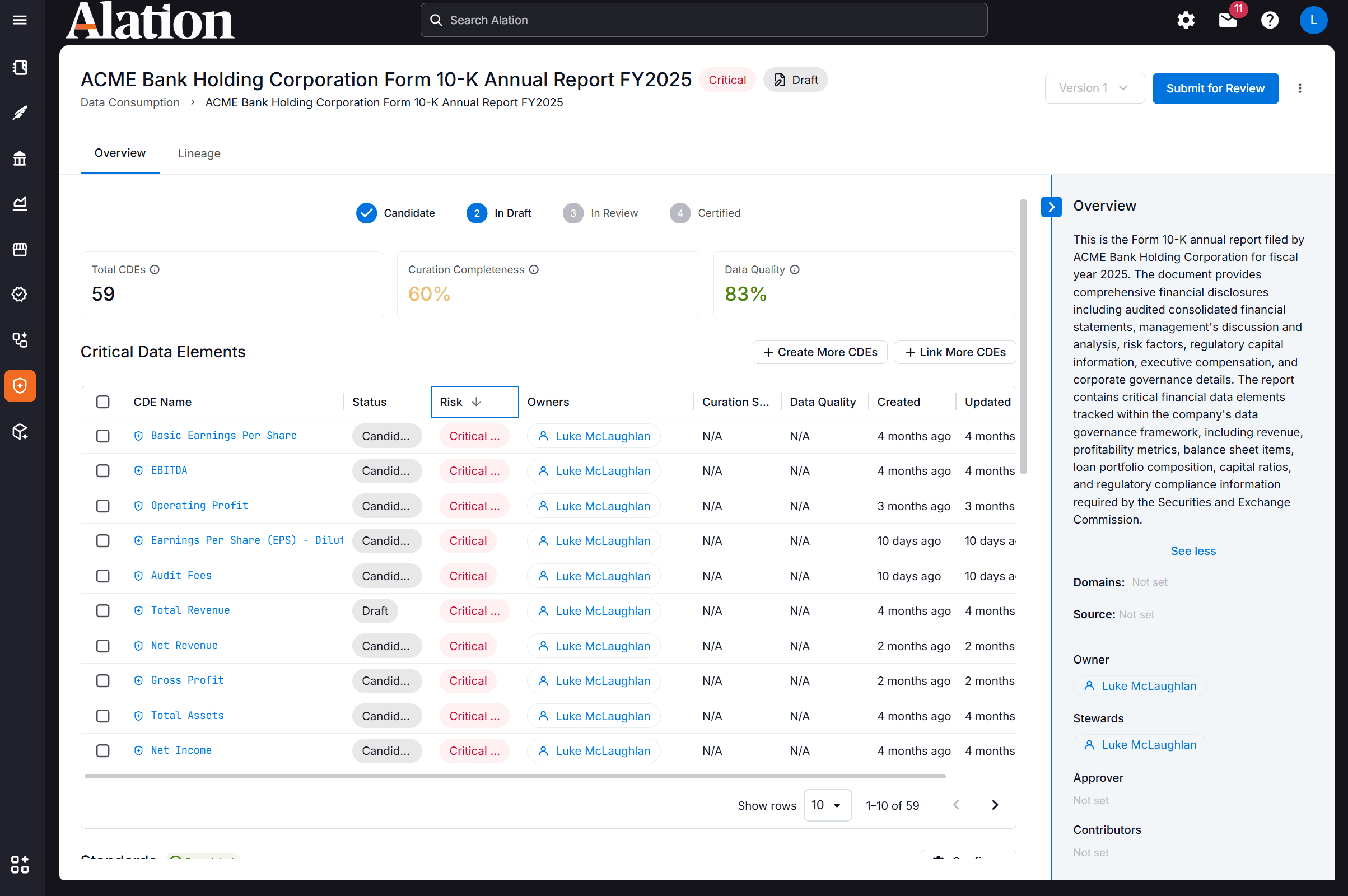
Spreadsheet registration turns a governance gap into a governed object. A steward specifies the platform, maps critical data, and the spreadsheet becomes part of the lineage graph.
The Application Register captures what connectors can't. Every connected data source in the catalog maps to an application entry. Unconnected systems, including legacy applications, are registered alongside them. The result is a system-level map of how data flows across the entire data landscape.
Placeholder lineage keeps work moving. When a subject-matter expert isn't available to resolve an exact mapping, a steward creates a placeholder node and continues building the trace. The placeholder can be resolved later or remain as a documented gap. Either way, the lineage is complete and defensible.
Version-controlled snapshots hold up over time. At certification, Critical Lineage captures a snapshot. Organizations can compare the current state against that point-in-time record to track migrations, decommissions, and structural changes.
"Alation's automated lineage gives you the technical truth, fast. But audits run on more than pipelines," said GT Volpe, Head of Product at Alation. "We let the business extend that foundation with the governed, offline artifacts every regulated process depends on — spreadsheets, models, manual controls — in one harmonized, audit-ready graph."
Alation customers across financial services, gaming, media, technology, and retail have independently asked for end-to-end lineage for critical reports, driven by new regulatory expectations and the limits of their current lineage tools. For example, the recently introduced OSFI Guideline E-21 (section §4.7 requires, among other things, that financial organizations collect, aggregate, trace lineage, and report critical data across the enterprise). BCBS 239, APRA CPS 230 and CPG 235, and SEC reporting obligations all expect traceable end-to-end lineage for regulated data. Indeed, supervisors themselves report that end-to-end traceability is where banks are struggling — legacy systems, distributed data estates, and the dynamic nature of lineage all complicate it.2
As agents increasingly consume lineage evidence to make decisions, the lineage graph itself becomes a governed input to AI. Critical Lineage ensures that input is complete, version-controlled, and defensible, so an agent grounded in your lineage is grounded in the truth. That's why Critical Lineage is built into AIOS, Alation's open, governed, self-improving intelligence operating system.
Common questions about Critical Lineage
What is Critical Lineage? Critical Lineage is a capability within Alation Critical Data Manager that provides end-to-end lineage for regulatory filings and critical reports. It blends automated technical lineage with structured manual lineage and placeholder lineage in one version-controlled graph, purpose-built for governance and audit evidence.
Does Critical Lineage replace existing automated lineage? No. Critical Lineage extends and fills gaps around automated lineage. Spreadsheets, unconnected applications, and placeholder nodes complement the automated graph rather than replacing it.
Which regulatory frameworks does Critical Lineage help address? Critical Lineage supports any framework that requires traceable end-to-end lineage for regulated data. Customers are using it to address BCBS 239 (global banking), OSFI Guideline E-21 (Canadian financial services), APRA CPS 230 and CPG 235 (Australian financial services), ECB RDARR expectations (EU banking supervision), and SEC reporting requirements (U.S. public companies). If your regulator asks you to trace a reported number back to its authoritative source, Critical Lineage applies.
Is placeholder lineage acceptable as audit evidence? A placeholder provides an accountable record of a known gap: what's missing, who owns resolving it, when it was raised, and what the resolution path is. That is a defensible position in a review, while an undocumented break in the chain is not. As gaps resolve, the placeholder is replaced by the verified mapping and the change is captured in the version history.
How does the steward interface work? Critical Lineage includes a guided, chat-based interface for stewards to build lineage step by step. The v1 interface is deliberately AI-free: regulated customers can adopt it without triggering internal AI approval processes that typically add three or more months to deployment timelines. The architecture is designed so AI capabilities layer into the same interface over time, but organizations can start building governed lineage today.
Is Critical Lineage available today? Critical Lineage reaches general availability on August 13, 2026, for Alation Cloud Service customers. It's part of Alation Critical Data Manager and requires Alation Consumption Units (ACUs). Customers can use their existing ACU allocation to get started.
Critical Lineage is available now
Critical Lineage is generally available on August 13, 2026, for all Alation Cloud Service customers as part of Alation Critical Data Manager.
To see Critical Lineage in action, request a demo or contact your Alation account team.
Sources & notes
Every external claim on this page is independently verifiable. The public sources are listed here.
Of 31 global systemically important banks assessed, only two were fully compliant with all BCBS 239 principles; no single principle was fully implemented across all banks. Supervisors noted several banks still lacked a common taxonomy and complete data lineage. — Basel Committee on Banking Supervision, "Progress in adopting the Principles for effective risk data aggregation and risk reporting,"
November 2023, pp. 1, 5 and 14.
Legacy systems, distributed data estates and the dynamic nature of data lineage complicate end-to-end traceability; identifying and maintaining lineage is resource-intensive.
— Basel Committee on Banking Supervision,"Implementation of the Principles for effective risk data aggregation and risk reporting (BCBS 239 Principles)," Newsletter, 6 January 2026. (The Committee states this newsletter is informational and does not constitute new supervisory guidance or expectations.)
Minimum supervisory expectation of complete and up-to-date data lineage at data-attribute level, from data capture through extraction, transformation and loading, for in-scope key risk indicators and critical data elements. — European Central Bank, "Guide on effective risk data aggregation and risk reporting," May 2024, §3.4(3).
Manual workarounds within scope are expected to be documented and subject to adequate control mechanisms until material data preparation and reporting steps are absorbed into a controlled, audit-trailed IT environment — European Central Bank, "Guide on effective risk data aggregation and risk reporting," May 2024, §3.5(5).
Balancing manual and automated processes is resource-intensive but contributes to effective risk data aggregation; risk-based compensating controls may be applied where there are known shortcomings in data aggregation processes. — Basel Committee on Banking Supervision, Newsletter, 6 January 2026
- Active Data Governance
- Data Governance
- Data Quality
- Digital Transformation
- Modern Data Stack
- Alation News
Luke McLaughlan is a Senior Product Manager at Alation, where he leads product for Critical Data Manager — automated governance for the data behind an organisation's most critical reports. He has spent the last decade on the gap between what governance tools promise and what the executives accountable for data actually need from them, first as a technology strategy consultant in regulated industries, then as a Solutions Architect at Salesforce and Alation. His work sits at the intersection of regulatory accountability, AI-era data risk, and the realities of running a governance program at scale.
Keep reading
More from the data desk