SOLUTION • GOVERNED AI/BI
Getting an answer is easy now.
Defending it is the hard part.
Every team can ask its data a question, through Genie, Cortex, a Copilot, or an app built over a weekend, and get a number in seconds. "Active customer" still means one thing in Snowflake, another in Databricks, and something else in Power BI. Disagreement used to surface in a meeting. Now agents answer alone. Every platform can govern the data it holds, but none can arbitrate between them, so each new warehouse, BI tool, and agent adds another definition to reconcile.
WHAT ALATION CAN DO FOR YOU
One foundation, or one more answer to reconcile.
The Alation Intelligence Operating System (AIOS) masters the definition once, above the platforms, then activates it back into the tools your teams already query. The answer, the agent, and the insight all resolve to the same source, the access controls follow, and you can show where every number came from.
- SEMANTIC MODEL MASTERING
- DATA PRODUCT MARKETPLACE
- LINEAGE
- DATA QUALITY
01
Master once, activate everywhere.
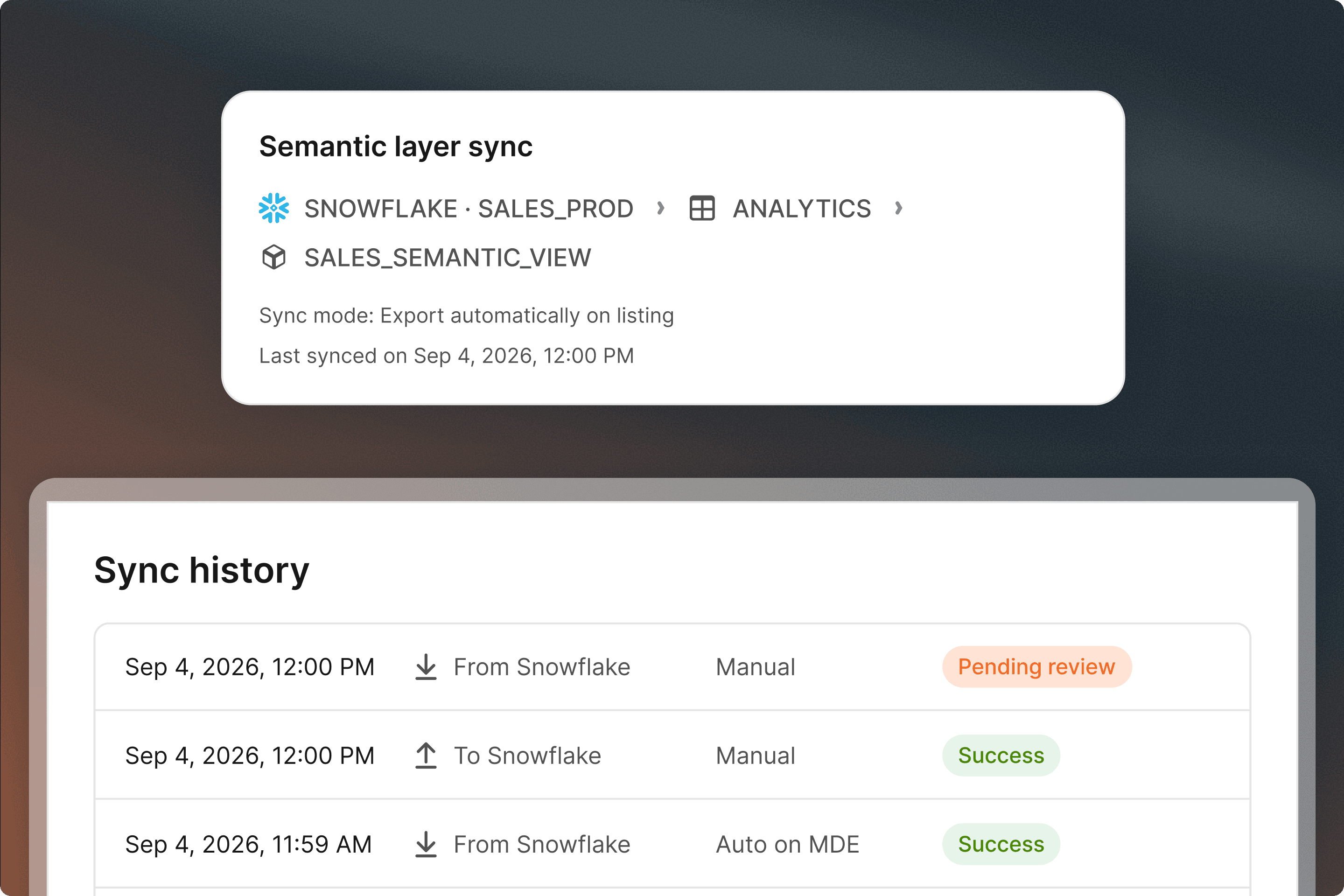
Definitions, dimensions, and rules live in one place, grounded in the catalog's column-level lineage, continuous quality checks and policy. Semantic Model Mastering syncs each governed definition back into Snowflake and Databricks, so an agent built in either resolves to your definition, not the platform's local one. Certified data products carry provenance, quality and a named owner with them, so the trust signals arrive attached to the number. When the business changes what "active customer" means, it changes once and every platform follows. A deprecated source cannot quietly end up in a board deck.
- ONTOLOGIES
- AGENT STUDIO
- GOVERNED COLLECTIONS
02
Every agent inherits it, and proves it before production.
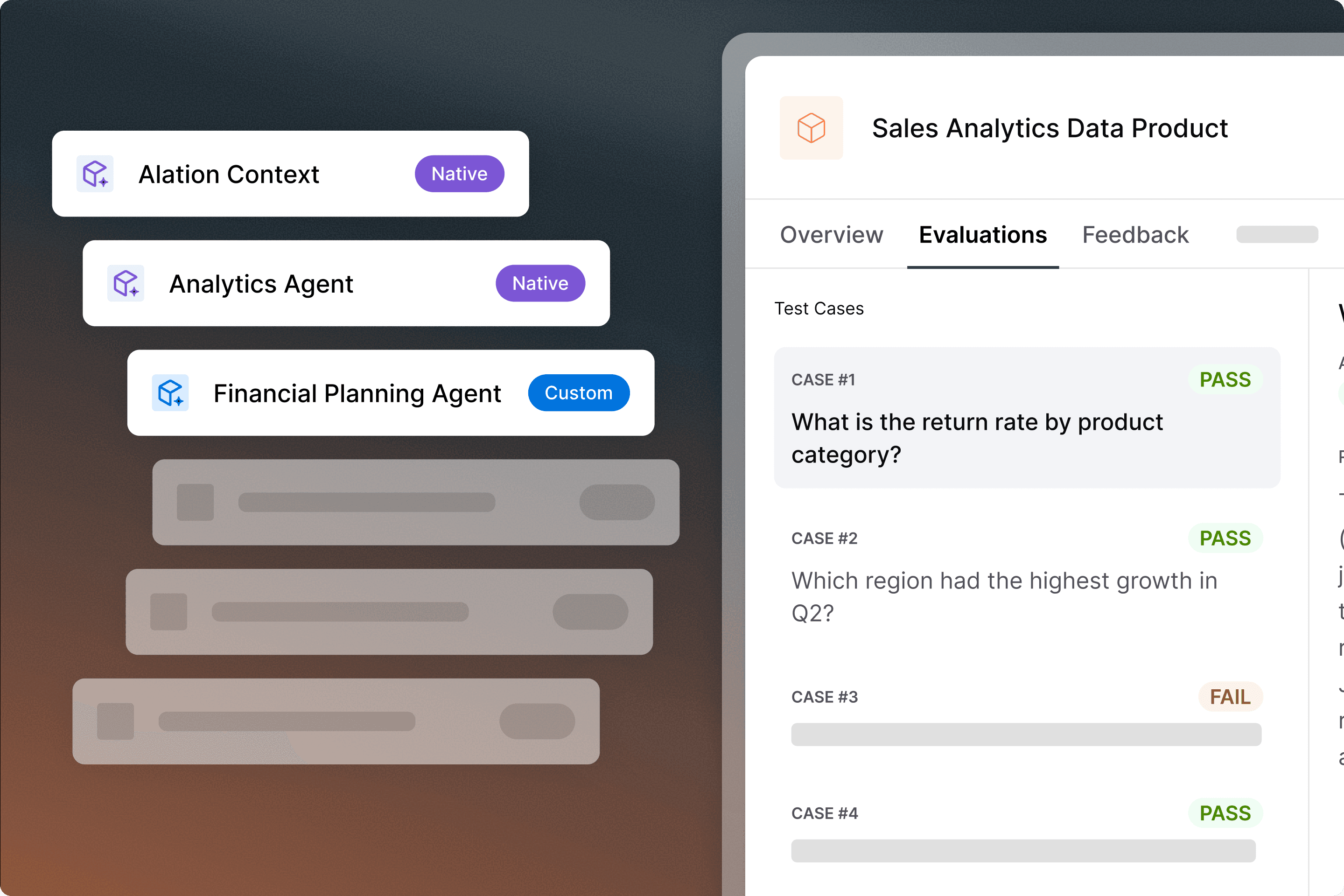
An agent that can query your warehouse still doesn't know that a customer has accounts, or which definition of active is yours. Ontologies tell it how your business works, and agents reason across warehouses, BI tools, applications, and the documents in Governed Collections. Build no-code with native agents, custom ones in Agent Studio, or bring agents built elsewhere over MCP or REST. Evaluations against your own Q&A pairs, judged to your accuracy bar, clear an agent before a user sees it. Corrections route back to the master, so a wrong answer fixes the source, not one tool.
- AI GOVERNANCE
- CRITICAL DATA MANAGER
03
The policy follows it.
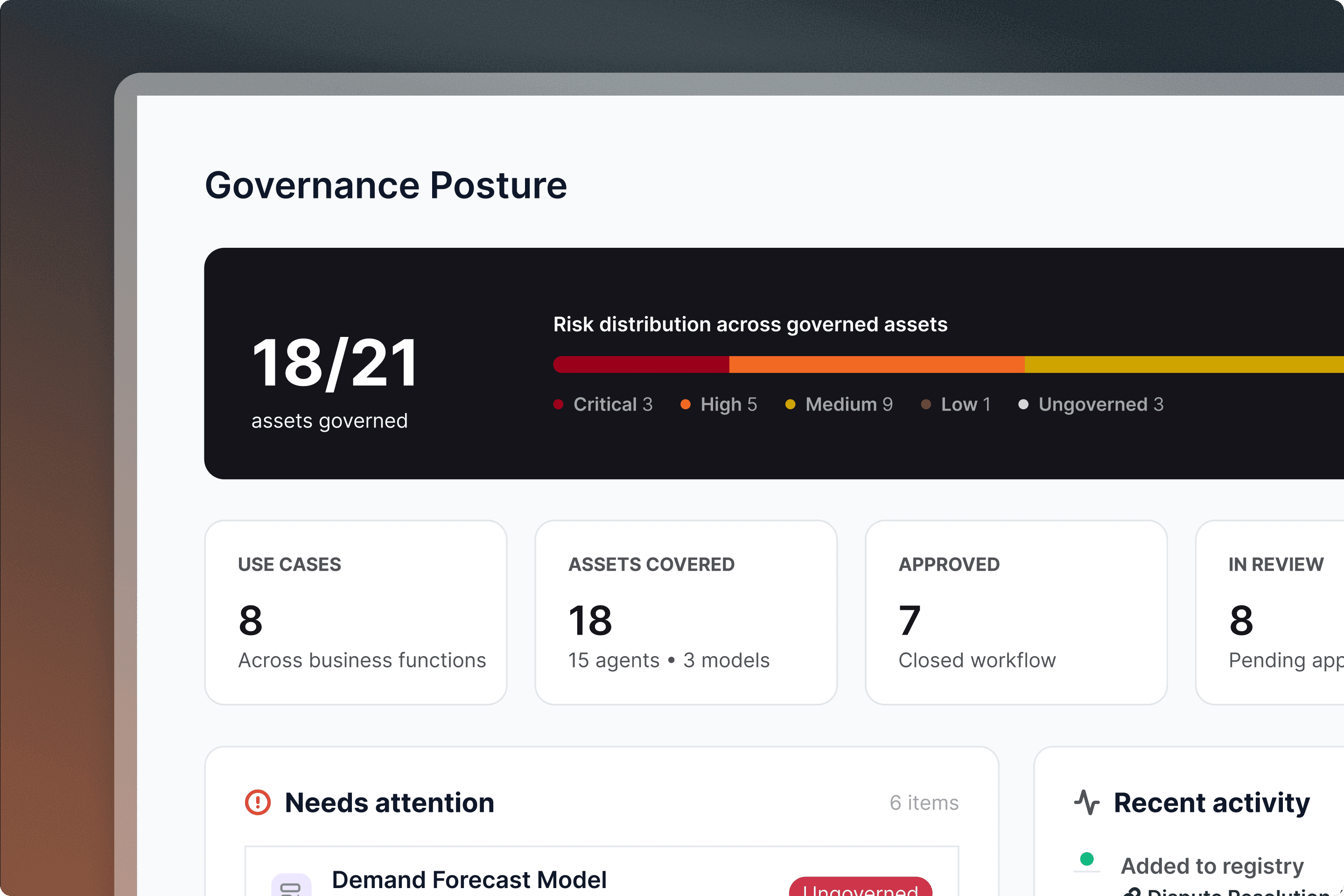
Access and masking rules attach to the definition, not the tool, so they follow it into every source and every agent that reads it, wherever that agent was built. The same rule applies whether a person or an agent is asking. Every agent and model goes on the register: AI Governance maps each one to the regulations that apply, generates model cards, and routes approvals. Critical Data Manager identifies the elements where a wrong number does the most damage, maps them automatically, and monitors them continuously with audit-ready evidence. Posture is live, not assembled the week the auditor calls.
- INTELLIGENT FEEDS
- CONSOLE
04
The weekly report delivers it, corrections improve it.
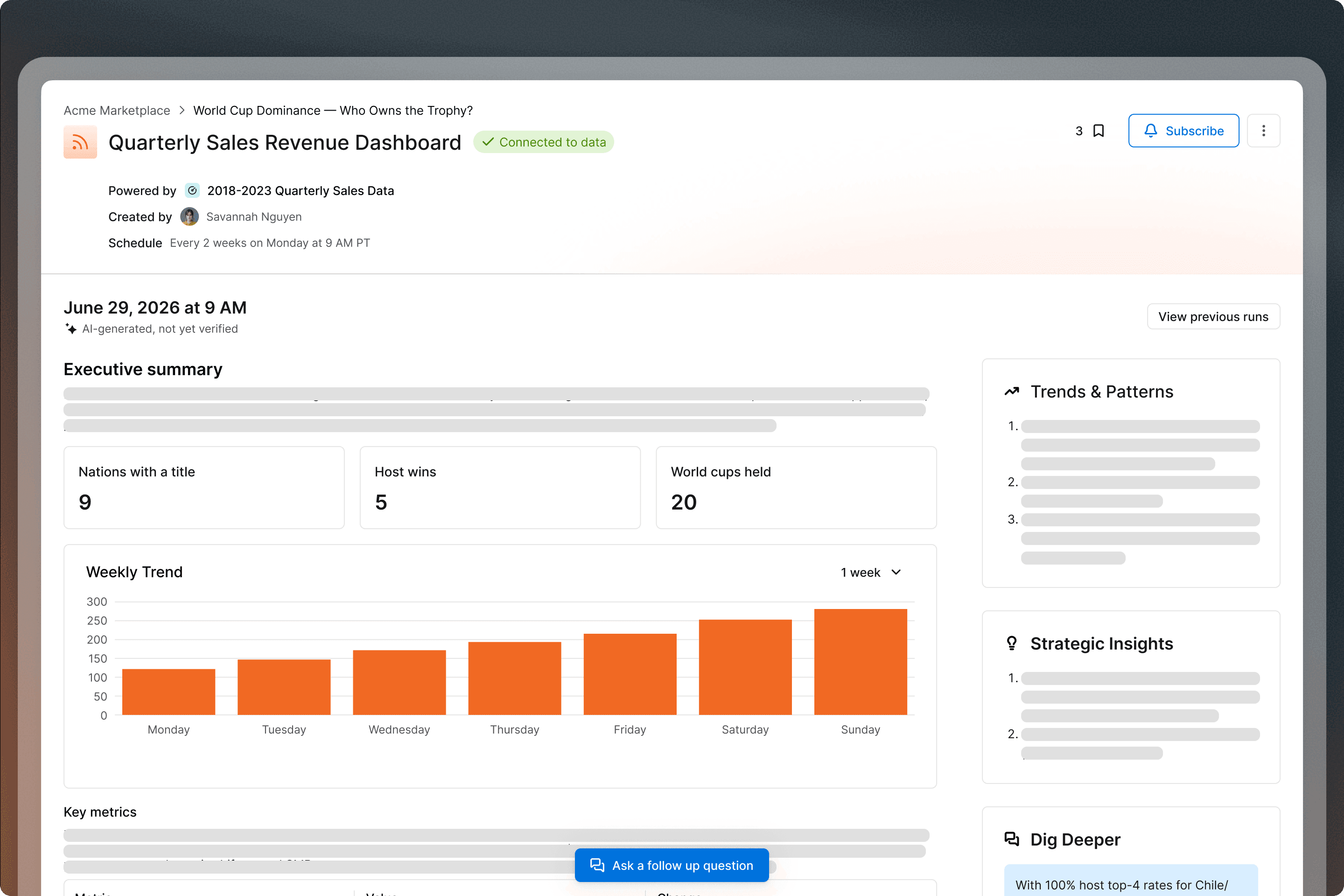
Self-service assumes someone has time to look. Intelligent Feeds run recurring analyses on schedule and deliver them where people work as a briefing with metrics, visuals and narrative. Feeds are built on certified data products, so every figure in the briefing carries the same provenance as the definition behind it. Ask a follow-up in Console and it routes you to the capability that answers it. Share across a team, restrict where needed, and everyone operates from the same numbers.
Where This Gets You
Defend every answer. Sharpen the next.
One master definition, activated everywhere. Agents inherit it, evaluations prove it, briefings trace every figure to an owner. Corrections return to the source, so the estate gets more accurate with use.
When the answers have to be right, we make sure they are. From the first data catalog to the operating system for enterprise AI, the job never changed. When enterprises absolutely have to trust the data underneath their most critical processes and decisions, we help them get it right.
What is governed AI/BI?
Governed AI/BI means every answer, agent, and report resolves to the same definition of a business metric, no matter which platform produced it. In most enterprises the same term is defined separately in each warehouse, BI tool, and agent, so a question asked three ways returns three numbers and someone spends the week reconciling them. AIOS masters the definition once against the catalog's lineage, quality, and policy, then activates it back into every platform that consumes it. Governance at that layer covers four things: one definition, full traceability, consistent access control, and accuracy you can measure.
How does Alation give every AI agent the same definition of a metric?
The definition is mastered once in Alation and then pushed down into the platforms where the agents actually run. Semantic Model Mastering writes the governed version into the semantic layers of Snowflake and Databricks, so a Genie or a Cortex agent reads your definition as though it were local. Nothing depends on whoever built the agent having checked the catalog first. Because the master is the upstream copy, an edit re-syncs the platforms underneath it, and agents that went live months ago pick up the new logic without being rebuilt.
How does governed AI/BI make data analysts more effective?
Governed AI/BI makes an analyst's judgment reusable. The definitions, dimensions, and rules an analyst sets get inherited by every agent, dashboard, and briefing across the estate, so a decision made once holds everywhere it applies and doesn't get re-argued tool by tool. Recurring analyses that used to be rebuilt by hand each cycle arrive on schedule through Intelligent Feeds, which puts analyst time back onto the definitions, the accuracy bar, and the exceptions. Accountability stays with people: each certified data product has a named owner, and when an analyst corrects an answer the fix lands on the master definition, so it holds the next time anyone asks.
Can you trace an AI-generated number back to its source?
Yes. Any figure an agent or a briefing returns resolves to a governed definition, and column-level lineage traces it through every transformation back to the system it originated in. The owner's name and the most recent quality result travel with the figure, so nobody has to open a second tool to decide whether to trust it. The manual alternative is an assembly project: pulling query history, screenshots, and chat threads to reconstruct where a number came from, usually weeks after the decision was made. One mastered definition means there is one answer to that question.
How do you get an AI agent into production?
The blocker is usually accuracy nobody can measure. Evaluations run against your own Q&A pairs with custom judges, so an agent has to clear your accuracy bar before a user ever sees it. After launch, the feedback users give becomes a correction to the master definition, which raises the quality of every agent reading it. Agents can be assembled without code, built to spec in Agent Studio, or brought in from outside and governed on the same terms; MCP and REST endpoints drop any of them into the apps and workflows people already use.
Start a Conversation
Speak with an Alation Expert
A 30-minute call to discuss your priorities, challenges, and goals.
Then we’ll show you how the Alation Intelligence Operating System ensures apps and agents act on current, quality, and compliant data.
Enterprises absolutely have to trust the data underneath their most critical process and decisions. We will help you get it right.