PRODUCT · ALATION DATA QUALITY
Quality checks grounded in meaning, not statistics
Alation Data Quality detects issues before they compound. Intelligent agents propose quality rules grounded in your catalog's metadata, lineage, and usage patterns rather than statistical guesses. Context isn't bolted on as an afterthought. It's inherited from the platform you already run.
WHY IT MATTERS
Monitoring catches the symptom. Context reveals the cause.
Generic quality checks scale your alert count, not the insight. Static rules quickly go stale, and coverage falls behind because manually authoring rules requires institutional knowledge teams rarely have time to encode.
Agents write it
Deploy quality coverage shaped by meaning. DQ Pilot scans your catalog and recommends what to monitor and what to skip, to drafting quality monitors grounded in metadata, lineage, usage patterns, and governance context. Stewards simply review and approve the suggested rules. At the same time, Coverage Mode deploys volume, freshness, and schema drift monitoring across entire data environments. No rule authoring. No config.
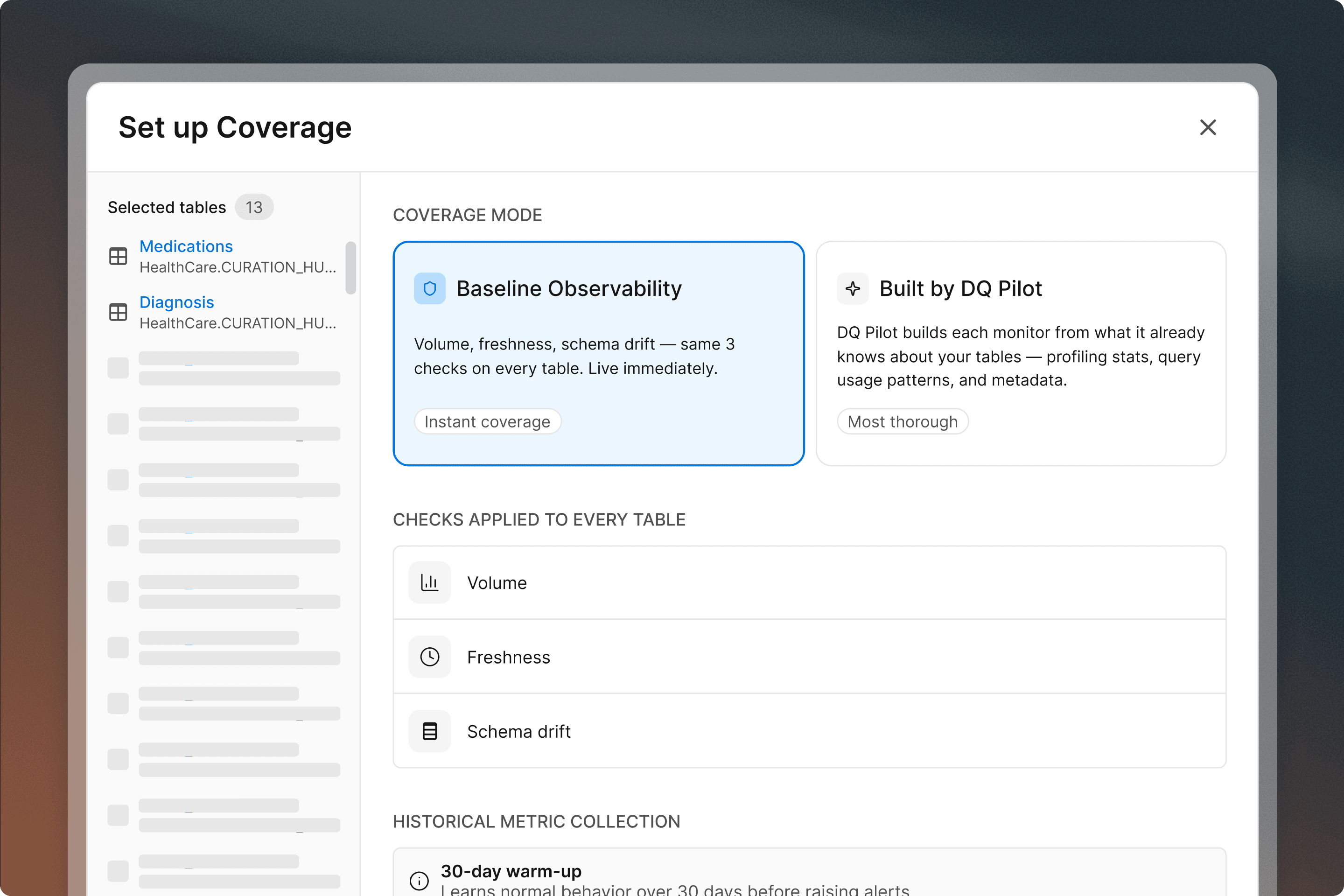
Meaning built in
Replace statistical guesses with true business semantics. Agents draft rules that reflect how your business actually uses data. For instance, a rule applied to a status column recognizes an order status with five valid values linked directly to an executive report. These context-grounded rules eliminate the noise that makes teams ignore DQ tools. When an alert fires, it matters. And it arrives with enough context for teams to act immediately. Alation monitors quality across every connected source in your stack, rather than confining oversight to a single platform.
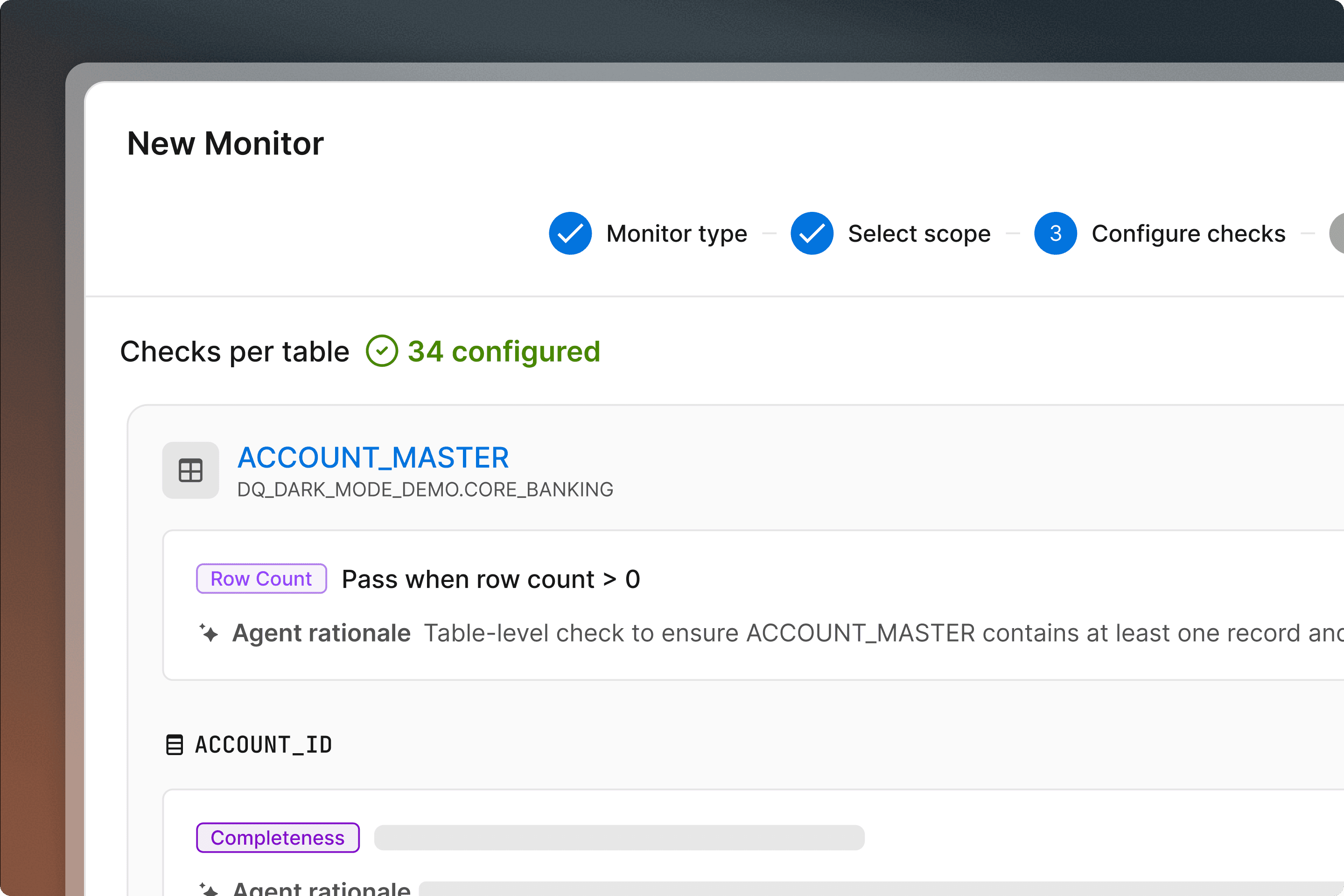
Smarter each cycle
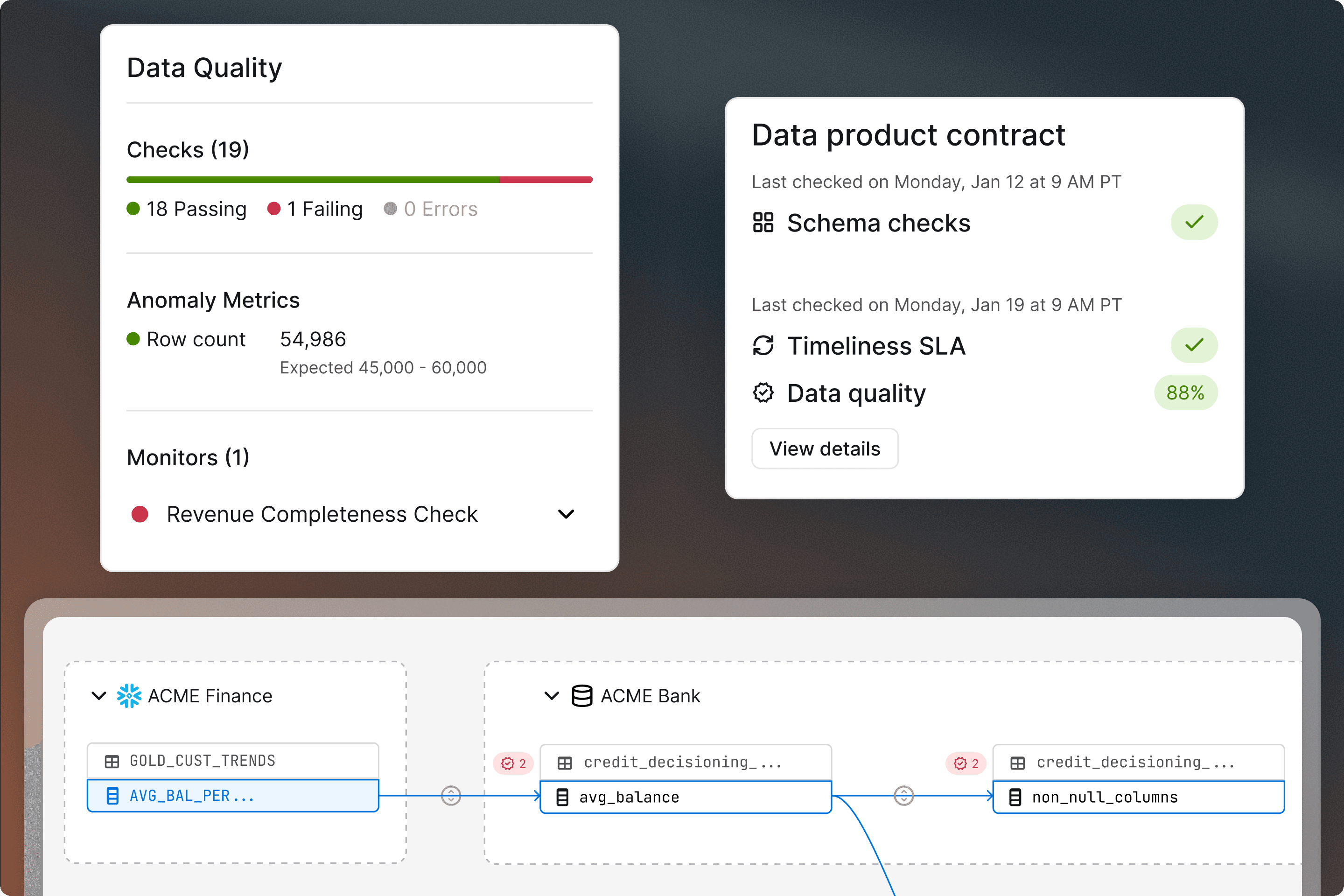
Every result enriches the metadata that agents use to refine future rules, deepening the platform's understanding over time. As data patterns evolve, agents proactively recommend rule updates, adjust thresholds, propose new checks, and flag stale rules for review. Quality scores flow into lineage views, data product pages, curation workflows, and CDM mappings. When a check fails, trust signals update platform-wide, stopping bad data before it reaches downstream reports.
DATA QUALITY FAQ
What you need to know about
Alation Data Quality
Q1 —
What is Alation Data Quality?
Alation Data Quality drafts semantic rules grounded in catalog metadata, lineage, and usage patterns. A rule on a status column knows it is an order status with five valid values tied to a downstream report. One quality layer spans every connected source. Enforcement is continuous. Context is inherited, not configured. Data quality monitoring as a discipline detects problems in the data your business relies on. Most tools use statistical anomaly detection, which scales alerts but not insight.
Q2 —
How does Alation Data Quality write rules automatically?
Here’s how it works: DQ Pilot scans your catalog and drafts monitors grounded in metadata, usage patterns, and governance context. A rule on a status column recognizes it is an order status with five valid values tied to a downstream executive report. Coverage Mode deploys volume, freshness, and schema drift monitoring across entire connected data stacks with no manual rule authoring and no configuration. DQ Pilot also recommends what data to monitor and what to skip, based on downstream usage and lineage, so coverage is shaped by meaning and actual usage.
Q3 —
How is Alation Data Quality different from standalone monitoring tools?
Standalone tools detect statistical anomalies but lack the catalog context to tell you what that anomaly means, or whether it’s even worth addressing. Alation DQ inherits metadata, lineage, usage, ownership, and governance policies from the catalog, so that rules are semantic, not just statistical. Alerts carry enough context for data engineers to remediate the issues immediately and for downstream users to see what’s impacted. With Alation, data quality is monitored across every connected source rather than one platform. The result is fewer alerts, more signal, and coverage that spans your full data estate.
Q4 —
Does Alation Data Quality improve over time?
Yes. Every check result enriches the metadata that agents use to draft rules. As data patterns shift, agents recommend rule updates based on accumulated check history. Thresholds adjust. New checks are proposed. Stale rules are flagged for review. Quality scores appear in lineage views, data product pages, curation workflows, and CDM mappings. A failed check does not just alert the DQ team. It updates trust signals across the platform. Monitoring that compounds rather than decays.
Start a Conversation
Speak with an Alation Expert
A 30-minute call to discuss your priorities, challenges, and goals.
Then we’ll show you how the Alation Intelligence Operating System ensures apps and agents act on current, quality, and compliant data.
Enterprises absolutely have to trust the data underneath their most critical process and decisions. We will help you get it right.