PRODUCT · CURATION AUTOMATION
Declare the standard.
Agents enforce it.
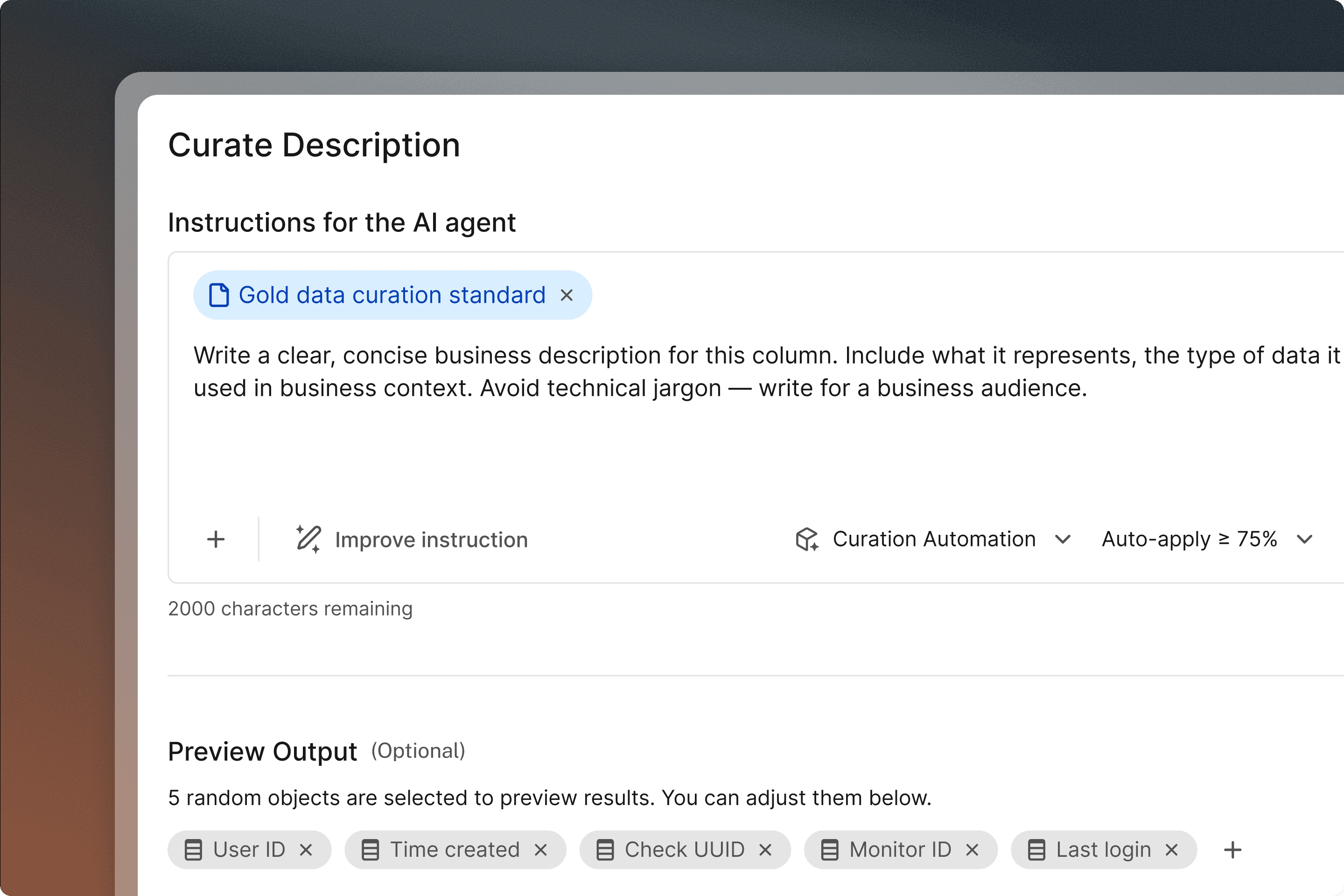
An AI that writes a description for every table just moves your bottleneck from writing to reviewing. Curation Automation works the other way: You state the standard once in plain language (what a good description contains, what an asset needs before certification, which fields a domain owner must fill), and agents apply it across the catalog, drawing on lineage, usage, and the glossary your teams already maintain rather than guessing from column names.
WHY IT MATTERS
Your agents are only as good as your metadata
Manual curation scales linearly. Data growth is exponential. Every cleanup decays within months. Agents can't run on metadata that is a quarter out of date.
One rule, at scale
With Alation, define rules in natural language and target them across all sources, schemas, and tables simultaneously, turning weeks of manual curation into a process that runs in minutes. Because every rule is grounded in catalog metadata (such as object names, hierarchy, DDL, joins, domains, and query patterns), the agent produces the same output a human steward would. And with Governed Collections, that grounding extends to governed documents from SharePoint, Confluence, and S3 — so rules can draw on the policies and procedures that define your data, not only the structured metadata around it. Suggestions must meet a 75% confidence threshold, giving stewards full ability to preview and tune recommendations before release.
Always improving
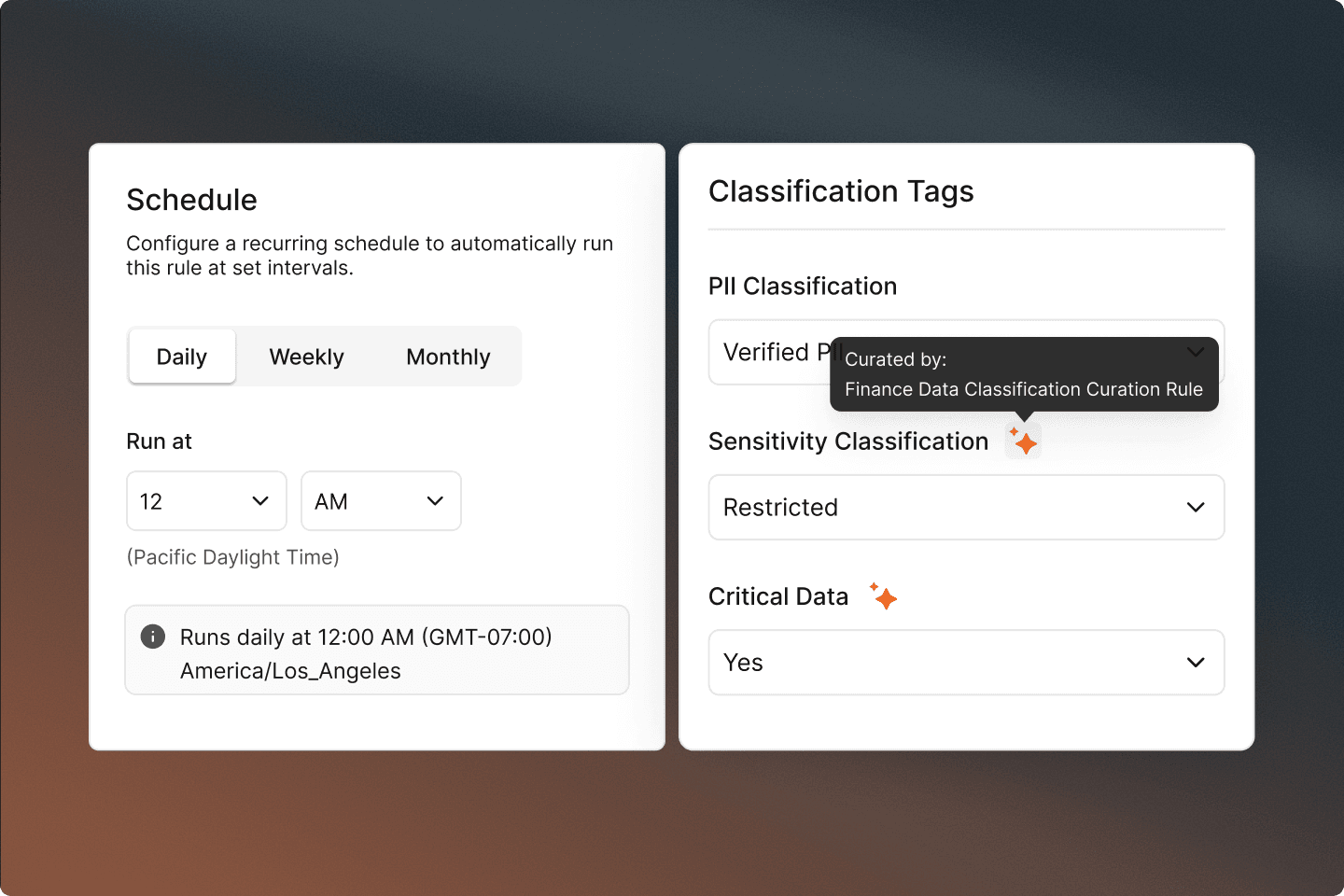
Governance rules rerun as your data changes, ensuring new assets, schemas, and sources are curated automatically. No manual triggers or quality decay. Every cycle sharpens the next: curation enriches the catalog, and a richer catalog improves the next recommendation. Accuracy compounds rather than degrades, meaning the metadata your stewards accepted last quarter makes this quarter's output better.
Curation FAQ
What you need to know about
Curation Automation
Q1 —
What is Alation Curation Automation?
Metadata curation is the process of documenting what data means, who owns it, and whether it can be trusted. At enterprise scale, manual curation never finishes. Alation Curation Automation encodes standards in natural language and deploys agents to enforce them across the catalog, grounded in lineage, quality signals, and organizational meaning. Every suggestion is previewable. Nothing commits without a quality gate. The backlog that governance teams carry for years is addressed in weeks.
Q2 —
How is Curation Automation different from AI-generated descriptions?
Bolt-on AI generates descriptions without your catalog's context, producing volume without quality. Curation Automation is native to AIOS. Every edit draws on object names, hierarchy, DDL, joins, domains, query patterns, and organizational meaning. The result is metadata your stewards actually accept, not suggestions they override. A 75% confidence threshold, preview and tune workflow, and regeneration options mean the system earns trust before it acts. Volume is the easy part. Quality is the hard part.
Q3 —
Does Curation Automation keep metadata current over time?
Yes. Rules rerun as data changes. New assets, schemas, and sources are curated automatically. There are no manual triggers and no scheduled catch-ups. Each cycle sharpens the next: curation enriches the catalog, and a richer catalog improves the next recommendation. Accuracy compounds rather than degrades. Manual curation decays within months because the data keeps moving. Curation Automation keeps pace because it reruns continuously, and every run starts with better context than the one before it.
Q4 —
How does Curation Automation support compliance and audits?
Every edit is traceable: what changed, which rule triggered it, who ran it. Compliance evidence is produced by default, not assembled the week of the audit. Fill-rate and compliance reporting replaces anecdotal governance metrics with provable outcomes tied to declared standards. Governance teams shift from measuring activity to proving the standard is being met. For regulated environments, this is the difference between hoping standards are enforced and being able to show an auditor that they are.
Start a Conversation
Speak with an Alation Expert
A 30-minute call to discuss your priorities, challenges, and goals.
Then we’ll show you how the Alation Intelligence Operating System ensures apps and agents act on current, quality, and compliant data.
Enterprises absolutely have to trust the data underneath their most critical process and decisions. We will help you get it right.