Alation Ontologies
Your business rules, in a model agents can read.
An Alation Ontology is a deterministic model of how your business actually works, including the entities that matter, how they relate, and the constraints that govern them. It gives agents the meaning and rules behind your data, so they reason from fact instead of inference. Every concept binds to the real tables and columns that hold the data.
WHY IT MATTERS
Your agents are guessing at the rules.
An agent sounds just as confident when it's wrong as when it's right, and no risk function signs off on "sometimes right." And when an agent acts on a guess, the mistake doesn't stay in a chat window. It lands in a real system.
Grounded model
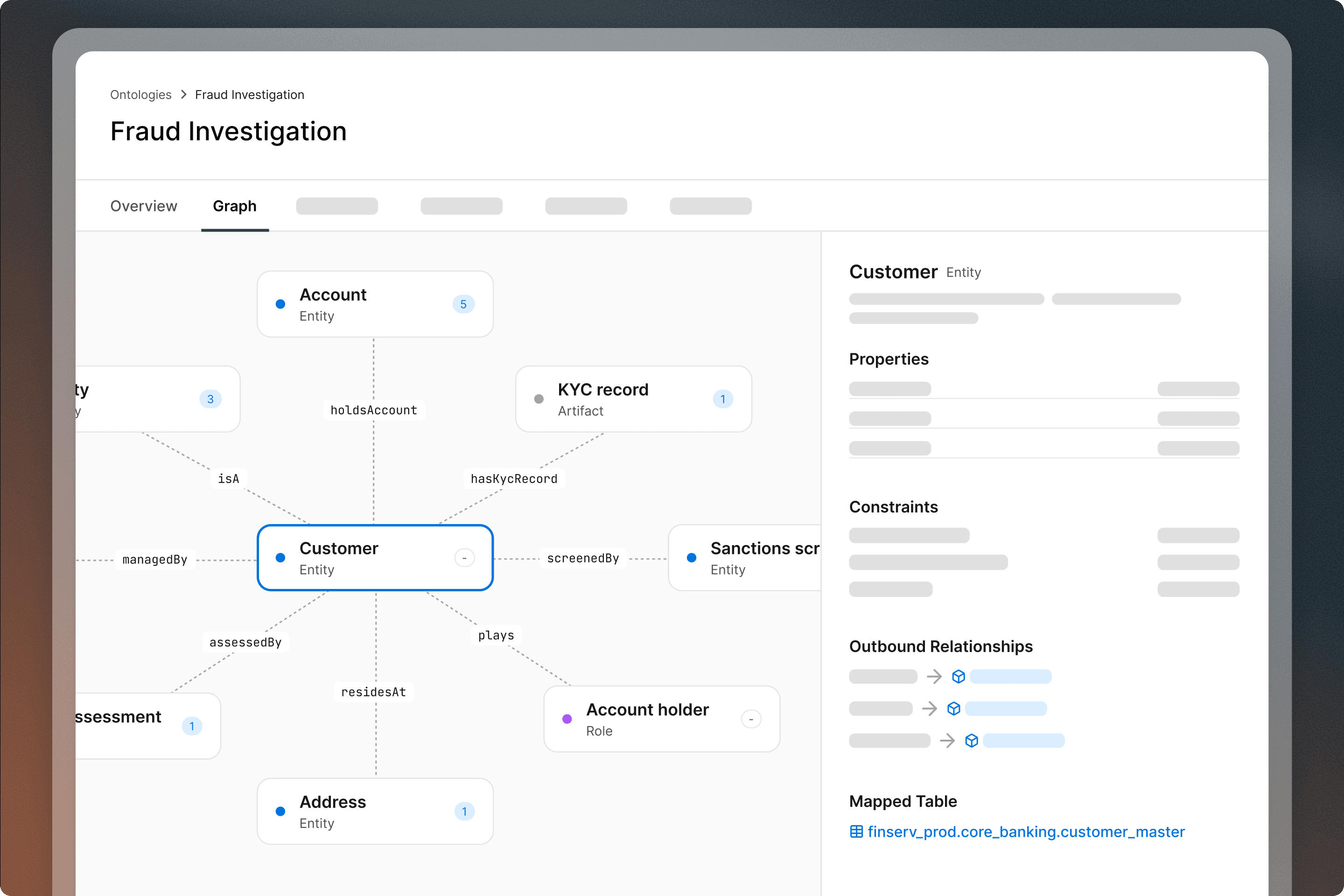
Alation already models your data from the bottom up, through query logs, lineage, and usage, and governs it from the top down through workflows, templates, and standards. An ontology adds a typed layer of business concepts on top of that foundation.
Here’s an example: A Customer holds Accounts, an Account carries Transactions, and a Transaction can trigger an Investigation. The model states those relationships explicitly, with direction and cardinality, instead of leaving an agent to infer them from foreign keys. Every concept binds to the real tables and columns underneath, so the agent reasons over a knowledge graph of your data, not a picture of it.
One set of rules
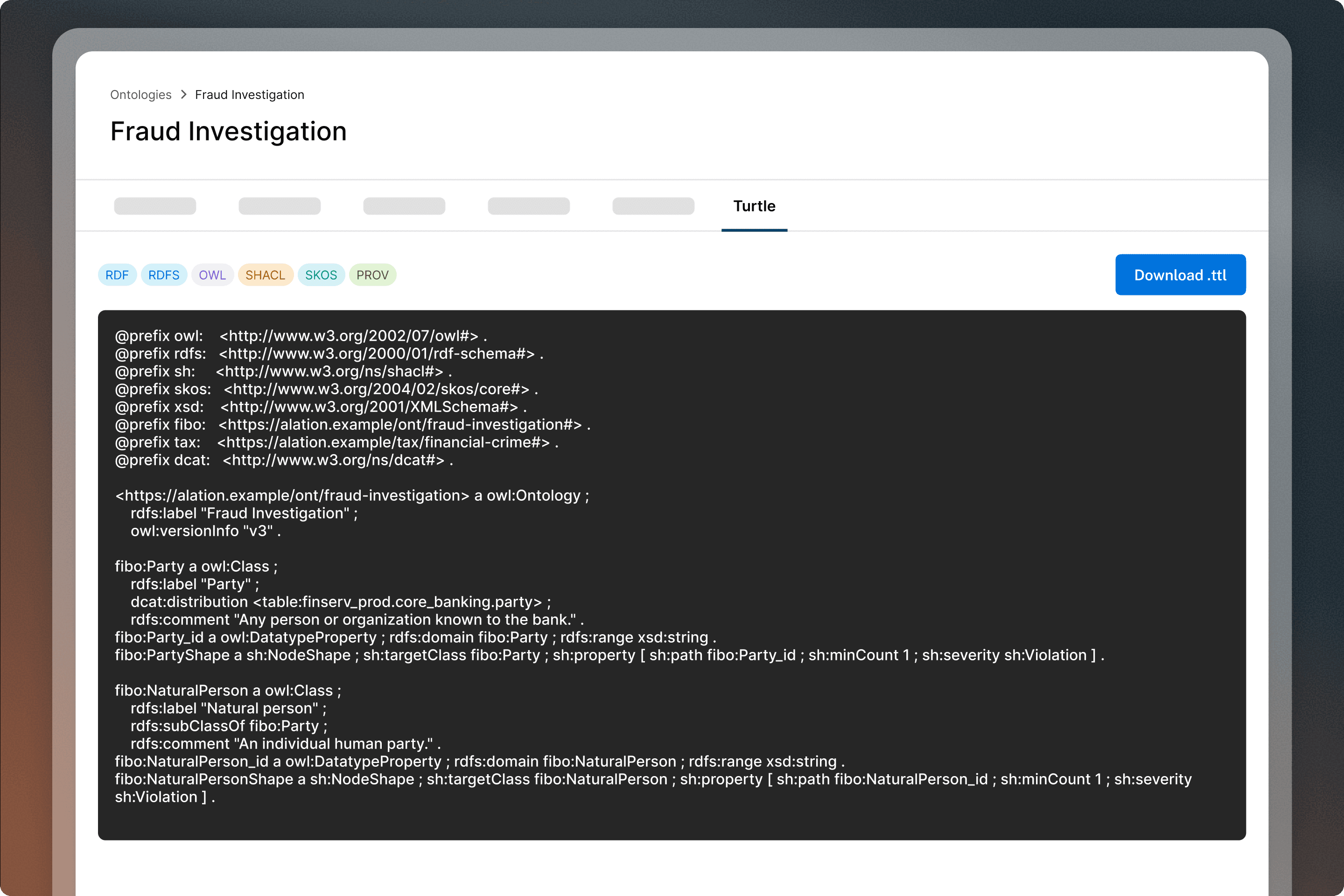
Business logic lives in the ontology instead of being rewritten into every system prompt, so a policy change updates every agent at once, instead of breaking them silently. Publish the ontology as an MCP server and every agent reads the same rules, whether it runs in Alation, your own framework, or on a platform you don't control. Concepts and relationships are modeled in OWL and RDF. Business rules are captured as SHACL constraints, the same definitions that can drive data quality checks, such as "account balance must be positive." Export the full model as a Turtle (.ttl) file and take it anywhere.
Auto-drafted
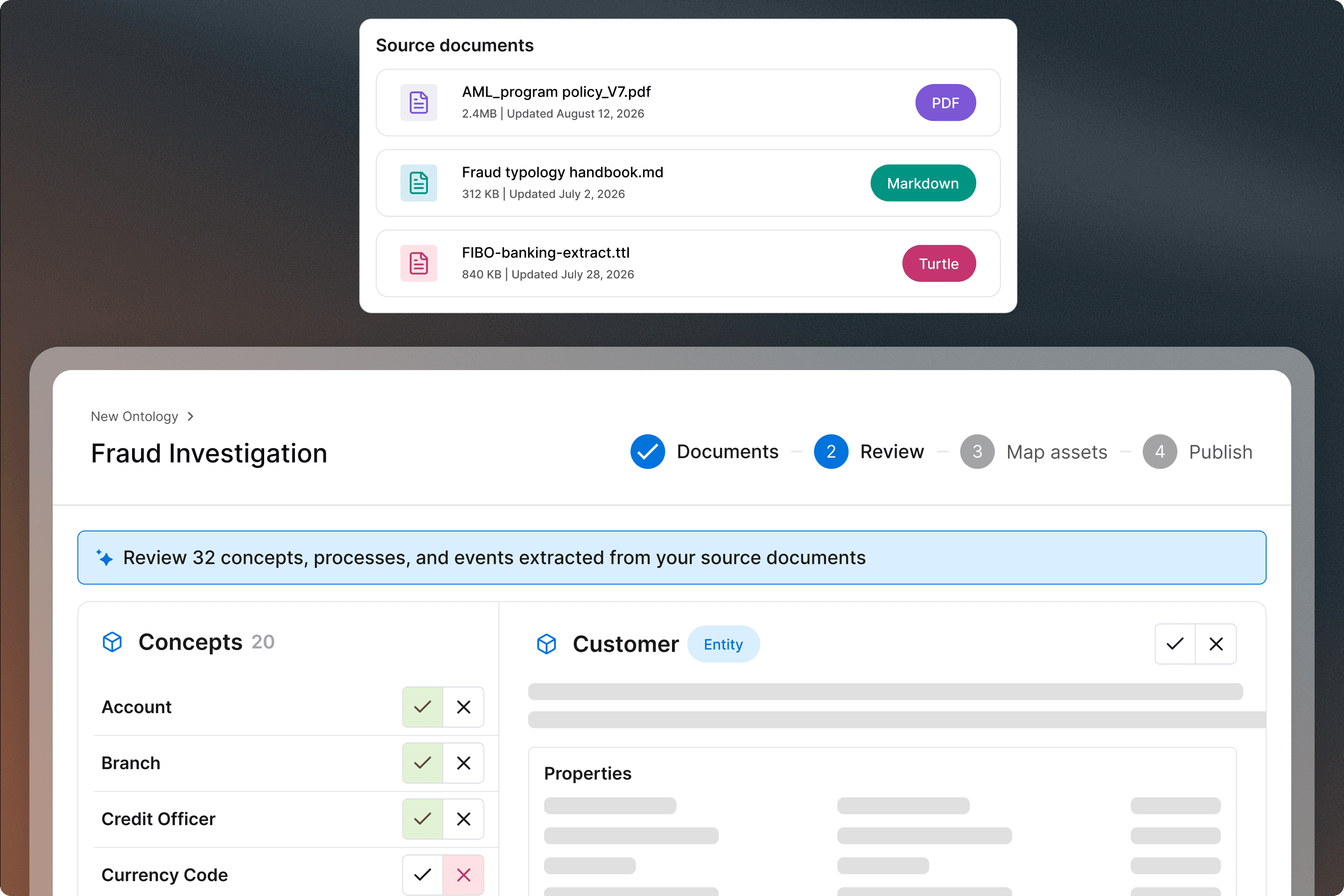
Point it at your policies, manuals, or an existing ontology. Agents draft the concepts, relationships, and constraints on the glossary, lineage, and policies you already govern, so there is no parallel modeling project. Every facet is editable inline, so your experts correct a draft instead of authoring from nothing. Agent feedback keeps it accurate as the business changes. Feedback runs both ways. Corrections and failed agent queries flow back into the model from the top, and freshness and quality signals flow up from the data underneath. Ontologies also pair with Semantic Model Mastering: governed metrics define what a number means, and the ontology defines the process logic that uses it. Feedback runs both ways. Corrections and failed agent queries flow back into the model from the top, and freshness and quality signals flow up from the data underneath. Ontologies also pair with Semantic Model Mastering: governed metrics define what a number means, and the ontology defines the process logic that uses it.
Ontologies FAQ
What you need to know about ontologies.
Q1 —
What is the difference between an ontology and a knowledge graph?
An ontology is the model that holds the concepts, relationships, and rules defining how your business works. A knowledge graph is that model grounded in your real data, every concept mapped to the tables and columns in your catalog. An ontology on its own is a diagram. A knowledge graph is that diagram connected to what is really in your systems, so an agent reasons over real data. Most tools give you one or the other. Because AIOS starts from the governed catalog, you get both as one governed object.
Q2 —
Why not use the ontology my data platform vendor already offers?
Because theirs works inside their platform, and your business does not. An ontology is the authoritative model of how your business works, so it should not be locked to one vendor's runtime or perimeter. AIOS Ontologies are built on open W3C standards, govern meaning across your whole stack, not one corner of it, and are exposed over MCP so any agent can consume them. Platform ontologies are built from what's queried and joined, so they capture what your data is. Your policies and process documents capture what your business does: approval thresholds, exception handling, policy logic. Usage logs don't contain that, and it's exactly what agents get wrong. Simply put: A platform vendor's ontology is built to make their agents better in their environment. This one is yours to take anywhere.
Q3 —
How do agents actually consume an Alation Ontology?
Over MCP, as a tool. When you publish an ontology, it's exposed as an MCP server. Agents built in Agent Studio call it directly, and any MCP-compatible agent or client can do the same. The model you build feeds whatever you already run, wherever the work happens. Publish once, use it anywhere.
Q4 —
How do we know the extracted model is correct?
You review it. Extraction produces a candidate model of concepts, relationships, and constraints for your experts to correct and approve. It does not publish anything on its own. Every facet is editable inline, so the people who actually know the process refine a draft rather than authoring from nothing, and the model carries their authority when it ships. Reviewing a draft is far faster than building from a blank graph. Nothing goes into production because a model proposed it.
Q5 —
Can agents take action using an Alation Ontology?
Yes. Agents in Agent Studio call a published ontology as a tool, then act on its rules, whether that's answering a question, running a step in a Flow, or triggering a downstream process. Because the same ontology is available to any MCP client, agents built in other frameworks follow the same rules.
Q6 —
Which open standards do Alation Ontologies use?
OWL and RDF for concepts and relationships, SHACL for constraints, and Turtle (.ttl) for export. Agents access ontologies over MCP. Alongside ontologies, data products use YAML contracts for quality and freshness, so the full context layer is defined on open, portable standards.
Q7 —
How are ontologies different from other catalog-based context layers?
Most context layers enrich metadata and serve it to agents. Alation Ontologies go further in two ways. They're extracted from the documents where your business logic actually lives, then reviewed by your experts. And they connect to a full agent harness: Agent Studio, Flows, evals, and feedback loops, so the rules carry through to action.
Start a Conversation
Speak with an Alation Expert
A 30-minute call to discuss your priorities, challenges, and goals.
Then we’ll show you how the Alation Intelligence Operating System ensures apps and agents act on current, quality, and compliant data.
Enterprises absolutely have to trust the data underneath their most critical process and decisions. We will help you get it right.