

Somewhere in your organization, a person spends part of every week rebuilding the same report. They open the dashboards, rerun the queries, pull the context together, and send it out. Then an executive forwards it back with one question: where did this number come from?
AI agents promise to take that work off their plate. But too often they hand back an answer with no link to the source and no transparency about where the numbers came from, which is hard to forward and harder to defend.
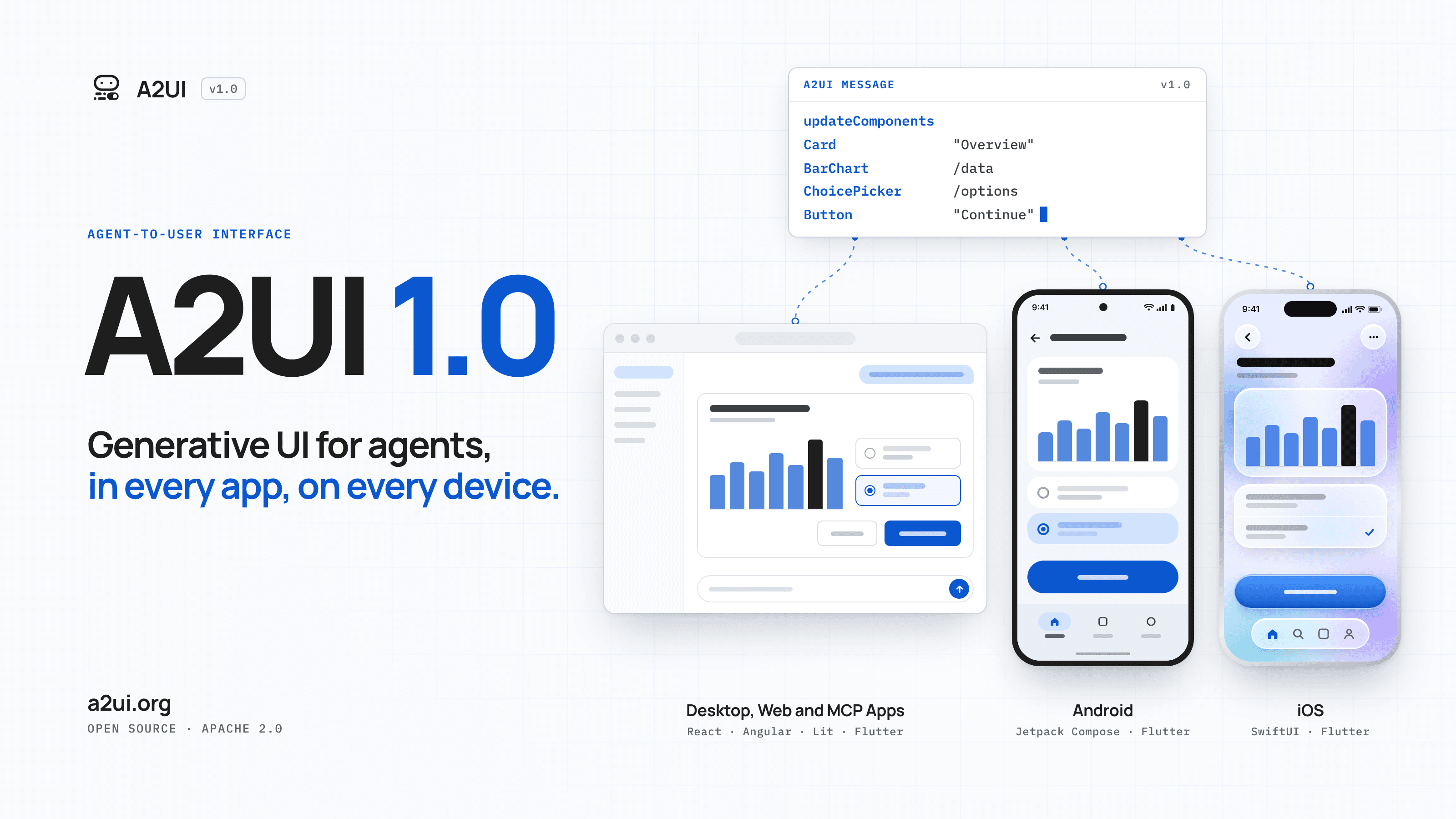
This week, Google released A2UI 1.0,¹ the first GA version of its open protocol for generative UI. It lets agents answer with interactive elements, such as metric cards and charts, instead of text alone. Alation is one of the teams Google highlights as building with it¹.
Intelligent Feeds in Claude: Charts, metrics, and the SQL behind them
Ask Claude for a feed about profitable products, and metric cards, charts, and custom components appear right in the conversation. The same feed, with the same information, can be viewed directly inside Alation with a nearly identical layout.4
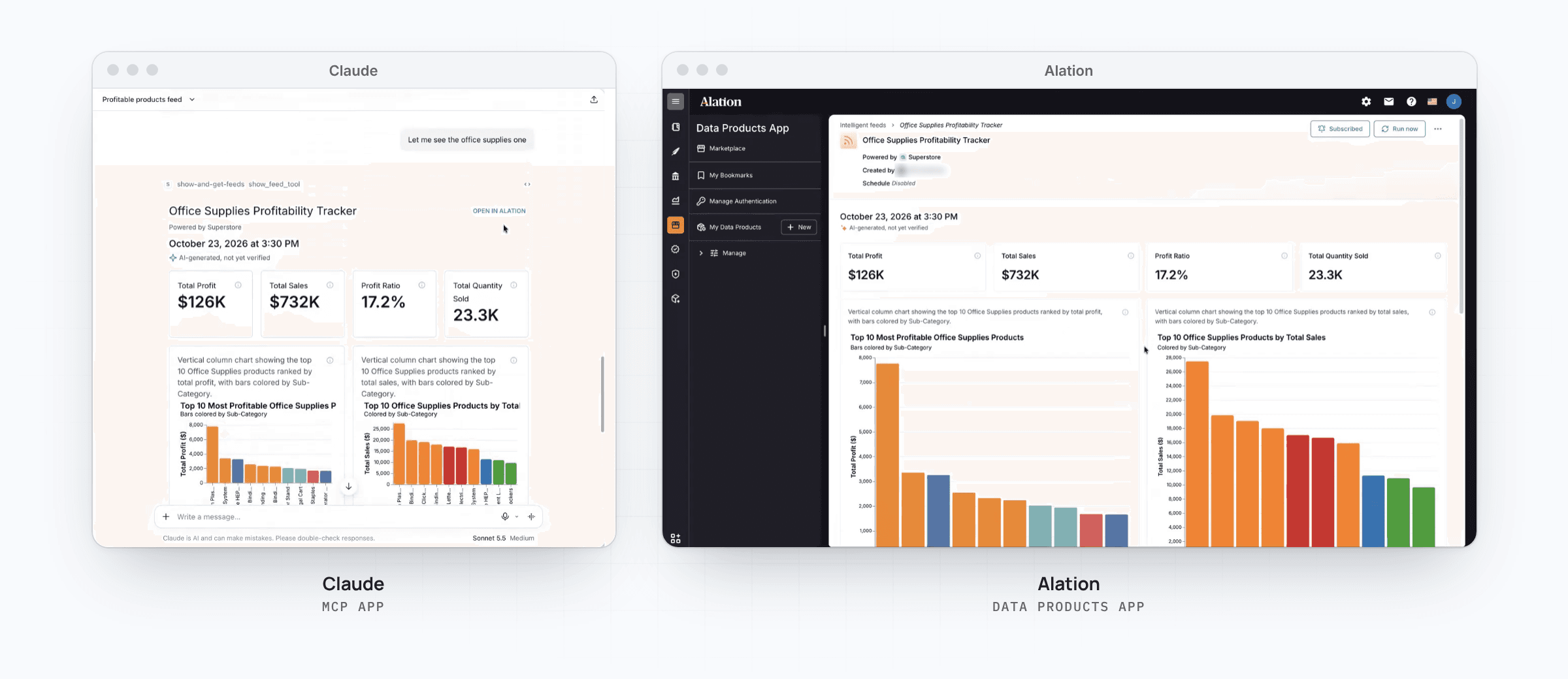
The feed isn't a picture of a report. It's interactive:
Each insight has a "show the data behind this" popover that reveals the SQL query and data behind it.
"Go deeper" buttons send a follow-up question back into the chat, so a reader can push on a number without filing a request.
Richer context is organized into clickable tabs, so the feed stays easy to scan.
Together, these turn a static answer into something your team can explore, question, and check, wherever they happen to be working. But an interactive feed only helps if people can rely on it, so here’s what makes it safe to render, built to be trusted, and open.
Why A2UI feeds are safe to render, traceable, and open
Three things make this more than a nicer-looking answer.
It's safe to render. The feed is described in A2UI, an open format that says "show these components, filled with this data." The client only draws components the developer has registered.”it already trusts. In Claude, the feed is delivered as an MCP App and runs in a sandbox with no network access.3 SQL and AI-written text appear as plain text and are never executed.
It's built to be trusted. Feeds are built on certified data products, so each figure traces back to a governed source carrying its provenance, quality, and standards. When the briefing gets forwarded upstairs, the trust question has already been answered.
It's open. A2UI is an open-source project2, and the same feed works across surfaces, in Alation and in Claude today. As more assistants adopt MCP Apps, more of Alation can follow.
That's the idea behind AIOS™: Alation is the sovereign, governed intelligent operating system for enterprises that can't afford to get AI wrong.
"The Alation Intelligence Operating System (AIOS) brings artifacts with data, charts, and insights directly to where teams work with transparency about where each figure comes from. A2UI provides the interactive UI scaffolding that makes these artifacts feel like high-touch, tailored applications, whether they are used in Alation or in the AI Assistants our customers already use."
GT Volpe, Vice President of Product Management, Alation
Put together, these mean an agent’s answer is no longer something you have to take on faith. It can be checked, questioned, and forwarded with confidence, and it shows up in the tools your team already uses. That matters most in the work that repeats every week.
From manual reporting to scheduled, traceable briefings
Now imagine the weekly revenue review again. The pack is already built when the team sits down, with metrics, visuals, and narrative assembled on the schedule the decision runs on. A recipient who wants a different cut asks in plain language instead of filing a ticket. When an executive asks where a figure came from, the answer is one click away. The person who used to assemble the report spends that week on analysis.
That's the day Intelligent Feeds are designed to give back to the people who build the pack.
Getting started with A2UI and Intelligent Feeds
Intelligent Feeds are in beta, and we're looking for design partners to build with us today.
Interested? Join the beta program.
Curious to learn more? Explore Google's A2UI 1.0 announcement or learn more about the program.
Sources & notes
Every external claim on this page is independently verifiable. The public sources are listed here.
A2UI 1.0 released Nov 11, 2026; Alation named among companies building with it; Alation feeds shown in Claude via MCP Apps. Google Developers Blog ↗ https://developers.googleblog.com/a2ui-10-build-delightful-fast-reliable-agentic-experiences/
A2UI is an Apache 2.0 open-source project that streams declarative data, not executable code. A2UI project site, accessed Nov 12, 2026 ↗ https://a2ui.org/
MCP Apps run in a sandboxed iframe with a restrictive network policy. A2UI docs, accessed Nov 12, 2026 ↗ https://a2ui.org/guides/a2ui-in-mcp-apps/
Alation AIOS feed rendered in Claude and in the Data Products App. A2UI “Built with A2UI,” accessed Nov 12, 2026 ↗ https://a2ui.org/built-with-a2ui/
- Data Products
- Digital Transformation
- Modern Data Stack
- Alation News
- Alation AI Labs
- AI
- Self-Service Business Intelligence

Robb Gibson
As a Senior Software Engineer at Alation, I contribute to the development of innovative solutions in Agentic AI development. My work focuses on MCP server and tools, AI agent memory, and agentic workflows for data domains. These efforts aim to refine the intelligence and efficiency of AI-driven solutions within Alation's ecosystem.
I hold a Master of Science degree in Software Engineering from Carnegie Mellon University, where I specialized in scalable systems and architectural design. My professional background includes positions at Kloudio and Alation, where I have built scalable infrastructure, enabled advanced cloud solutions, and supported the development of impactful data-driven tools. My expertise lies in Agentic AI development, architectural design, and cloud infrastructure.
Keep reading
More from the data desk