

Most data leaders are being asked a version of the same question right now: can we point agents at our data?
It sounds like an infrastructure question. But whether an agent can be trusted to act on enterprise data depends almost entirely on whether that data has been described, governed, and traced well enough for a non-human consumer to interpret it correctly, and on whether anyone can prove after the fact that it did.
That is the territory "agentic data management" describes. This guide defines this new concept, walks through how agentic data management actually functions, separates it from master data management and DataOps, and covers the part most discussions skip: how you verify that an autonomous agent got it right.
What is agentic data management?
Agentic data management (ADM) is the practice of applying goal-directed AI agents to data lifecycle work (discovery, documentation, quality, governance, and lineage) under constraints a human defines. Agents interpret intent, plan the work, act, and adapt as conditions change, rather than executing fixed rules.
The operative phrase is goal-directed. Conventional automation in data management is instruction-following: a steward writes a validation rule, schedules it, and maintains it as the underlying table evolves. When the schema changes, the rule breaks and someone fixes it. By contrast, an agentic system is given an objective instead of a procedure. Tell it that a customer email must be valid and protected, or that revenue must reconcile across systems, and it works out which assets are in scope, what checks satisfy the objective, and what to do when conditions shift. IBM frames the distinguishing property as self-adaptiveness: the system continuously learns from signals and adjusts rather than treating workflows as fixed artifacts.1
Which is not to say it’s unsupervised. Every credible implementation operates under bounded autonomy: humans set objectives, define constraints, and retain oversight while agents execute within those parameters. In practice, that boundary is enforced mechanically. Agents authenticate before acting, run under least-privilege permissions, write immutable audit logs, validate outputs against data contracts before committing changes, and support rollback to a known-good state.
The two things people mean by "agentic data management"
Here is where the market vocabulary splits. Both meanings are legitimate. They have different buyers, different success metrics, and different failure modes. Conflating them is the most common reason an ADM initiative gets funded against the wrong outcome.
1. Agents that do the data management work | 2. Data management as the substrate for enterprise agents | |
What it means | AI agents perform the stewardship, curation, quality, and governance tasks that people do today | The catalog, metadata, semantics, policy, and lineage layer that other people's agents depend on to act correctly |
What gets automated | Documentation, classification, quality rule generation, policy enforcement, data product packaging | Nothing directly. It supplies the context and guardrails agents consume, typically via MCP or APIs |
Primary buyer | Data governance and data platform leaders, measured on team capacity and audit readiness | Anyone shipping agents into production: data, engineering, and business unit owners |
Success looks like | Coverage and consistency at a fraction of the manual effort, plus provable compliance | Agents that answer correctly, cite their sources, and stay accurate after the pilot |
Failure looks like | Agents confidently applying the wrong standard at scale | Agents reasoning over raw schemas with no business context, producing plausible wrong answers |
The second column represents new, uncharted territory, as businesses race to leverage their unique context to fuel accurate agents. It also bears mentioning that the first column is a precondition for the second. Mature programs run both, with agentic data management furnishing the substrate for second-order enterprise agents.
Why agentic data management matters now
Three pressures are converging, and only one of them is about efficiency.
Data team capacity has hit a ceiling. The manual work scales with the data estate, and the estate is growing faster than headcount. Engineers spend 10 to 30% of their time finding data issues and another 10 to 30% resolving them, with some estimates calculating this to be more than 770 hours per engineer annually, over $40,000 in labor per person2. Meanwhile, analysts and business users wait one to four weeks for data because integration work is siloed or stalled.1 Fragmentation compounds it: IBM reports that more than half of organizations run three or more data integration tools, and, citing industry survey data, 77% lack the talent to manage that complexity.1
Agent deployment is outrunning data readiness. Gartner projects that 40% of enterprise applications will include task-specific AI agents by the end of 2026, up from under 5% in 2025.3 The foundation hasn't kept pace. A Gartner survey found 63% of organizations either lack the right data management practices for AI or are unsure whether they have them, and Gartner's standing prediction, made in early 2025, was that organizations would abandon 60% of AI projects through 2026 for want of AI-ready data.4 Access alone doesn't close the gap. Gartner has also warned that by 2028, 60% of agentic analytics projects relying solely on MCP will fail for lack of a consistent semantic layer.5
The cost of data quality has gone up. Faster, automated analysis compounds faster errors. While a bad number in a dashboard will be caught by an analyst before the morning meeting, once an agent analyzes the same data and acts on it across a dozen systems in seconds, the window for catching it shuts.6 Dan Federoff, head of data at the consultancy Bridgenext, puts the mechanism plainly: agents don't question or push back on bad data, so the error spreads through analytics and actions before anyone notices.6 McKinsey makes the same architectural point from the other direction, arguing that quality monitoring has to become continuous rather than periodic precisely to stop issues propagating across agent workflows.7
Today, incomplete and inconsistent metadata is the practical blocker for most enterprise AI programs. Gartner's own guidance is blunt about the sequencing: organizations with basic or manual metadata management practices will struggle to make data AI-ready, and maturing those practices is the first step, not a parallel workstream.4 Agentic data management is the response to that arithmetic: declare the standard once and let governed agents enforce it, with people spending their time on the exceptions.
How agentic data management works: The six-stage loop
Most descriptions of agentic data management stop at five stages, ending where the work executes successfully. The sixth is what separates a system that automates from a system that improves.
To make this concrete, here is one example threaded through all six stages. A bank has a critical data element, counterparty country of domicile, that feeds regulatory reporting. It appears in nine systems under six different names. Today, a steward maintains its documentation, mappings, and quality checks by hand, and re-does the work every time a source changes.
1. Intent is declared in business terms. Someone states the outcome rather than the procedure: country of domicile must be accurate, current, and traceable for regulatory reporting. No rule syntax, no ticket, no technical specification. This is the shift from documenting process to declaring outcome, and it is the stage that determines everything downstream. A vague objective produces a confidently wrong plan.
2. A plan is generated and reviewed. A planning agent interprets the intent and works out what satisfying it actually requires: which assets carry this element, which glossary term governs it, which policies apply, what "current" means in this reporting context, and what evidence an auditor would want. Other agents then assess that plan from their own domains, confirming lineage, dependencies, and catalog metadata before anything executes.1 Critically, the plan is inspectable. A human sees the scope before the system acts on it.
3. The work executes. Agents map the element across all nine systems, generate the validation checks that satisfy the objective, apply classifications, populate missing descriptions from real business context, and assign ownership. (This is the stage that used to consume months of steward time and rarely reached completion, because the estate changed faster than the mapping did.)
4. Guardrails are enforced during execution, not after. Policy and semantic checks run at each step. Supervisory logic monitors activity and blocks actions that violate standards before they commit.1 Every action lands in an audit log, and every agent operates under least-privilege permissions scoped to the task. This is where bounded autonomy stops being a slogan: the boundary is code, not policy documentation.
5. The system adapts when conditions change. A tenth system comes online. A definition is revised. A schema shifts. Rather than breaking and waiting for a human to notice, the system re-plans: re-scoping the element, regenerating affected checks, and flagging what it cannot resolve on its own. In this way pipelines begin to behave rather than merely execute, altering their execution path instead of breaking when conditions shift.1
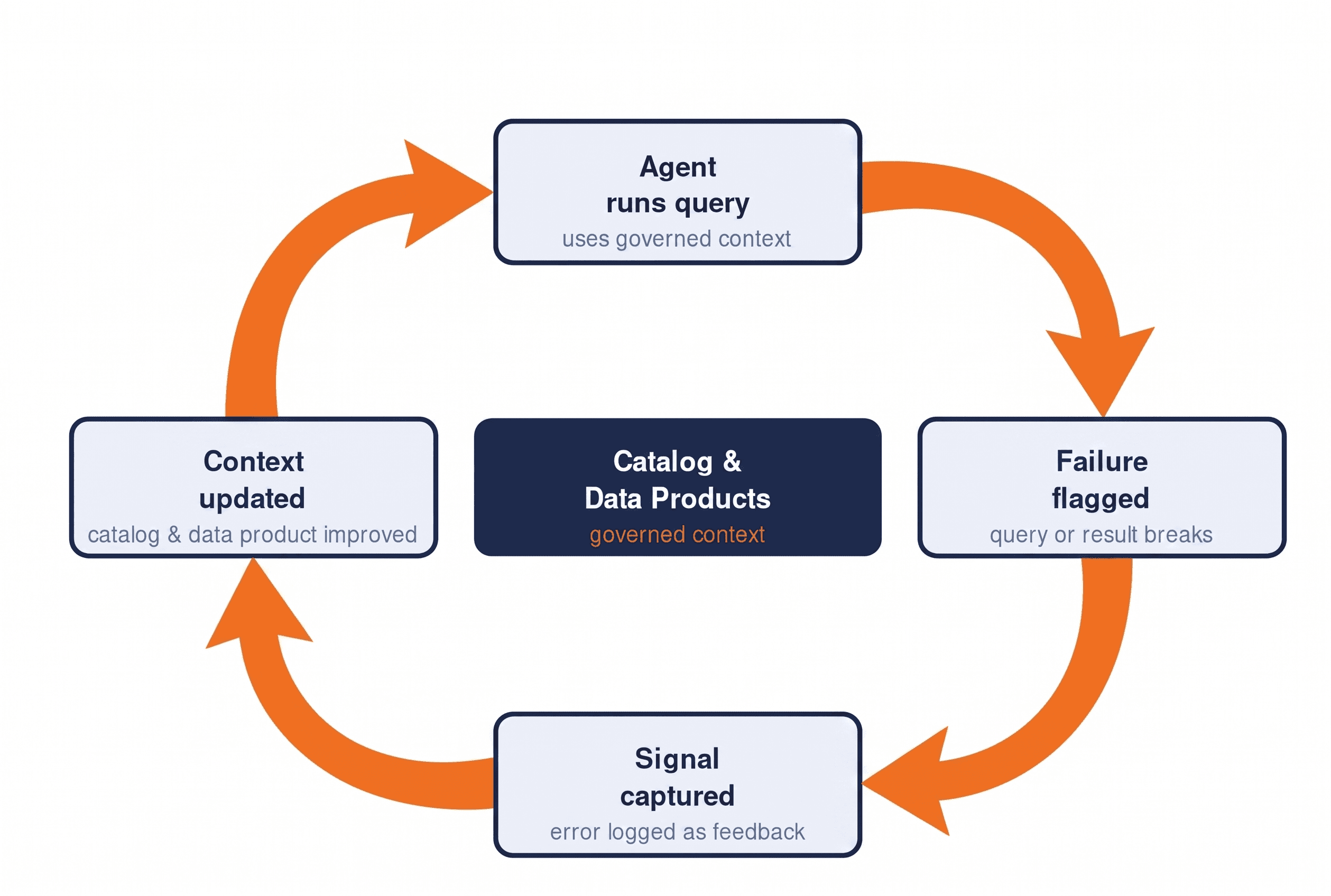
6. Corrections and evaluations feed back. A steward overrides one of the agent's mappings, because the element in the legacy trading system means something subtly different. In most implementations, that correction dies as a one-off edit. In a closed-loop system, it routes back to the layer that produced the error: the glossary definition, the semantic mapping, or the agent's evaluation set. The next agent to touch that context inherits the fix.
Before you deploy: Seven prerequisites for agentic data management
Agents are the visible layer, and these are the conditions that determine whether they work. Each bullet names what breaks without it.
Broad active metadata coverage. Agents can only act on what the catalog knows exists. Blind spots become silent gaps in enforcement.
End-to-end column-level lineage. Without it, agents cannot trace an error to its source, and no auditor will accept the output as evidence.
A semantic layer that encodes business meaning. Absent shared definitions, agents reason over field names and produce answers that are structurally valid and semantically wrong.
Governance policy in machine-readable form. Policy that lives in documents cannot be enforced by software. It has to be executable.
A defined accuracy threshold and an evaluation method. If no one has stated what "good enough for production" means, nothing stops an agent from shipping wrong.
Scoped permissions and an immutable audit trail. Least-privilege access and full traceability are what keep autonomy from becoming exposure.
A named human owner for exceptions. Every agentic workflow needs someone accountable for the cases the agent escalates. Unowned exceptions accumulate.
Gartner's own AI-readiness sequence runs parallel to this list: align data to use cases, define governance requirements, evolve metadata from passive to active, prepare pipelines, then assure and monitor.4 If four or more of these are missing, the first project is foundational, not agentic.
Agentic data management vs. MDM, DataOps, and agentic analytics
The most common objection from practitioners is that ADM is “DataOps with better marketing.” The second most common is that it replaces MDM. Neither is right, and the distinction is easier to hold once you separate what each discipline is actually responsible for:
Master data management | DataOps | Agentic analytics | Agentic data management | |
Primary object | Authoritative records in curated domains (customer, product, supplier) | Delivery of pipelines and releases | The consumption experience: questions, insights, actions | Data in motion across the estate, plus the context that describes it |
Execution model | Rules and mappings, applied through governed stewardship cycles | CI/CD, orchestration, testing as engineering practice | Agent answers a user's question against a governed layer | Intent-driven. Agents plan, act, and validate against declared outcomes |
Adaptability | Adapts at the pace of process. Changes land after governance workflows complete | Adapts at the pace of releases | Adapts per query | Adapts at the pace of change. Re-plans as definitions and sources shift |
Human role | Stewards write mappings and adjudicate exceptions | Engineers build and maintain | Analyst or business user asks | Humans declare standards, review agent decisions, handle exceptions |
Failure mode | Definitions are right but stale, and drift downstream unnoticed | Pipelines ship reliably while carrying bad data reliably | Fluent answers with no basis in governed data | Agents enforce the wrong standard at scale, quickly |
In plain terms: MDM decides what a customer is. DataOps ensures the pipeline carrying customer data runs. Agentic analytics lets someone ask a question about customers and get an answer. Agentic data management keeps the definition, the quality, and the governance of that data intact everywhere it moves, and increasingly supplies all three to the agents doing the asking. They stack. ADM deployed without MDM's authoritative definitions produces agents that are confidently, consistently wrong, because they enforce a standard nobody agreed on.
A note on agent-washing. Gartner has a name for the most common misconception in this market: "agentwashing," calling embedded AI assistants "agents" when they depend on human input for every step and do not operate independently.3 The test is whether the system sets its own plan against a stated objective, acts without a human initiating each step, and adapts when conditions change. A tool that drafts a data description for a steward to accept is useful, but it is not an agent.
What agentic data management actually automates today
Concept aside, here is what has actually shipped and where the honest boundaries sit. Each of these runs in production somewhere. None of them runs unattended.
Metadata enrichment and documentation
What the agent does: Harvests metadata across connected systems, then drafts descriptions grounded in real business context (the reports, queries, and documents where an asset is actually used) and assigns ownership.
What stays human: Approving descriptions for assets that carry regulatory or financial reporting weight, and resolving cases where usage patterns contradict the stated definition.
What "working" looks like: Documentation coverage rises across the whole estate rather than the 200 tables a steward could reach, and stays current as assets change.
Critical data element identification and enforcement
What the agent does: Translates governance intent expressed in natural language into executable standards, identifies where those elements live across the estate, and monitors compliance continuously. This work can now happen "in days or weeks (with far greater consistency) while still keeping people in the loop for nuance, review and exceptions."8
What stays human: Deciding which elements are critical in the first place, and signing off on the policy translation before enforcement begins.
What "working" looks like: An auditor asks for evidence and gets a live view rather than a spreadsheet assembled in a panic.
Data quality rule generation and monitoring
What the agent does: Rather than waiting for an engineer to write checks table by table, reads query patterns and usage signals to find the data that actually matters, then generates and applies the relevant anomaly-detection and validation rules. Alation's Behavioral Analysis Engine, which learns from query patterns, usage metrics, and behavior signals to identify critical data elements, is one working example of the pattern.9
What stays human: Setting thresholds for what constitutes a failure worth blocking versus flagging, and triaging genuinely novel anomalies.
What "working" looks like: Quality coverage concentrates where business impact is highest, instead of spreading evenly across assets nobody queries.
Governed data product packaging
What the agent does: Assembles governed assets into data products with context, ownership, quality scores, and certification embedded at publication, in the form agents and analysts can both consume.
What stays human: Product definition and consumer contract. Deciding what belongs in a product and what does not.
What "working" looks like: Data arrives certified rather than merely available, which is the difference between an agent pilot and an agent in production.
Lineage reconstruction
What the agent does: Parses code, transformation logic, and external files to infer lineage that was never explicitly documented, filling gaps in the graph.
What stays human: Validating inferred lineage before it is used as audit evidence. Inferred is not the same as verified.
What "working" looks like: "Where did this number come from?" gets answered on screen rather than through a two-week investigation.
Semantic drift detection
What the agent does: Monitors for changes in what data means rather than how it is structured. A customer segment gets redefined or a product hierarchy reorganized, the schema stays identical, and every downstream calculation quietly changes.
What stays human: Nearly all adjudication. When two systems both call a field "revenue" and mean different things, the agent can surface the conflict. Only a person can decide which one is right.
What "working" looks like: The conflict surfaces before it reaches a board deck, not after.
Agents are reliable when it comes to tedious work: scope, coverage, and consistency, but they grow weak where meaning is contested.
The trust problem: How do you know the agent was right?
Everything above describes agents taking action. Almost nothing in the market describes how anyone verifies those actions were correct.
The gap is expensive in both directions. Gartner projects that by 2027, organizations that prioritize semantics in AI-ready data will increase their agentic AI accuracy by up to 80% and reduce costs by up to 60%, which is another way of saying that most organizations are currently paying full price for agents operating well below their achievable accuracy.5
Accurate determines whether agentic data management becomes infrastructure or stays a pilot. In software, nobody ships code without tests. In enterprise AI, teams routinely ship agents on the strength of a good demo, which our engineering team calls "vibe-checking" your way to production.10 The failure mode is familiar to anyone who has run one of those demos: the first question lands beautifully, the follow-up produces a broken join or a slightly wrong column name, and the room goes quiet.
Autonomy without verification is merely faster error propagation. Four requirements separate a system you can trust from one you are hoping about, and each one converts into a question worth asking any vendor.
1. A measurable accuracy threshold, tested against your questions. Generic benchmarks tell you almost nothing, because accuracy is specific to your schema, your terminology, and the questions your business actually asks. What works instead is a defined set of evaluation cases: a natural-language input paired with the correct output, whether that is a specific executable query, an expected set of artifacts, or summarization guidance. The suite becomes the gold standard, and running it simulates each case fresh so you can see precisely where the logic breaks.
The gap this closes is larger than most teams expect. Alation published a worked example that started with what we call a naked data product, raw table and column definitions with no descriptions or business context, benchmarked against 20 question-and-SQL pairs on a sales dataset. The agent got 12 of 20 right, a 60% accuracy rate, failing mostly on date-filtering logic and table granularity.10 Those are the ordinary semantics of a sales dataset, and an agent with access but no context could not resolve them.
Ask: What accuracy threshold does this agent have to clear before production, measured against whose questions?
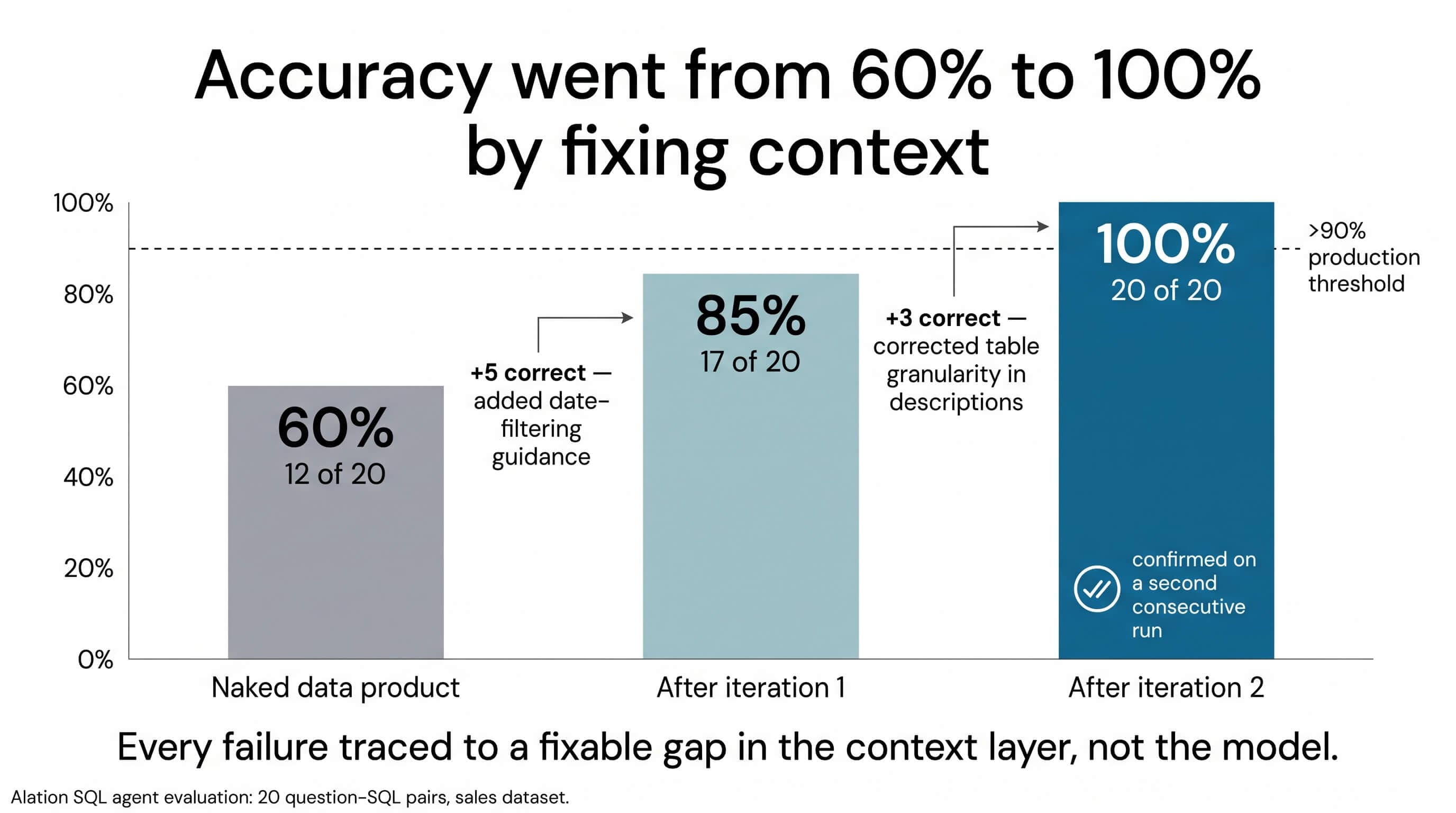
2. Failure diagnosis at the metadata level. Knowing an agent was wrong is not useful. Knowing why is. The diagnostic question is whether a failure traces back to a specific deficiency in the context the agent was given: a missing description, an unstated join rule, an ambiguous metric definition. In the example above, two automated iterations closed the whole gap. The first added guidance on date filtering and recovered five answers; the second identified that the agent had misread table granularity and updated the descriptions to explain how rows should aggregate. Accuracy reached 100%, confirmed across two consecutive runs.10 The important detail is not the number. It is that every failure was attributable to a fixable gap in the knowledge layer rater than to the model.
Ask: When an agent fails, does the system tell me which piece of metadata caused it?
3. A feedback path that updates the context, not just the output. This is the requirement that separates a system from a document, and it is where most architectures quietly fail. Context starts decaying the moment it ships in a phenomenon we call the headcount trap: if the only mechanism for keeping context current is a person noticing drift and editing a definition, then every additional use case requires more people to keep the previous ones alive.11
The alternative is a loop in both directions. Above the catalog, agent interactions generate signals: user corrections, failed queries, questions that exposed a definition gap. Those signals update the catalog and data products automatically rather than dying in a chat log. Below it, data quality monitoring validates freshness and conformance and flags problems before an agent builds an answer on top of stale data.11 Run both, and the context improves from use instead of degrading from it.
A fix applied to the context improves every agent consuming that context, including agents built on someone else's platform. One correction, propagated everywhere, is a fundamentally different economic proposition from one correction applied once.
Ask: When a user corrects an agent, what else changes? And does that improvement reach agents built outside this platform?
4. Human oversight of what changed and why. Automated improvement without review is just a different flavor of ungoverned. The requirement is that proposed changes to the knowledge layer surface for human approval, and that the resulting trail is inspectable afterward. In the Alation example, every change made to the data product is exposed for review before it lands, which is what keeps the behavior explainable and the audit trail defensible.10 This is not a compliance afterthought. IBM's own forward-look treats reasoning traces, auditable logs, and human-in-the-loop checkpoints as prerequisites for trust as data teams shift from building systems to supervising them.1
Ask: Who approves changes to the context layer, and can I reconstruct why the agent behaved as it did six months ago?
One clarifying test cuts through most vendor conversations. A platform that asserts its context layer makes AI more accurate, but provides no way to measure that against your real questions, diagnose failures, update the layer, and re-test, is making a theoretical claim. Accuracy that comes out of a closed loop is a different kind of claim from accuracy asserted without one.
Accuracy is a process rather than a promise: Agent Studio's evaluation workflow, with Q&A pairs, built-in testing, and custom judges, is designed to clear a >90% accuracy bar before an agent reaches production,12 and AIOS is built to route corrections, and decision traces back to the layer that produced them.13
Moor Insights & Strategy, reviewing the architecture, describes the intent as a correction travelling back to the layer that caused it, with every other agent pulling from that context picking up the fix.14
Where agentic data management is heading
Three shifts are visible now and worth planning against.
Policy becomes executable rather than documentary. The clearest signal is Gartner's projection that by 2030, 50% of organizations will use autonomous AI agents to interpret governance policies and technical standards into machine-verifiable data contracts, automating compliance and governance policy enforcement.15 The near-term implication is unglamorous: policy that exists only as prose in a document is not a foundation you can automate against. Getting standards into structured, machine-readable form is the work that makes everything after it possible.
Semantic drift overtakes schema drift as the dominant quality problem. Today's data quality failures usually trace to structural change: a column renamed, a type altered, a table dropped. IBM argues that tomorrow's failures will trace to business meanings that change while the structure stays identical.1 A customer segment gets redefined, a product hierarchy is reorganized, and every dependent calculation shifts without a single schema alert firing. Detecting that requires semantic memory and context-aware validation rather than better schema monitoring, and it puts a premium on the layer where meaning is recorded. Gartner puts the same shift in budget terms: by 2030, universal semantic layers will be treated as critical infrastructure, alongside data platforms and cybersecurity — a line item, not an initiative.15 It’s worth noting that prompts belong in this category too: when a metric definition or filter rule lives inside a prompt authored outside the governed system, it is ungoverned business logic, and it drifts like everything else.
Data teams move from building to supervising, and governance becomes runtime. As agentic operating models mature, engineers spend less time hand-coding transformations and more time designing guardrails, reviewing agent decisions, and resolving edge cases.1 That shift only holds if the oversight infrastructure exists, and Gartner is direct about the risk when it does not: by 2030, 50% of AI agent deployment failures will be due to insufficient AI governance platform runtime enforcement for capabilities and multisystem interoperability.15 Governance that runs as an annual review cannot supervise a system that acts in seconds.
The through-line across all three is a single reversal. The early agentic pitch was about agents that manage your data. The durable value is data management that makes your agents worth trusting, wherever they were built and whoever built them. The organizations that get there are not the ones with the most agents. They are the ones whose context can learn.
Curious to learn how AIOS can support your vision for agentic data management? Let’s connect.
Frequently asked questions
What is agentic data management in simple terms? Agentic data management (ADM) is the use of goal-directed AI agents to carry out data management work, including discovering, documenting, validating, and governing data, within limits a human defines. Instead of following fixed rules, agents interpret intent, plan the steps, act, and adapt when schemas, definitions, or policies change.1 The term also carries a second meaning: the data management practices that make other agents reliable, by supplying them with governed, well-described, lineage-traced data.
What is the difference between agentic data management and master data management? MDM establishes authoritative records within curated domains and manages data at rest through matching, cleansing, and standardization, updated on governed stewardship cycles. ADM manages data in motion, applying policies, lineage checks, and semantic validation as data flows, and adapts as conditions change rather than waiting for a governance cycle to complete.1 They are complementary. ADM enforces and extends the definitions MDM establishes, and without those definitions it enforces a standard nobody agreed on.
Do AI agents replace data stewards? No. Agentic data management operates under bounded autonomy: humans set objectives, define constraints, and handle exceptions while agents execute routine work within those boundaries. The steward's role shifts from applying rules asset by asset to declaring standards, reviewing agent decisions, and adjudicating semantic ambiguity that agents cannot resolve, such as when two systems use the same field name for genuinely different business concepts.
How do you know an AI agent's output is accurate? Through evaluation rather than inspection. You define a set of test cases pairing real business questions with correct expected outputs, run the agent against them, and measure. Failures then get diagnosed at the metadata level, which usually reveals a missing description, an unstated join rule, or an ambiguous definition rather than a model problem. One published example moved a SQL agent from 60% to 100% accuracy in two iterations purely by fixing the context it was given.10 The test for any platform is whether it can measure accuracy against your questions, diagnose failures, update the knowledge layer, and re-test, with human approval of what changed.
What do you need in place before deploying agentic data management? Four essentials: comprehensive active metadata with end-to-end lineage; a semantic layer encoding what business terms actually mean; governance policy in machine-readable form; and an evaluation method with a defined accuracy threshold agents must clear before production. Connecting a model to a warehouse without these is the most common failure pattern. Gartner projects that organizations prioritizing semantics in AI-ready data will increase agentic AI accuracy by up to 80% and cut costs by up to 60% by 2027, and warns that 60% of agentic analytics projects relying solely on protocol-level access like MCP will fail by 2028 without semantic foundations.5
Sources & notes
Every external claim on this page is independently verifiable. The public sources are listed here.
Agentic data management defined as self-adaptive; peer-agent plan review; supervisory logic that blocks non-compliant actions; over 50% of organizations rely on three or more data integration tools; 77% lack the talent to manage the complexity (IBM citing industry survey data); analysts and business users wait 1–4 weeks for data; pipelines that behave rather than execute; semantic drift overtaking schema drift; data teams shifting from builders to supervisors; reasoning traces, auditable logs and human-in-the-loop checkpoints as prerequisites for trust; MDM/ADM comparison axes. — IBM Think, "Agentic data management: The next evolution of enterprise data ecosystems," 20 February 2026 (updated 10 July 2026) ↗ https://www.ibm.com/think/insights/agentic-data-management
Engineers spend 10–30% of their time uncovering data issues and another 10–30% resolving them, amounting to over 770 hours and more than USD 40,000 in labor per engineer annually. Figures are IBM's own estimates, published alongside its data observability product. — IBM, "Smart data engineering: How observability drives productivity and efficiency," 19 November 2025 ↗ https://www.ibm.com/new/product-blog/smart-data-engineering-how-observability-drives-productivity-and-efficiency
40% of enterprise applications will be integrated with task-specific AI agents by the end of 2026, up from less than 5%; "agentwashing" defined as the mislabeling of AI assistants, which depend on human input and do not operate independently, as agents. — Gartner, "Gartner Predicts 40% of Enterprise Apps Will Feature Task-Specific AI Agents by 2026, Up from Less Than 5% in 2025," 26 August 2025 (updated 5 September 2025) ↗ https://www.gartner.com/en/newsroom/press-releases/2025-08-26-gartner-predicts-40-percent-of-enterprise-apps-will-feature-task-specific-ai-agents-by-2026-up-from-less-than-5-percent-in-2025
63% of organizations either do not have or are unsure whether they have the right data management practices for AI; prediction that through 2026 organizations would abandon 60% of AI projects unsupported by AI-ready data; organizations with basic or manual metadata management practices will face challenges making data AI-ready; the five-step AI-readiness sequence. — Gartner, "Lack of AI-Ready Data Puts AI Projects at Risk," Q&A with Roxane Edjlali, 26 February 2025 ↗ https://www.gartner.com/en/newsroom/press-releases/2025-02-26-lack-of-ai-ready-data-puts-ai-projects-at-risk
AI agents cannot operate accurately without context and are more likely to hallucinate without it; by 2027, organizations that prioritize semantics in AI-ready data are projected to increase agentic AI accuracy by up to 80% and reduce costs by up to 60%. — Gartner, "Gartner Says Lack of Semantics Causes Inaccurate AI Agents and Wasted Spending," 11 May 2026 ↗ https://www.gartner.com/en/newsroom/press-releases/2026-05-11-gartner-says-lack-of-semantics-causes-inaccurate-artificial-intelligence-agents-and-wasted-spending — The related prediction that by 2028, 60% of agentic analytics projects relying solely on MCP will fail for lack of a consistent semantic layer appears in Gartner, Market Guide for Agentic Analytics, Deepak Seth, Georgia O'Callaghan, Fay Fei and Jeroen Cornelissen, 9 February 2026 (client access required; see Analyst Attributions below).
Agentic AI expands the potential blast radius of data issues: a bad number in a dashboard can be caught by an analyst before the morning meeting, but an agent acting on the same data across a dozen systems within seconds closes that window. Agents will not question or push back on bad data (Dan Federoff, vice president and head of data, Bridgenext). — TechTarget, "How agentic AI amplifies data management challenges," 17 July 2026 ↗ https://www.techtarget.com/searchdatamanagement/feature/How-agentic-AI-amplifies-data-management-challenges
Continuous, real-time data quality monitoring, supported by automated validation, anomaly detection and enrichment, to prevent issues propagating across agent workflows. — McKinsey, "Building the foundations for agentic AI at scale," 2 April 2026 ↗ https://www.mckinsey.com/capabilities/mckinsey-technology/our-insights/building-the-foundations-for-agentic-ai-at-scale
CDE governance work "can now happen in days or weeks — with far greater consistency — while still keeping people in the loop for nuance, review and exceptions as the data and needs evolve" (GT Volpe, senior director, product management, Alation). — TechTarget, "Alation automates governance with latest AI-powered suite" ↗ https://www.techtarget.com/searchdatamanagement/news/366639805/Alation-automates-governance-with-latest-AI-powered-suite
The Behavioral Analysis Engine learns from query patterns, usage metrics and behavior signals to identify critical data elements, and generates tailored anomaly-detection and validation rules. — Alation, Data Quality Agent ↗ https://www.alation.com/product/data-quality-agent/
"Vibe-checking" to production; a "naked" data product benchmarked against 20 question-SQL pairs scored 60% (12 of 20), failing on date-filtering logic and table granularity; two automated iterations (five additional correct answers, then three) reached 100%, confirmed on a second consecutive run; every proposed change to the data product surfaced for human review and approval. — Alation, "AI Agent Evaluations: How to Build Reliable SQL Agents," 10 March 2026 ↗ https://www.alation.com/blog/ai-agent-evaluations/
The headcount trap: every use case deployed without automated context maintenance requires a human team to keep it alive, shifting headcount into a context-maintenance function and consuming the capacity needed for the next use case. Feedback loops and data quality monitoring identified as the two mechanisms distinguishing a living context layer from a static one. — Alation, "Your Context Layer Is Already Wrong (And How to Fix It)," 29 April 2026 ↗ https://www.alation.com/blog/perspective-context-gets-stale/
Agent Studio's evaluation workflow — Q&A pairs, built-in testing and custom judges — is designed to achieve >90% accuracy before production. — Alation, Agent Studio ↗ https://www.alation.com/product/agent-studio/
AIOS as one system of data, context, agents and governance, with feedback loops running through every layer. — Alation, AIOS ↗ https://www.alation.com/aios/
Independent review of the AIOS architecture, describing (as Alation presents it) corrections travelling back to the layer that caused a failure, with every other agent drawing on that context inheriting the fix. — Moor Insights & Strategy, "Alation's AIOS Bets the Context Layer Has to Fix Itself," 17 July 2026 ↗ https://moorinsightsstrategy.com/field-notes/alation-aios-context-layer/
By 2030, 50% of organizations will use autonomous AI agents to interpret governance policies and technical standards into machine-verifiable data contracts, automating compliance and governance policy enforcement; by 2030, 50% of AI agent deployment failures will be due to insufficient AI governance platform runtime enforcement for capabilities and multisystem interoperability; by 2030, universal semantic layers will be treated as critical infrastructure, alongside data platforms and cybersecurity. — Gartner, "Gartner Announces Top Predictions for Data and Analytics in 2026," 11 March 2026 ↗ https://www.gartner.com/en/newsroom/press-releases/2026-03-11-gartner-announces-top-predictions-for-data-and-analytics-in-2026
Analyst Attributions & Disclaimers
Gartner, Market Guide for Agentic Analytics, Deepak Seth, Georgia O'Callaghan, Fay Fei, Jeroen Cornelissen, 9 February 2026.
GARTNER is a registered trademark and service mark of Gartner, Inc. and/or its affiliates in the U.S. and internationally and is used herein with permission. All rights reserved.
Gartner does not endorse any vendor, product or service depicted in its research publications and does not advise technology users to select only those vendors with the highest ratings or other designation. Gartner research publications consist of the opinions of Gartner's research organization and should not be construed as statements of fact. Gartner disclaims all warranties, expressed or implied, with respect to this research, including any warranties of merchantability or fitness for a particular purpose. GARTNER and Magic Quadrant are registered trademarks and service marks of Gartner, Inc. and/or its affiliates in the U.S. and internationally and are used herein with permission. All rights reserved.
- Active Data Governance
- AI
- Data Catalog
- Data Governance
- Data Intelligence
- Engineering
Keep reading
More from the data desk