

AI-ready data is easy to claim and hard to prove. Most organizations can say their catalog is well documented, yet few can show which tables an AI agent can safely reason about and which it would misread with total confidence. Gartner's 2024 survey of data management leaders found that 63% of organizations lack, or can't confirm they have, the data management practices AI requires.¹
At revAlation London 2026, Rob Davie of the BBC, Data Governance Lead - Data Discoverability, Data Documentation and Data Platform Governance, described how his data governance team is closing that gap. They wrote a standard for what AI-ready means, built a tiered model for grading data against it, and designed an agent to do the grading.²
Davie spoke alongside the session host and Rish, an Alation deployment strategist who pre-built and ran the approach live on a demonstration instance.² His central argument is that governing data for AI and governing data with AI are two halves of one loop.² Teams that build both halves can scale curation without a standing army of stewards. Here is how it works, and what you can borrow.
Why does an AI agent need more context than a person?
The BBC measures itself differently from a commercial company. Its annual report covers measures such as weekly reach, weekly active accounts, perceived value for money and impartiality scores.³ Answering those questions across the whole UK, Davie explained, takes "consistent, trusted, reusable measures." The nightmare scenario he offered was having 15 different measures of who watched Traitors.²
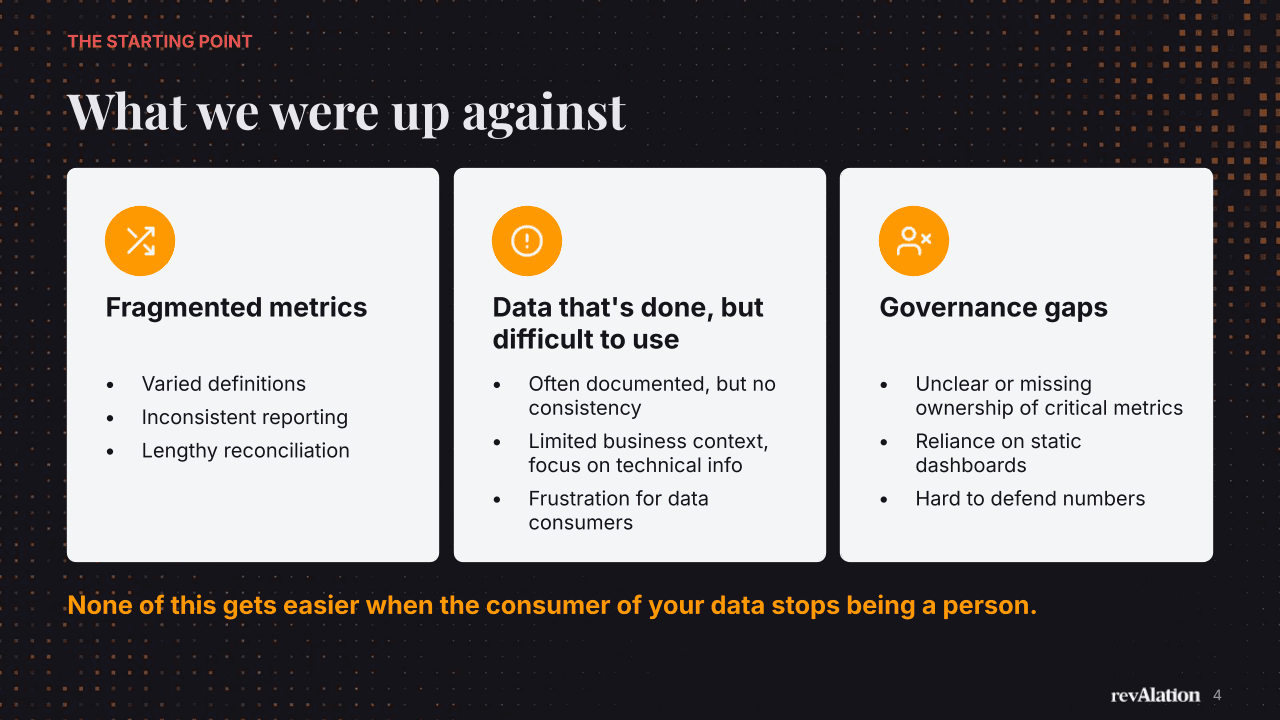
Disambiguating metrics demands time and expertise. Definitions live in Word documents, Confluence pages, and team-specific corners of the organization.² Ownership of a metric can be unclear, so even a good definition often has nobody to confirm it is still right.² People can work around this. A person reads a description and spots that the owner has changed, or that a calculation was updated and the page was not. Davie was blunt about what happens when the consumer is an agent: "An agent will just take that and run with it. It will use the wrong context and give the wrong answer really confidently."²
Agents need what people can skip. They need detailed descriptions, business context written down with no assumptions, and an explicit understanding of synonyms.² As an example, views, plays, and streams could all be synonyms, or could in fact be completely different metrics. A person might know that. An AI agent has to be told, with examples of how the differences change the answer. Davie's summary of the stakes: "All of this wonderful, lovely AI stuff is only as good as the context underneath it." If that context is wrong, the answers are wrong, badly informed decisions will be made, the presenter of that information looks foolish… and the person presenting that information to senior leaders is the one who pays for it.
What does AI-ready mean? A three-tier readiness standard
The BBC's answer was to write the standard down and make it graded. The model has three tiers, each describing who can get value from a data asset and what it takes to get there:
Tier | Who can use it | What it requires |
Human readable | A person who brings tribal knowledge and can tolerate fuzziness | A description a knowledgeable colleague can interpret |
AI usable | An agent that must reason without guessing | Business context written down, key columns described, tribal knowledge documented |
Chat ready | An agent answering business questions in plain language through Alation’s Chat with Your Data | Everything in AI usable, plus synonyms, common phrasings, caveats and known limitations, sample questions, joins, and evals |
The top tier includes something many readiness frameworks skip: known limitations. Davie wants an agent to be able to answer, "Actually, no, I can't do that with this product." He called that a really nice safety feature, because a data product that admits its boundaries is safer for an agent to use than one that implies it can answer anything.
Davie also offered a caveat on the model itself: Human-readable and AI-usable overlap enough that the BBC may reduce from a 3-tier to a 2-tier model over time. His advice to others was to adapt it: you might want two tiers or five, as long as the standard says exactly what each one requires.
The standards themselves are written to be machine-readable. At the BBC, they are stored as policies in Alation, laid out with headings, numbered lists, and tick and cross symbols. As Rish explained, the agent picks up that markdown structure directly and uses it in its decisions. A standard that an AI can read is the first requirement for an AI that can enforce it.
Which data deserves the top tier?
Not everything, and Davie was emphatic about that. Asked whether every asset should climb to the top tier, he answered, “No, that way madness lies.” The BBC ingests technical metadata broadly, including lineage, because discovering what it did not know turned out to be valuable and because lineage can surface unexpected results. The curation effort goes to critical assets. The data feeding the BBC's critical data products should reach tiers one, two, and three. Most other assets can sit at tier one, with as little as possible left at zero. Effort has a cost, whether it is human time or compute, and the BBC wants to spend it where it returns the most. (For a deeper look at how organizations identify what matters most, see Alation's guide to critical data elements.⁴)
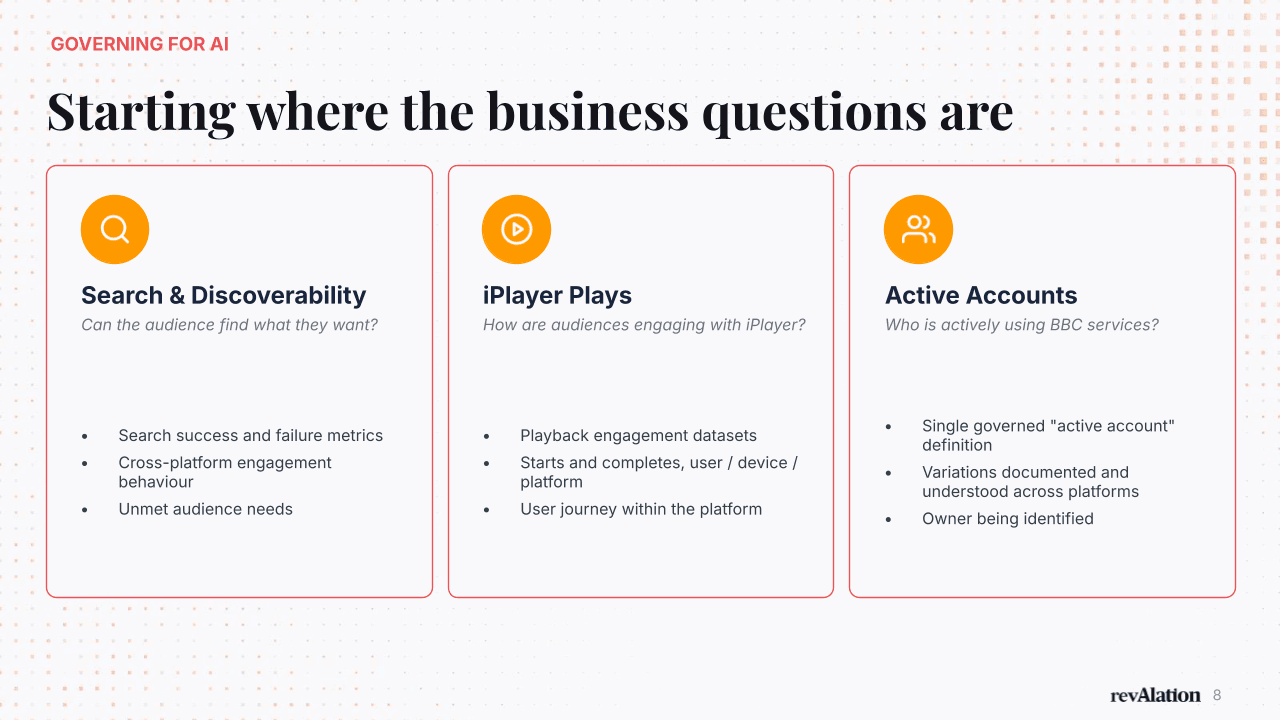
Choosing which assets matter followed the same logic. The team did not start with the data. They started with the key measures watched by senior management, including the Director-General in some instances, because visibility and buy-in are what let a program keep moving.² That produced data products such as Weekly Active Accounts (WAA), which Davie described in the session as the BBC's North Star metric and which the BBC reports as a headline audience measure in its annual accounts.²˒³ (Earlier BBC work on this approach is covered in Alation's look at the Search Metrics data product.⁵ Alation was the winning supplier in the BBC's open tender for a data catalogue, which drew 14 bids; the contract concluded in October 2024.⁶)
These data products now sit behind what Davie calls one front door for BBC data: the data product marketplace. Users, human or agent, can discover data in natural language, understand its business context, and then either apply for access or chat with the data directly.⁷ Narrowing scope to well-described products also means an agent is not wading through thousands of raw assets.
How can an agent measure readiness at scale?
A steward can compare one table against the standard on two screens. Doing that for a domain with a thousand tables is a different job, and few organizations have rafts of full-time stewards to do it. The BBC's answer, as Davie described it, is a compliance agent that reads catalog objects, compares their descriptions and related fields to the written standards, and assigns a tier. It can run on a single table or across a whole schema or domain, then summarize the distribution.
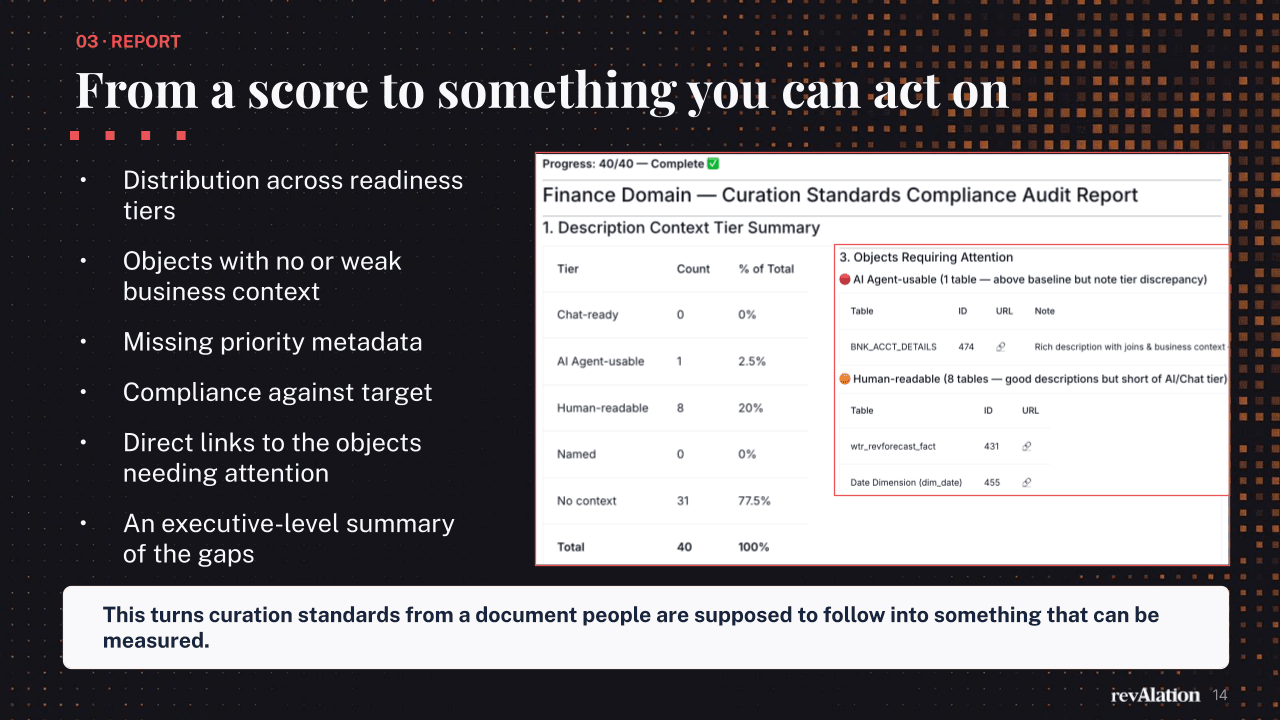
The design choices are as instructive as the capability. The agent is built with Alation's agent tooling⁸ and calls a set of tools. Some come out of the box, such as retrieving data sources. Others had to be built for the job, including a tool that fetches the curation policies from the catalog. The prompt is large, because it must define the tier names, the output format, the context to use, and where to find more. Davie was candid that this is skilled work: "It's not a walk-in day one, and it will work."* The model is swappable so teams can compare responses from different models.⁸
Safeguards are part of the design. The agent narrates what it is doing, so it fails gracefully rather than confidently or silently.² It includes a checkpoint, so a run touching more than 100 tables pauses for confirmation.² Its output includes the split of tables by tier, gaps such as missing classification, objects with no context at all, a plan stewards can work from, and executive observations that give leaders the headline and the detail to act on it.²
[GRAPHIC: A circular or left-to-right workflow with four stages: Define the standard, Assess the catalog, Report to stewards, Act on gaps. Show the tier written back to the catalog as an arrow feeding the next cycle. Style: clean diagram, Alation brand colors.]
Why start advisory, and how does governing with AI close the loop?
Davie described a four-step process: define the standard, assess the catalog against it, report on what the assessment found, and act. Stewards handle remediation today. Further along, the agent may suggest changes. Eventually, once it has proven itself, some actions might become autonomous. As Sangani noted at the start of the session, few organizations are running end-to-end AI yet, and Davie agreed that a big trust journey lies ahead before that is realistic.
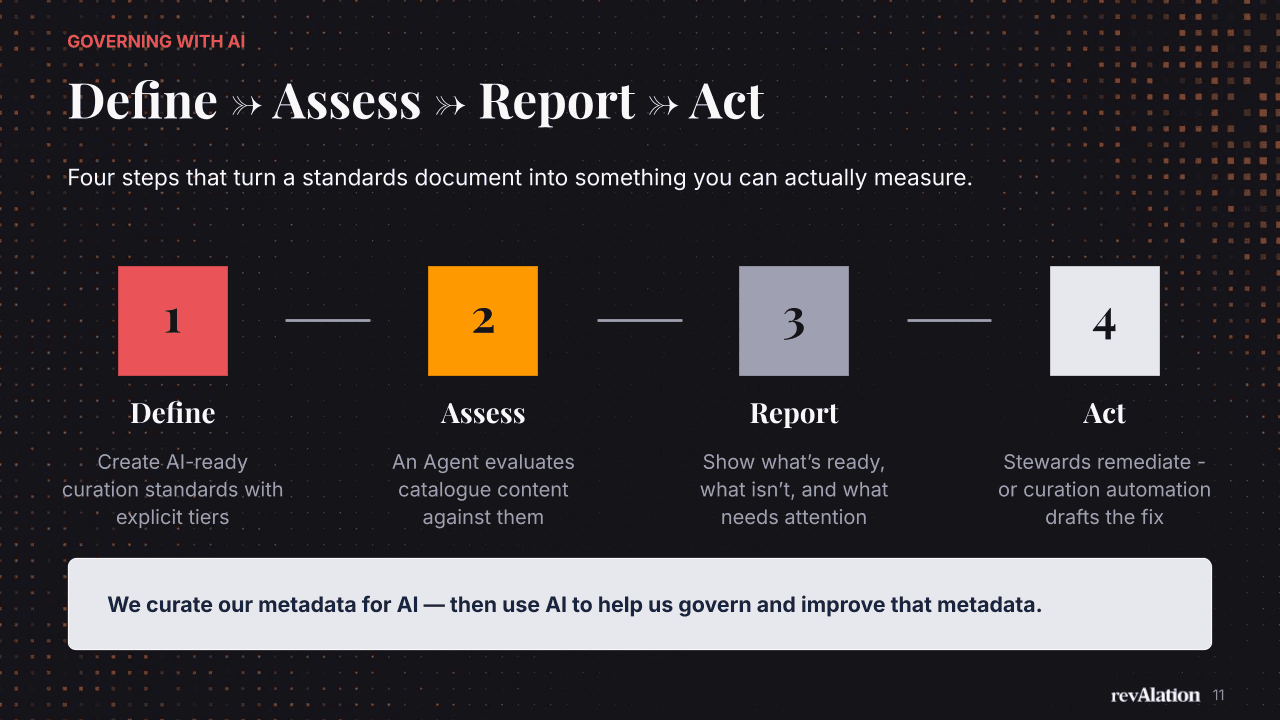
So the agent is deliberately advisory, with one exception. After the agent identifies each table's tier, it asks for confirmation and, if approved, sets the tier in a drop-down field on the table. It is a small, reversible write that is easy to review. The tier then becomes context for the next piece of automation, which is where the loop closes. As Davie put it, "we're using AI to govern for AI." The tier tag on a table gives a future agent something to act on.
The operating model keeps humans in charge, as the BBC runs a federated approach: A central team sets standards and provides tooling, and data stewards in each domain do the curation. The rollout goes domain by domain, and the steward education includes this tooling. Human review is critical to trust and to culture, because not everyone is ready to unleash an agent at scale.
This sequencing matches what the BBC's Nathalie Berdat described in her interview about governing data and AI when trust is key.⁹ Before agents get autonomy, an organization needs clear ownership, documented lineage, and machine-readable governance rules.⁹ A readiness standard and an advisory agent are a practical way to build that foundation. It is the same logic behind Alation's approach to agentic data governance, where automation scales stewardship while people stay accountable.¹⁰
What should other data leaders take from the BBC's approach?
Davie closed with four pieces of advice:
Write the standard. Tier it in whatever way suits you, and spell out exactly what each tier requires, in a form an AI can read.
Start advisory. Have the agent suggest rather than change, apart from small actions like flipping a switch.
Make compliance visible. In his words, “a standard that nobody measures, that nobody understands, doesn't really matter even if it says AI ready.” People need to know what the label means.
Build the loop. AI governing for AI is how an organization gets more reliable work from agents while stewards move to higher-value tasks.
A fifth lesson comes from Rish, the session host: publish your results. Executive observations like those the agent generates are the proof points that turn a governance program from overhead into a visible contributor to AI progress.
For teams starting out, the underlying principle is that the metadata in your catalog does double duty. It is the context agents read, and it is the record of how ready that context is. Keeping both in one governed system means the standard, the assessment, and the verdict stay connected. It is also what makes the promise of governed AI/BI achievable: the same metric, the same answer, no matter who or what is asking.¹¹
Frequently asked questions
What is AI-ready data?
AI-ready data is data with enough documented context for an AI agent to use it correctly without guessing. That means business definitions written down, key columns described, ownership clear, and known limitations stated. The BBC's three-tier model gives that idea a measurable form.²
How do you measure whether data is ready for AI agents?
Write an explicit standard, then assess assets against it. The BBC's governance team has designed an agent that compares catalog descriptions and related fields to written curation policies and assigns each asset a tier.² Running that assessment with an agent makes it repeatable across a whole domain, with stewards reviewing the results.
How many readiness tiers do you need?
The BBC uses three: human-readable, AI-usable, and chat-ready. Davie says it may become two, since the first two have some overlap and AI is improving all the time.² The right number is the one that lets you state clearly what each level requires.
Should AI agents be allowed to change metadata automatically?
Start with advice. In the design Davie described, the agent recommends actions and makes one low-risk change, setting an asset's tier after a person confirms it.² Wider autonomy comes later, as trust in the agent's accuracy builds.
What is the difference between governing for AI and governing with AI?
Governing for AI means preparing data so agents can use it, through standards, descriptions, and context. Governing with AI means using agents to help with that preparation, such as assessing metadata or drafting fixes. Each strengthens the other.
Curious how curation standards and agents can support your AI readiness program? Book a demo with us today.
Sources & citations
The sources for the claims in this post are listed here. Items marked as session remarks come from the recording, not a public web page.
Gartner, "Lack of AI-Ready Data Puts AI Projects at Risk" (Q&A with Roxane Edjlali), press release, 26 February 2025. Supports the 63% survey finding and the point that proving AI readiness depends on metadata that aligns, qualifies and governs data. https://www.gartner.com/en/newsroom/press-releases/2025-02-26-lack-of-ai-ready-data-puts-ai-projects-at-risk
Session remarks and live demonstration: Rob Davie (BBC), Rish (Alation) and the session host, [event name], [date]. Covers all quotes, the tier model, the agent design and safeguards, the operating model, the closing advice, and the Traitors example. [Add recording link if public; confirm every quote verbatim and get BBC comms sign-off.]
BBC Group Annual Report and Accounts 2024/25. Supports weekly reach (84% of UK adults), weekly active accounts (23.6 million against a target of 23 million or more), the average value-for-money rating (five out of ten) and the rise in impartiality scores. https://assets.publishing.service.gov.uk/media/6876519139d0452326e28ec7/BBC_Annual_Report___Accounts_24_25_final_accessible.pdf
Alation, "Critical Data Elements Explained: Defining, Governing, and Automating CDEs," 20 February 2025. https://www.alation.com/blog/critical-data-elements-definition-governance-automation/
Alation, "From Broadcast to Breakthrough: Inside the BBC's Data Product Transformation," 22 May 2025. https://www.alation.com/blog/bbc-data-product-transformation/
UK Government, Find a Tender, contract award notice 2024/S 000-040206 (BBC "Data Catalogue"): open procedure, 14 tenders received, contract awarded to Alation Inc, concluded 8 October 2024, published 13 December 2024. Accessed 15 October 2026. https://www.find-tender.service.gov.uk/Notice/040206-2024
Alation Marketplace product page, accessed 15 October 2026. Supports plain-language search, access requests through an existing workflow, and chat from a listing. https://www.alation.com/aios/marketplace/
Alation Agents product page, accessed 15 October 2026. Supports native agents, cloning an agent to change its prompt, tools or model, and Agent Studio. https://www.alation.com/aios/agents/
Alation, "How the BBC Governs Data and AI When Trust Is Key," 28 August 2026. Supports Berdat's requirements of clear ownership, documented lineage and machine-readable governance rules before agent autonomy. https://www.alation.com/blog/bbc-data-ai-governance/
Alation Agentic Data Governance solution page, accessed 15 October 2026. Supports "agents propose and people approve." https://www.alation.com/solutions/agentic-data-governance/
Alation Governed AI/BI solution page, tagline "Same metric, same answer, no matter who or what is asking," as shown in live site navigation, accessed 15 October 2026. https://www.alation.com/solutions/governed-ai-bi/
Analyst attribution and disclaimer
Gartner, Lack of AI-Ready Data Puts AI Projects at Risk (Q&A with Roxane Edjlali), press release, 26 February 2025.
Gartner does not endorse any vendor, product or service depicted in its research publications and does not advise technology users to select only those vendors with the highest ratings or other designation. Gartner research publications consist of the opinions of Gartner's research organization and should not be construed as statements of fact. Gartner disclaims all warranties, expressed or implied, with respect to this research, including any warranties of merchantability or fitness for a particular purpose. GARTNER and Magic Quadrant are registered trademarks and service marks of Gartner, Inc. and/or its affiliates in the U.S. and internationally and are used herein with permission. All rights reserved.
- AI
- Customer Stories
- Data Governance
- Data Products
- Digital Transformation
Keep reading
More from the data desk