

Quick answer: Governed agent discovery is the practice of finding the AI agents running across an enterprise’s platforms, registering each in a single inventory, and linking every agent to the use case it serves and the data it depends on. It treats discovery as a governance control rather than a directory: what an agent can find should be decided by policy, not just by what exists.
In Alation, the AI Asset Registry in AI Governance ingests agents from connected platforms and the SDK.¹
This guide covers discovery in the governance sense. It isn’t about the protocol mechanics of A2A agent cards or MCP.
What is governed agent discovery?
Nearly three in four organizations are already giving agentic AI access to their data and processes, whether they are piloting agents, scaling them, or running them in production.² That access can spread across teams and platforms without any single point of coordination. One team builds a copilot, another ships a notebook-based agent, and a third switches on a vendor feature. Governed agent discovery gives an organization a systematic way to account for that spread, so that it can say which agents exist, what each one is for, and what data each one touches.
Governed agent discovery is a repeatable process with three parts:
Find. The process identifies the agents running on the platforms the enterprise has connected.
Register. It records each agent in a single inventory rather than leaving it in the platform where it was built.
Link. It associates each agent with the use case it serves and the data it depends on, so that questions about risk and compliance can be answered from the record instead of being reconstructed by hand.
The word governed separates this practice from a simple, static directory. A directory only lists what exists. Governed discovery adds a control layer, because your governance policy determines what an agent can find and later call, so access doesn’t depend solely on what happens to be reachable. That distinction runs through the rest of this guide.
Why does agent discovery need governance?
Governance processes weren’t built for the rapid pace of agentic innovation taking place today. Grant Thornton’s 2026 AI Impact Survey report argues that most governance models were not built for the volume of AI use cases organizations are now deploying, and 78% of the executives surveyed lack strong confidence they could pass an independent AI governance audit within 90 days.² An agent can be built, connected to data, and put in front of users in a matter of hours. A spreadsheet inventory, or a review process that runs quarterly, describes the estate as it was.
Discovery has to come before authorization: you can’t authorize an agent you haven’t found. That is only half the job, though. Knowing an agent exists doesn’t tell you what it stands on. An agent is only as governable as your ability to trace it to the data it consumes, and to know whether that data is certified, current, and covered by policy.
Identity and inventory tell you who an agent is. They don’t, on their own, tell you which regulations apply, what data feeds it, or what changes if that data changes. Governed agent discovery closes that gap by keeping the answers in one place, so compliance and risk teams aren’t assembling evidence from separate platform views.
How is governed agent discovery different from an agent registry or inventory?
Discovery, registry, and inventory are often used interchangeably, but each term describes a distinct part of the work, and keeping them separate clarifies what each one contributes. Discovery is the process of finding agents. A registry is the system of record that the process populates. Lineage and authorization are capabilities that build on that record, because neither can be applied reliably to agents the organization has not first found and recorded.
Concept | The question it answers |
|---|---|
Discovery | Which agents exist across our connected platforms? |
Registry | What do we know about each one, in one place? |
Lineage | What data does each agent depend on, and what risk does that carry? |
Authorization | What is each agent allowed to find and call? |
Read together, the four concepts form a sequence: discovery finds the agents, the registry records them, lineage connects each one to its data, and authorization governs what each one may do.
In Alation, the registry is part of AI Governance. It holds models, agents and tools, so it is broader than an agent registry in the narrow sense.¹ Discovery is how agents get into it: from connected platforms, or by submission through the SDK.¹ Once an asset is in, it gets a searchable profile with lineage to its upstream data dependencies.¹
How does governed agent discovery work?
Governed agent discovery follows a sequence of four steps that carries an agent from the platform where it was built to a governed record connecting it to a business purpose, to its data, and to the regulations that apply to it. Each step builds on the one before it, so the order matters.
Connect the platforms where agents are built. Alation provides six native connectors: Amazon Bedrock, Amazon SageMaker, Databricks MLflow, Microsoft Copilot Studio, Microsoft Foundry and Snowflake Cortex.⁴ That covers agents built on AWS (Bedrock, SageMaker), Databricks (MLflow), Snowflake (Cortex) and Microsoft (Copilot Studio, Foundry). Agents built elsewhere can be registered through the SDK.³
Register each agent in the registry. Each registered asset links to the use case it serves, which gives the agent a business context instead of just a platform name.³
Link each agent to its data and set its risk. Lineage ties the agent to its upstream data dependencies.¹ In Alation, the owner of the use case sets its risk tier.³
Map assets to regulations and monitor posture. AI Governance includes built-in support for the EU AI Act, the AI-relevant subsets of GDPR, NIST AI RMF and ISO 42001. Teams can add other regulations.¹ The result is a compliance posture available on demand, not assembled before an audit.¹
Together, these steps replace a loose collection of agents with a governed record. Registration establishes which agents exist and what each one is for, and lineage establishes what each one depends on. The next section looks at what that additional layer makes possible.
What does agent lineage add?
Registration establishes which agents exist and what each one is for. It does not, on its own, show what each agent depends on, and that dependency largely determines how far the agent’s answers can be trusted. Lineage supplies the missing view by connecting each agent to the data beneath it.
Agent lineage tracing, part of AI Governance, traces each agent’s regulatory risk through the live data it consumes.⁴ As a result, an agent’s risk can be understood in terms of the data it actually uses, rather than only in terms of the platform it runs on or the purpose it was registered for.
Consider an agent that answers finance questions from a table whose quality checks have started failing. Without lineage, that failure appears in a data-quality report that no one associates with the agent, and the agent keeps producing answers that look authoritative. With lineage integrated, the failing table can be traced to the agents that depend on it, so the people responsible can see which agents are affected and decide how to respond.
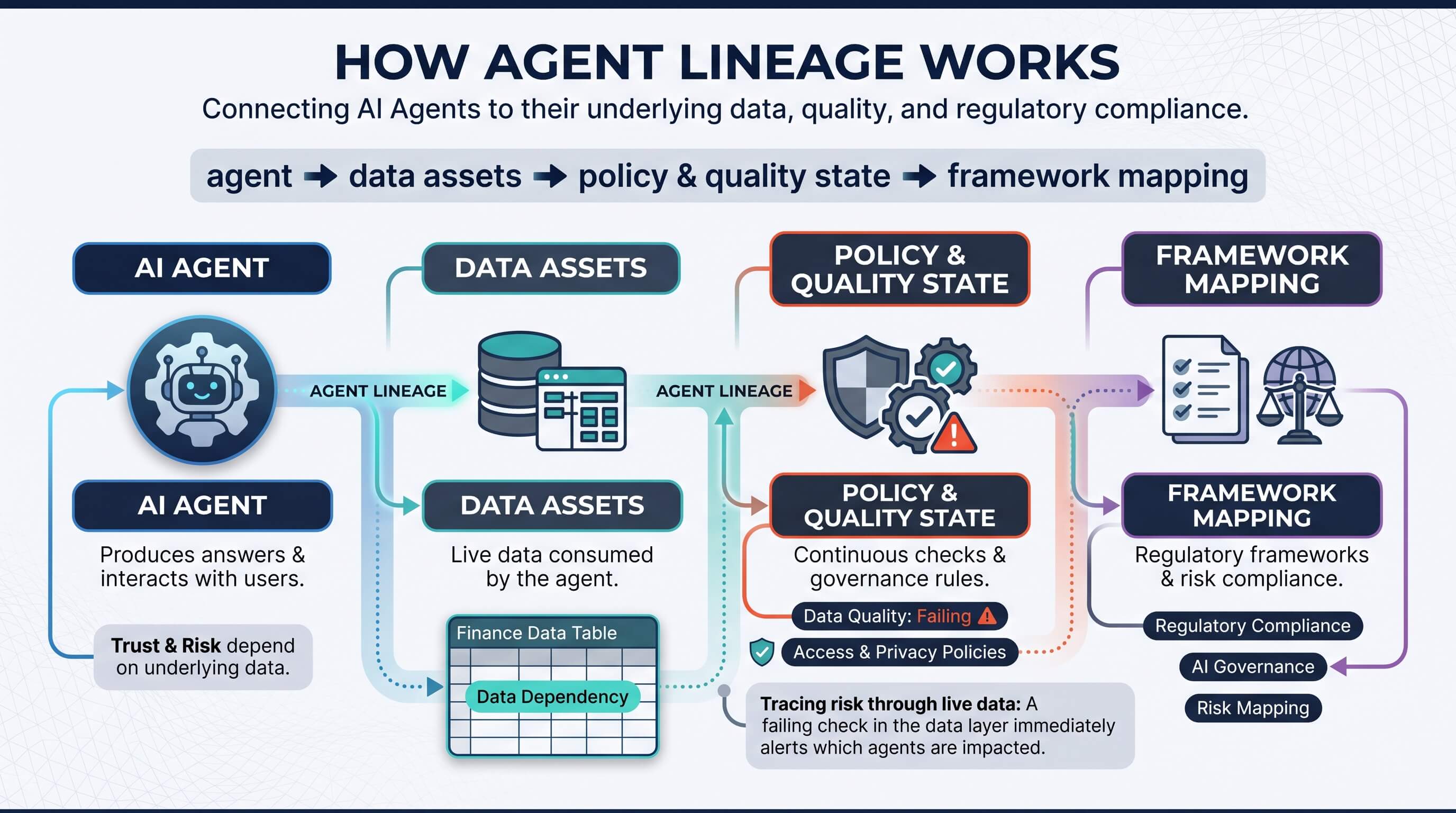
This matters for discovery because the answers to the most consequential governance questions sit in the data layer, in lineage, quality, and policy state. Which regulations apply to an agent, what data feeds its answers, and what changes when that data changes are all questions about the data, and governed agent discovery looks for the answers there. That is why it links each agent to its data and not only to the platform where it was built.
Knowing what an agent depends on is only part of governing it, however. The next section turns to the remaining question of what each agent is permitted to see and to do.
How does discovery-time filtering differ from invocation-time authorization?
Whenever an agent works with tools, two separate moments determine what it can do, and governing only one of them leaves a gap. The first is discovery time, when the agent learns which tools are available to it. The second is invocation time, when the agent attempts to use one of those tools. Each answers a different question, and each calls for its own control.
At discovery time, the question is what the agent gets to see. Filtering at this stage limits the tools an agent is shown, so that the tools it should not use never appear in its list. At invocation time, the question is what the agent is allowed to do when it makes a call. Authorization at this stage evaluates the specific request against policy and permits or refuses it.
Visibility is not permission. An agent that can see a tool has not thereby been authorized to use it, and an agent that has been authorized to use a tool should not be able to see tools it has no reason to know about. A tool list that shows everything invites calls that policy must then refuse, which increases the number of refusals and widens the surface that has to be defended. Filtering what is listed narrows that surface from the start. Checking at the moment of the call is what actually enforces the rule, because a list can be incomplete, outdated, or bypassed, while a check at invocation applies to the request as it is made. A sound design therefore uses both controls: filtering reduces what the agent can attempt, and authorization decides what it is permitted to complete.
This distinction applies directly to MCP servers, where the tool list an agent receives is its discovery surface. The next subsection looks at how that works in practice.
How does this apply to MCP servers?
MCP servers expose tools to agents, which makes the tool list the discovery surface. Alation’s remote MCP server resolves its tool list dynamically, which means it can filter out tools the current user cannot use when it lists tools.⁵ See Connectors + SDKs for setup.
Filtering is one piece. The other is knowing whose authority an agent acts under. For how an agent’s own identity can be bound to a delegating human’s limits, with an expiry on the grant, see Who Authorized Your AI Agent?⁶ And for the other side of enforcement, a record of what an agent was refused, by whom and when, see Context Tells an Agent What It Knows. Permissions Decide What It Can Do.
Does governed agent discovery catch shadow AI agents?
It catches them in part, and how much it catches depends on how completely an organization connects its platforms and registers what it builds. Shadow agents are agents that operate without the knowledge or approval of the teams responsible for governance, and the hardest to manage are those that never appear in any inventory. Governed agent discovery addresses that problem within defined boundaries, and knowing those boundaries is what lets an organization rely on the approach appropriately.
What falls within scope
Agents on connected platforms are in scope, as are agents registered through the SDK.¹ For platforms with a native connector, agents are ingested from the platform itself. For platforms without one, agents can be registered through the SDK from wherever they are built.³ This extends coverage beyond the native connectors, provided that someone completes the registration.
What falls outside scope
An agent built outside both paths, such as a script running on a laptop or a tool on a platform that has not been connected, is not something this approach claims to detect. Such an agent remains outside the registry unless someone registers it. Until then, it has no recorded use case, no mapped data dependencies, and no evidence trail.
How to narrow the gap
Organizations can shrink the uncovered area through process choices as well as technology. Connecting every platform in use that has a native connector reduces the number of agents that can go unrecorded. Treating SDK registration as a required step before an agent is released closes much of the remainder. Comparing the registry with the teams and platforms known to build agents also helps, because an unexpected absence is often the first sign that an agent has gone unregistered.
What stays with other layers
Governed agent discovery is one layer among several and does not replace the others. Provisioning, secrets, and rotation stay with your identity provider, because Alation does not issue, rotate, or expire credentials.⁶ What Alation holds is the register, the evidence trail, and the policy that follows the data.⁶ Finding an agent that was never registered calls for controls outside the registry, such as those an organization already operates for its network and workloads. Once such an agent is found, it can be registered, which brings it into the same record as the rest.
Together, these boundaries show what governed agent discovery covers and where it depends on other controls. The next section describes how Alation provides the registry, lineage, and connectors discussed so far.
How does Alation do this?
Alation AI Governance brings these pieces together. The AI Asset Registry is a single inventory of models, agents and tools, ingested from connected platforms or submitted via the SDK.¹ Agent lineage tracing connects each agent to the live data it consumes.⁴ The remote MCP server and the AI Agent SDK expose catalog context to agents built in other stacks, and Agent Studio is where agents are created, refined and deployed.⁵ Related capabilities, including Ontologies and Governed Collections, are in early access.⁴
FAQ
What is governed agent discovery? It is the practice of finding the AI agents running on an enterprise’s platforms, registering each in one inventory, and linking each to its use case and the data it depends on. It treats discovery as a governance control, so policy shapes what an agent can find.
Is it the same as an agent registry? No. Discovery is the process that finds agents, and the registry is the system of record it feeds. The AI Asset Registry in Alation AI Governance covers models, agents and tools, so it is broader than an agent registry alone.¹
Does it find agents outside connected platforms? The AI Asset Registry ingests agents from connected platforms and accepts agents registered through the SDK.¹ An agent built outside those paths isn’t in the registry unless someone registers it, so pair it with identity and network controls.
How does it differ from identity or NHI discovery? Identity-based discovery starts from the agent’s identity. Governed agent discovery links each registered agent to its use case and the data it depends on. The two complement each other, and your identity provider keeps provisioning, secrets and rotation.⁶
Which platforms are supported? Six native connectors: Amazon Bedrock, Amazon SageMaker, Databricks MLflow, Microsoft Copilot Studio, Microsoft Foundry and Snowflake Cortex.⁴ Agents from other platforms can be registered through the SDK.³
Which regulations does it map to? AI Governance has built-in support for the EU AI Act, the AI-relevant subsets of GDPR, NIST AI RMF and ISO 42001. Teams can add other regulations.¹
Related reading
Sources & notes
Every external claim on this page is independently verifiable. The public sources are listed here.
AI Asset Registry: a single inventory of models, agents and tools; assets ingested from connected platforms or submitted via SDK; each asset has a searchable profile with lineage to its upstream data dependencies; built-in support for the EU AI Act, AI-relevant subsets of GDPR, NIST AI RMF and ISO 42001, with additional regulations supported; live compliance posture on demand. — Alation press release, May 11, 2026. ↗ https://www.alation.com/news-and-press/alation-announces-new-ai-governance-offering/
Nearly three in four organizations are giving agentic AI access to their data and processes; 78% of business executives lack strong confidence they could pass an independent AI governance audit within 90 days; the report argues most governance models were not built for the volume of AI use cases being deployed. Survey of 950 business leaders across 10 industries, fielded February 23–March 18, 2026. — Grant Thornton, 2026 AI Impact Survey Report. ↗ https://www.grantthornton.com/services/advisory-services/artificial-intelligence/2026-ai-impact-survey
Models and agents can be registered via SDK; each asset links to the use case it serves, the data it depends on and the catalog entry that governs it; the owner sets a risk tier. — Alation AI Governance solution page, accessed October 20, 2026. ↗ https://www.alation.com/solutions/ai-governance/
Six native connectors (Amazon Bedrock, Amazon SageMaker, Databricks MLflow, Microsoft Copilot Studio, Microsoft Foundry, Snowflake Cortex); agent lineage tracing for each agent’s regulatory risk through the live data it consumes; AI Governance enhancements available now; Ontologies, Intelligent Feeds, Console and Governed Collections in early access. — Alation press release, September 17, 2026. ↗ https://www.alation.com/news-and-press/alation-launches-aios-tm-expansion-with-six-products-that-accelerate-ai-transformation/
The remote MCP server resolves its tool list dynamically and can filter out tools the current user cannot use; the MCP integration exposes context capabilities to any MCP client; Agent Studio supports creating, refining and deploying agents. — Alation AI Agent SDK README (November 4, 2025 update), accessed October 20, 2026. ↗ https://github.com/Alation/alation-ai-agent-sdk
Your identity provider handles provisioning, secrets and rotation; Alation does not issue, rotate or expire credentials and holds the register, the evidence trail and the policy that follows the data; an agent’s identity can be bound by a delegation record to a human’s limits, with an expiry on the grant. — Alation blog, “Who Authorized Your AI Agent? A Chain of Command for Autonomous Actions,” September 28, 2026. ↗ https://www.alation.com/blog/ai-agent-delegated-authority/
- AI
- Cloud Transformation
- Data Catalog
- Data Intelligence
- Data Quality
- Digital Transformation
Keep reading
More from the data desk