
If you're a chief information officer (CIO), chief data officer (CDO), chief data and analytics officer (CDAO), or chief operating officer (COO), you've likely already had ISO 42001 land on your desk in a vendor questionnaire, a board deck, or a Request for Proposal (RFP) you're trying to win. ISO/IEC 42001 is the first global standard built specifically for AI management systems, and it's what procurement teams and auditors default to when they need proof an AI program is under control.1
This guide walks through what ISO/IEC 42001 actually requires, how certification works, and where it sits next to standards you may already hold. It's for anyone trying to prove on paper and in production that their AI is under control.
Beyond compliance: How ISO 42001 supports best practices in enterprise AI development
An auditor checking ISO 42001 compliance wants evidence that risk decisions were made on purpose, not assumed. A procurement team scanning for the same certificate is asking something related but distinct: can this vendor's AI be trusted with our data and our exposure, without us auditing it ourselves?
But scoping ISO 42001 certification only to what a regulator or a buyer demands undersells what the discipline behind it is actually for. Raza Habib, CEO of the LLM evaluation platform Humanloop, made the point directly on Alation's Data Radicals podcast: regulators are starting to require certain practices, like tracking the data a system was built on, versioning changes to it, running repeatable evaluations, and keeping a real audit trail.2 But these are all also what building AI well looks like, compliance mandate or not. Habib's argument is that this discipline is what lets a team answer a concrete question: is the system actually better than it was three months ago, or does it just feel that way?
That reframes what ISO 42001's Plan-Do-Check-Act (PDCA) cycle is doing. Checked once a year for an audit, it's an AI compliance ritual. Run continuously, it's the same discipline Habib is describing, and it's the difference between assuming a model is still accurate and actually knowing.
Certification proves that discipline existed on audit day. What happens on every other day is a separate question, and it's the one the rest of this guide is built around.
What does ISO/IEC 42001 actually require of an AI management system?
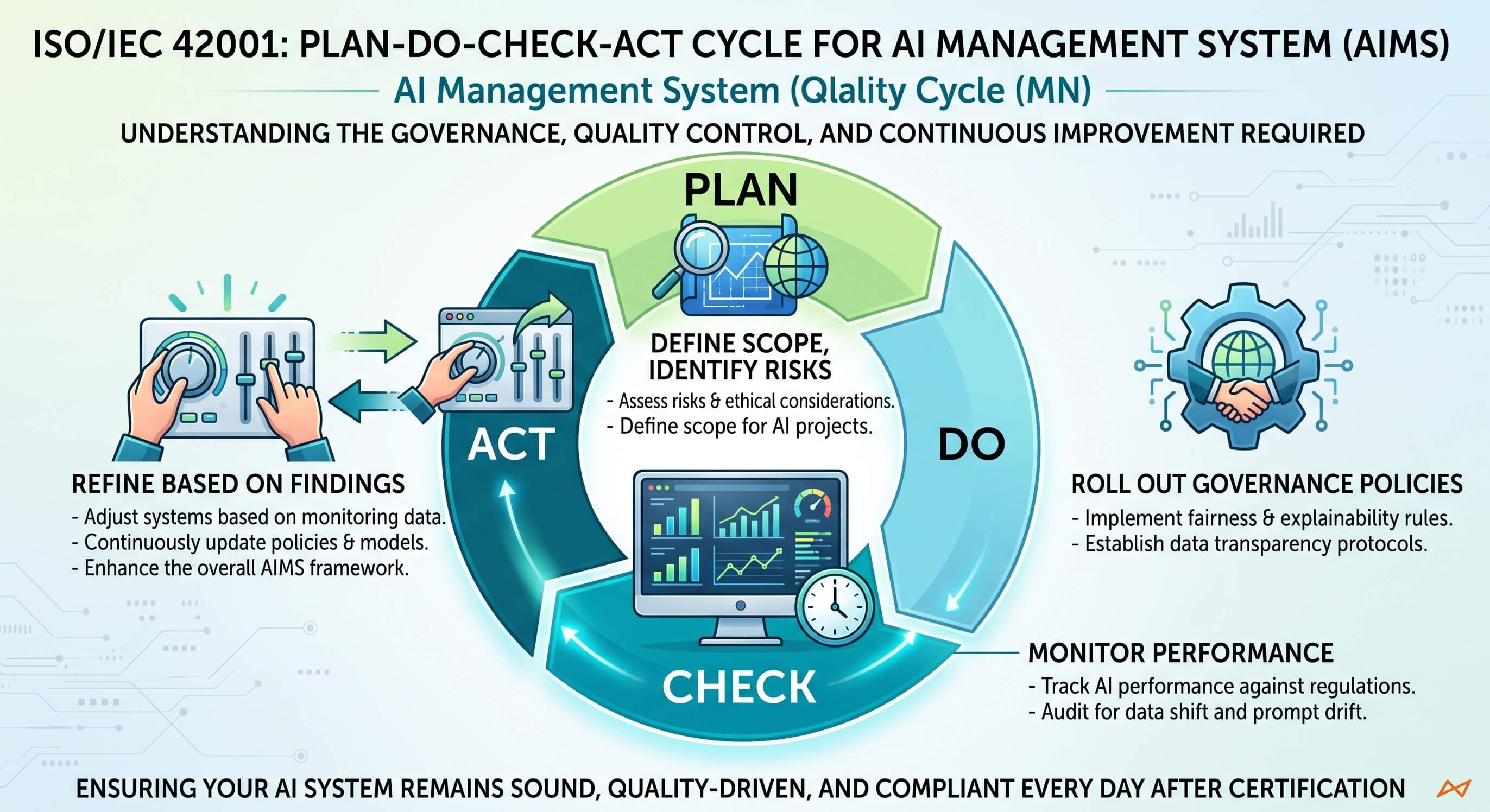
ISO/IEC 42001 defines the requirements for an AI management system (AIMS) as: the set of policies, processes, and controls an organization puts in place to govern how it designs, develops, deploys, and uses its AI systems.3 AIMS runs on the same Plan-Do-Check-Act cycle as other ISO management-system standards, like ISO 9001 (quality management) and ISO 14001 (environmental management):4,5
Plan: define scope, identify risks and ethical considerations up front
Do: roll out governance policies for fairness, explainability, and data transparency
Check: monitor AI performance against evolving regulations and internal benchmarks
Act: refine the system based on what monitoring turns up
Most AI programs are strong on Plan and Do and thin on Check and Act. That's the pattern behind what teams running production AI have started calling the day 180 problem. On day one, the prompts are stable, the tools are stable, the context is current, and the data is clean. By day 180, the prompts have drifted, the tools have been versioned, the context has decayed, and the data has shifted beneath it all. Nothing broke loudly. The system just stopped being as accurate as the documentation says it is.
Klarna's AI customer-service rollout is a live example of what happens when the Act step doesn't run. In February 2024, its AI assistant was handling 2.3 million conversations a month and had cut average resolution time from 11 minutes to under 2.6 By 2025, CEO Sebastian Siemiatkowski was telling Bloomberg that cost had become too high at the sacrifice of quality.7 The company began rehiring human agents to fix what the AI had gotten worse at over time.
An AIMS names an owner for that quality threshold before launch rather than after a public reversal. It documents who owns model updates, how output quality gets tested before each release, and what happens when a confident answer turns out to be wrong.
In most organizations, that record doesn't exist in one place. The workflow for reviewing, approving, and documenting an AI system lives wherever the conversation happened to start: Slack threads, email chains, SharePoint pages, Jira tickets. Alation AI Governance is designed to be the system of record for that work, so the approvals, evidence, and ownership an auditor asks for are a live record rather than a deck assembled the week before the audit committee meets.
Certification confirms your AI management system was sound on the day it was examined. Keeping it sound every day after is a different discipline, and it's the one the closing section of this guide comes back to.
Why does ISO 42001 require third-party certification?
ISO 42001 requires an accredited third-party auditor because self-attestation can't be trusted to catch what actually goes wrong with AI, like bias, explainability gaps, and ungoverned model changes. System and Organization Controls 2 (SOC 2) built its credibility on that same third-party model, but its scope stops at security, availability, and operational controls.8 It has no mechanism for asking who reviews a model's outputs or how bias gets tested before release. ISO 42001 takes that audited, third-party structure and applies it specifically to AI: risk management, human oversight, and continual monitoring built into what gets certified.
ISO requires certification bodies to clear an AI-specific accreditation bar (ISO/IEC 42006) before they're allowed to audit against ISO 42001, on top of the general management-system accreditation that covers standards like ISO 27001.9 A body accredited for one isn't automatically qualified for the other.
For AI consultants and system integrators (SIs), scoping the certification path means verifying that the third-party auditor is accredited for ISO 42001 certification, specifically.
ISO 42001 vs. ISO 27001: How do the two standards compare?
If your organization already holds ISO 27001, the real question is what gap ISO 27001 leaves open now that AI is in the picture. CIOs, CDAOs, and the compliance leads scoping an AI program often assume information-security certification already covers AI risk, since both are ISO management-system standards built on the same underlying structure. It doesn't. ISO 27001 secures your data, and ISO 42001 governs what your AI does with it. That difference decides where your next audit budget actually needs to go.
ISO 27001 | ISO 42001 | |
Focus | Information security | AI-specific risk |
Core concern | Confidentiality, integrity, and availability of data | Bias, explainability, lifecycle risk, third-party AI oversight |
Applies to | Any org handling data | Orgs building, deploying, or using AI systems |
If you already hold ISO 27001, you're not starting from zero. Both standards follow ISO's Harmonized Structure, a common template that ISO requires for every management-system standard it publishes.10 Using this ensures that standards covering completely different subjects still share the same clause structure, core terminology, and definitions. That shared template is what lets an organization certified against ISO 27001 reuse a meaningful share of its documentation when it takes on ISO 42001 certification, instead of starting a second program from scratch.
But the overlap has a limit. Say your team bolts a generative AI assistant onto a platform that's already ISO 27001-certified. The security controls covering the underlying data don't say anything about whether the model's outputs are biased, explainable, or safe to act on. You need both ISO 27001 and ISO 42001 if AI touches sensitive information. And once AI is in the picture, the next question is which regulation or framework actually tells you what "responsible" means for your specific use case.
Does ISO 42001 overlap with the EU AI Act and NIST AI RMF?
ISO/IEC 42001 doesn't compete with the EU AI Act or NIST AI RMF. Instead, it's the operational layer that can satisfy pieces of both at once. ISO 42001's risk-assessment clauses map closely onto the EU AI Act's Article 9 risk management requirements for high-risk systems under Annex III, set to go into enforcement December 2, 2027.11,12 For CIOs and CDAOs running programs against multiple frameworks at once, that overlap is the difference between building three separate compliance efforts and building one AIMS that does double duty:
Risk management: The EU AI Act requires providers of high-risk systems to run a risk management system across the AI lifecycle. ISO 42001 requires the same through its risk assessment and treatment clauses.
Data governance: The EU AI Act sets requirements for training, validation, and testing data quality. ISO 42001's Annex A includes dedicated data-management controls covering similar ground.13
Human oversight: Both require a human able to understand, monitor, and intervene in an AI system's outputs, not just a technical log of what happened.
Technical documentation and record-keeping: The EU AI Act's Article 11 requires technical documentation before a system reaches the market, and Article 12 requires automatic logging of system events over its lifetime.14,15 These map to ISO 42001's requirements for documented information and traceable records.
Transparency: The Act requires disclosing AI use and system limitations to affected people. ISO 42001 has its own transparency and communication requirements covering similar ground.
Continual monitoring and improvement: The EU AI Act's post-market monitoring duty and ISO 42001's Check/Act cycle both require watching for and correcting drift after deployment, not just at launch.
Running one program against three frameworks only works if the mapping between them is maintained somewhere other than a spreadsheet. Alation AI Governance includes built-in support for key frameworks including the EU AI Act, GDPR (AI-relevant subset), NIST AI RMF, and ISO 42001, helping teams connect regulatory guidance to AI asset requirements. Enterprises can extend this with additional regulations, with AI-assisted suggestions to accelerate requirement mapping.
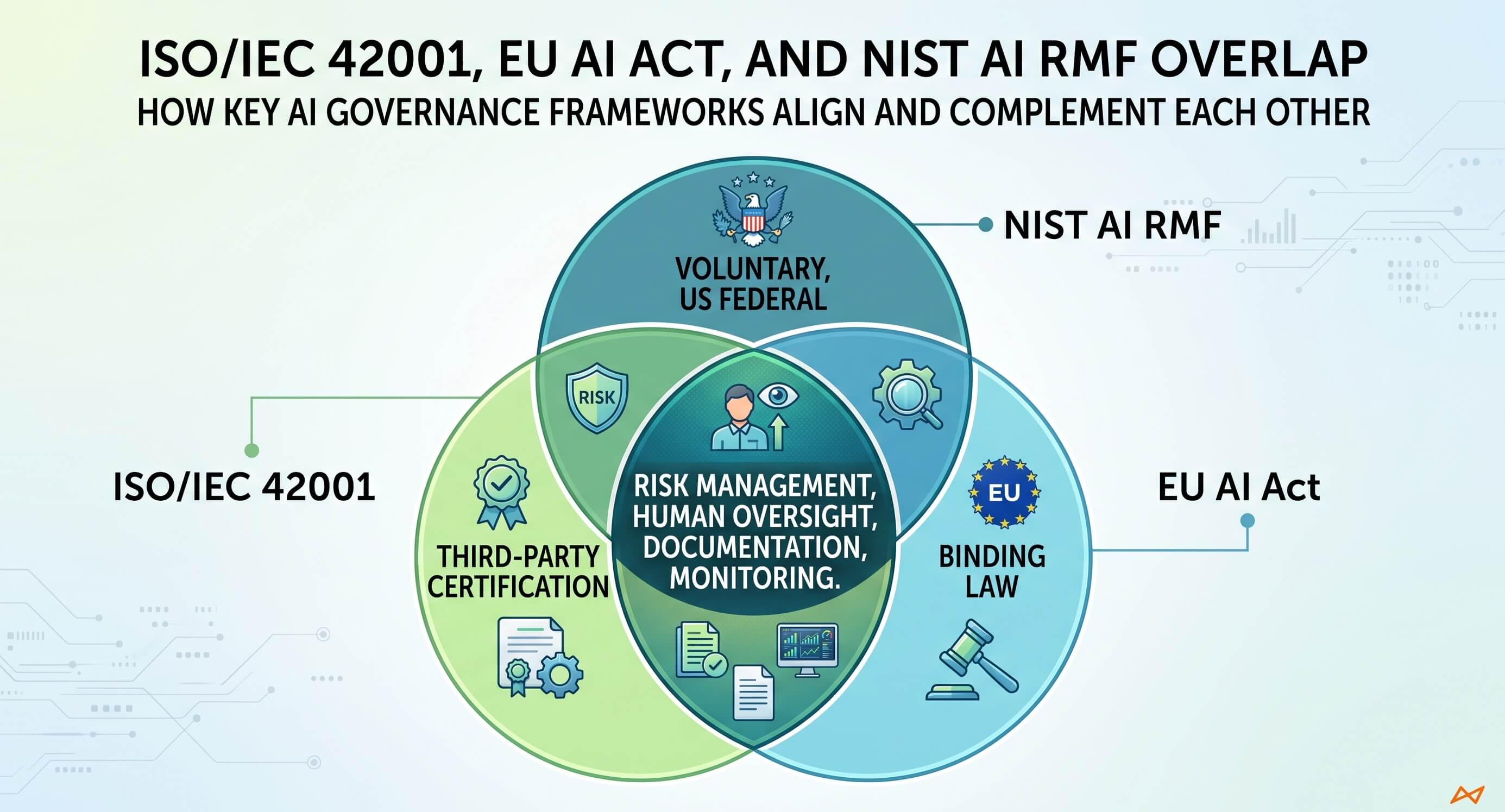
Organizations already working from NIST's AI RMF will recognize a similar rhythm in ISO 42001's PDCA loop. NIST's framework runs on four functions (Govern, Map, Measure, Manage), and Govern in particular does the same job that ISO 42001's leadership and policy clauses do: setting the accountability structure that the other functions run within.16
How is ISO 42001 used in practice?
For the practitioners and advisors actually running these programs, ISO 42001 does four things day to day. It catches AI-specific risk before it becomes a public problem, manages the risk introduced by vendor and embedded AI tools, keeps a program aligned to regulation as it lands, and gives legal, compliance, and technical teams one shared framework instead of three separate ones.
Risk management: Catching AI-specific risks like bias, security gaps, and unintended outcomes before they turn into expensive, public problems
Third-party AI oversight: Managing risk introduced by vendor and embedded AI tools most organizations didn't build in-house
Regulatory alignment: Mapping to the EU AI Act and other AI-specific regulation as it lands, instead of reworking your program every time a new law passes
Internal accountability: One shared framework for legal, compliance, and technical teams, instead of each function running its own ad hoc review
That internal work pays off outside the organization, too. ISO 42001 certification gives buyers a credential they can check, the same way SOC 2 became a standard ask in procurement.
Compliance isn't a narrower version of AI governance. It's the artifact that proves the governance program is working. Which is why the harder question isn't whether you can produce the certificate. It's whether the underlying data, context, and agents are still accurate on the days nobody is auditing them.
That's the gap Alation's intelligence operating system (AIOS) is built to close. Rather than assembling evidence when an auditor calls, feedback loops are designed to route a correction back to whichever layer actually broke: the system prompt, the tool definition, the context and data products an AI system reads from, or the data contract underneath it. The intent is that the AIMS your auditor signed off on stays accurate between audits, too.
Is your AI compliance program ISO 42001-ready?
No single person can answer that alone. Readiness means every function that touches the program can check its own box. Have each of the following confirm where they stand:
CDOs and CDAOs: Can you produce a current inventory of every AI model and agent in production?
Compliance and risk leads: Is your evidence mapped to specific ISO 42001 clauses?
AI consultants and SIs: Can your client show an auditor a live compliance posture?
COOs and VP Ops: If production drifts between certification cycles, would you know before your auditor does?
Four functions, four different systems of record, and usually no single place where the four answers reconcile. Alation AI Governance is built to close that gap: a current registry of the AI assets running in production, model documentation that stays current instead of going stale the day it's filed, an approval trail that shows who signed off on what evidence, and a compliance posture leadership can read without someone rebuilding it by hand.
If your team is still answering "not yet" to more than one of these, Alation's AI Governance Checklist breaks down what AI-readiness actually requires at the data layer, before a model or agent ever touches it.
What happens after ISO 42001 certification
Getting ISO 42001 certified proves your AI management system was sound on paper, on a specific day.
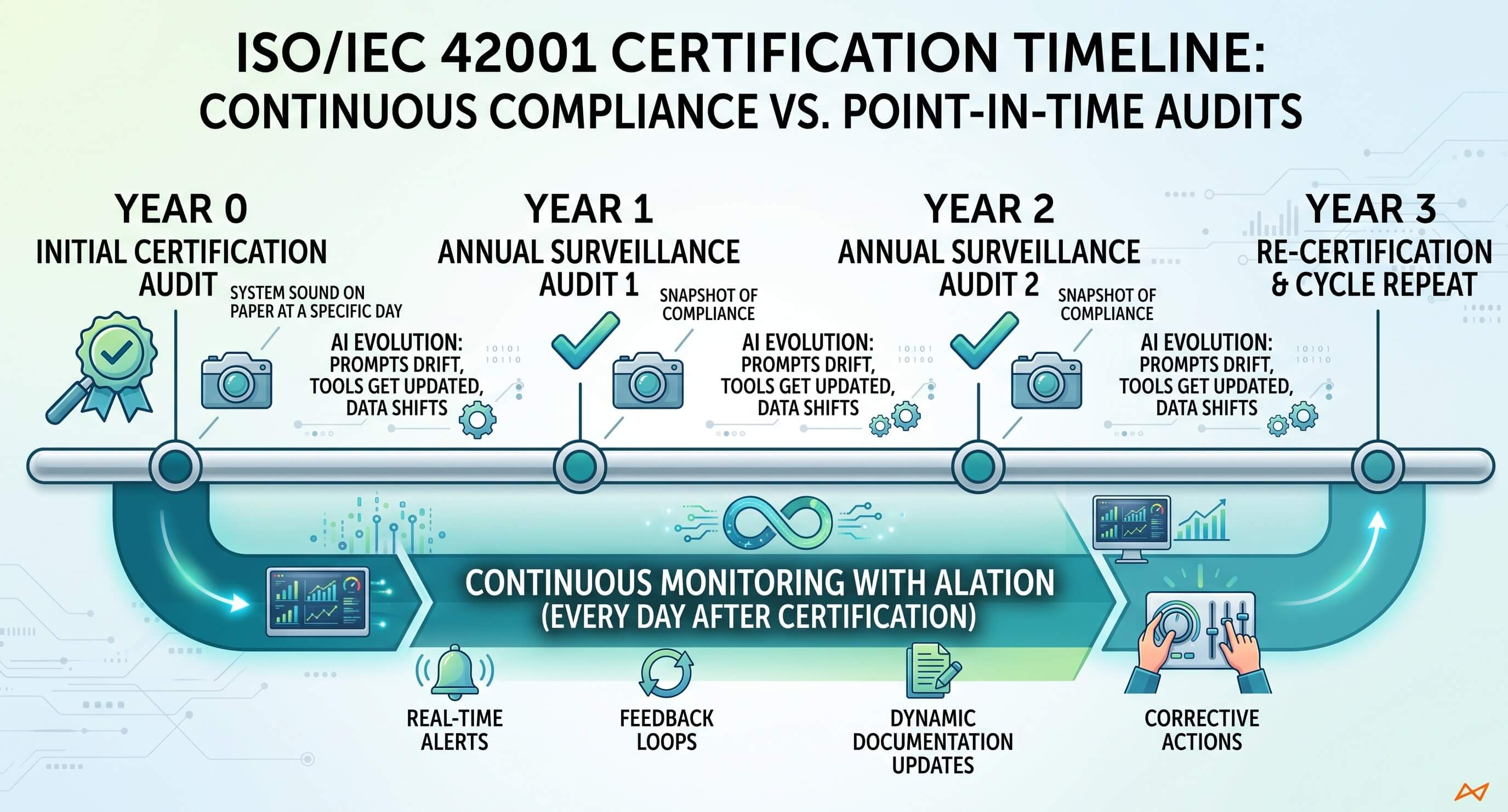
But certification runs on a three-year cycle, with annual surveillance audits conducted in between.17 AI doesn't hold still between those checkpoints. Prompts drift as your business changes, tools get updated, and data quality shifts.
That's a different problem from certification itself, and it's the one Alation is built to solve. Feedback loops are designed to route corrections back to whichever layer broke, before the next audit has to find it, keeping your documentation current as models and regulations both change.
Certification gets you through audit day. Book a demo with Alation to get it right every day after.
Frequently Asked Questions
What is the ISO 42001 certification standard?
ISO 42001 certification confirms that an accredited third-party auditor has verified that an organization's AI management system (AIMS) meets ISO/IEC 42001's requirements for risk management, human oversight, and continual monitoring.1 It certifies the management system governing how an organization designs, develops, deploys, and uses AI across its lifecycle. Certification runs on a three-year cycle with annual surveillance audits, so it confirms the system was sound at the time of audit, not indefinitely.
What is the difference between ISO 27001 and ISO 42001?
ISO 27001 secures your data. ISO 42001 governs what your AI does with it. Both are ISO management-system standards built on the same Harmonized Structure, but they cover different risk domains. ISO 27001's core concern is the confidentiality, integrity, and availability of data. ISO 42001 covers AI-specific risk, like bias, explainability, lifecycle risk, and third-party AI oversight. An organization handling sensitive data through AI typically needs both, since ISO 27001 alone says nothing about whether a model's outputs are biased, explainable, or safe to act on.
What is the difference between ISO 42001 and ISO 13485?
ISO 42001 and ISO 13485 solve unrelated problems and aren't typically compared as alternatives. ISO 13485 is a quality management standard for the design, production, and servicing of medical devices. It predates AI entirely and has no AI-specific content. ISO 42001 applies across any industry using AI, including finance, manufacturing, healthcare, and beyond.
Where the two intersect is medical AI. A medical device with an embedded AI component may need ISO 13485 to certify the device's quality management system and ISO 42001 to certify the AI management system governing the AI inside it. One doesn't substitute for the other.
What is ISO 42001 used for?
ISO 42001 is used to catch AI-specific risk before it becomes a public problem, manage risk introduced by third-party and embedded AI tools, keep a compliance program aligned to regulation as it lands, and give legal, AI compliance, and technical teams one shared framework instead of separate ad hoc reviews. It also functions as an external trust signal: certification gives buyers, auditors, and regulators a credential they can check, rather than taking a vendor's word for it. What it doesn't do is confirm ongoing accuracy. It verifies the AI management system was sound on audit day, not that the underlying models and data stay that way every day after.
Sources & notes
Every external claim on this page is independently verifiable. The public sources are listed here.
ISO/IEC 42001:2023 is the world's first international standard specifying requirements for establishing, implementing, maintaining, and continually improving an AI Management System (AIMS). International Organization for Standardization, published December 2023. https://www.iso.org/standard/42001
Raza Habib, CEO of Humanloop, argues that the practices AI regulation is starting to require are also just good AI development discipline independent of any compliance mandate. Data Radicals podcast, Alation, Season 3 Episode 8. https://www.alation.com/podcast/episodes/llm-starter-guide-raza-habib-humanloop/
ISO/IEC 42001 defines the requirements for an AI Management System (AIMS): a structured set of policies, processes, and controls that help organizations govern how AI systems are designed, developed, deployed, and used. International Organization for Standardization, "ISO 42001 explained." https://www.iso.org/home/insights-news/resources/iso-42001-explained-what-it-is.html
ISO 9001 is the International Standard for quality management systems, providing a framework that helps organizations deliver consistent products and services, improve efficiency, and meet customer and regulatory expectations. International Organization for Standardization, "ISO 9001 explained." https://www.iso.org/home/insights-news/resources/iso-9001-explained.html
ISO 14001 is the International Standard for environmental management systems, helping organizations manage their environmental impacts, comply with applicable legal requirements, prevent pollution, and improve environmental performance over time. International Organization for Standardization, "ISO 14001 explained." https://www.iso.org/home/insights-news/resources/iso-14001-explained.html
Klarna's AI customer service assistant handled 2.3 million conversations in its first month after its February 2024 launch, work the company said was equivalent to roughly 700 full-time agents, and cut average resolution time from 11 minutes to under 2. CX Dive, 9 May 2025. https://www.customerexperiencedive.com/news/klarna-reinvests-human-talent-customer-service-AI-chatbot/747586/
Klarna CEO Sebastian Siemiatkowski told Bloomberg that cost had become too dominant a factor in how the company ran its AI customer service, resulting in lower quality, and that Klarna was rehiring human agents to address it. CX Dive, reporting a Bloomberg interview, 9 May 2025. https://www.customerexperiencedive.com/news/klarna-reinvests-human-talent-customer-service-AI-chatbot/747586/
SOC 2 (System and Organization Controls 2) is the AICPA's suite of services for evaluating an organization's controls relevant to security, availability, processing integrity, confidentiality, and privacy. American Institute of CPAs (AICPA) & Chartered Institute of Management Accountants (CIMA). https://www.aicpa-cima.com/resources/landing/system-and-organization-controls-soc-suite-of-services
ISO/IEC 42006:2025 sets additional requirements for the bodies that audit and certify AI management systems (AIMS) against ISO/IEC 42001, supplementing the general management-system accreditation requirements in ISO/IEC 17021-1. International Organization for Standardization, published July 2025. https://www.iso.org/standard/42006
The Harmonized Structure is ISO's mandatory template for management system standards, ensuring that standards covering different subjects share the same clause structure, terminology, and core definitions, so an organization familiar with one ISO management system standard can more easily adopt another. International Organization for Standardization. https://www.iso.org/management-system-standards.html
EU AI Act Article 9 requires providers of high-risk AI systems to establish a risk management system as a continuous, iterative process run throughout the system's entire lifecycle, with regular systematic review and updating. European Commission, AI Act Service Desk. https://ai-act-service-desk.ec.europa.eu/en/ai-act/article-9
Rules for high-risk AI systems listed in Annex III of the EU AI Act apply from 2 December 2027; rules for high-risk AI embedded in regulated products under Annex I apply from 2 August 2028. European Commission, "The enforcement framework of the AI Act." https://digital-strategy.ec.europa.eu/en/policies/regulatory-framework-ai
[VERIFY: this footnote is empty in the source document. The claim it supports is the EU AI Act's data governance requirement for high-risk systems, which is Article 10. Confirm and add the source before publication.]
EU AI Act Article 11 requires that technical documentation for a high-risk AI system be drawn up before the system is placed on the market or put into service, and kept up to date. European Commission, AI Act Service Desk. https://ai-act-service-desk.ec.europa.eu/en/ai-act/article-11
EU AI Act Article 12 requires that high-risk AI systems technically allow for the automatic recording of events (logs) over the lifetime of the system. European Commission, AI Act Service Desk. https://ai-act-service-desk.ec.europa.eu/en/ai-act/article-12
NIST's AI Risk Management Framework runs on four core functions (Govern, Map, Measure, and Manage) with Govern designated as a cross-cutting function infused throughout the other three, setting the accountability structure they operate within. National Institute of Standards and Technology. https://www.nist.gov/itl/ai-risk-management-framework
An ISO 42001 certificate is valid for three years and is maintained through annual surveillance audits, following a two-stage initial certification audit. Schellman, "What to Expect in the ISO 42001 Certification Process," published June 16, 2025, updated June 16, 2026. https://www.schellman.com/blog/iso-certifications/iso-42001-certification-processs
- Data Governance
- AI
- Active Data Governance
- Digital Transformation
- Data Intelligence
- Modern Data Stack
- Enterprise Data Catalog
Keep reading
More from the data desk