

Alation's Data Products Marketplace now includes Semantic Model Mastering, a new capability that lets enterprises catalog semantic models from any platform, govern them as data products, and sync back to source systems. For data stewards and data product owners managing semantic models across multiple platforms, this closes a gap by providing central governance for the context that AI depends on.
Semantic Model Mastering is available today via YAML upload, with expanded Snowflake connector and syncing support targeting June 2, 2026.
The challenge: Semantic models are created everywhere, but mastered nowhere
Every major data platform now maintains its own semantic layer. Each one defines metrics, dimensions, and business terms within its own boundary. For enterprises running three or more of these platforms, the result is predictable: information sprawl, unclear source of truth, incomplete or contradictory definitions, and lack of ownership.
The problem compounds as AI features consume these definitions. When the underlying semantic models are inconsistent, incomplete, or stale, the AI outputs built on them inherit those same gaps. Organizations that invested in governed data foundations are watching ungoverned semantic models undermine the accuracy of their AI tools.
Platform-native governance stops at the boundary
Each platform's governance stops at its own boundary. That's a design reality. But enterprises don't operate within a single boundary. They run data across multiple platforms, and the semantic models that exist should be made available in a flexible, trusted manner for use across the organization.
Central mastering requires an independent layer. One place where definitions are owned, approved, versioned, and enriched with business context that spans every platform in the organization. One place where changes propagate outward to every platform where analysts and AI agents consume data. The pattern is familiar: it's the same architecture that master data management brought to customer records and product hierarchies decades ago, now applied to semantics.
Governed semantic models produce better AI results
The business case is straightforward. When AI features operate on semantic models that have been governed, enriched with business context, and centrally mastered, they produce more accurate and consistent results across every platform. Data stewards stop reconciling definitions manually. One governed source replaces the spreadsheet-and-Slack approach to semantic consistency. When a definition changes, it changes in one place and propagates to consuming systems through a controlled sync.
Multiple enterprise accounts across financial services, technology, and manufacturing have independently requested the ability to master semantic models centrally and push governed definitions back to their data platforms.
How Alation Semantic Model Mastering works
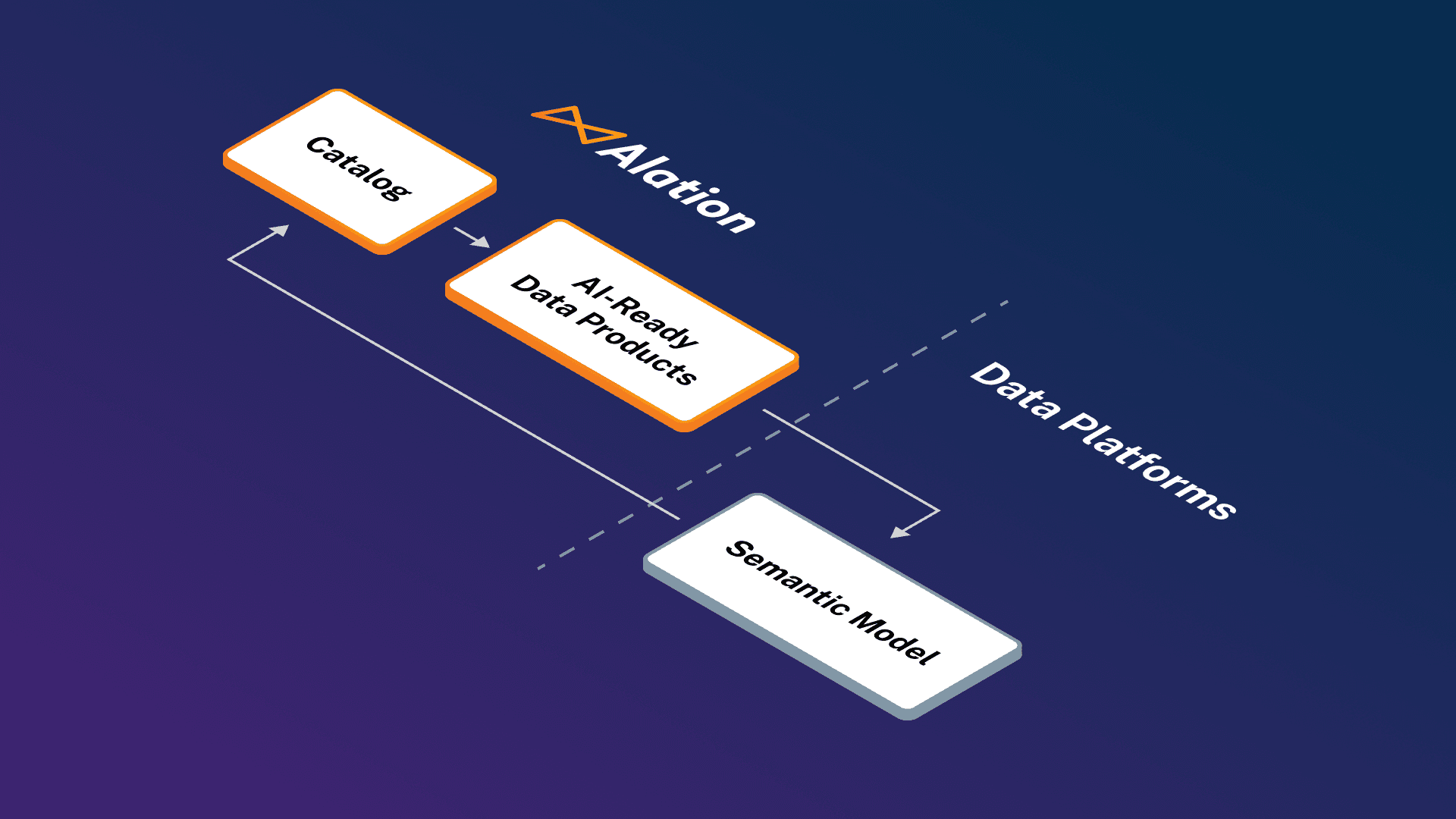
Semantic Model Mastering extends the Data Products Marketplace to close the govern-once, activate-everywhere loop.
Create data products from any source: Ingest Snowflake semantic views through the expanded connector or bring in definitions from BI tools like Power BI and Tableau. Each path produces a governed data product aligned with the Open Semantic Interchange standard.
Govern through data products: Promote cataloged semantic models to data products with ownership assignment, approval workflows, version control, and quality standards. The data product becomes the mastered version, governed in one place regardless of origin.
Enrich beyond what any single platform provides: Alation adds business context that goes beyond the technical metadata available within any one platform. Richer context flows through to downstream AI features, improving their performance without changing how teams work.
Sync back to source systems: Materialize enriched data products back to source platforms. AI features then operate on governed, enriched definitions without users ever entering Alation.
Alation is a launch partner alongside Snowflake for the Open Semantic Interchange.
Common questions about Semantic Model Mastering
What is Semantic Model Mastering?
It's a cross-platform semantic model governance available as part of Alation's Data Products Marketplace. Catalog, govern, enrich, and sync semantic models from any source. Think of it as MDM for your semantic layer: one master, multiple consumers, governance in the middle.
Does this work with platforms beyond Snowflake?
Yes. Snowflake semantic views flow through the expanded connector. BI definitions from Power BI and Tableau are also supported. For Databricks, you can create a data product by uploading a metric view YAML file (targeting June 2), with sync-back to Databricks targeted for end of June.
What is the Open Semantic Interchange?
OSI is an open standard for semantic model interchange. Alation is a launch partner alongside Snowflake. OSI provides the interchange format; Alation provides the mastering engine.
See Semantic Model Mastering at Snowflake Summit
Semantic Model Mastering is available today via YAML upload. The expanded Snowflake connector with sync-back is targeting June 2, 2026.
See it live at Snowflake Summit in San Francisco, June 1-4, and at Databricks Data + AI Summit, June 15-18. Book a demo to see how Alation masters your semantic models across every platform.
- Active Data Governance
- Data Intelligence
- Digital Transformation
- Engineering
- Enterprise Data Catalog
- AI
- Alation News
- Data Catalog
- Data Governance
- Data Products

Robb Gibson
Keep reading
More from the data desk