

Gartner predicts that through 2026, organizations will abandon 60% of AI projects unsupported by AI-ready data¹ — and a Gartner survey of over 1,200 data management leaders found that 63% either lack the right data management practices for AI or aren't sure they have them¹. The problem often isn't the AI model. If data is incomplete, outdated, hard to find, or missing context, even advanced AI tools produce poor answers.
AI-ready data is accurate, complete, well governed, and easy to discover, with enough business context for both people and AI systems to use it correctly. That takes more than cleaning records — organizations also need governance, security, and ongoing maintenance built into how data is managed day to day, not bolted on before a single project.
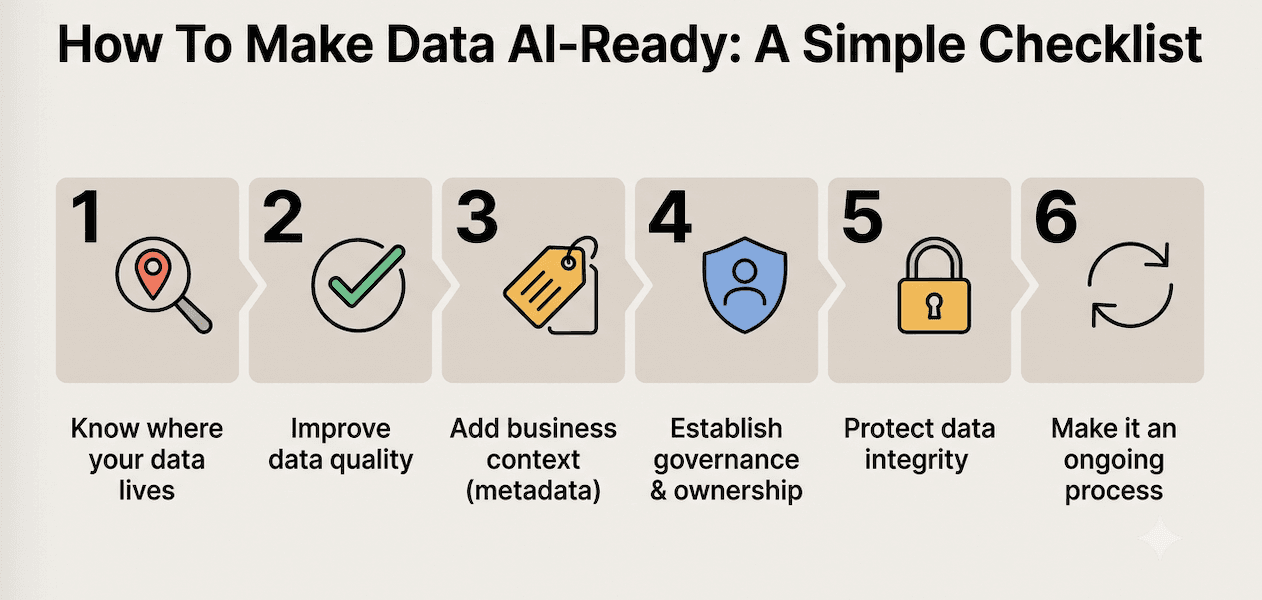
This checklist covers six practices that help organizations prepare their data for AI and identify where to focus first.
What does it mean for data to be AI-ready?
When data is AI-ready, AI systems can use it reliably in real business situations. Teams can find the right data, understand what it represents, and trust that it is suitable for the task. This allows AI to produce more reliable reports, forecasts, customer support responses, and business insights.
To reach that point, data needs to be accurate, complete, and consistent across every source. It also needs clear governance, defined ownership, and enough metadata so people can discover the right datasets instead of guessing which version to use.
For example, if sales and finance each use different revenue figures, an AI model may generate conflicting insights. Without additional context, the model cannot determine which dataset is authoritative.
AI doesn't correct poor data before using it. It learns from whatever information it receives, meaning missing values, duplicate records, or inconsistent definitions can carry through to model outputs.
NIST's AI Risk Management Framework² emphasizes that managing AI risk requires governance, data quality, and ongoing oversight to support trustworthy AI systems. As a result, inaccurate outputs can appear convincing and become harder to identify.
Gartner's research draws a useful distinction here: AI-ready data isn't just "good" data by traditional data-quality standards. It requires metadata that's active: continuously discovered, enriched, and used to qualify and govern data¹ — rather than passive documentation that sits in a wiki. That distinction shapes most of the checklist below.
A simple checklist for making data AI-ready
Preparing data for AI doesn't happen with a single project or tool. It comes from a series of practical steps that improve how data is managed, trusted, and used across the organization.
1. Know where your data lives
Start by creating an inventory of both structured and unstructured data across the business. This helps reduce data silos and gives teams a clearer view of what information is available.
Just as important, employees need to find trusted datasets without wasting time searching across different systems. For example, a marketing analyst looking for customer data should be able to identify the approved dataset rather than choosing among several versions with differing values.
Quick check:
Do you have a current inventory of structured and unstructured data across the business?
Can employees identify the single trusted version of a key dataset without asking around?
Are known data silos documented so gaps are visible rather than discovered mid-project?
2. Improve data quality before training or analysis
Before using data for AI, check that it is accurate, complete, and free from duplicate or outdated records. Start with the datasets that support your most important business processes. Improving those first helps reduce risk and deliver better results in early AI projects.
Data quality problems often begin long before AI enters the picture — at the point data is first created or captured. Standardizing how data is captured at the source (consistent field formats, required values, validation rules at entry) keeps records clean going forward instead of relying on large cleanup projects later. This turns data readiness from a one-time cleanup task into an ongoing, built-in part of the workflow.
Tools built for this (like Alation Data Quality) run these checks continuously against production data rather than as a periodic audit, surfacing completeness, accuracy, and duplication issues as they appear instead of during the next scheduled review.
Quick check:
Have you profiled your top three to five business-critical datasets for completeness, accuracy, and duplicates?
Are quality checks automated and recurring, rather than a one-time cleanup?
Is there a documented quality baseline you're measuring improvement against?
3. Add business context through metadata
Data without context is difficult for both people and AI to interpret. Metadata explains what a dataset contains and how it should be used. At a minimum, document:
Business definitions so everyone interprets key terms consistently.
Ownership so users know who is responsible for the dataset.
Data lineage so teams can see where the data came from and how it has changed over time.
Organizations often use a data catalog to make this information easier to access. For example, Alation helps teams:
Discover trusted datasets
View metadata and lineage
Identify dataset owners before using data for analytics or AI
4. Establish governance and clear ownership
AI works best when data follows the same rules across the organization. Without clear ownership and governance, different teams may collect, label, or update the same data in different ways. That creates inconsistencies that make AI outputs less reliable.
Assign data owners and stewards who are responsible for maintaining key datasets. Then establish governance policies that define how data should be created, updated, and managed.
Governance should also define common business terminology, approval workflows, and quality expectations so that data remains consistent as additional systems and teams contribute new information.
For example, if sales and customer support both collect customer information, shared standards help keep records consistent, no matter which team enters the data.
Some organizations formalize this through a critical data element (CDE) program, naming an owner for each business-critical dataset, defining the standard it must meet, and tracking whether it does. Alation's Critical Data Manager is built around this pattern, connecting ownership and standards directly to the datasets they govern rather than tracking them in a separate spreadsheet.
Quick check:
Does every business-critical dataset have a named owner or steward?
Are shared business terms (like "customer" or "revenue") defined once and used consistently?
Is there an approval workflow for changes to shared definitions or schemas?
5. Protect data integrity, not just access
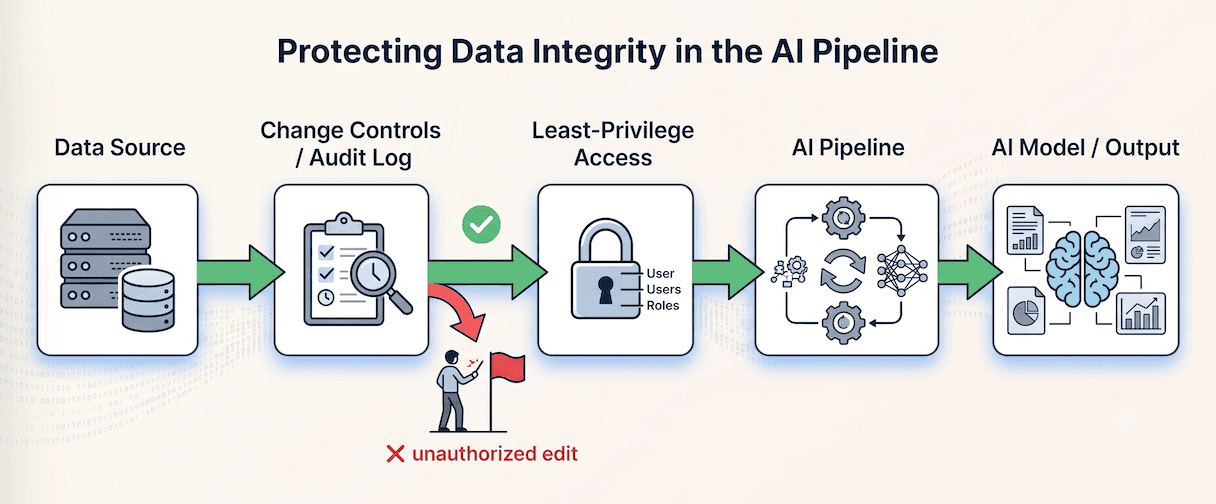
AI uses the data it is given. If that data has been altered without anyone noticing, the model has no way to tell the difference between correct and incorrect information. The result can be inaccurate reports, forecasts, or recommendations. If someone changes pricing data before an AI model analyzes it, the model will base its output on incorrect information.
Before data is considered AI-ready, organizations also need controls that protect data integrity throughout its lifecycle: change controls, audit logging, and least-privilege access that prevent unauthorized or accidental edits to the data feeding AI pipelines and the models trained on them. NIST's AI RMF² treats this kind of integrity monitoring as part of ongoing measurement and management, not a one-time security review. Clean data isn't just accurate — it also hasn't been tampered with.
Quick check:
Are changes to source data logged and attributable to a specific person or system?
Is access to critical datasets governed by least-privilege principles?
Do you run integrity checks (checksums, validation rules) before data feeds an AI model?
6. Make AI readiness an ongoing process
Making data AI-ready is an ongoing process. As new data enters the organization, quality issues, missing metadata, governance gaps, and broken lineage can appear. Review these areas regularly and automate routine checks where possible so that new problems are identified before they affect AI outputs.
"Remember that AI-ready data is not 'one and done.' Think of it as a practice where the data management infrastructure needs constant improvement based on existing and upcoming AI use cases."
This is why some organizations move routine curation work (think: writing descriptions, classifying sensitive fields, and assigning ownership) from a one-time backlog into an automated, ongoing process. Alation's Curation Automation applies metadata standards at scale on a recurring basis, so gaps get caught and closed continuously rather than resurfacing every time someone audits the catalog.
Quick check:
Is there a recurring (not one-time) review cadence for data quality, metadata, and lineage?
Are routine checks automated rather than manually run?
Is there a clear owner accountable for maintaining AI-readiness as the business changes?
Turn this checklist into your AI-ready data plan
Preparing data for AI takes more than improving quality. Organizations also need:
Strong governance
Clear ownership
Data that people can discover
Protection against unauthorized changes
Ongoing maintenance as new information enters the business
Each step in this checklist helps create data that people and AI can use more consistently.
Review your current data practices against these recommendations to identify gaps and decide where to improve first. Platforms such as Alation can support that work by helping teams discover trusted data, strengthen governance, and add business context across the organization.
AI readiness is ultimately an ongoing data management discipline rather than a one-time initiative. As organizations expand their AI use cases, strengthening governance, metadata, lineage, and data quality becomes increasingly important. Explore more resources on the Alation blog to continue building a trusted foundation for AI.
FAQs
What makes data AI-ready? Data is AI-ready when it is accurate, complete, consistent, well governed, easy to discover, and supported by clear metadata. It should also be protected from unauthorized changes so AI systems can use trusted information.
Why isn't clean data enough for AI? Clean data is only one part of AI readiness. AI also needs governance, ownership, metadata, lineage, and security controls so people and AI systems can understand and use data correctly.
How is AI-ready data different from traditional data quality management? Traditional data quality focuses on accuracy and completeness within a single system. AI readiness adds requirements traditional programs often skip: metadata that's actively maintained rather than static documentation, enough business context for an AI agent to know which dataset is authoritative and how to interpret it, and governance that spans every system feeding an agent's context — not just one source of truth.
How long does it take to make data AI-ready? There's no fixed timeline — it depends on how many systems and datasets are in scope. Most organizations start with the datasets behind their highest-priority AI use case, get those governed and documented, then expand. Treating it as an ongoing practice rather than a project with an end date produces better long-term results.
How often should organizations review AI readiness? AI readiness should be reviewed on an ongoing basis. As new data enters the organization, monitor data quality, metadata, governance, and lineage to identify issues before they affect AI outputs.
What tools help track AI data readiness? Data catalogs are the most common tool for this, since they centralize metadata, lineage, ownership, and quality signals in one place so teams can see readiness gaps across systems rather than checking each source manually.
Sources & notes
Every external claim on this page is independently verifiable. The public sources are listed here.
Sixty-three percent of 1,203 data management leaders surveyed (July 2024) either lack or are unsure they have the right data management practices for AI; Gartner predicts organizations will abandon 60% of AI projects unsupported by AI-ready data through 2026; metadata must move from passive to active; quote from Roxane Edjlali, Senior Director Analyst. — Gartner, "Lack of AI-Ready Data Puts AI Projects at Risk," Q&A with Roxane Edjlali, February 26, 2025. https://www.gartner.com/en/newsroom/press-releases/2025-02-26-lack-of-ai-ready-data-puts-ai-projects-at-risk
Managing AI risk requires governance, data quality, and ongoing oversight (via the Framework's Govern, Map, Measure, and Manage functions) to support trustworthy AI systems. — Tabassi, E., Artificial Intelligence Risk Management Framework (AI RMF 1.0), NIST AI 100-1, National Institute of Standards and Technology, January 26, 2023. https://www.nist.gov/publications/artificial-intelligence-risk-management-framework-ai-rmf-10
- Active Data Governance
- Data Culture
- Data Intelligence
- Digital Transformation
- Engineering
- Enterprise Data Catalog
- AI
- Data Catalog
- Data Governance

Kristina Iavarone
Keep reading
More from the data desk