

Most enterprises have spent the last decade building metadata infrastructure: data catalogs, glossaries, lineage graphs. Then they deployed AI agents on top of that investment and got confidently wrong answers anyway.
The reason isn't that the metadata was bad. It's that metadata and context are being treated as the same thing, when they aren't. Metadata is the record of what your data is. Context is the interpretation of what that data means for a specific question, user, or moment. An agent can have perfect metadata and still fail, because knowing that a column exists is not the same as knowing whether it's the right column to use.
This distinction sounds academic until you're the one explaining to a stakeholder why the AI assistant confidently queried the wrong "revenue" table. So let's define both terms precisely, separate them from the adjacent jargon they get lumped in with, and get into why the gap between them is the actual reason most enterprise AI deployments plateau.
What is metadata?
Metadata is structured data about data: names, types, owners, tags, lineage, freshness, and usage statistics. It's the layer that answers "what exists and where does it live," not "what does it mean for my question."
AI agents typically draw on four categories of metadata:
Technical metadata — schema, data types, table structures.
Business metadata — descriptions, glossary terms, stated ownership.
Operational metadata — lineage, freshness, refresh schedules, query logs.
Usage metadata — what's actually queried and trusted by real analysts, as distinct from what's merely documented.
Take a revenue column as an example. Metadata tells you its data type is numeric, it lives in the finance.transactions table, and it was last updated eleven hours ago. That's useful. It's also not enough to know whether this is the revenue figure the CFO's team actually certifies for board reporting.
Why AI agents need metadata first
Without metadata, an agent has to guess at structure: which tables join, what a column is called, whether a business term maps to one field or five. That guessing is where hallucinations start. Grounding AI agents in real metadata matters: Alation has reported that its metadata-aware query capability, Chat with Your Data, can improve answer accuracy by up to 30%¹ — an early signal that grounding alone measurably reduces errors, even before context is layered on top. Metadata is necessary. It just isn't sufficient, which is where context comes in.
What is context in AI?
Context is the layer of interpretation built on top of metadata: the business logic, definitions, relationships, and rules that tell an agent how the organization actually works, not just what data exists. Where metadata says a table exists, context says which of the three tables with "revenue" in the name is the one certified for this specific business unit's board deck.
It's worth separating context from the three terms it constantly gets conflated with:
A prompt is not context. A prompt is an instruction given at query time; context is the standing body of business knowledge the prompt draws on.
RAG retrieval is not context. Retrieval is a delivery mechanism — a way of fetching relevant documents. It's only as good as the underlying context it's retrieving from.
A semantic layer is part of context, not all of it. Metric definitions matter, but so do governance policies, ownership, and the tribal knowledge of which sources analysts actually trust.
Data products as context in practice
The most concrete unit where context gets packaged today is the data product: a scoped, curated bundle of tables, definitions, and usage instructions that an agent can reason over directly, rather than having to infer meaning from raw schema alone. Think of a data product as a page in an internal Wikipedia — self-contained, but linked back to the broader catalog for anything it doesn't cover.
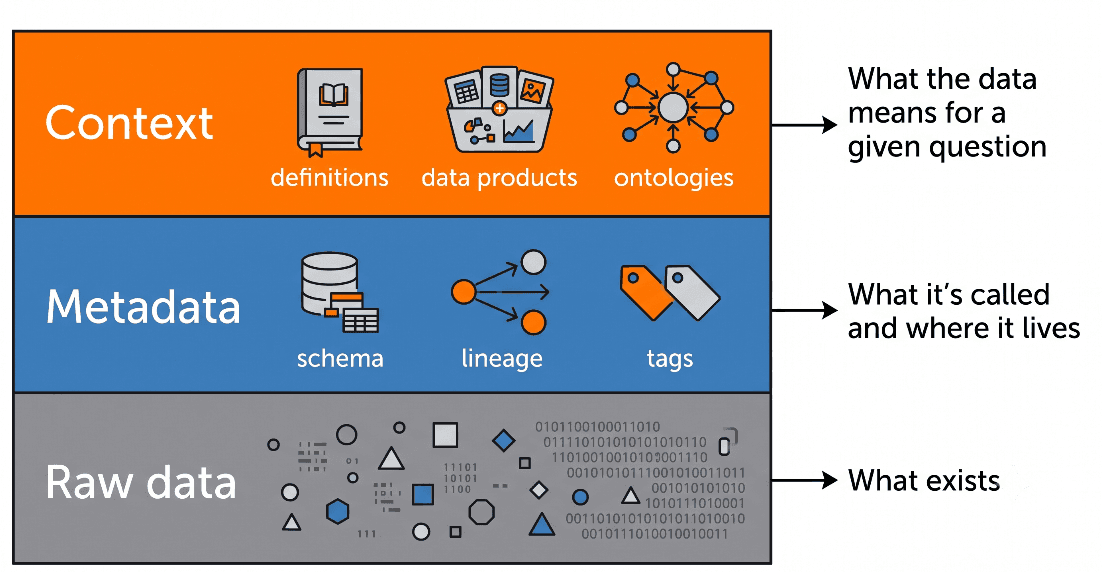
Metadata vs. context: Core differences
Metadata | Context | |
Answers the question | What data exists, and where? | What does this data mean, for this question? |
Primary source | Schema, catalog entries, lineage, logs | Data products, glossaries, ontologies, governance rules |
Example | revenue column, numeric, updated 11 hours ago | Which revenue definition is certified for board reporting vs. regional sales |
Role in AI accuracy | Prevents structural hallucination (wrong joins, wrong columns) | Prevents semantic hallucination (right column, wrong interpretation) |
A simple analogy: metadata is a library's card catalog: it tells you what books exist and where they sit on the shelf. Context is the research librarian who knows which of the twelve books on your topic is actually the right one for your specific question. You need both. A library with no card catalog is unusable; a card catalog with no librarian still leaves you guessing.
Importantly, this isn't a hierarchy where context replaces metadata. Context is built on metadata and is worthless without it, because you can't interpret the meaning of data that you can't first locate and describe.
Why the distinction matters for enterprise AI
Agents built on metadata alone produce a specific, dangerous failure mode: technically valid but wrong answers. Gartner predicts more than 40% of agentic AI projects will be canceled by the end of 2027, due to escalating costs, unclear business value, or inadequate risk controls² — the exact failure mode this section describes.
The join is real, the column exists, the SQL executes cleanly — and the answer is still wrong, because the agent picked a defensible-looking path instead of the correct one. That failure mode is harder to catch than an outright error, because nothing about the output looks broken.
There's also a governance dimension. Without context, agents can't explain their reasoning or route decisions through policy, which turns data governance from an enforceable standard into a hope. And here's the harder truth most vendors don't lead with: even organizations that build real context still watch it decay, because most vendors deliver metadata, call it context, and stop there. The real gap isn't defining context correctly. It's keeping it correct as the business changes underneath it.
The problem nobody solves: Context goes stale the moment you ship it
The business doesn't hold still. A metric definition gets updated. A table gets deprecated. A team reorganizes and ownership shifts to someone new. Context captured at deployment time starts drifting from reality immediately — and most architectures treat that drift as a maintenance problem: someone notices, manually updates a definition, redeploys. That works for one use case with a dedicated team behind it. It collapses at ten use cases, or fifty.
This is the headcount trap. Every AI use case deployed without a mechanism to keep context current automatically requires a human team to keep it alive. You're not saving work — you're shifting headcount from the business into a context-maintenance function, and that function's capacity gets consumed keeping use case one alive instead of freeing anyone to build use case two.
The distinction that separates organizations that scale from ones that stall: context as a document versus context as a system. A document is accurate on the day it's written and decays from there. A system improves from use, absorbing what agents discover in production — the ambiguous definitions that only surface under real queries, the edge cases where two metrics conflict — and feeding those discoveries back into itself.
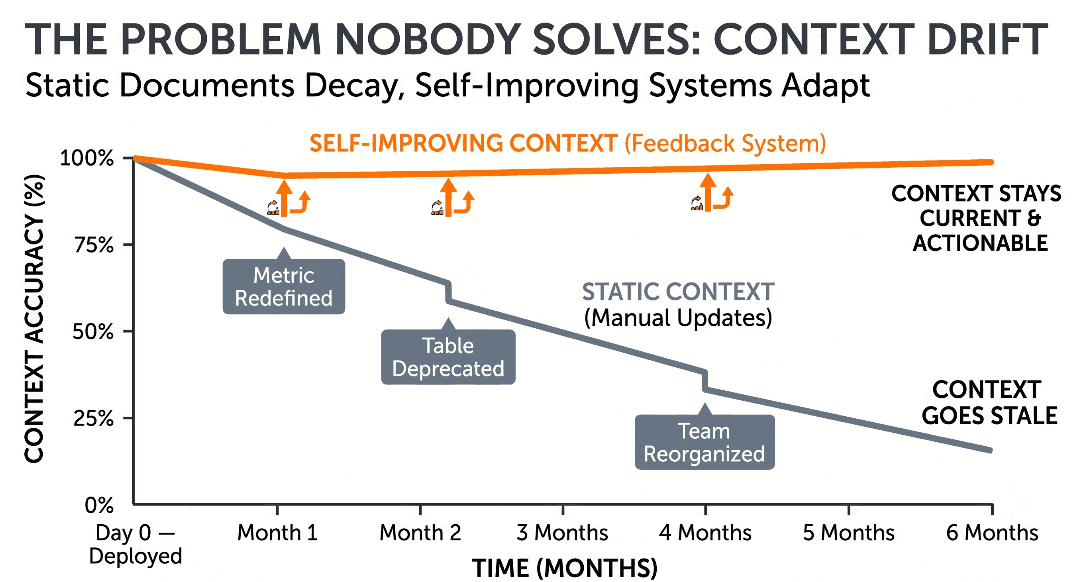
What keeps context alive: Evaluations and feedback loops
This is the mechanism most "context layer" pitches skip entirely, and it's the one that actually determines whether accuracy holds up past the pilot.
Evaluations: how you prove context is actually working
AI agent evaluations are structured test cases — a natural-language input paired with an expected output — that measure whether an agent's answer is actually correct against real business questions, not a generic industry benchmark. In one documented case, a SQL agent built on a "naked" data product with no descriptive metadata scored 60% accuracy against 20 real question-SQL pairs. Two automated improvement iterations later — each one diagnosing a specific failure pattern (date-filtering logic in the first pass, table granularity in the second) and updating the underlying metadata accordingly — the same agent scored 100%³, with every proposed change surfaced for human review before it took effect.
That case study matters because it reframes accuracy from something you assert into something you measure, tune, and re-test, with an audit trail attached. "Our AI is accurate" becomes a claim you can defend to a stakeholder instead of one you're hoping holds up.
Feedback loops: context that learns from its own mistakes
Evaluations tell you where context is wrong. Feedback loops are what fix it automatically. When agents interact with real users in production, corrections, failed queries, and ambiguous questions that expose a definition gap all become signals — signals that flow back to update the catalog and data products without a human manually rewriting anything. Alongside this sits data quality monitoring, the bottom-up half of the same loop: continuously validating freshness and conformance in the raw data itself, flagging problems before an agent ever builds an answer on top of them.
The compounding effect is the part worth sitting with: a fix made because one agent got something wrong improves every other agent that draws on that same context, not just the one that surfaced the error. Over time, that accumulation becomes institutional knowledge rather than a pile of one-off patches.
This is the principle worth holding onto through the rest of this piece: a context layer without evaluations and feedback loops to self-improve cannot sustainably support accurate AI. It can only be accurate on the day it was built.
Why general-purpose context fails at enterprise scale
Even a context layer that's actively maintained isn't automatically enough, because a shared knowledge layer alone doesn't account for how differently teams interpret the same data. General-purpose agents plateau at enterprise scale precisely because they hedge across every possible question a dataset could support, instead of executing one domain's logic precisely.
In a documented head-to-head, a custom agent — built with the same underlying knowledge layer as a generic one, but tuned with domain-specific instructions on metric definitions and filtering conventions — came out 20% more accurate and 40% faster than the generic version⁴. Same context. Different outcome. That gap is further proof that context isn't a one-time deliverable you hand off and walk away from; it has to be built, tested, and refined per use case, the same way the context layer itself has to keep being tested and refined over time.
What a self-improving context layer looks like
Put the pieces together — governed metadata, interpreted context, evaluated agents, and a feedback loop tying them all back together — and you get an architecture rather than a static hand-off. Alation's AIOS is built around exactly that structure: a trusted data foundation, a context layer of definitions and data products, agents built and proven in Agent Studio through the same evaluation cycle described above, and governance that travels with the data rather than getting bolted on afterward — all wrapped in a self-improving flywheel where corrections and eval results route back into the catalog automatically.
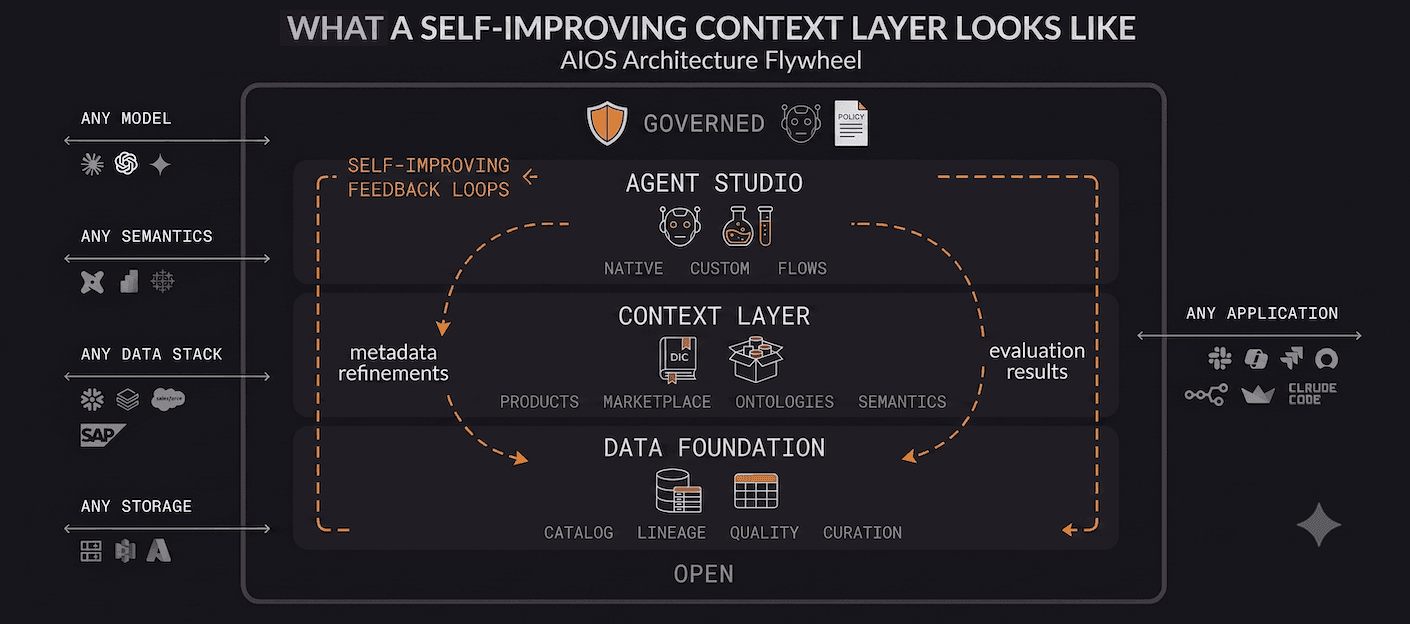
Metadata-aware agents in practice
The output of this architecture is what's sometimes called a metadata-aware agent: an agent grounded in an organization's real metadata and semantics rather than reasoning blind, able to interpret business logic, enforce access policy, and produce answers that are explainable and auditable after the fact. But it's worth being precise about what makes that trustworthy at scale: metadata-awareness paired with a static context layer still drifts. It's only the combination — grounded metadata, interpreted context, and a running evaluation and feedback loop — that keeps an agent's accuracy intact six months after launch, not just on demo day.
FAQs
Is context the same thing as metadata? No. Metadata is the record of what data exists and its structure; context is the business interpretation of what that data means for a specific question. Context is built on metadata but adds definitions, rules, and relationships metadata alone doesn't capture.
What is a context layer in AI? A context layer is the set of definitions, business logic, and governed data products that let an AI agent interpret raw data the way the business actually uses it, rather than reasoning from schema alone.
Why does AI context "go stale"? Because the business keeps changing after context is captured: metric definitions get updated, tables get deprecated, ownership shifts. Without an automated way to detect and correct that drift, context degrades from the moment it ships.
What's the difference between a context layer and a knowledge layer with built-in evaluations? A context layer typically hands an agent business definitions once and calls the job done. A knowledge layer with built-in evaluations is tested against real business questions on an ongoing basis, with failures diagnosed and fed back into the metadata automatically — the difference between a claim and a measured, improving fact.
How do you know if an AI agent's context is actually working? You run structured evaluations against real business questions, not a generic benchmark, and track accuracy over successive iterations. If there's no evaluation history, "the AI is accurate" is an assumption rather than something you can prove.
What to do next
If your organization already has a mature catalog and is now deploying agents on top of it, this AI agent evaluations article is the most direct next read, as it walks through the exact mechanics of the 60%-to-100% improvement cycle referenced above. If you're earlier in the process and want the fuller architectural picture of how data, context, agents, and governance fit together as one self-improving system, start with AIOS. And if the "headcount trap" section above hit close to home, Your Context Layer Is Already Wrong goes deeper on why context drift is the default outcome, not an edge case.
Sources & notes
Every external claim on this page is independently verifiable. The public sources are listed here.
Alation's Chat with Your Data claims up to 30% accuracy improvement. — VentureBeat ↗ https://venturebeat.com/data-infrastructure/alation-says-new-query-feature-offers-30-accuracy-boost-helping-enterprises-turn-data-catalogs-into-problem-solvers/
Over 40% of agentic AI projects predicted to be canceled by end of 2027 (escalating costs, unclear value, inadequate risk controls). — Gartner ↗ https://www.gartner.com/en/newsroom/press-releases/2025-06-25-gartner-predicts-over-40-percent-of-agentic-ai-projects-will-be-canceled-by-end-of-2027
SQL agent went from 60% to 100% accuracy in two automated evaluation iterations. — Alation ↗ https://www.alation.com/blog/ai-agent-evaluations/
Custom agent was 20% more accurate and 40% faster than generic agent (80.39% vs. 58.82% accuracy; 93s vs. 160s). — Alation ↗ https://www.alation.com/blog/general-vs-specialized-enterprise-ai-agents/
Analyst Attributions & Disclaimers
Gartner, press release, "Gartner Predicts Over 40% of Agentic AI Projects Will Be Canceled by End of 2027," June 25, 2025.
Gartner does not endorse any vendor, product or service depicted in its research publications and does not advise technology users to select only those vendors with the highest ratings or other designation. Gartner research publications consist of the opinions of Gartner's research organization and should not be construed as statements of fact. Gartner disclaims all warranties, expressed or implied, with respect to this research, including any warranties of merchantability or fitness for a particular purpose. GARTNER and Magic Quadrant are registered trademarks and service marks of Gartner, Inc. and/or its affiliates in the U.S. and internationally and are used herein with permission. All rights reserved.
- Active Data Governance
- Data Culture
- Data Intelligence
- Digital Transformation
- Engineering
- Enterprise Data Catalog
- AI
- Data Governance
- Data Products
Keep reading
More from the data desk