

TL;DR
AI agents accelerate model risk: Unmonitored models quietly decay, but chained AI agents compound this risk by taking actions without human review.
Uniform governance drives agent failures: Binary AI trust causes Gartner to predict 40% of autonomous agents will be decommissioned by 2027.
Regulations are expanding beyond banking: Frameworks like the EU AI Act and NIST AI RMF now mandate risk controls across hiring, healthcare, and safety.
Structured execution requires three lines of defense: A five-step lifecycle (identify, validate, monitor, govern, remediate) divides duties among business, validation, and audit teams.
Outcome-based governance keeps AI correct: Platforms like Alation’s AIOS™ use column-level lineage and active feedback loops to prevent post-deployment model decay.
Model validators, risk and compliance leads, data science managers, and chief data and analytics officers (CDAOs) scaling AI past the pilot stage likely know why model risk management matters: a model can pass every test in production and still go quietly wrong six months later. Nothing crashes, but the model just stops matching the reality it was built to represent while the business keeps trusting its output anyway.
And now that gap is widening as AI agents advance: they now chain models together and act on outputs without a human checking the work first.
Gartner's Shiva Varma puts it directly: "Enterprises are treating AI agent governance as binary, either locked down or fully trusted."¹ Governing every agent identically either over-restricts simple ones or leaves autonomous ones dangerously under-controlled. It’s a mismatch that’s driving Gartner’s prediction that 40% of enterprises will demote or decommission autonomous AI agents by 2027 because governance gaps only surfaced after something already went wrong in production.
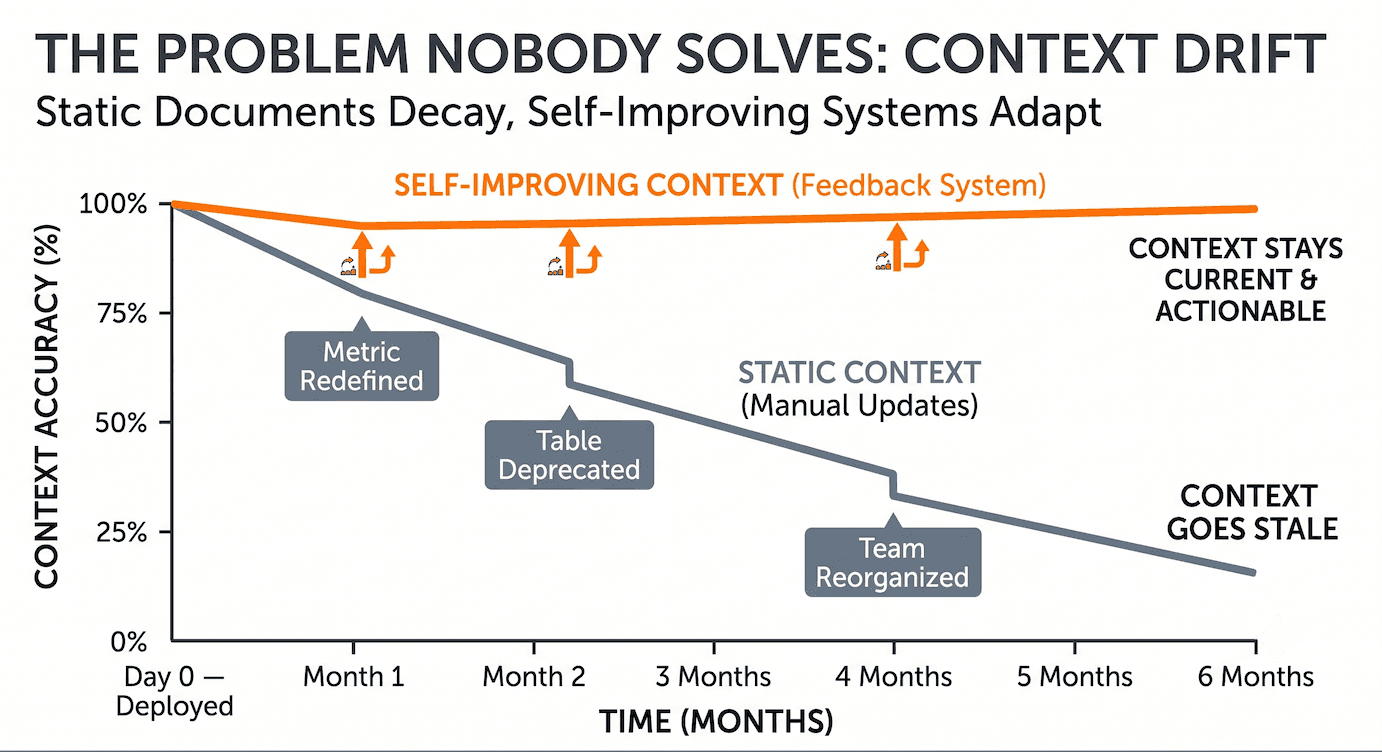
At Alation, we see the same pattern across enterprises moving from pilot to production: almost any team can stand up a risk management model or agent, but almost none keep it right past Day 180 and beyond. Closing that gap takes more than following a validation checklist.
What is model risk management?
Model risk management is the practice of identifying, measuring, monitoring, and controlling the risk that a model produces wrong, biased, or misleading outputs.
Take, for example, the lawsuit a Florida man filed against OpenAI in July 2026.2
Scott Winters says he consulted ChatGPT-4o repeatedly for months about worsening dizziness and unstable blood pressure. The chatbot reportedly reassured him his symptoms weren't dangerous and encouraged him to stay put rather than seek care. He later suffered a massive pulmonary embolism that one of his doctors linked to the prolonged inactivity the chatbot had recommended.
Model risk management is what catches this before it costs the business, or the person on the other end of the model, anything. Ongoing monitoring flags the gap between what a model was validated to do and what it's actually being used for in the field. That gap triggers a re-validation or a hard boundary on the use case, and the finding routes back to whoever owns the deployment. Then the model gets recalibrated, restricted, or replaced with one built for that job.
Which industries use risk modeling?
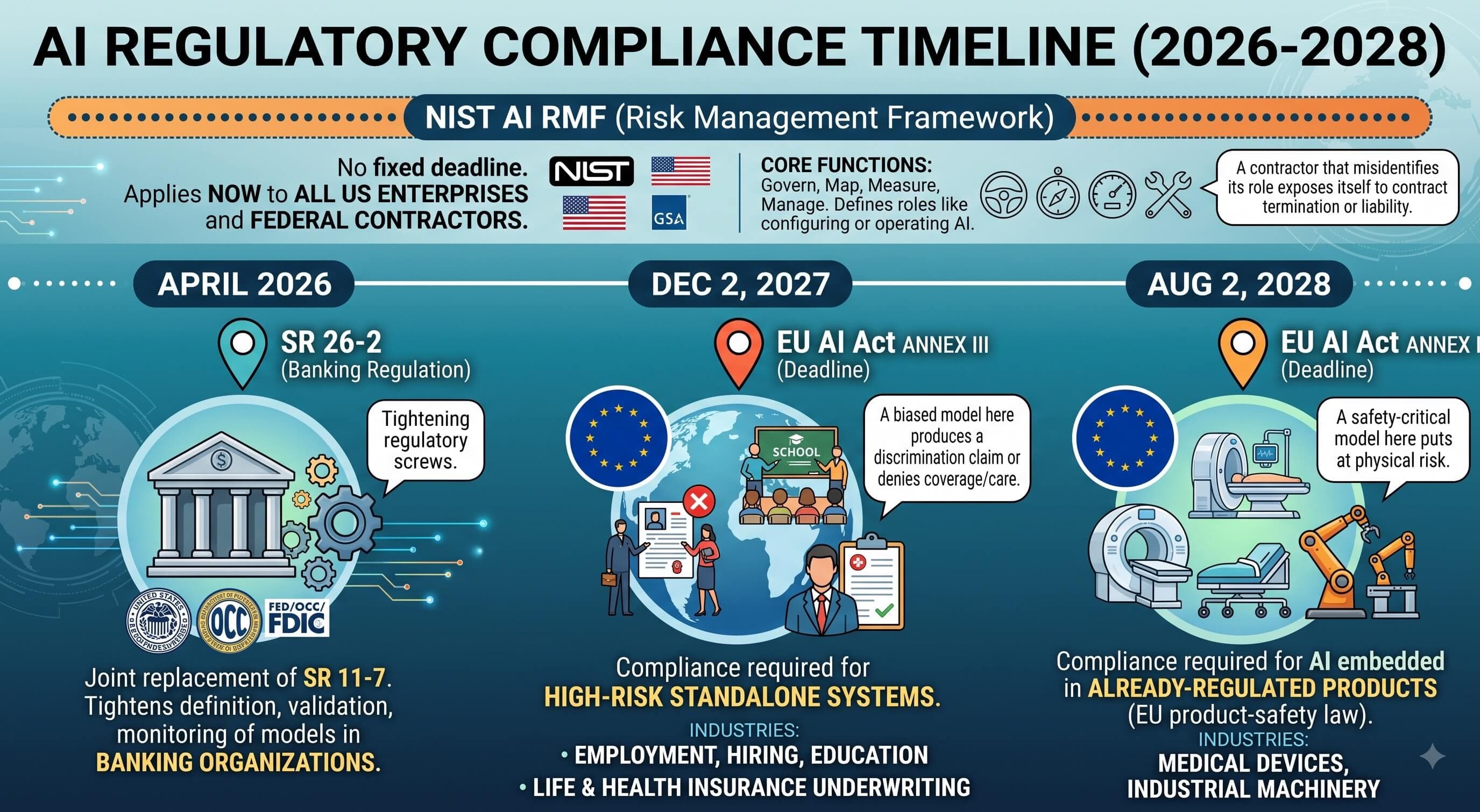
Model risk management, and the risk modeling practices underlying it, started as a supervisory requirement for banks. In April 2026, the Federal Reserve, Office of the Comptroller of the Currency (OCC), and Federal Deposit Insurance Corporation (FDIC) jointly replaced their longstanding SR 11-7 guidance with SR 26-2, tightening how banking organizations define, validate, and monitor the models they rely on.3
That banking-only scope hasn’t held. Regulation now maps model risk across a much wider set of industries:
Employment, hiring, and education: hiring, performance evaluation, promotion/termination decisions, and access to educational or vocational training under the EU AI Act, Annex III (high-risk standalone systems), compliance required by December 2, 2027.4 A biased model here doesn't just misclassify a resume, it produces a discrimination claim.
Life and health insurance underwriting: risk assessment and pricing for natural persons under the EU AI Act, Annex III, same December 2, 2027 deadline.4 A flawed model here denies someone coverage or care they were entitled to.
Medical devices and industrial machinery: AI as a safety component in products already regulated under EU product-safety law under the EU AI Act, Annex I (AI embedded in already-regulated products), compliance required by August 2, 2028.5 A safety-critical model here puts a person at physical risk.
Federal contracting: U.S. General Services Administration (GSA)'s acquisition rule assigns contractors distinct roles, like building, hosting/operating, or configuring the model.6 Each maps to a specific National Institute of Standards and Technology AI Risk Management Framework (NIST AI RMF) actor category and its documentation duties.7 A contractor that misidentifies its own role exposes itself to contract termination or liability for a system it certified as compliant.
Any US enterprise, regardless of sector: the NIST AI RMF's four core functions (Govern, Map, Measure, Manage) apply to any AI system's lifecycle, filling the gap where no binding rule exists yet. A model running here without that structure leaves the business with no way to show reasonable care was taken before something went wrong.
The underlying exposure across all of these is the same: a model that runs unmonitored eventually produces a decision nobody can defend. Model risk management exists to catch that decision before it ships, not after it becomes a headline.
What are the three types of model risk?
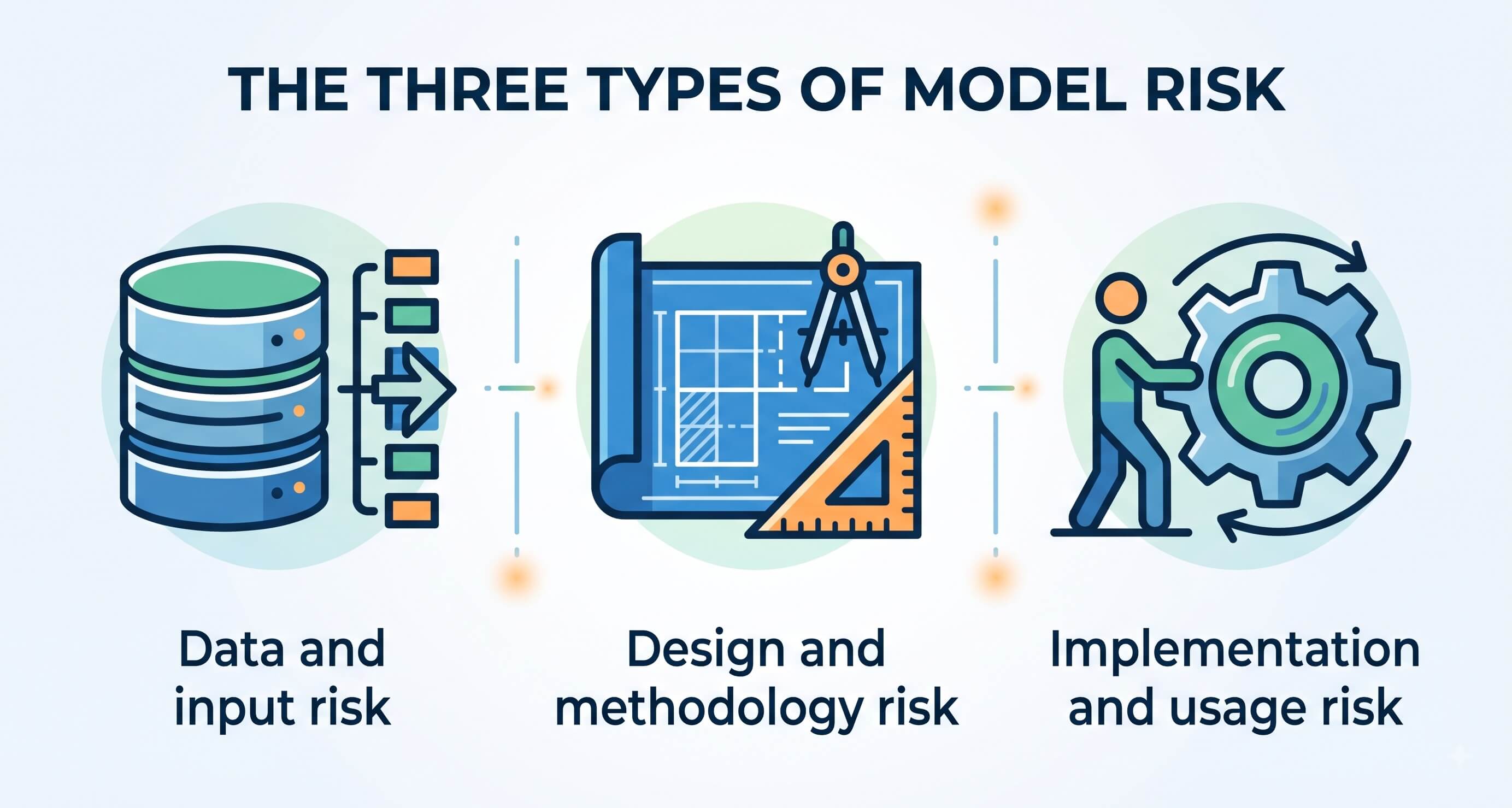
The three types of model risk are data and input risk, design and methodology risk, and implementation and usage risk. Banking regulators first broke model risk into distinct components back in 2000,8 and the split still holds today even as what counts as "a model" has expanded to include agents and the tools they call.
The table below breaks down how each risk type shows up in practice, why it happens, and how agents are changing its shape:
Risk Type | What It Is | Why It Happens |
Data and input risk | The model runs on stale, incomplete, or unrepresentative data | Source systems and business conditions shift gradually, and the model is never re-validated against that drift. Gartner’s research on AI-ready data makes the point directly: production-grade AI needs data that includes the errors, outliers, and edge cases a traditional data-quality program would normally clean away.9 |
Design and methodology risk | The model itself rests on flawed assumptions, the wrong variables, or a statistical approach that doesn't fit the problem | These are conceptual soundness errors baked in at build time, so no amount of better data downstream fixes them. |
Implementation and usage risk | The model is sound, but it's applied to a use case it wasn't built for, or misread by the humans or agents acting on its output | Agents now chain models together and act on their outputs directly, at a pace that outpaces human review, as per Gartner.1 This is turning what used to be a slow, occasional misuse into a fast, recurring one |
Individually, these are manageable. But bad PR and lost public trust rarely stay contained to one line item.
When Air Canada's customer-service chatbot invented a bereavement-fare policy that didn't exist, a British Columbia tribunal ordered the airline to pay just $812.02 in damages, a trivial sum on its own.10 The real cost was reputational as the case drew international coverage, in large part because Air Canada tried to argue in court that its own chatbot shouldn't count as the company speaking. The tribunal rejected this defense outright.
The real exposure is aggregate model risk: the combined exposure across every model, agent, and workflow in the enterprise, including the cost a single narrow failure creates once it becomes public. That's why mature programs anchor decisions to a defined risk appetite and risk tolerance, rather than auditing every model with equal intensity.
Alation's governance model is built around a similar principle: one inventory across every model, agent, and asset, with governance intensity calibrated to risk tolerance rather than applied uniformly.
That principle is called outcome-based governance, and it argues: Don't govern everything, govern what matters most, and prove it. Critical Data Manager applies that thesis to data, concentrating governance effort on the elements a regulator will actually ask about instead of spreading it evenly across the estate. Alation's AI governance work is designed to extend the same thesis to AI assets, so the intensity of review tracks regulatory applicability and business consequence, and the proof exists for the assets where proof is demanded.
Five steps of a risk management model
A risk management model runs on five steps: identify, validate, monitor, govern and document, and remediate and feed back. Agentic AI changes how fast these steps need to happen, since agents now chain models together and act on outputs before a human review cycle would normally catch a problem.
Standing up a risk management model doesn't require starting from a blank page. Whether you're building the program for the first time or tightening an existing one, the arc looks the same:
Identify. Inventory every model in use, including the shadow spreadsheet nobody documented, and flag which ones actually carry business risk.
Validate. Test the risk management model independently before it goes live and periodically afterward. The team that built it doesn't get to grade its own homework.
Monitor. Track performance in production. Accuracy today says nothing about accuracy months from now.
Govern and document. Keep a clear record of what the model does, who owns it, and where its limits sit. Auditors will ask.
Remediate and feed back. When something breaks, fix the layer that actually broke, not just the symptom. Route the correction back into the system so it doesn't recur.
Step five is also where Alation's AIOS™ differs from a static registry. Instead of just logging that a model drifted, feedback loops route the correction back to whichever layer actually caused the failure, whether that’s the data, the context, or the model itself.
Step one, inventorying every model, is where most programs stall first. Alation's breakdown of what an AI model registry actually needs to capture goes beyond a spreadsheet of names and owners.
Who owns each step?
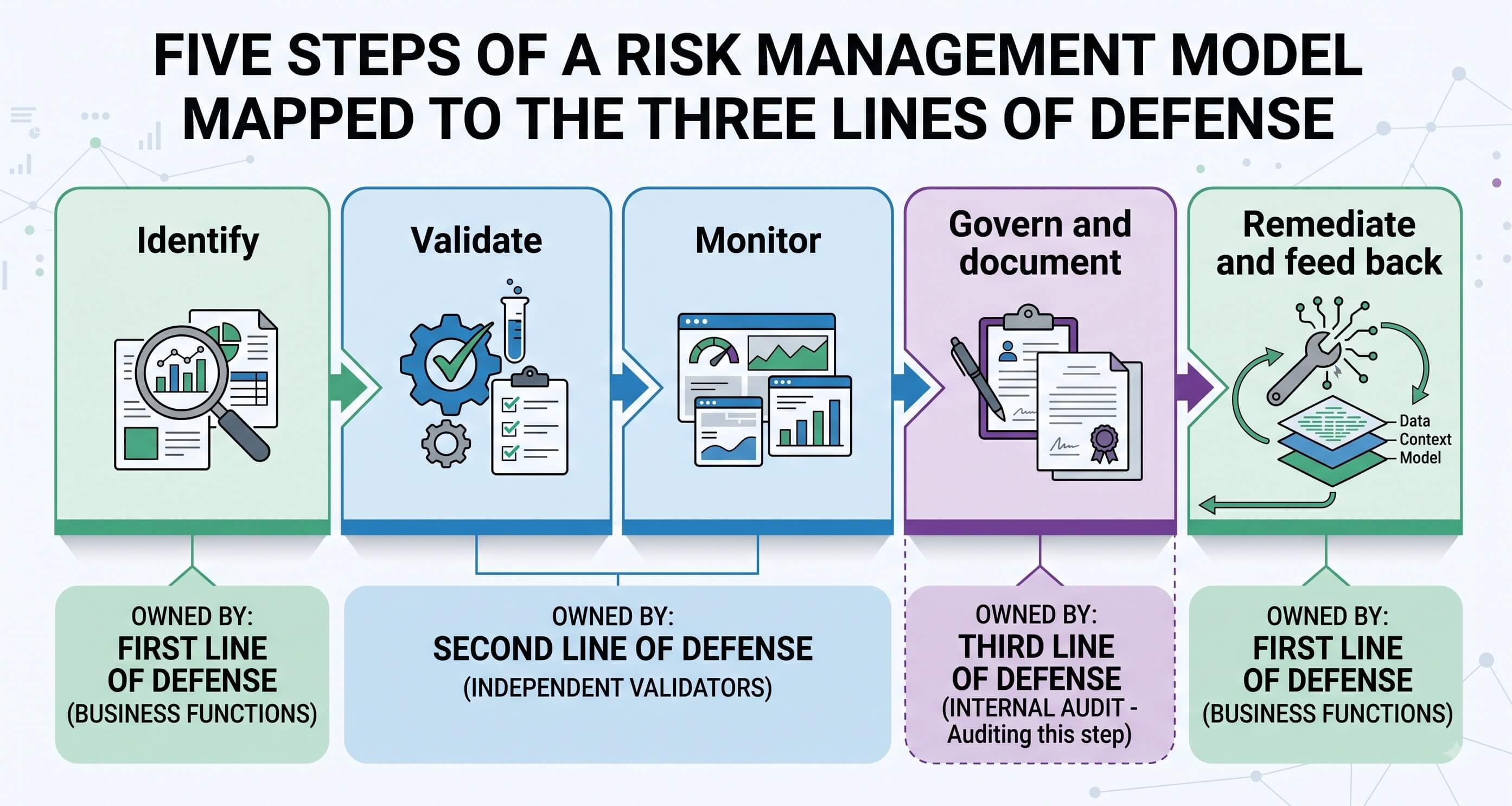
Three lines of defense own the five steps between them: the business functions that build and use the model, independent validators who test it before and after launch, and internal audit, which checks whether the first two actually did their jobs.
First line: The business functions that build and use the model own its day-to-day risk. This is who's on the hook for Identify and for Remediate and feed back, since they're closest to the model when something breaks.
Second line: Independent validators who re-run the risk management model against held-out data, document where its assumptions break down, and sign off before it goes into production. This is Validate and Monitor, ownership doesn't stop at launch.
Third line: An internal audit function, independent of both the first and second lines and reporting directly to the board or audit committee. It audits whether the first two lines actually did their jobs: whether validation happened on schedule, whether flagged issues got escalated, whether sign-offs were real reviews and not rubber stamps. This is auditing whether govern and document actually happened, not doing the governing itself.
This structure isn't unique to AI. It's the same accountability framework the OCC's Heightened Standards require large banks to use across every risk domain.11 And the Institute of Internal Auditors refreshed it again in July 2026, retiring its 2020 update in favor of sharper board-level accountability.12
What to look for in a model risk management program
Effective model risk management programs should:
Trace full lineage of where a model's data comes from, what it feeds, and who's downstream of it
Monitor continuously, not just at annual review
Document with a real approval trail and version history, not a summary memo assembled after the fact
Work across the full stack, not just one cloud or one team's tools
Column-level lineage is where that first bullet either pays off or stays theoretical. Alation traces an AI asset's data dependencies back to source at the column level, so the question "what fed this model, and what happens downstream if it's wrong" has an answer that comes out of the system rather than out of a meeting. That's also the shape of evidence the EU AI Act asks for under Article 10 on data and data governance. Lineage stops being a diagram on a slide and becomes the artifact that closes an auditor's question.
To see these capabilities working together end to end, Alation's Agentic Data Intelligence Platform datasheet walks through how governed data products ground agents in institutional knowledge, not just raw enterprise data.
Much of the model risk tooling on the market today is built as a point solution: it governs models inside its own platform and misses the rest of the mesh a modern enterprise runs on. Even tools that do see the whole mesh often stop at cataloging. They log that a model exists, tag its risk tier, and track whether a review happened. That's AI governance, and it's necessary, but it's table stakes.
Governed AI is different. It means the knowledge feeding a model or agent is accurate, improving, and defensible. This is what lets a program actually keep pace with what agents are doing, instead of documenting them after the fact.
Alation's approach registers every model, agent, and asset into one inventory, then maps each to the regulations that actually apply to it: EU AI Act, NIST AI RMF, ISO 42001. High-risk items route to the right team automatically, with a live compliance posture instead of a static file. Governed AI is what happens once that inventory exists: the knowledge behind it stays accurate and improving.
For teams building the agents themselves, Agent Studio grounds every agent in the same governed context before it ever reaches production. Validation isn't a separate step bolted on afterward.
Where Alation fits in
SR 26-2 explicitly excludes generative and agentic AI from its scope, calling them "novel and rapidly evolving".13 And other regulations govern the model itself, but not the agent now acting on its output.
Alation built its intelligence operating system (AIOS™) to keep AI right long after the initial pilot, not just launch it. A leading global automotive manufacturer is a live example of AIOS in action: supply-chain agents now flag part shortages 7 days faster. This gives planners time to reroute a shipment or adjust a production schedule before a line actually stops, instead of finding out after it already has.
A model risk program should operate like a compounding intelligence system, getting smarter over time. Imported regulations train the Regulation-to-Requirements Agent, model card reviews build evidence patterns, and approval decisions refine future remediation. While standard programs decay as growing portfolios outpace documentation (the classic "Day 180 problem") a compounding program gains accuracy with scale, widening its advantage every month.
Start a Conversation with Alation today.
Frequently asked questions
How does agentic AI change model risk management requirements?
Traditional model risk management validates a model before deployment and re-checks it on a fixed schedule. Agentic AI breaks that cadence: agents chain models together and act on outputs in real time, so a gap that would have surfaced at the next scheduled review can compound for weeks before anyone notices. Programs built for agents need continuous monitoring at the point of action, not just periodic checks at the model layer.
Is model risk management the same as AI governance?
No. Model risk management is the discipline that catches wrong or drifting outputs. AI governance is the broader practice of cataloging, tracking, and documenting AI systems for compliance. A well-governed AI program can still carry significant model risk if nothing is actually monitoring whether the models stay accurate, cataloging and correctness are different problems.
Which line of defense owns model risk when agents are involved?
The Institute of Internal Auditors' three-lines structure still applies, but agentic systems blur first-line ownership. 12 Whoever configures or deploys an agent, not just whoever built the underlying model, inherits day-to-day accountability for what that agent does in production.
Does the NIST AI RMF apply if my organization isn't in a regulated industry?
Yes. The NIST AI Risk Management Framework's four core functions, Govern, Map, Measure, Manage, apply to any US enterprise's AI lifecycle regardless of sector. 7 It's currently the closest thing to a general-purpose compliance baseline where no binding regulation exists yet.
How often should an agentic system be re-validated, compared to a traditional model?
Traditional models typically run on a fixed annual or biennial revalidation schedule. Agentic systems need continuous monitoring instead, because the chain of models and tools an agent depends on, a new tool version, an updated prompt, a shifted data source, can change far more often than the underlying statistical model does.
Sources & Notes
Every external claim on this page is independently verifiable. The public sources are listed here.
Uniform governance across AI agents of different autonomy levels drives two failure modes: over-restriction and under-restriction. — Gartner, 26 May 2026 — https://www.gartner.com/en/newsroom/press-releases/2026-05-26-gartner-says-applying-uniform-governance-across-ai-agents-will-lead-to-enterprise-ai-agent-failure
A Florida man sued OpenAI in July 2026 alleging ChatGPT-4o's health advice delayed treatment for a pulmonary embolism. — GV Wire (New York Times), 22 Jul 2026 — https://gvwire.com/2026/07/22/chatgpt-led-to-a-mans-near-fatal-health-crisis-lawsuit-claims/
Federal Reserve, OCC, and FDIC jointly issued SR 26-2 in April 2026, superseding SR 11-7. — Federal Reserve — https://www.federalreserve.gov/supervisionreg/srletters/SR2602.htm
High-risk obligations under EU AI Act Annex III (employment/education; insurance underwriting), compliance required by 2 Dec 2027. — EU AI Act — https://artificialintelligenceact.eu/annex/3/
EU AI Act Annex I (AI as a safety component in already-regulated products, e.g., medical devices/machinery), compliance required by 2 Aug 2028. — EU AI Act — https://artificialintelligenceact.eu/annex/1/
GSA acquisition rule assigning contractors distinct roles mapped to NIST AI RMF actor categories. — Federal Register, 17 Jun 2026 — https://www.federalregister.gov/documents/2026/06/17/2026-12205/general-services-acquisition-regulation-acquisition-of-information-and-communication-technology
NIST AI Risk Management Framework's four core functions (Govern, Map, Measure, Manage). — NIST — https://www.nist.gov/itl/ai-risk-management-framework
Banking regulators first split model risk into distinct components in 2000. — OCC Bulletin 2000-16 (historical reference) — https://www.occ.gov/static/rescinded-bulletins/bulletin-2000-16.pdf
Production-grade AI needs data that includes errors, outliers, and edge cases a traditional data-quality program would normally clean away. — Gartner, "AI-Ready Data Essentials to Capture AI Value," Rita Sallam (no publish date listed on source page) — https://www.gartner.com/en/articles/ai-ready-data
Air Canada's chatbot invented a bereavement-fare policy; a BC tribunal ordered $812.02 CAD in damages. — CBC News, 16 Feb 2024 — https://www.cbc.ca/news/canada/british-columbia/air-canada-chatbot-lawsuit-1.7116416
The OCC's Heightened Standards require covered banks to establish a formal risk governance framework with well-defined roles for front line units, independent risk management, and internal audit — the "three lines of defense." OCC. https://www.occ.gov/news-issuances/bulletins/2025/bulletin-2025-51.html
The Institute of Internal Auditors published its updated Statement of Position, "Assurance and Advice in Support of Effective Governance — Three Lines Model," in the first half of July 2026, retiring its 2020 Position Paper. The IIA. https://www.theiia.org/globalassets/site/resources/statements-of-position/tlm_assurance_advice_support_effective_gov_en.pdf
SR 26-2 states that "generative AI and agentic AI models are novel and rapidly evolving. As such, they are not within the scope of this guidance," leaving banking organizations to apply existing risk management practices to systems the guidance itself doesn't cover. Federal Reserve, OCC, and FDIC, April 17, 2026. https://www.federalreserve.gov/supervisionreg/srletters/SR2602.htm
Analyst Attributions & Disclaimers
Gartner, "Gartner Says Applying Uniform Governance Across AI Agents Will Lead to Enterprise AI Agent Failure," 26 May 2026.
Gartner, "AI-Ready Data Essentials to Capture AI Value," Rita Sallam.
Gartner does not endorse any vendor, product or service depicted in its research publications and does not advise technology users to select only those vendors with the highest ratings or other designation. Gartner research publications consist of the opinions of Gartner's research organization and should not be construed as statements of fact. Gartner disclaims all warranties, expressed or implied, with respect to this research, including any warranties of merchantability or fitness for a particular purpose. GARTNER and Magic Quadrant are registered trademarks and service marks of Gartner, Inc. and/or its affiliates in the U.S. and internationally and are used herein with permission. All rights reserved.
- Active Data Governance
- AI
- Cloud Transformation
- Customer Stories
- Data Governance
- Data Quality
- Enterprise Data Catalog
- Digital Transformation
- Data Intelligence
Keep reading
More from the data desk