

Conversational analytics lets people ask a business question in plain language and receive an answer computed from company data.
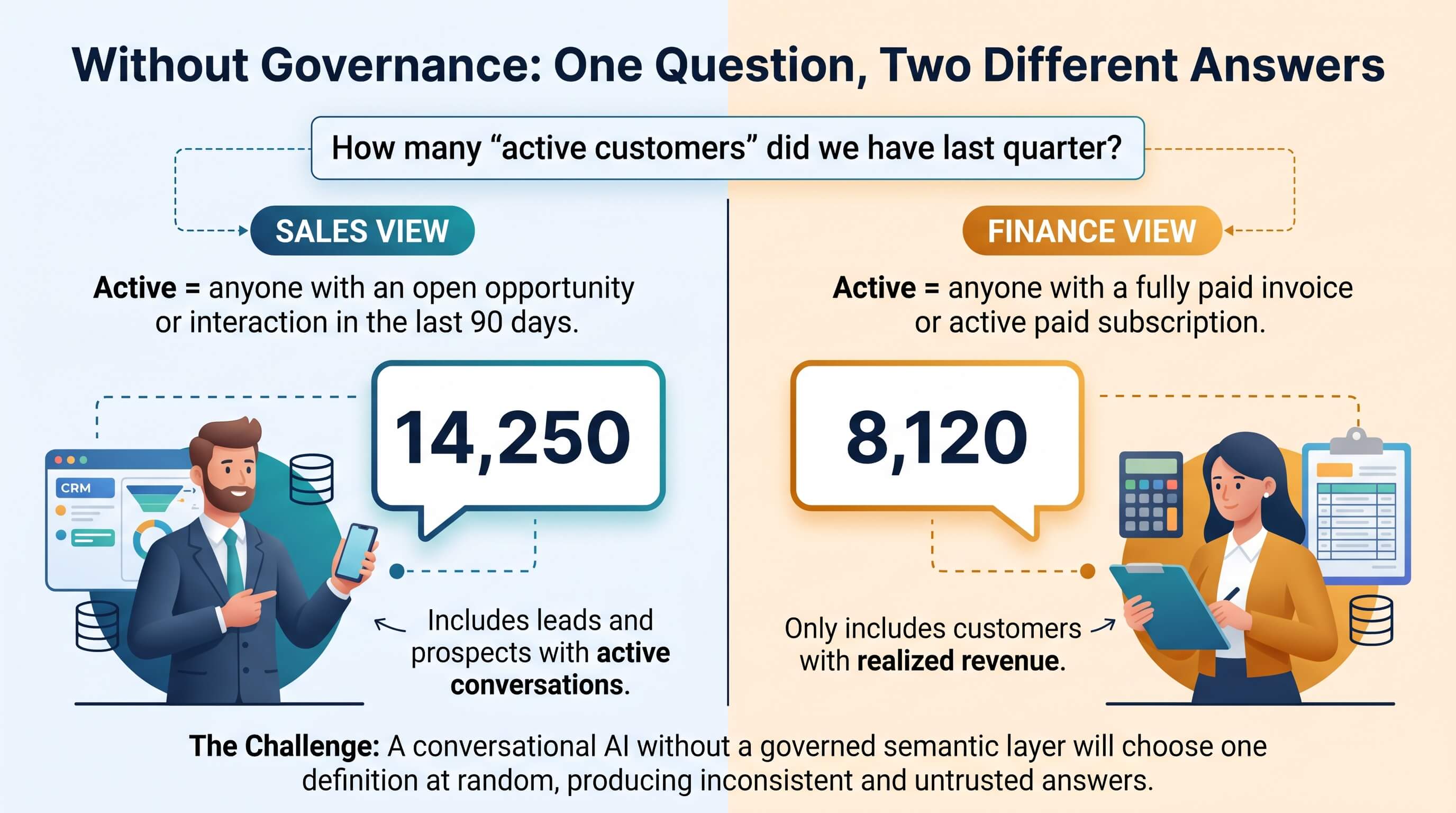
Its core challenge is semantic disambiguation: inside an enterprise, the same term means different things by department and use case. Finance and Risk can each calculate “total loan exposure” correctly and still report different figures, and two tools asked for “active customers” can return two different counts. spider
A person resolves that ambiguity with context. An AI assistant can’t, unless the system specifies which definition applies to this user and this question. Without that guidance, it picks one on its own, so the answer varies by tool and by how the question is phrased. Today, the success of such a capability depends on governed context: certified definitions, lineage, and ownership to support more trusted, nuanced answers.
This guide explains how conversational analytics works and how to trust its answers. It is written for data and analytics leaders, including chief data officers (CDOs) and BI teams, and for the AI consultants and systems integrators (SIs) who build these assistants. It also separates the category from conversation analytics software, which analyzes contact-center calls.
Key takeaways
Conversational analytics turns plain-language questions into governed queries and charts.
Answer accuracy depends on certified definitions and the context returned with each answer, as well as the broader system that applies and learns from context as it evolves.
Text-to-SQL accuracy on enterprise schemas is still low, so definitions carry more weight than model choice.
"Same metric, same answer" requires one governed layer across every BI and AI tool.
What is conversational analytics?
Conversational analytics, also called conversational AI analytics, combines three components. A large language model (LLM) interprets the question. A semantic layer translates business terms such as “churn” into the formulas that calculate them. Conversational data supplies the context: the tables, the metadata describing them, the metric definitions, and the named owner of each. Most people reach these systems through natural language interfaces built into BI tools and chat apps.
Each component shapes the answer. When a sales VP asks “Which territories missed Q3 quota?”, the LLM can parse the question, but the result depends on the bookings table and the agreed-upon definition of quota attainment. A fluent interface can’t compensate for a definition that is missing or disputed. One naming clash needs settling first.
The difference between conversational analytics vs conversation analytics software
Conversation analytics software analyzes recorded customer interactions, while conversational analytics answers business questions from company data. The names overlap, so searches for one often surface the other.
Conversational analytics | Conversation analytics software | |
Purpose | Answer business questions on demand | Analyze customer and agent interactions |
Data source | Warehouses and semantic models | Call recordings and chat transcripts |
Users | Business users and AI agents | Contact-center and customer experience teams |
Typical outputs | Metrics and charts, with generated SQL | Sentiment scores and agent scorecards |
The two connect downstream. Once contact-center tools score interactions, those scores become conversational data that a business user can query next to revenue.
How does conversational analytics work?
Conversational analytics is often described as ChatGPT for enterprise data, and the premise is easy to state. If any person in the company could ask the right question and get a reliable answer, insight would stop waiting on an analyst queue or a dashboard someone has to build. The sales VP, the supply chain planner, and the finance analyst could each investigate their own questions in their own words.
The comparison holds for the interface and breaks down on the substance. A consumer chatbot draws on public text. An enterprise system has to answer from company data, where terms carry company-specific meanings, and it has to return a defensible answer.
Conversational analytics works in five steps:
A user asks a question.
An LLM interprets the intent.
Business terms map to governed definitions.
The system generates a query, usually through text-to-SQL.
The system returns the answer with its definition and lineage.
Step 4 gets most of the attention, but step 3 decides whether the answer is right. A model can write valid SQL against the wrong definition of “active customer,” and the query still runs without an error.
The Spider 2.0 benchmark, presented at ICLR 2025, shows what happens when an agent has to work that meaning out on its own. Its 632 questions come from actual enterprise databases, many with more than 1,000 columns. To answer them, the AI often has to dig through documentation and column descriptions just to figure out what the data means. On that test, the researchers’ AI agent solved 21.3% of those tasks, compared with 91.2% on the original Spider benchmark.¹ Governed definitions in step 3 give the model that context up front.
While models may keep improving, ambiguous definitions stay ambiguous until someone governs them.
Semantic layers, ontologies, and context layers often get pitched as competing options. Read Alation's guide to how they work together to see the right build sequence.
Conversational analytics examples: From question to governed answer
Conversational analytics suits questions that need quick answers when waiting days for a custom report would mean deciding without the data. They are specific, tied to a function, and phrased the way a colleague would ask them. Typical examples include:
Marketing: “Which campaigns sourced the most pipeline this quarter?”
Supply chain: “Which SKUs are below safety stock, by warehouse?”
Finance: “Why did travel spend run over budget?”
Revenue: “How do win rates compare by segment?”
Operations: “Which metrics moved most this week?”
Increasingly, the asker is not a person. An AI agent may request governed renewal figures to assemble a customer brief.
Each of these questions depends on a definition. “Pipeline,” “safety stock,” “over budget,” and “win rate” mean something specific inside a given company, and the answer is only as reliable as the system’s grasp of that meaning.
Worked example: one question through five steps
A finance director asks, “What was gross margin in EMEA last quarter?”
Steps 1–2: The system receives the question, and the LLM interprets the intent.
Step 3: “Gross margin” maps to the certified financial planning and analysis (FP&A) definition, which excludes freight. A similarly named column in a sandbox table is ignored.
Step 4: The system writes SQL against the certified finance data product.
Step 5: The answer returns with the definition’s name and owner, [a freshness timestamp,] and lineage back to the general ledger.=
Without step 3, the director would receive a confident number built on the wrong logic, with no signal that anything was off. BI dashboards manage that risk differently, by vetting definitions once, when a view is built.
How does conversational analytics compare to traditional BI dashboards?
Conversational analytics and BI dashboards solve related but different problems.
Dashboards present vetted, consistent views of questions the organization already knows it will ask, such as weekly sales or monthly churn, and they are built for recurring reporting where every viewer must see the same number.
Conversational analytics handles new questions, including the follow-up that comes after reading a dashboard and the one-off question that would never justify building a new view.
The table compares the two across the dimensions that matter most in practice.
Conversational analytics | Traditional BI dashboards | |
Speed to answer | Seconds for new questions | Weeks to build a new view |
Who can use it | Anyone who can type a question | Users trained on the dashboard |
Flexibility | Open-ended follow-ups | Fixed views and filters |
Governance needs | Definitions resolve at query time | Definitions vetted at build time |
Failure mode | Fluent answer on a wrong assumption | Stale view nobody updates |
The governance row is the most consequential. A dashboard’s logic is reviewed once, when the view is built, which keeps it dependable until the business changes and no one updates it. Conversational analytics resolves definitions every time a question is asked, which makes it flexible but entirely dependent on those definitions being clear, owned, and governed. Most organizations need both, and both degrade the same way when definitions drift between teams.
That shared dependency is why getting definitions right pays off well beyond any single tool. The sections that follow show where the return appears across business functions, starting with the key use cases for conversational analytics.
What are the key conversational analytics use cases?
Conversational analytics delivers the most value where people need answers faster than a ticket queue can supply them, and where a delayed answer means a decision made without the data. The six use cases below are the most common across enterprises. They are not an exhaustive list, but they show where teams most often start and where the return is easiest to see.
Self-service analytics: A marketer checks campaign-sourced pipeline without filing a request.
Supply chain and operations: A planner finds stock-keeping units (SKUs) below safety stock by warehouse, the kind of question supply chain AI agents are starting to act on.”
Finance variance analysis: An FP&A analyst asks why travel spend ran over budget.
Sales performance: A chief revenue officer compares win rates by segment before a forecast call.
Executive briefings: A chief operating officer gets a weekly summary of the metrics that moved most.
AI agents querying data: An agent pulls governed figures into a customer renewal brief.
The pattern across all six is that each question depends on a specific definition, whether “pipeline,” “safety stock,” “over budget,” “win rate,” or “renewal.” When the definitions and data underneath are ambiguous, stale, or ungoverned, every one of these use cases fails in the same way: the system returns a confident answer that can’t be defended. The failure is rarely the model’s alone. Understanding why it happens, and where in the process it can be prevented, is the next question to answer.
How can you tell if a conversational analytics answer is trustworthy?
Trust in an answer should come from evidence you can inspect, not from how confident or fluent it sounds. Language models are fluent by default, so a wrong number and a right one arrive in the same polished sentence, and tone tells you nothing. The reliable signals are four pieces of context that a well-built system returns alongside the number. You can check for them in any tool in under a minute.
Definition. The answer states what “revenue,” “active customer,” or “gross margin” means in this instance, including what is included and excluded. If sales and finance define a term differently, it says which one it used, or shows both. Without this, you can’t tell whether the number matches the one a colleague quoted in last week’s meeting.
Source. You can see which table or system the figure came from, which tells you whether it is a certified dataset or an unvetted copy. Many wrong answers come from deprecated or experimental tables that look legitimate by name, and a visible source makes those mistakes easy to catch.
Freshness. A number is only useful relative to its date, so the answer shows when the underlying data was last refreshed. A figure that is accurate but three weeks old can mislead a decision as effectively as one that is simply wrong.
Owner. A named person or team stands behind the definition, so when you question the number, someone is accountable for defending it or fixing it. Ownership turns a disputed answer from an argument into a request with a clear destination.
Together, these checks make a simple test. If an answer shows its definition, source, freshness, and owner, you can verify it and challenge it with a specific question. If it shows none of them, treat it as a draft that needs confirmation before anyone acts on it, however reasonable the number looks.
A good habit is to ask the assistant for a figure you already know, such as last quarter’s revenue, and confirm that it matches what your finance team reports and that the context is displayed. Two or three spot-checks reveal quickly whether a tool deserves a place in real decisions. When one of the four signals is missing, the answer is usually wrong for one of four reasons, covered next.
Why does conversational analytics get answers wrong?
When a conversational analytics system returns a wrong number, the language model is rarely the only cause. Most failures trace back to the definitions and data underneath the interface, which is why they are preventable. Four causes account for most of them:
Ambiguous metric definitions. Sales and finance each define “revenue” and “active customer” differently. The system has no way to know which one the asker means, so it chooses, and the answer looks authoritative whichever it picks.
Uncertified or stale data. The assistant queries a deprecated table that no one marked as deprecated, or an experimental copy whose name looks legitimate. The query runs, and the figure is out of date or unvetted.
Missing lineage. Nobody can show where a number came from, so nobody can defend it. A disputed figure becomes an argument instead of a request with a clear destination.
Conflicting definitions across platforms. The warehouse, the BI tool, and the AI agent each hold their own version of the same metric. A question asked three ways returns three answers.
Each cause corresponds to a signal a trustworthy answer should carry: its definition, its source, and its owner. When a system omits those, the user can’t tell a correct answer from a plausible one.
Research on data readiness points the same way. Gartner’s research on AI-ready data finds that readiness is continuing work, not a project completed once and left alone.² Grant Thornton’s 2026 AI Impact Survey of 950 senior business leaders found insufficient data readiness to be the third-leading cause of AI underperformance. In the same survey, 55% of CIOs and CTOs said fewer than half their core applications are AI-ready.³ Organizations aren’t failing because the models are weak. They are scaling AI on data and definitions that haven’t been prepared for it.
What types of conversational analytics tools are there, and what should you ask vendors?
Ask five vendors what conversational analytics is and you will hear five different pitches. A more useful approach is to sort tools by what they can see, because that determines where their answers can be trusted. Most fall into four categories.
Category | Examples | Typically limited to | Trade-off |
BI-native copilots | Microsoft Copilot in Power BI | The semantic models inside that BI tool | Convenient if your analytics live in one tool |
Data-platform assistants | Databricks Genie, Snowflake Intelligence | The data and definitions inside that platform | Strong on that platform, blind to definitions elsewhere |
General chat assistants with connectors | Chat assistants connected to files or databases | Whatever the connector exposes, with definitions often inferred | Flexible, but the least control over definitions and permissions |
Cross-platform governed approaches | [Alation Chat with Your Data; confirm naming and status] | Definitions mastered across platforms | Requires governance work up front, but definitions travel across tools |
Each category has legitimate uses. A BI-native copilot is the simplest choice for a team that lives in one BI tool, while a cross-platform approach pays off when the same metric must read the same way in several places.
To separate marketing from capability, put the same five questions to every vendor:
Can you show a live answer on our data that displays its definition and SQL?
Does it enforce our existing permissions at the row and column level? Test this with real user accounts instead of assuming it.
What happens when two definitions conflict? A well-designed system names both or asks which you mean, instead of guessing.
How do corrections reach the next person who asks? The fix should update the definition, not just one conversation.
Where does our data go, and is it retained? Ask whether queries are sent to a model provider and whether anything is stored or used for training.
Also ask for cost estimates at your expected question volume, since usage-based pricing and warehouse compute can grow quickly as adoption spreads. Vendors who answer these questions well, and can demonstrate the answers on your own data, have usually done the underlying governance work. That work is the subject of the framework that follows.
How to get accurate, trusted answers from conversational analytics
You get accurate answers from conversational analytics by governing business meaning before you scale the interface. The purpose of the governed-answer framework is to make every answer traceable to an owned definition. Its practice is six controls your team runs daily.
Data leaders can use these steps as a readiness check before rollout. SIs can use them to scope the work before signing a statement of work (SOW).
Define and certify critical metrics. Signal: every top-20 metric has a named owner and a certification date.
Build a business glossary and semantic layer. Signal: each term resolves to one definition or to clearly labeled variants.
Expose lineage and quality signals with every answer. Signal: users see the source and its freshness inside the chat.
Apply access policies. Signal: the assistant returns only rows the person asking is allowed to see.
Capture user corrections as feedback. Signal: a correction updates the master definition for everyone.
Monitor answers continuously. Signal: you test against your own question-and-answer pairs and track accuracy monthly.
Run together, these controls move responsibility for accuracy from the model to the organization’s corpus of knowledge. A trusted answer is one a person can trace to a defined, owned, and current source, and each control supplies one link in that chain. The framework also clarifies a distinction that is often blurred: governing the AI systems you deploy is a different job from governing the knowledge those systems rely on.
Governed AI is not AI governance. AI governance covers the table stakes, such as cataloging models and registering agents for compliance. Governed AI means the knowledge your agents consume is accurate and defensible and keeps improving. It allows agents to operate with enough autonomy to reduce expedited freight spend, shorten exception cycles, and measurably change outcomes.
Which regulations apply to conversational analytics?
No single law governs conversational analytics. Several regimes apply depending on where the system operates, who uses it, and what decisions its answers inform. Three questions determine which ones matter: whether the system interacts directly with people, whether its answers feed regulated decisions, and whether it handles personal data. The frameworks below are the ones data and AI leaders ask about most.
Framework | Status | What it means for conversational analytics |
EU AI Act, Article 50 (transparency)4 | Applies from 2 August 2026 | Systems designed to interact directly with people must tell them they are dealing with AI, unless that is obvious from context. Separate marking duties cover AI-generated content. Systems already on the market before 2 August have until 2 December 2026 for the content-marking rule. |
EU AI Act, high-risk obligations | Delayed to 2 December 2027 for most standalone systems | Applies if answers feed decisions in listed areas such as credit or employment. Documentation, risk management, and human oversight requirements follow. |
NIST AI Risk Management Framework | Voluntary | Organizes AI risk work into four functions: govern, map, measure, and manage. It is a common reference for internal AI policy and for demonstrating due diligence.5 |
Data protection and sector rules (GDPR, financial and healthcare regulation) | Depends on the data and industry | Govern what the assistant may query and who may see the result, including personal data in questions and answers. |
In practice, these frameworks ask for the same things: knowing which AI systems you run, being able to explain how an answer was produced, controlling who sees what, and showing that the system is monitored. They map closely to the six controls above. Lineage and definitions support explainability. Access policies support data protection. Continuous testing supports the “measure” and “manage” functions in NIST.
Scope depends on whether the system is placed on the EU market, who deploys it, and what its answers are used for, so have counsel confirm how each requirement applies to your deployment.
Alation AI Governance gives teams a register of their AI assets and maps each one to the regulations that apply to it. That makes the inventory and documentation these frameworks require easier to keep current. The next section shows how the framework looks in a working deployment.
Conversational analytics in practice: From mastered definitions to trusted answers
The earlier controls depend on one precondition: the business has agreed on what its terms mean, and someone owns each definition. Two Alation capabilities put that into practice. Semantic model mastering gets definitions agreed and approved, and data products deliver them to every chat interface and agent that needs them.
What is semantic model mastering?
Semantic model mastering applies the logic of master data management to the semantic layer. Alation brings semantic models from sources such as Snowflake, Power BI, and Tableau into its Data Products Marketplace, where owners enrich and approve them as governed data products, aligned to the Open Semantic Interchange standard. Approved definitions can then be synchronized back, so the tools your teams already query read the governed version. The goal is explicit, owned definitions, with the agent told which one applies to the question.
How do data products deliver governed definitions?
A data product is a reusable package of data and business context, so a mastered definition travels with the data into every interface and agent that uses it. Alation Chat with Your Data is built into the marketplace and answers questions from these certified data products. One gaming company runs more than 30 Alation data products that support dozens of agents.⁶
Euromonitor: Governed answers in a customer-facing app
Euromonitor International, a London-based market research firm founded in 1972, wanted its 2,500+ partners to ask questions instead of clicking through pages and filters in its Passport platform. Trust and accuracy were non-negotiable, along with lineage and permissions applied by subscriber level.
Alation's agents reason over curated data products, so answers stay grounded in Euromonitor's business definitions and show the underlying SQL and lineage. Custom aggregation lets Euromonitor customers apply their own regional definitions, the on-time-in-full lesson in a new setting.
Euromonitor's advice: enforce existing security policies from day one, and get partner help with legacy data structures. The program was in beta when the case study was written, so its time-to-insight gains were projected rather than measured.
The pattern holds across both examples: master the definitions and package them as data products, then return every answer with lineage attached.
How Alation AIOS™ powers governed conversational analytics
The Alation Intelligence Operating System (AIOS™) masters business meaning across data and AI platforms and governs how agents use it, with structured evaluation improving that meaning over time. Alation's Governed AI/BI solution puts that into practice: the same governed definitions sit behind every answer, whether a person or an agent is asking.
Each Alation differentiator maps to a framework step:
Cross-platform semantics: One governed definition for each metric, mastered across the platforms you run and delivered to your BI and AI tools (steps 1 and 2).
Lineage: Answers trace back to governed sources, so you can show where a number came from (step 3).
Feedback loops that compound: Corrections route to the right layer (context, data product, or prompt), so the next answer is better than the last (step 5).
Evidence on demand: Traceability builds as answers are produced, so you can prove it when the auditor calls, not after (steps 4 and 6).
Together, these four pieces keep a conversational answer from being a one-off. The definition behind it is shared across platforms, its sources are traceable, and every correction makes the next answer better. That foundation matters even more once the thing asking is no longer a person at a keyboard, but an agent ready to act on the answer.
The future of conversational AI analytics: From questions to agents
The category is moving from answering questions to agents acting on governed data, such as drafting a renewal brief or flagging a stockout. Governed context means certified definitions, lineage, quality signals, and access policies delivered with every request. That context now sits at the center of the enterprise AI stack.
Governed context lets agents act with real autonomy, because every action traces back to a definition someone owns. Autonomy should grow only as fast as measured accuracy allows.
Trusted answers start with governed definitions
So, what is conversational analytics at its best? A faster path from question to answer, built on conversational data your business has defined and can defend.
Govern meaning first and return context with every answer, and conversational AI analytics becomes something your teams can act on. Contact-center call analysis stays a separate job for conversation analytics software.
Ready to make every answer defensible? Start a conversation.
Frequently asked questions
What are the four types of analytics?
The four types of analytics are descriptive (what happened), diagnostic (why it happened), predictive (what will happen), and prescriptive (what to do next). Conversational analytics handles descriptive questions best, because they map cleanly to certified metrics. Diagnostic and predictive questions need trusted lineage and governed forecast models, while prescriptive work increasingly falls to agents.
What are the best conversational analytics tools?
The best conversational analytics tools show the definition behind every answer and enforce your existing permissions. Ask five vendors “what is conversational analytics?” and you’ll hear five pitches, so ask each one to prove on your own data that answers carry their definition and SQL.
BI-native and data-platform assistants stay limited to their own semantic models, so cross-platform definitions matter. AI-powered search also helps users find the right certified asset before they ask.
What accuracy should you expect from conversational AI analytics on enterprise schemas?
Conversational AI analytics on enterprise schemas is less accurate than vendor demos suggest. The best agent on the Spider 2.0 benchmark solved 21.3% of enterprise tasks at release.¹ Governed definitions close more of that gap than model upgrades do.
Can conversation analytics software feed a conversational analytics program?
Yes. Contact-center tools produce interaction scores and topics that become conversational data, which business users can query alongside revenue and churn.
What role does a semantic layer play in conversational AI analytics?
A semantic layer translates business terms into calculation logic. Without a governed semantic layer, the LLM guesses which definition of "revenue" a user means.
How do you govern AI-generated answers to business questions?
Governing AI-generated answers starts with certifying critical metrics and returning each answer with its definition and lineage. Teams then enforce existing access policies and test answers against their own question-and-answer pairs.
Can conversational analytics work across multiple BI and data platforms?
Conversational analytics works across platforms when definitions are mastered once and synced to each platform. Without that sync, each platform answers with its own local definition.
Sources & notes
Every external claim on this page is independently verifiable.
Best Spider 2.0 agent solved 21.3% of 632 enterprise text-to-SQL tasks vs. 91.2% on Spider 1.0. Lei et al., ICLR 2025: https://arxiv.org/abs/2411.07763v2
Data readiness for AI is not built once and for all. Gartner, Quick Answer: What Makes Data AI-Ready?, 15 May 2024, as cited by Alation: https://www.alation.com/blog/gartner-report-ai-ready-data-drives-success/
Insufficient data readiness ranked third-leading cause of AI underperformance (n=950, Feb–Mar 2026). Grant Thornton: https://www.grantthornton.com/services/advisory-services/artificial-intelligence/2026-ai-impact-survey
EU AI Act Article 50 applies from 2 August 2026. European Commission: https://digital-strategy.ec.europa.eu/en/faqs/transparency-obligations-under-article-50-ai-act
NIST AI RMF 1.0 is voluntary and built on govern, map, measure, and manage. NIST, 26 Jan 2023: https://nist.gov/news-events/news/2023/01/nist-risk-management-framework-aims-improve-trustworthiness-artificial
Sangani on on-time-in-full definitions; video game company with 30+ data products (per Alation). Forbes, Victor Dey, 17 Sep 2026: https://www.forbes.com/sites/victordey/2026/09/17/alation-ceo-warns-that-smarter-ai-agents-can-still-get-your-business-wrong/
Analyst attributions & disclaimers
Gartner, Quick Answer: What Makes Data AI-Ready?, Roxane Edjlali, Mark Beyer, Svetlana Sicular & Ehtisham Zaidi, 15 May 2024.
Gartner does not endorse any vendor, product or service depicted in its research publications and does not advise technology users to select only those vendors with the highest ratings or other designation. Gartner research publications consist of the opinions of Gartner's research organization and should not be construed as statements of fact. Gartner disclaims all warranties, expressed or implied, with respect to this research, including any warranties of merchantability or fitness for a particular purpose. GARTNER and Magic Quadrant are registered trademarks and service marks of Gartner, Inc. and/or its affiliates in the U.S. and internationally and are used herein with permission. All rights reserved.
- AI
- Data Governance
- Data Products
- Data Quality
- Digital Transformation
Keep reading
More from the data desk