

AI in supply chain management is the organizational discipline of using AI and ML to plan, source, store, and move goods.
When a forecast misses, the model usually takes the blame. More often, the cause sits upstream in siloed systems and conflicting definitions of the same metric across regions. An AI system’s accuracy depends on whether the data behind each decision is fit for that specific use case. Gartner’s research on AI-ready data makes the same point: readiness is judged one use case at a time, as data is aligned, qualified, and governed for the job the AI system is asked to do.¹
This guide is written for supply chain and planning leaders, and for the data leaders who support them. It covers where AI in supply chain management delivers value today, and how to deploy AI agents so that the decisions they’re allowed to make expand only as their results prove reliable.
Key takeaways
AI in supply chain management applies machine learning and AI agents to planning, sourcing, inventory, and logistics.
Shared business definitions and trusted data shape AI results more than model choice does.
The fastest safe start is a narrow one: identify your most valuable trusted data, package it as data products, and expand agent autonomy as results prove out.
Alation’s view: governed context decides where agents act alone and where a human stays in the loop.
What is AI in supply chain management?
AI in supply chain management is the application of machine learning, predictive analytics, generative AI, and agentic AI to decisions across planning, sourcing, inventory, and logistics. Today it presents as a set of capabilities organizations add to the systems they already run, such as ERP, warehouse management, and transportation platforms.
Where those systems execute fixed rules, AI models learn from historical and live data to forecast what comes next and recommend the next actoin. In some cases, the system can also take that next action.
Agentic AI extends this further. An AI agent is software that pursues a defined goal by planning steps, calling tools and data sources, and acting within the permissions it’s been given.
In a supply chain, that might be an agent that detects a late inbound shipment, checks which customer orders it affects, and drafts a reallocation for a planner to approve. Agentic accuracy often depends on the context it works from: the definitions, policies, and quality thresholds that enable it to grasp what key terms (like “customer”) truly mean and recommend the next best action depending on the unique needs of your organization.
How do AI-enabled supply chain systems differ from rules-based software?
Traditional supply chain software is deterministic: given the same inputs, it applies the same rule and returns the same output every time. AI systems are probabilistic: they estimate the most likely outcome from patterns in data, so their answers come with a degree of confidence rather than certainty.
This distinction changes what must be governed. You can audit a rule by reading it, but a model’s output is only as reliable as the data it learned from and the data it acts on. The difference shows up in four attributes:
How decisions get made
What data feeds them
How fast they happen
Where people step in.
The table below shows how the two approaches compare:
Attribute | Traditional supply chain software | AI-driven supply chain systems |
Decision type | Rules-based: reorder when stock hits a set point | Predictive and prescriptive: forecast shifts and recommend action |
Data inputs | Structured transactions, mostly from one ERP system | ERP, warehouse, transport, IoT sensor, and external data combined |
Speed | Batch runs, often nightly or weekly | Near real time, as new data arrives |
Human role | People make and execute every decision | People set boundaries and own high-stakes calls |
Human oversight is essential. Once software starts recommending actions, the question shifts from "Is the model accurate?" to "Can we trust the data it's acting on?" The next section shows where that question already applies in production.
How is AI being used in supply chain management today?
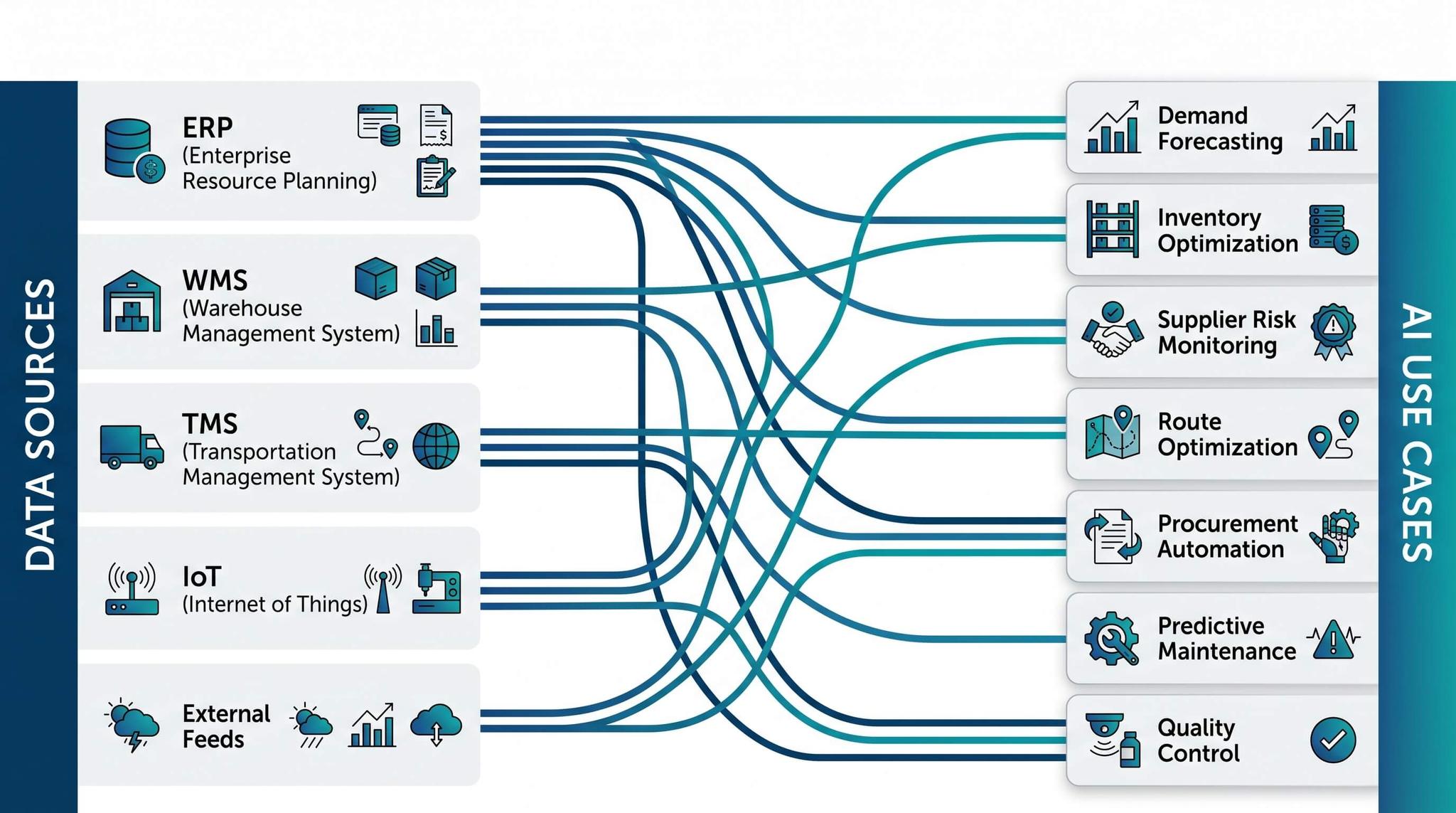
Companies use AI in supply chain management to forecast demand, optimize inventory, monitor supplier risk, plan routes, automate procurement, predict equipment failures, and inspect product quality. Each use case depends on a specific set of data, and that dependency is where most projects succeed or stall.
Here are those seven supply chain automation use cases, with the data each one needs:
Use case | What AI does | Data it depends on |
Demand forecasting | Predicts demand by SKU and location from sales history, promotions, and market signals | Order and point-of-sale history, promotion calendars, a stable product master |
Inventory optimization | Recalculates safety stock and reorder points as demand and lead times shift | Inventory positions, supplier lead times, a consistent location hierarchy |
Supplier risk monitoring | Flags suppliers exposed to delays, financial stress, or regional disruption | Supplier master data, delivery performance, external risk feeds |
Route optimization | Re-plans routes and carrier choices around congestion and weather | Shipment records, carrier milestones, traffic and weather data |
Procurement automation | Drafts purchase orders and matches invoices to goods receipts | Purchase orders, contracts, receipts, invoices |
Predictive maintenance | Spots failure patterns in equipment before a breakdown | IoT sensor readings, maintenance logs, failure history |
Quality control | Uses computer vision to catch packaging and labeling defects on the line | Labeled images, product specifications, defect history |
Every row in that table carries the same dependency: the AI is only as dependable as the data underneath it. The teams that get furthest tend not to tackle all seven use cases at once. They start with one, anchored in a business problem people already feel. Lipton is a clear example.
How Lipton used its supply chain as a proving ground for AI
LIPTON Teas and Infusions treats its supply chain as the proving ground for AI, according to Robin Rietveldt, the company's Global Director of Data & AI. Lipton's AI program includes three supply chain automation use cases at different stages:¹
A frontline assistant, in development, that helps factory operators troubleshoot machine failures by pulling up the right instructions and manuals.
Computer vision on production lines that detects packaging and labeling defects and triggers a response on the spot, which reduces costs later in the supply chain.
Prescriptive maintenance with digital twins, which Lipton is developing now so it can simulate production scenarios and repair machines before they break.
These use cases grew out of specific business pressure. Since its acquisition by CVC Capital Partners in 2022, Lipton has operated as a standalone, private-equity-backed company, and its data priorities center on cost reduction and efficiency. Rietveldt chose the supply chain as the proving ground because it combines clean, controllable data with a workforce eager to adopt new tools. His guiding lesson is to start with the business pain points people actually feel, rather than curating a catalog first and looking for uses later.²
Why the global supply chain needs analytics before AI
The Federal Reserve Bank of New York’s Global Supply Chain Pressure Index rose to 1.82 in April 2026, its highest reading in nearly four years, as war in the Middle East disrupted shipping around the Strait of Hormuz.³ By June, the index had eased to 1.25. In a market that moves that fast, forecasts trained on last quarter’s lead times and carrier performance can go stale within weeks.
That’s why analytics maturity matters for AI in supply chain management. Predictive and prescriptive models learn from the same descriptive data teams already report on. If two regions report different on-time delivery rates for the same quarter, a model trained on both inherits the disagreement.
Most organizations build toward AI through three stages of analytics maturity:
Descriptive analytics explains what happened, such as on-time delivery by carrier last quarter.
Predictive analytics estimates what is likely next, such as stockout risk by SKU over six weeks.
Prescriptive analytics recommends what to do, such as alternate sourcing for an at-risk component.
The good news is that this doesn’t require trusting all of your data at once. With Alation, teams can quickly pinpoint the highest-value, most trusted data in the organization and use it as a narrow starting wedge.
That wedge becomes the data product, where definitions are mastered, policies and permissions are applied, regulatory requirements are governed, and quality thresholds are set for each AI use case. Without trusted analytics, supply chain dashboards and AI models alike end up reporting different answers to the same question.
Our guide to supply chain analytics covers how teams move from descriptive to prescriptive, including the KPIs worth instrumenting at each step.
Gartner’s guidance supports that use-case-by-use-case approach: “Data readiness for AI is not something you can build once and for all.”¹ In the Alation Intelligence Operating System (AIOS™), data products are where that work lives. Each product is designed to address a single specific business question, and packages trusted data with its certified definitions, policies, and quality checks, so a new AI use case starts from data that’s already fit for its given purpose.
Why semantic consistency determines AI accuracy in the supply chain
Data products are how organizations align on the business terms their AI depends on. When every system, dashboard, and agent draws on the same certified definition of a metric, AI answers stay consistent.
When they don’t, an agent acts on whichever definition it finds, without flagging the conflict. Gartner predicts that by 2027, organizations that prioritize semantics in AI-ready data will increase agentic AI accuracy by up to 80% and reduce costs by up to 60%.⁴
For AI in supply chain management, three gaps break that consistency:
Siloed systems. ERP (enterprise resource planning), WMS (warehouse management system), and TMS (transportation management system) data that never reconciles.
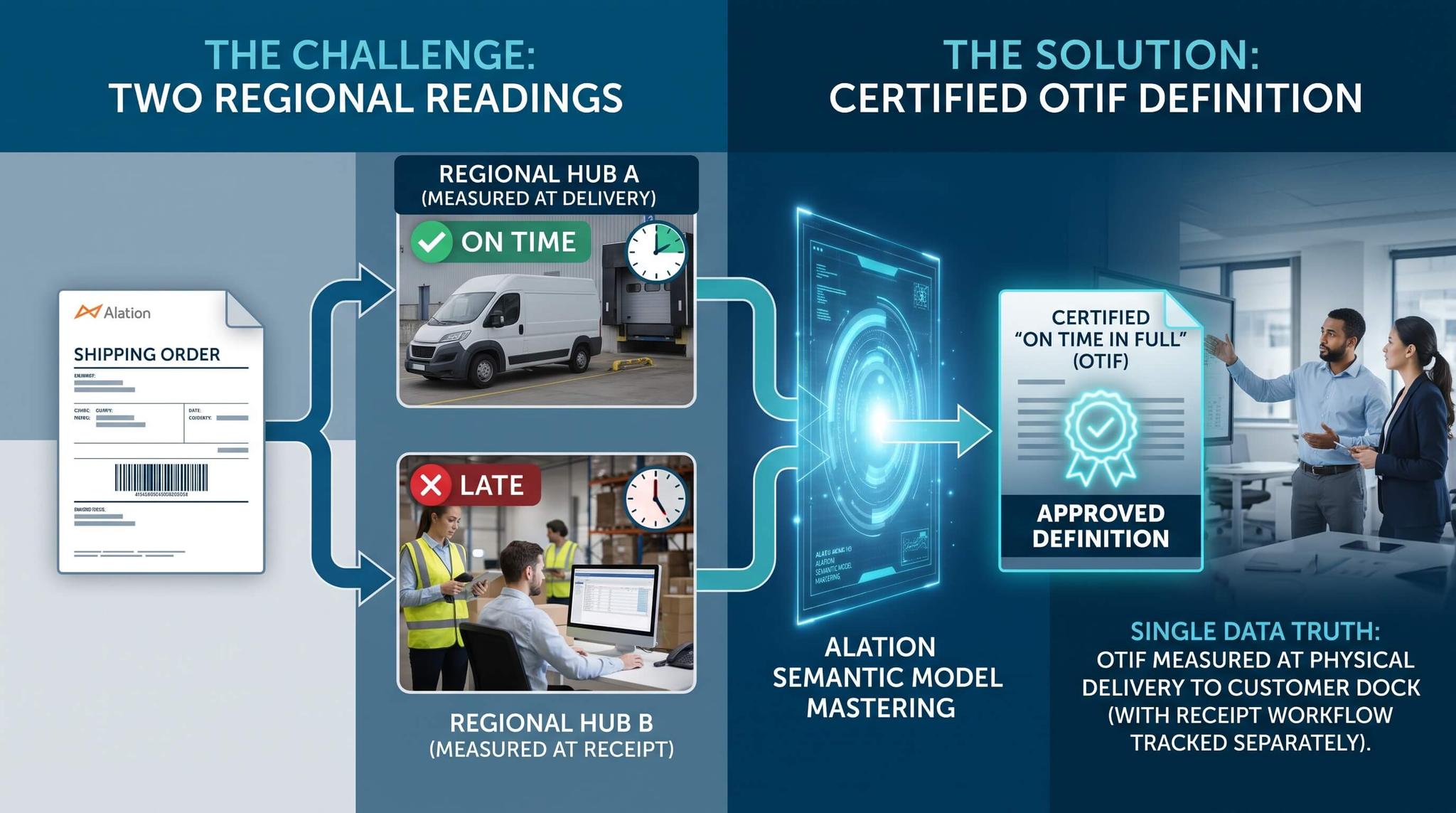
Conflicting metric definitions. "On-time delivery" measured at shipment in one region and at receipt in another.
Missing lineage. No way to trace a forecast input back to its source when an upstream table changes.
When definitions conflict, even mature analytics, supply chain dashboards included, report two different truths. This problem is the hardest to see.
Alation co-founder and CEO Satyen Sangani told Forbes that customers define on-time in full (OTIF) differently. Some measure timeliness at delivery, others when the recipient records receipt.⁵
Both can be legitimate. An agent that picks the wrong one will still calculate a precise answer, and that precision makes the error harder to catch.
Alation built Semantic Model Mastering for this exact reason: approved business definitions live in one place, owners certify them, and the definitions sync back to the platforms where agents work. The goal is the same metric, same answer, no matter which person or agent is asking. Deciding which OTIF definition wins stays a business decision.
What Brambles learned about governing supply chain data at scale
Brambles, one of the world’s largest providers of reusable pallets and containers, shows what governing supply chain data looks like at global scale. The company manages about a third of a billion of these assets, which it calls “platforms,” across roughly 60 countries, and IoT devices on them generate billions of data points.⁶
That scale extends into the data itself. Brambles organizes its data into 10 domains, 31 subdomains, and roughly 323 sub-subdomains, and a single system connection can bring in hundreds of thousands of records at once. When the team connected its ERP, 300,000 objects came into scope, and Alistair Griffin, Global Data Governance Lead, said he’d bet a good share of them were duplicates.⁶
Rather than govern all of it equally, Brambles concentrates its effort on critical data elements (CDEs): a fraction of the total that sits at the top of its data value pyramid. Griffin defines these as data that reduces serious risk, produces new income, or is tied to something the business must do to operate, such as regulation. As he told Brambles’ executives, not all data is equal.⁶
But prioritizing only works if governance can find those CDEs wherever they live. Most supply chain planning software is built as a point solution. It governs what sits inside its own platform, not the full mesh of systems a modern enterprise runs.
Brambles tackled this with Alation’s Critical Data Manager. The team codified its CDE standards once and applied them uniformly across every data domain, so individual departments no longer defined “critical” on their own terms. AI agents then sorted through the incoming objects, identified which ones were CDEs, and linked each to its business glossary definition automatically. Griffin estimates the automation will save "hundreds of hours probably" as the rollout continues.⁶
Brambles’ sequence, narrowing first and then automating, is the same one that makes AI in supply chain management safe to scale. The next section lays it out step by step.
How to use AI in supply chain management safely
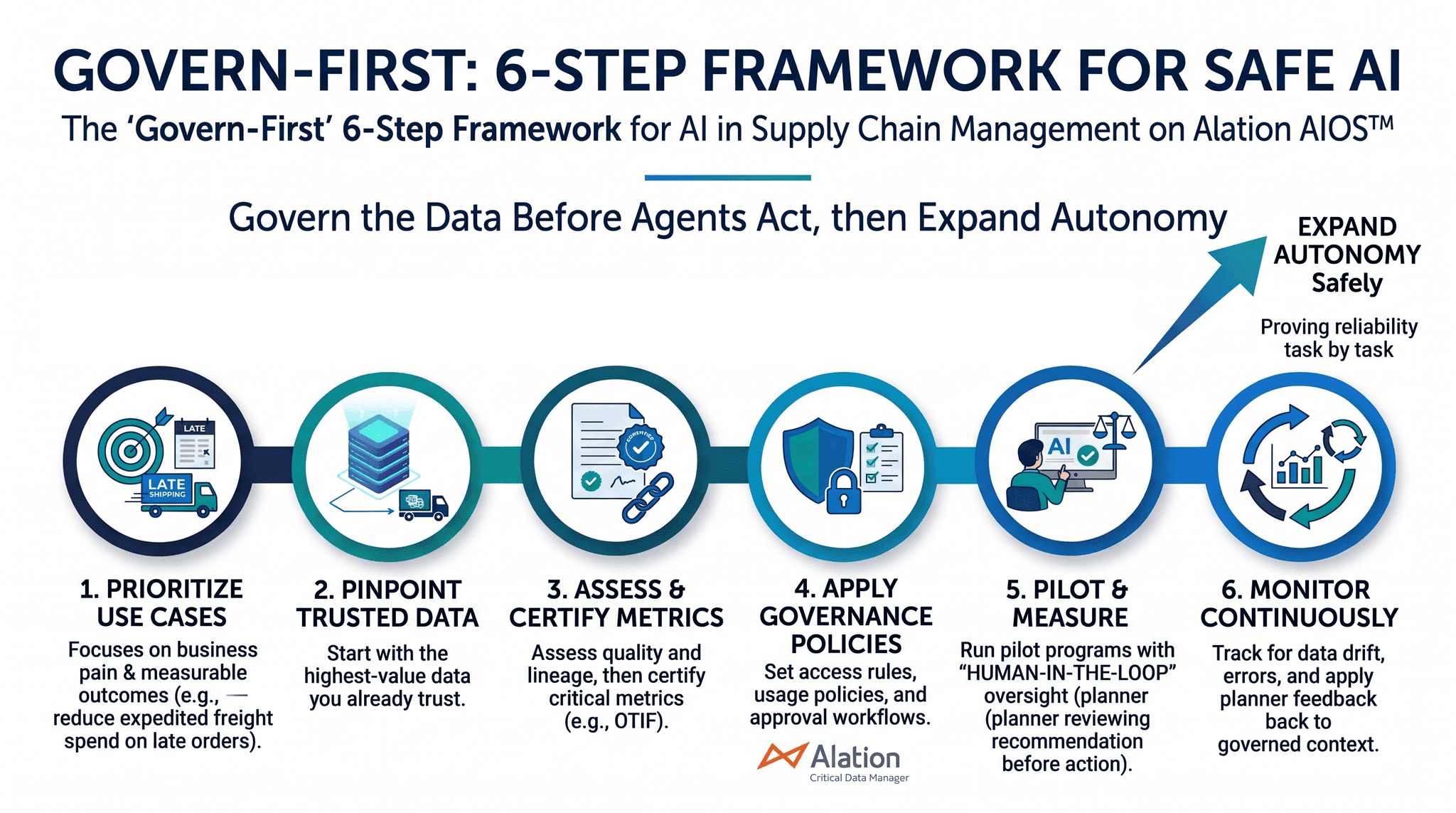
To use AI in supply chain management safely, govern the data before agents act on it, and expand autonomy only as results prove out. The six-step govern-first framework below follows Gartner’s advice to start with low-risk decisions and build the data and governance foundation first.⁹ Systems integrators (SIs) delivering supply chain AI programs for clients can use it as a delivery sequence.
Purpose. The framework puts trusted, certified data under every AI decision before an agent can act on it.
Approach. Start from business pain and a measurable outcome, as Lipton did. Govern the data that matters most, as Brambles does. Then widen agent autonomy one proven task at a time.
Practice. Day to day, this means a named owner for every critical metric and a certification review before any definition changes.
The six steps:
Prioritize supply chain automation use cases by business pain and measurable outcome. Example: reduce expedited freight spend on late orders by a target amount.
Pinpoint the trusted data the use case needs. Start with the highest-value data you already trust, then add sources as the use case expands.
Assess quality and lineage, then define and certify critical metrics. Get an owner to sign off on one OTIF definition and the CDEs beneath it.
Apply governance policies. Set access rules, usage policies, and who can approve a definition change.
Pilot and measure. Keep a human reviewing every recommendation, and compare results to the baseline from step 1.
Monitor continuously. Watch for data drift and agent errors, and write planner corrections back into governed context.
Regulation adds a timeline. Under Regulation (EU) 2026/1744, the Digital Omnibus on AI, EU AI Act obligations for stand-alone high-risk AI systems now apply from 2 December 2027, and from 2 August 2028 for high-risk AI embedded in regulated products.⁷
In the US, the NIST AI Risk Management Framework (AI RMF) is a voluntary framework organized around four functions: govern, map, measure, and manage.⁸ NIST is also developing an AI RMF profile for critical infrastructure, with a concept note released in April 2026.⁸
Alation AI Governance maps registered AI assets to the EU AI Act, the NIST AI RMF, ISO/IEC 42001 (the international standard for AI management systems), and GDPR, so the evidence for each requirement builds as the program runs. That foundation is what the Alation platform is designed to provide.
How Alation AIOS™ supports governed AI in supply chain management
Alation AIOS™ gives AI agents a governed source of business context. It masters business definitions across data and AI platforms through data products, controls which data and definitions each agent is permitted to use, and improves that context as people correct agent outputs. The data catalog is one component inside AIOS™.
Governed AI is not AI governance. AI governance is one part of the picture. In practice, Alation covers three kinds of governance:
Governance of AI. Registering AI models, agents, and tools, and proving compliance with regulations such as the EU AI Act. This is Alation AI Governance.
Governance with AI. Using AI to automate traditional governance work, such as curation and documentation, through Alation Curation Automation.
Governance for AI. The context layer agents draw on, built from data products and ontologies, so agents work from certified meaning.
Governed AI is the result of all three: the knowledge your agents consume is accurate, improving, and defensible. For AI in supply chain management, AIOS delivers four capabilities:
Cross-platform visibility. One certified definition of on-time delivery, shared by planning, BI, and AI tools.
Lineage and context tracing. Impact analysis with Alation Lineage shows what breaks downstream when a supplier table changes.
Feedback loops that compound. Planner corrections are recorded in a governed context, so the next answer starts from the fix.
Audit-grade evidence. Compliance proof builds continuously, ready before a review instead of assembled the week of it.
The customer stories show what this looks like in practice. Brambles uses Alation Critical Data Manager to automate discovery and mapping of its critical data elements. Griffin estimated the automation would save hundreds of hours, though the rollout was still under way when he spoke.⁶ At Lipton, Alation metadata feeds the front page of each Power BI report, so data sources and refresh schedules appear in the tools people already use.¹
Packaging governed data for reuse is the next step. Our guide to supply chain data products covers the five highest-value products to build first, and Alation Data Products makes them discoverable across teams.
Governed data products also set the limits for what agents can safely take on next.
What does agentic AI mean for the future of the supply chain?
The future of the supply chain is agents taking on defined tasks, with autonomy expanded only as each task proves reliable. Gartner predicts that by 2031, 60% of supply chain disruptions will be resolved without human intervention.⁹
The same Gartner research sets a near-term limit. Because of current technological immaturity and data availability issues, Gartner advises restricting full automation to low-risk decisions for now and using AI to augment human judgment on higher-stakes calls.⁹ Its recommendations to chief supply chain officers start with investment in data quality and governance.⁹
Alation's position matches that sequence. Sangani advocates "a start point of zero trust," with companies proving where AI is useful before expanding its responsibilities.⁵ Governed context shows where an agent can act alone and where a human keeps the final call.
Most enterprises are earlier on this curve than headlines about AI in supply chain management suggest. In Grant Thornton's 2026 AI Impact Survey of 950 senior leaders, only 5% allow agents to execute high-stakes decisions without human review, and 78% lack strong confidence they could pass an independent AI governance audit within 90 days.¹⁰ The future of the supply chain will be shaped by the organizations that close that gap first.
Expect the next wave of supply chain automation use cases to target exception handling in planning and logistics.
With that context, here's where to begin.
Where should AI in supply chain management start?
AI in supply chain management should start with one decision that’s slow or costly today, and the trusted data underneath it. Take expedited freight. If planners are paying premium rates to rescue late orders, the first use case is an agent that flags at-risk orders early. The data it needs is narrow: open orders, inbound shipments, carrier milestones, and one certified definition of on-time delivery.
Package that data as a data product, let the agent recommend actions while a planner approves them, and widen its authority as its recommendations prove reliable. Lipton followed the same logic by starting from the business pain points people felt, and Brambles did it by focusing on the critical data that mattered most.
See how Alation helps supply chain leaders put trusted data under every AI decision. Start a Conversation.
Frequently asked questions about AI in supply chain management
How is AI being used in the supply chain?
AI is being used in supply chain management mainly for demand forecasting, inventory optimization, supplier risk monitoring, and predictive maintenance, with agents increasingly handling exception detection. The leading programs scope each agent to one domain and one task, grounded in a governed data product, rather than deploying general-purpose AI across the global supply chain.
Is AI in supply chain management safe?
AI in supply chain management is safe when agents act on certified data within defined boundaries and humans review high-stakes decisions. The main risk is ungoverned definitions, because an agent acts on a wrong metric without flagging it. Grant Thornton found that only 20% of organizations have a tested response plan for AI failures.¹⁰
Is AI going to take over logistics?
AI isn't going to take over logistics decisions wholesale. Agents will handle defined tasks such as rerouting around a delay or flagging a stockout risk, while humans keep the judgment calls that commit spend or change a customer promise. Gartner advises restricting full automation to low-risk decisions for now.⁹
What data does AI in supply chain management need before agents can act on it?
AI in supply chain management needs reconciled ERP, WMS, and TMS data, certified definitions for critical metrics such as OTIF, and lineage that traces every input to its source. For the future of the supply chain, the most important addition is ownership: a named person accountable for each critical data element.
How do you govern AI agents across a multi-platform supply chain?
Govern AI agents by registering every agent and model in one inventory, then mapping each one to its data dependencies and the regulations that apply. Alation AI Governance maps assets to the EU AI Act, NIST AI RMF, ISO/IEC 42001, and GDPR. Cross-platform visibility matters because supply chain automation use cases usually span several vendors' systems.
Sources & notes
Every external claim on this page is independently verifiable.
Data readiness for AI judged one use case at a time; data aligned, qualified, and governed for each use case; readiness as an ongoing practice that isn’t built once. Gartner, Quick Answer: What Makes Data AI-Ready?, Roxane Edjlali, Mark Beyer, Svetlana Sicular, Ehtisham Zaidi, 15 May 2024, as cited in Alation, Gartner Report: How AI-Ready Data Drives AI Success. https://www.alation.com/blog/gartner-report-ai-ready-data-drives-success/
LIPTON Teas and Infusions: standalone, private-equity-backed company since its 2022 acquisition by CVC Capital Partners, with data priorities centered on cost reduction and efficiency; supply chain as the proving ground for AI because of clean, controllable data and an eager workforce; frontline assistant in development; computer vision for packaging and labeling defects, reducing downstream costs; prescriptive maintenance with digital twins; lesson to start with real business pain points; Alation metadata feeding Power BI report front pages. Alation, How Lipton Is Brewing a Smarter Supply Chain with Alation, 24 November 2025. https://www.alation.com/blog/lipton-smarter-supply-chain-with-alation/
Global Supply Chain Pressure Index at 1.82 in April 2026, highest in nearly four years; 1.25 in June 2026. Federal Reserve Bank of New York, Global Supply Chain Pressure Index. https://www.newyorkfed.org/research/policy/gscpi
Prediction that by 2027, organizations that prioritize semantics in AI-ready data will increase agentic AI accuracy by up to 80% and reduce costs by up to 60%, listed under the “AI Context Platforms” trend. Gartner, Gartner Identifies the Top Strategic Technology Trends for 2027, 20 October 2026. https://www.gartner.com/en/newsroom/press-releases/2026-10-20-gartner-identifies-the-top-strategic-technology-trends-for-2027
Satyen Sangani on customers defining on-time in full (OTIF) differently, and on “a start point of zero trust.” Victor Dey, Alation CEO Warns That Smarter AI Agents Can Still Get Your Business Wrong, Forbes (contributor), 17 September 2026. https://www.forbes.com/sites/victordey/2026/09/17/alation-ceo-warns-that-smarter-ai-agents-can-still-get-your-business-wrong/
Brambles: about a third of a billion platforms across roughly 60 countries; billions of IoT data points; 10 data domains, 31 subdomains, and approximately 323 sub-subdomains; 300,000 ERP objects, likely duplicated; data value pyramid with critical data elements at the apex; “not all data is equal”; Critical Data Manager automation estimated to save “hundreds of hours probably” during rollout. Alation, How Brambles Uses CDEs to Govern Its Global Supply-Chain Data, 16 December 2025. https://www.alation.com/blog/how-brambles-uses-cdes-to-govern-supply-chain-data/
Prediction that 60% of supply chain disruptions will be resolved without human intervention by 2031; full automation restricted to low-risk decisions for now; data quality and governance investment recommended; advice to start with low-risk decisions and build the data and governance foundation first. Gartner, Gartner Predicts 60% of Supply Chain Disruptions Will Be Resolved Without Human Intervention by 2031, 18 March 2026. https://www.gartner.com/en/newsroom/press-releases/2026-03-18-gartner-predicts-60-percent-of-supply-chain-disruptions-will-be-resolved-without-human-intervention-by-2031
High-risk AI obligations apply from 2 December 2027 (stand-alone) and 2 August 2028 (embedded in products). Regulation (EU) 2026/1744 (Digital Omnibus on AI), Official Journal, 24 July 2026. https://eur-lex.europa.eu/eli/reg/2026/1744/oj?locale=en
NIST AI RMF as a voluntary framework; govern, map, measure, and manage functions; critical infrastructure profile concept note, 7 April 2026. National Institute of Standards and Technology, AI Risk Management Framework. https://www.nist.gov/itl/ai-risk-management-framework
5% allow agents to execute high-stakes decisions without human review; 78% lack strong confidence they could pass an independent AI governance audit within 90 days; 20% have a tested AI incident response plan. Survey of 950 senior leaders, 23 February to 18 March 2026. Grant Thornton, 2026 AI Impact Survey Report. https://www.grantthornton.com/services/advisory-services/artificial-intelligence/2026-ai-impact-survey
Analyst attributions & disclaimers
Gartner, Quick Answer: What Makes Data AI-Ready?, Roxane Edjlali, Mark Beyer, Svetlana Sicular, Ehtisham Zaidi, 15 May 2024.
Gartner, Lack of AI-Ready Data Puts AI Projects at Risk, press release, 26 February 2025.
Gartner, Gartner Predicts 60% of Supply Chain Disruptions Will Be Resolved Without Human Intervention by 2031, press release, 18 March 2026.
Gartner does not endorse any vendor, product or service depicted in its research publications and does not advise technology users to select only those vendors with the highest ratings or other designation. Gartner research publications consist of the opinions of Gartner's research organization and should not be construed as statements of fact. Gartner disclaims all warranties, expressed or implied, with respect to this research, including any warranties of merchantability or fitness for a particular purpose. GARTNER and Magic Quadrant are registered trademarks and service marks of Gartner, Inc. and/or its affiliates in the U.S. and internationally and are used herein with permission. All rights reserved.
- AI
- Cloud Transformation
- Data Governance
- Data Products
- Digital Transformation
Keep reading
More from the data desk
What Is a Data Product Operating Model? A Step-by-Step Guide
Active Data Governance
Learn how to operationalize data products with a data product operating model. Discover strategies to align people, processes, and technology, implement a producer/consumer model, and scale smart for long-term success.

Compliance That Sustains Itself: How We Automated the Data Management Work at the Heart of OSFI E-21
Active Data Governance
Alation and PwC Canada have partnered to help financial insitutions meet the regulatory demands of OSFI E-21. See how automated classification, lineage, and evidence sustain compliance past September.