

An AI operating system (AIOS) is the layer that connects an enterprise's data, business context, AI agents, and governance so that AI stays accurate after the pilot ends, not just during the demo. This checklist gives IT and data leaders seven concrete questions to put to any AIOS vendor, built around the one thing most evaluations skip: whether the system gets more accurate over time, or quietly decays the day it ships.
One note before the checklist: "AIOS" also refers to an unrelated open-source agent-scheduling framework for LLM-based agents⁴. This article is about the enterprise category: a system spanning data, context, agents, and governance.
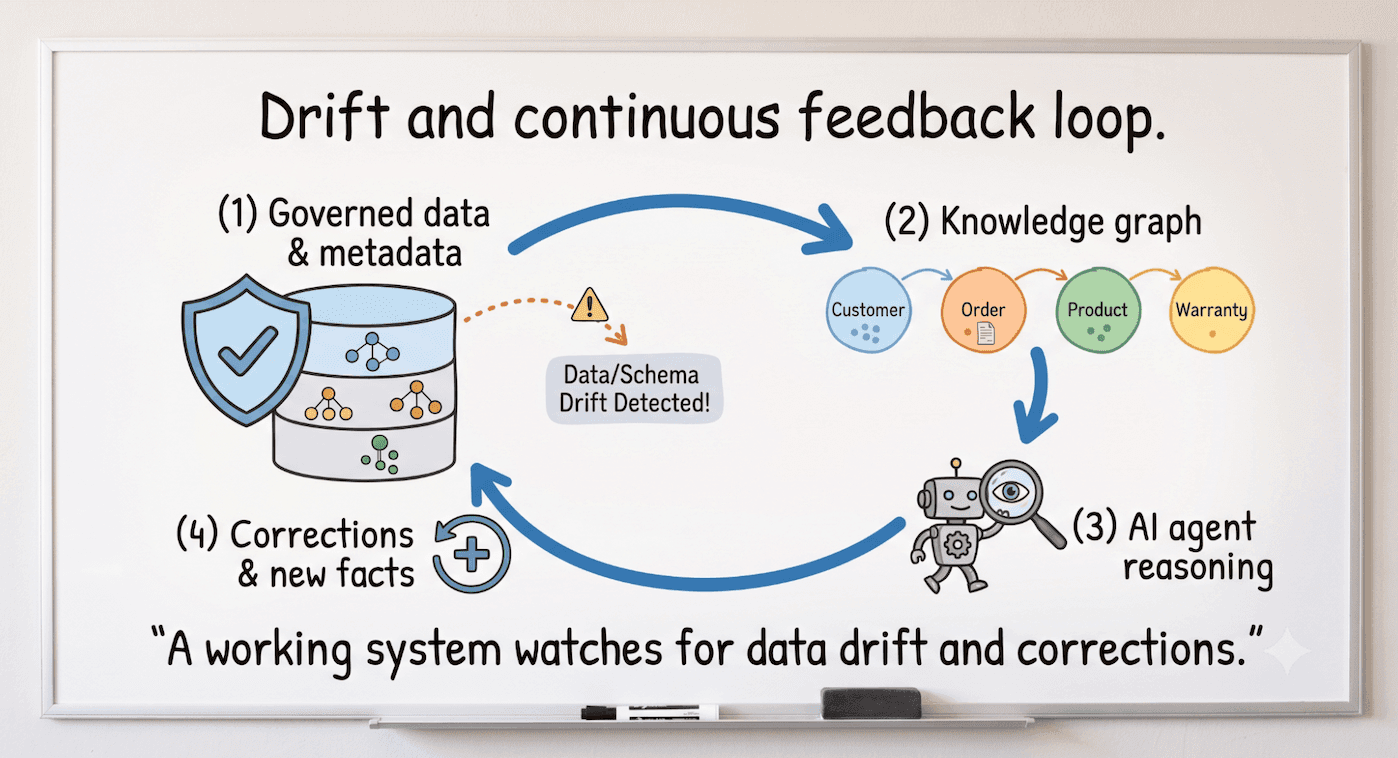
What an AI operating system actually means
Just as a computer can't run modern software directly on hardware, an enterprise can't run reliable AI directly on raw data. It needs a layer in between, one that abstracts away scattered tables, undocumented definitions, and inconsistent access rules, and gives every agent a consistent, governed way to find and use the right information.
That's the AI operating system: a foundation of data (what you have), context (what it means), agents (what gets done with it), and governance (what's allowed), with feedback loops running through all four so the system improves from real usage instead of staying frozen at launch.
That structure is table stakes for most vendors in this category today. The part that separates a genuinely useful AI operating system for enterprise teams from a rebranded data catalog is what happens after day one, whether the context an agent relies on this month is still accurate six months from now. That's what the rest of this checklist tests for.
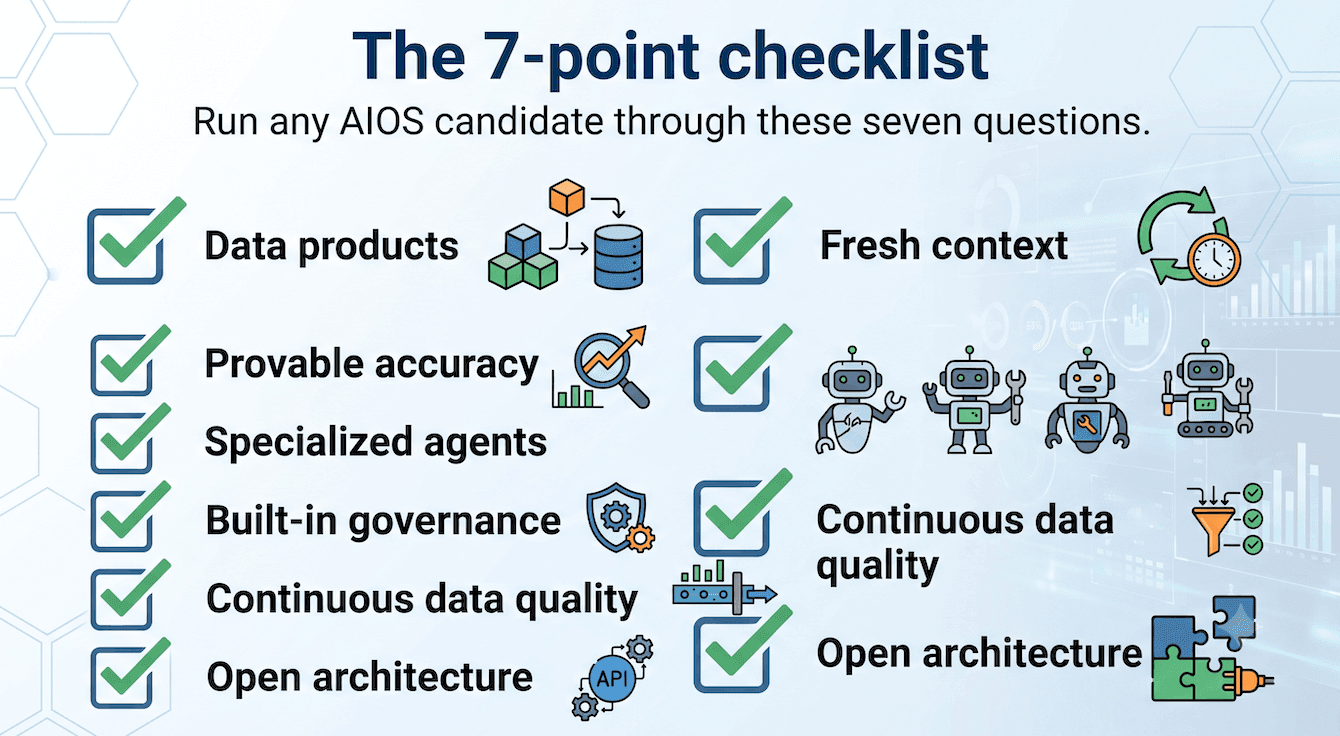
The 7-point checklist
Run any AIOS candidate through these seven questions. Each one exposes a place where vendors commonly cut corners, usually the exact place where a promising pilot quietly turns into a maintenance burden.
1. Does it treat data products as the foundation, not an afterthought?
A data product is a curated, governed package of data built for reuse — an analytic dataset, a data pipeline, an ML model, an API, or an embedded insight, each with clear ownership, lineage, and documentation attached. Data products matter because they're what an agent actually queries against; a platform that hands agents raw, undocumented tables instead of governed products is asking them to guess at business meaning every time.
Ask the vendor to show you a real data product, not a marketing slide: can it produce one with lineage, contracts, and ownership already attached, browsable in a marketplace where both people and agents can find it? If the answer involves a services engagement to "get there eventually," that's worth noting before you move to the next question, which is where most vendors actually fall short.
2. Does context stay fresh, or does it ship as a static snapshot?
This is the question that separates a genuine AI operating system from a one-time integration project. Business context drifts constantly: a metric gets redefined, a table gets deprecated, a team reorganizes, and context that can't learn from how agents actually use it starts degrading the moment it ships. Without an automated way to catch that drift, every additional AI use case requires a dedicated human team just to keep it accurate, which quietly turns an AI initiative into a staffing problem.
The test is specific: when an agent gets something wrong, and a user corrects it, does that correction flow back into the underlying data product automatically, or does someone have to notice the failure and manually go update a definition? Vendors who can only describe the first scenario in the abstract, without showing you the actual feedback path, are describing a document, not a system that compounds. That distinction only matters if you can actually measure it, which is exactly what the next question tests.
3. Can it prove accuracy with evaluations, not just claim it?
"Our AI is accurate" is a claim. A documented evaluation cycle is proof. In one real example, a SQL agent started at 60% accuracy against a set of test questions, and reached 100% after two rounds of diagnosing failures, updating the underlying data product's descriptions, and re-testing — with a human reviewing every change along the way.
Ask whether you can write your own evaluation cases against your own schema and your own business questions, run them repeatedly, and watch the score move. If a vendor can only offer a generic accuracy benchmark that has nothing to do with your data, you have no way to verify the claim once you're actually in production, which is exactly the gap the next question probes further.
4. Does it support specialized agents, or force one generalist on every team?
A general-purpose agent has to hedge across every possible question and dataset in the company; a specialized agent knows exactly what "correct" looks like for one domain and executes accordingly. In one head-to-head test, a custom-built agent outperformed a well-tuned generalist by 20 percentage points on accuracy and finished 40% faster², using the exact same underlying knowledge layer.
The difference wasn't effort; it was architecture. Look for a platform like Agent Studio that lets data and IT teams build, evaluate, and deploy agents tuned to a specific team's metrics, filters, and conventions, rather than a single bot everyone is expected to make do with. Once agents are tuned per domain, the next question is whether the rules governing them travel consistently wherever those agents show up.
5. Is governance built into every layer, or bolted on at the end?
Access policies, data classifications, and regulatory mappings need to travel with the data and the agent's output wherever it's actually consumed: a Slack channel, a BI dashboard, an embedded app inside a product. Governance that only lives in a separate compliance tool, disconnected from where agents actually answer questions, tends to get checked once during procurement and ignored afterward.
Ask for a live example: one policy, enforced the same way across two different places where people or agents consume data. If the vendor can only show governance working inside their own UI and not wherever your teams actually work, that's a gap worth flagging before you evaluate how they handle the data quality underneath all of this.
6. Does data quality get monitored continuously, at the source?
Accuracy at the agent layer is only as good as the data underneath it. Data quality practices like validation rules, unified metadata, and monitoring of critical data elements catch degraded or stale sources before an agent ever builds an answer on top of them — not after a wrong number has already reached a leadership meeting. This is also central to how AI accuracy actually gets sustained: metadata and quality signals anchor a model's output to something verifiable, rather than leaving accuracy to chance.
The test: is there an actual quality gate between raw data and anything an agent is allowed to query, or is "data quality" a dashboard someone checks on a schedule? A true gate blocks bad data before it reaches an agent; a dashboard just reports the damage after the fact. The last item on this list is less about accuracy and more about whether you'll ever be able to use any of this without a rebuild.
7. Is it open enough to fit the stack you already have?
Enterprises shouldn't have to rip out Snowflake, Databricks, or an existing BI layer to get value from an AI operating system. Ask whether you can bring your own model, connect through open standards, and leave data where it already lives, or whether meaningful functionality is locked behind a full platform migration.
A vendor that requires wholesale replacement to deliver value is asking you to bet an entire AI strategy on a single migration project succeeding first. With all seven checks in hand, it's worth seeing how these criteria stack up against simpler alternatives side by side.
How an AI operating system compares to point solutions
The checklist above becomes easier to apply once it's placed next to the alternatives most teams are already running. A single chatbot or copilot, a data catalog on its own, and a full AI operating system solve genuinely different problems, and it's worth being clear about which one you're actually buying.
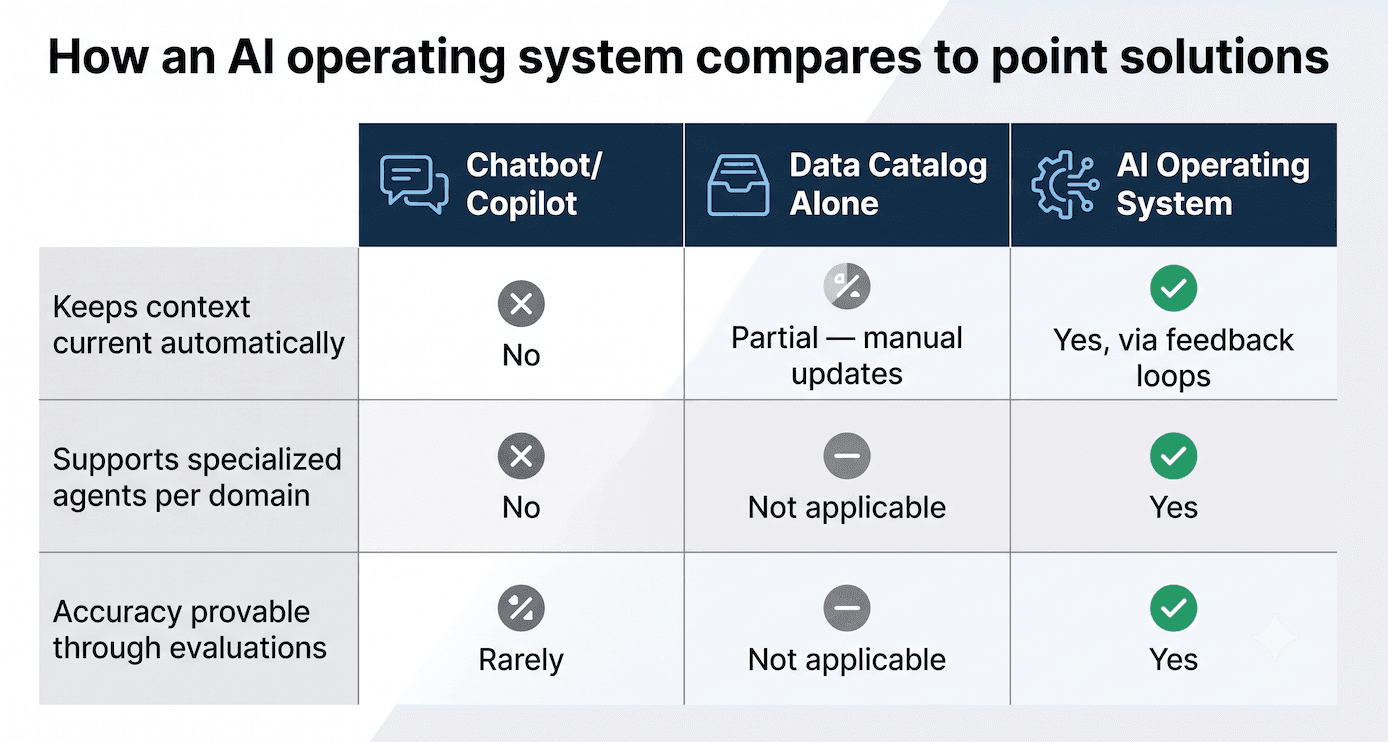
Single chatbot / copilot | Data catalog alone | AI operating system | |
Keeps context current automatically | No | Partial — manual updates | Yes, via feedback loops |
Supports specialized agents per domain | No | Not applicable | Yes |
Accuracy provable through evaluations | Rarely | Not applicable | Yes |
None of these categories is inherently wrong to run; a catalog is genuinely necessary infrastructure, and a copilot can be a fine entry point. The problem shows up when a vendor sells one of the first two columns while describing it with the promises that only belong in the third, which is exactly the pattern the next section calls out directly.
Red flags that mean you're buying a snapshot, not a system
A few patterns reliably signal that an "AI operating system" pitch is really a static context layer wearing new branding.
Watch for vendors who sell data products, evaluations, and governance as separate add-on purchases rather than one connected system; that structure alone tells you the feedback loop between them probably doesn't exist yet.
Watch for "context layers" delivered as a one-time document: accurate on the day it's written, with no mechanism to absorb what agents discover once real users start asking real questions.
And watch for generalist bots marketed as zero-configuration miracle workers, since Gartner has estimated that a substantial share of generative AI projects are abandoned after proof-of-concept³ due to exactly this kind of unmanaged complexity, not a lack of ambition.
The pattern underneath all three red flags is the same: a system that was assembled once and never learns from what happens after deployment. Before ruling any of this in or out for your own organization, it helps to check whether you're already living with the symptoms.
Signs you need an AI operating system now
A few situations tend to show up before a team realizes they've outgrown point solutions:
Your agents give different answers to the same question depending on who built them.
Someone on the data team is manually re-fixing metric definitions every time an agent breaks.
You're running more AI pilots than you have people available to keep their context current.
Nobody can produce an evaluation score for an agent that's already live in production.
If two or more of these sound familiar, the checklist above is worth running against whatever is already on your shortlist, and the questions people tend to ask once they get that far are answered below.
Frequently asked questions
What is an AI operating system for enterprise teams? It's the layer that connects an organization's data, business context, AI agents, and governance policies into one system, so that agents stay accurate and consistent as the underlying business and data change, rather than degrading after the first deployment.
How is an AI operating system different from a data catalog? A catalog is the foundation — the record of what data exists and what it means. An AI operating system builds on that foundation, adding governed context, specialized agents, and enforcement of policy across every place that data gets used.
Do I need an AI operating system if I already have AI agents? Likely yes, if those agents were built independently of one another. Individual agents solve individual tasks; an AI operating system is what keeps many agents, built by different teams, all drawing on the same accurate, current context instead of each one drifting on its own.
How long does it take to see results from an AI operating system? For a single use case, results can show up quickly — one documented example took a SQL agent from 60% to 100% accuracy in two evaluation cycles¹. Company-wide rollout across many use cases takes longer, but the timeline depends heavily on whether the platform automates context maintenance or requires a team to do it by hand.
These four questions cover what most buyers ask before a first call — the answer to all of them, in practice, comes down to whether a given platform passes the seven-point checklist above.
Test any AIOS candidate against this list
Every criterion in this checklist maps directly to something Alation's AIOS was built to do: data products with lineage and contracts built in, self-improving feedback loops that update context automatically, evaluations built into the agent-creation workflow, Agent Studio for building specialized agents per domain, governance that travels with the data wherever it's consumed, and open connectors so nothing has to be ripped out to get started.
Rather than take that on faith, run your own shortlist through the seven questions above — including Alation's. Book a demo to see how it holds up.
Sources & notes
Every external claim on this page is independently verifiable. Every self-reported case-study claim is footnoted and labeled as such.
In a documented Alation case study, a query agent started at 60% accuracy (12 of 20 test questions correct) using only raw metadata, then reached 100% accuracy after two automated "Suggest Improvements" iterations that updated the underlying data product's descriptions. Note: this is Alation's own published case study, not an independently audited or third-party benchmark. — Alation, "How to Build SQL Agents That Actually Work: Why Evaluations Matter," published March 10, 2026. https://www.alation.com/blog/ai-agent-evaluations/
In a documented Alation case study run with a real enterprise customer (51 real-world questions), a custom-built Agent Studio agent averaged 80.39% accuracy in 93 seconds versus a generalist agent's 58.82% accuracy in 160 seconds — a 20-point accuracy gap and roughly 40% faster response time. Note: this is Alation's own published case study with one customer, not an independently audited or third-party benchmark. — Alation, "One Size Fits None: Why General-Purpose Agents Fail in the Enterprise," published March 18, 2026. https://www.alation.com/blog/general-vs-specialized-enterprise-ai-agents/
Gartner predicted that at least 30% of generative AI projects would be abandoned after proof of concept by the end of 2025, due to poor data quality, inadequate risk controls, escalating costs, or unclear business value. — Gartner, "Gartner Predicts 30% of Generative AI Projects Will Be Abandoned After Proof of Concept By End of 2025," published July 29, 2024. https://www.gartner.com/en/newsroom/press-releases/2024-07-29-gartner-predicts-30-percent-of-generative-ai-projects-will-be-abandoned-after-proof-of-concept-by-end-of-2025. Note: the original draft linked to Gartner's general press-release listing page rather than this specific release; corrected to the deep URL above.
"AIOS" is also the name of an existing open-source academic project — "AIOS: LLM Agent Operating System" (Mei, Zhu, Xu, Hua, Jin, Li, Xu, Ye, Ge & Zhang) — a kernel-level resource-scheduling architecture for LLM-based agents, published as a full paper at COLM 2025. — arXiv:2403.16971. https://arxiv.org/abs/2403.16971; source code at https://github.com/agiresearch/AIOS
Gartner found that 63% of organizations either do not have, or are unsure if they have, the right data management practices for AI (based on a July 2024 survey of 1,203 data management leaders), and predicts that through 2026, organizations will abandon 60% of AI projects unsupported by AI-ready data. — Gartner, "Lack of AI-Ready Data Puts AI Projects at Risk," Q&A with Roxane Edjlali, published February 26, 2025. https://www.gartner.com/en/newsroom/press-releases/2025-02-26-lack-of-ai-ready-data-puts-ai-projects-at-risk.
- Active Data Governance
- Data Culture
- Data Intelligence
- Digital Transformation
- Engineering
- Enterprise Data Catalog
- AI
- Data Catalog
- Data Governance
- Data Products
- Data Quality
Keep reading
More from the data desk