
Four seasons ago, we started a podcast to talk about data culture: how organizations actually change the way they work with data, one stubborn habit at a time.
Then AI showed up and rewrote the question entirely. It changed the story we're all telling.
Data culture has been absorbed into something bigger and more urgent, because you cannot build trustworthy AI on shaky data foundations. A robust foundation of governed data is now table stakes for the conversation that matters now.
And what a conversation it is. This is a thrilling time to be working in data. Every enterprise on the planet is racing to win with AI, and the winner will not be decided by who has the flashiest model, but by who has the data foundation to make that model trustworthy when it actually counts.
That means the people who've spent their careers doing the unglamorous work of governance, lineage, and data quality are suddenly holding the keys to the most consequential initiative their company has ever undertaken. That is an enormous opportunity, if you're ready to rise to it.
Season 4 is built for exactly those people: the change agents who don't just talk about AI transformation, but the ones shipping it. So it's time to make it official.
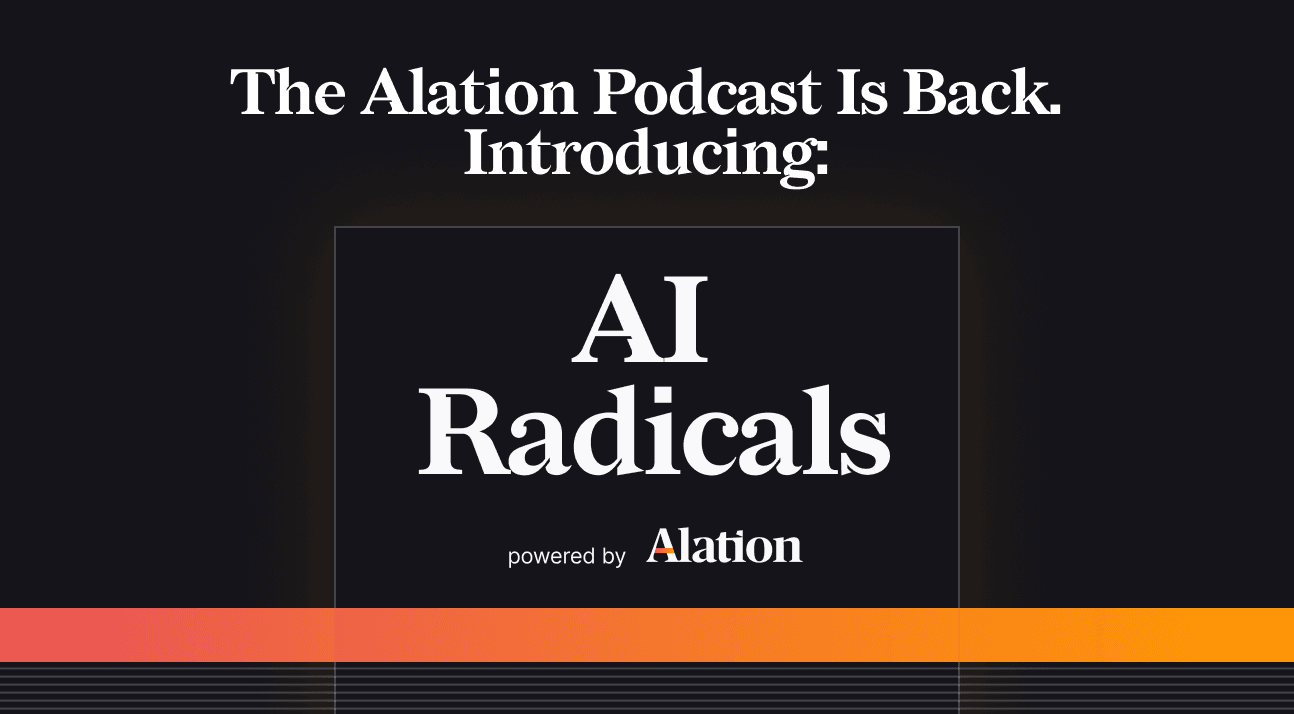
Data Radicals is now AI Radicals. And season 4 launches on Wednesday, July 29.
Why a name change, and why now
Every enterprise is wrestling with the same question: how do you put AI to work on the decisions that actually matter without putting the business at risk? That's not a tooling question. It's existential. And it's exactly the conversation this podcast now exists to have.
Three years ago, many podcast guests described data governance and self-service analytics as their central challenge. Critical work… but largely internal.
Today, the conversation has shifted: enterprises aren't experimenting with AI anymore, they're running it against decisions that carry real regulatory, financial, and operational weight. These changes are happening across the business. Underwriting. Claims. Compliance. Supply chain. And while the stakes of getting it wrong have gone up, so has the appetite to get it right.
Which raises the real question underneath all of this: in a world awash with new AI tools, what's holding people back?
The problem was never a lack of AI
Here's what nobody says out loud during the pilot phase: getting an agent to produce a good answer once is easy. Getting it to still be right on day 90 and day 180 is incredibly difficult — the exact production problem most enterprise AI projects run into.
That's because AI doesn't behave like software. Software has clean interfaces and predictable failure modes; you can test it, debug it, and trust that a passing check today is still valid in six months.
Agents don't work that way. They aren't microservices with tidy handoffs; they're stacked on top of each other, model on model, tool on tool, and a small drift at the bottom compounds into a confident, wrong answer at the top. So:
A system prompt no longer reflects how the business actually operates.
The tools an agent calls get re-versioned.
The context quietly goes stale — too many documents, or missing the one metric that mattered.
The underlying data changes, or someone retains access they shouldn't have, or a quality issue goes uncaught until the agent surfaces it in an answer nobody double-checks.
None of that shows up as an error message. It shows up, months later, as an organization that quietly stops trusting what its AI tells it.
Guest after guest shared some version of this. Francois Ajenstat, founder of Golden Analytics and former Chief Product Officer at Tableau,¹ described what happens when you connect an LLM to everything without discipline: it doesn't fail loudly, it fails quietly, inventing plausible-sounding correlations instead of real answers. "Just giving more context actually doesn't give you a better answer," he argued. What matters is knowing which context to call on, and trusting that it's right.
Erin McIntosh, who leads global data operations at CNA Insurance,² framed the same problem from the governance side, after spending a year rebuilding how her team thinks about data governance — and what a durable data governance framework actually looks like — for an AI-first world: "The biggest challenge in AI isn't technology. It's trust."
And as AI becomes intertwined with organizational DNA, the goal is much more than "automate this decision"; the goal is to grow smarter in data-driven decision-making as we learn with AI. Efficiency without improving judgment… isn't a win.
What to expect this season
AI Radicals keeps the format that's worked for three seasons: honest, unfiltered conversations with people actually doing this work, not just theorizing about it. More guests this season include:
Mark Nelson, Venture Partner at Madrona and former Tableau executive, on what he's seeing across the AI startup landscape, and which bets are actually paying off.
Nathalie Berdat, Head of Data & AI Governance at the BBC, on delivering trusted data and AI inside one of the most visible media organizations in the world.
Eugene Wu, Associate Professor at Columbia University, on the research questions that will determine how trustworthy AI systems actually get built.
Brian Solis and Dave Wright, co-authors of Infinite: How Visionary Leaders Transform Today's Businesses into AI-Forward Companies, on what separates organizations that are genuinely becoming AI-forward from the ones just saying they are.
Sanjeev Mohan, former Gartner analyst and founder of SanjMo, on where the data and AI tooling landscape is actually headed, past the hype cycle.
Across every one of these conversations, the same idea keeps surfacing: AI is only as good as the data, the context, and the governance underneath it. That's not a compliance talking point. It's the difference between an AI initiative that scales and one that quietly erodes trust the first time it's wrong at a bad moment.
Same radicals, bigger conversation
Data Radicals was never just a practitioner's how-to guide. Some of our most memorable conversations featured visionaries using data in radical new ways:
General Stanley McChrystal, who transformed Joint Special Operations Command (JSOC) from an organization that let intelligence rot in garbage bags into a data-hungry network, one that ran missions just to generate intel, and even declassified enemy records on his own authority to get them into the right hands faster.
Dr. Elisabeth Bik, who turned an eye for spotting duplicated images (the same instinct that catches a mismatched floor tile) into a full-time hunt for fraud in scientific publishing, flagging thousands of papers for image manipulation — more than 7,600 by one recent count³ — and exposing industrial-scale "paper mills" that sell fabricated research to authors who need a publication credit.
Tarak Shah, who turned a warehouse of rotting, rat-chewed Guatemalan police archives into courtroom evidence that convicted a former national police chief, and later built ML tools to uncover hidden patterns of police violence in hundreds of thousands of scanned Chicago police documents.
Seth Stephens-Davidowitz, a former Google data scientist who realized people lie to pollsters but not to search engines, and used anonymized Google searches to expose hidden truths about racism, hate crimes, and society writ large that no survey could ever surface, then built an entire data-driven self-help philosophy on the idea that our guts are usually wrong.
Those episodes weren't practical playbooks, exactly. They were proof of what becomes possible when someone takes data seriously enough to change how we see the world.
AI Radicals is going to keep doing both things: sharing practical guidance for leaders trying to move AI from pilot to production without betting the company's credibility on it, and the inspiring, slightly wild stories of people using data and AI to attempt something nobody thought to try.
For data leaders staring down that exact production problem, this season is built for them. And for the builders and dreamers whose job titles don't exist yet, the people who are going to invent entirely new categories of work because AI made them possible, there's a seat here too. The industry has widened its aperture, and the show is widening with it.
New episodes of AI Radicals launch July 29. Bookmark Alation's YouTube channel to catch them.
Building the foundation this season keeps circling back to
Everyone can stand up an agent that gives a good answer once. Almost no one can keep it right, and that's the exact day 90 and day 180 problem this season keeps circling back to. It's also the thesis behind AIOS, the operating system Alation has spent the last year building to keep agents, data, and context current as they drift.
The idea is simple. When someone corrects an agent, that correction shouldn't just patch the one bad answer. It gets routed back to whatever was actually wrong: a system prompt, a semantic definition, a data product. Fix it once, and it stays fixed everywhere that context gets reused — the same feedback-loop mechanism that's driving accuracy gains in production AI more broadly. More than 500 enterprises are already running on it well past their own day 90.
For any organization building toward that same foundation, book a demo to see how it holds up.
Sources & notes
Claims above that rest on outside facts are footnoted here. Internal links elsewhere in the piece point to related Alation resources and aren't citations.
Francois Ajenstat is founder of Golden Analytics and spent over seven years as Chief Product Officer at Tableau. — GeekWire, Apr 2026 ↗ https://www.geekwire.com/2026/former-tableau-product-chief-launches-golden-analytics-using-ai-to-challenge-the-bi-old-guard/
Erin McIntosh is Vice President, Global Data Operations at CNA Insurance. — The Org ↗ https://theorg.com/org/cna-insurance/org-chart/erin-mcintosh
Dr. Elisabeth Bik has flagged more than 7,600 papers for fraudulent or erroneous image data. — Einstein Foundation Award, 2024 ↗ https://award.einsteinfoundation.de/award-winners-finalists/recipients-2024/elisabeth-bik
- Active Data Governance
- Data Culture
- Data Intelligence
- Digital Transformation
- Engineering
- Enterprise Data Catalog
- Alation News
- Data Catalog
- Data Governance
- Data Quality
- AI
- Modern Data Stack
Keep reading
More from the data desk