Season 4 · Episode 5
Infinite: Why AI Business Reinvention Beats Automation

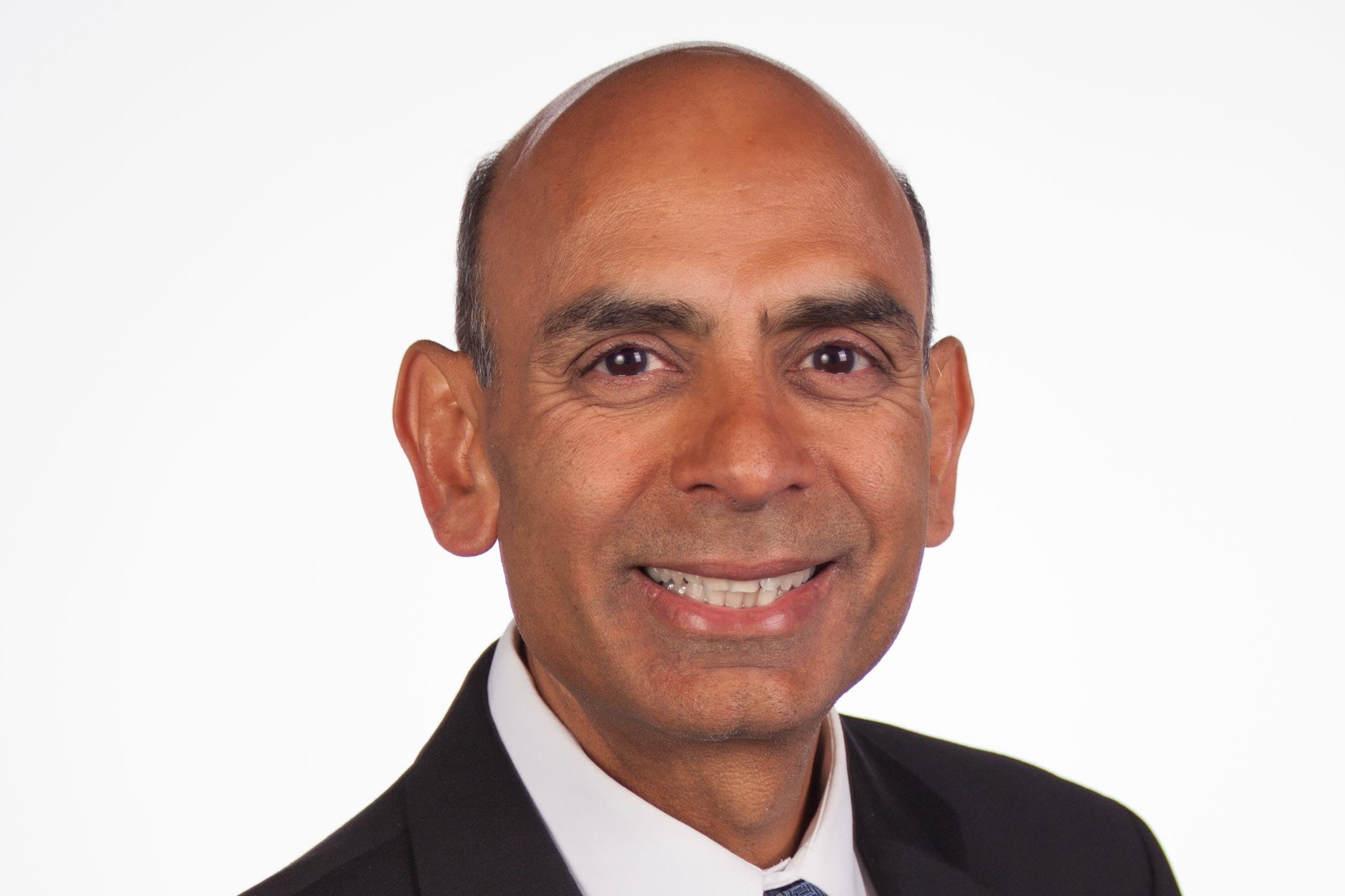
Brian Solis
Head of Global Innovation, ServiceNow
Author of 60+ research reports on competitiveness and co-author of Infinite, Brian studies the AI questions executives aren't asking, including the one almost nobody has an answer for: what will you actually do with the hours AI just freed up?

Dave Wright
Chief Innovation Officer, ServiceNow
Forty years in technology and a decade inside ServiceNow's own AI buildout, Dave argues AI belongs in the asset register (with ownership, lifecycle, and accountability) because "it was just a rogue agent" is not an explanation an enterprise can survive on.
Satyen Sangani
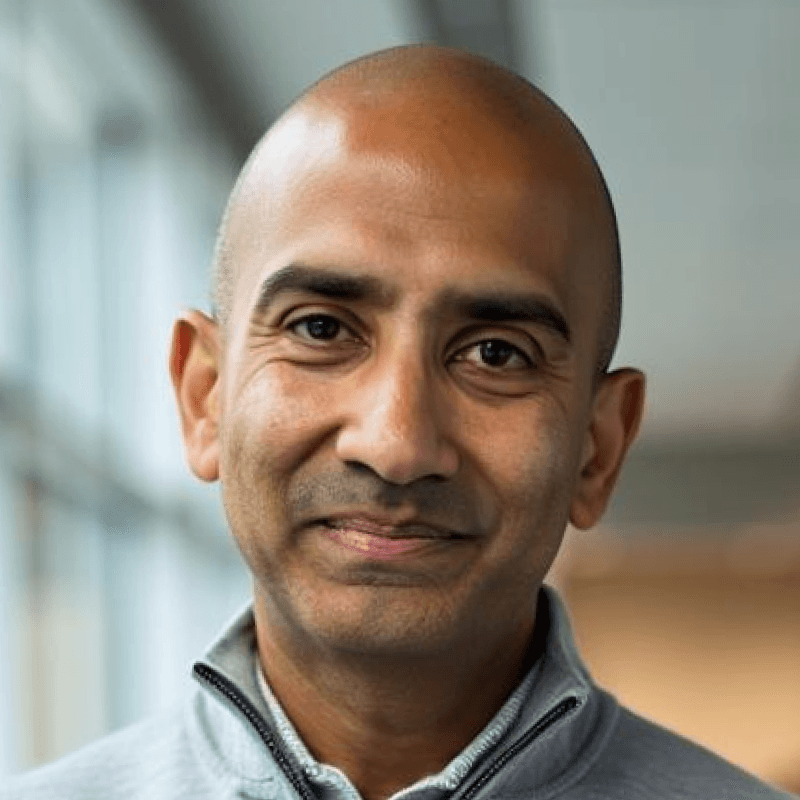
CEO & Co-Founder, Alation
As the Co-founder and CEO of Alation, Satyen lives his passion of empowering a curious and rational world by fundamentally improving the way data consumers, creators, and stewards find, understand, and trust data. Industry insiders call him a visionary entrepreneur. Those who meet him call him warm and down-to-earth. His kids call him “Dad.”
Why "What's the ROI of AI?" Is the Wrong Question, with ServiceNow's Brian Solis and Dave Wright
Brian Solis and Dave Wright have spent the last two years asking enterprise leaders a question most of them have no answer to: what will you actually do with the capacity AI just gave you? Solis is Head of Global Innovation at ServiceNow and the author of more than 60 research reports on competitiveness. Wright is ServiceNow's Chief Innovation Officer, with 40 years in technology and a decade inside ServiceNow's own AI buildout. Together they wrote Infinite, a book about using AI to continually reinvent a company rather than optimize it into oblivion.
In this conversation with Alation CEO Satyen Sangani, they make the case that AI is an amplifier rather than a strategy, walk through the mode one and mode two framework that separates scaling yesterday's work from creating new value, and explain why Wright thinks AI belongs in the asset register. Along the way: Ford rehiring the quality engineers it automated away, IKEA turning deflected support calls into a billion-euro design business, and the governance signal that tells you an agent has gone rogue. For readers working through the same questions, Alation's guide to enterprise AI strategy and ROI covers adjacent ground.
Is your company using AI to optimize yesterday or build tomorrow?
Alation CEO Satyen Sangani opens the episode by framing the central question of the conversation with ServiceNow's Brian Solis and Dave Wright: speed versus reinvention.
[00:00:00] Satyen Sangani, CEO of Alation: Welcome back to AI Radicals. Today's conversation tackles a question every leader is quietly wrestling with: Are you using AI to do what you already do a little bit faster, or to become a fundamentally different company? My guests are Brian Solis and Dave Wright of ServiceNow. Brian is Head of Global Innovation. Dave is the Chief Innovation Officer. And together, they've just co-authored Infinite, a book on AI-driven business reinvention. Between them, they've spent decades studying how organizations actually change.
[00:00:19] Sangani: We get into why "what's the ROI of AI" may be the wrong question, how IKEA turned its call center staff into interior designers, and why governing AI like an asset is what lets you scale it responsibly. If you're trying to figure out whether your company is optimizing yesterday or building tomorrow, this episode is for you.
[00:00:50] Producer: This show is brought to you by Alation. Only 5% of enterprise AI pilots from 2025 delivered ROI in production. Alation's free agentic AI opportunity discovery guide shows you exactly how to find the right processes to automate and build AI that actually sticks. Get it at alation.com/ai-guide.
Why Brian Solis and Dave Wright wrote a book on AI-driven business reinvention
Sangani asks Solis and Wright why the book needed to exist, given a public debate split between AI eliminating every job and AI changing very little.
[00:01:16] Sangani: Brian, Dave, welcome to the show. You've done incredible work in writing a book about AI and how it's reinventing organizations. Tell us a little bit about why you thought the need to do this, and the differentiated perspective in a world where there seem to be two camps. One of which is, "Hey, AI's gonna take away every job in the galaxy," and the alternative of which is, "This is a great new tech, but it's actually not changing things. Look at the employment numbers. They're actually going up."
[00:01:43] Dave Wright, Chief Innovation Officer, ServiceNow: Thanks for inviting us on, Satyen. It's great to be here. I'll try and keep it a short answer, because we can dig into more detail as we go through it. One of the interesting things that me and Brian have is we spend a lot of time speaking to customers and trying to understand what they're trying to achieve with AI.
[00:02:00] Wright: As we spoke to more and more customers, we realized a lot of people were coming up with the same challenges. A lot of people were saying, "Hey, we're implementing AI. We're not really getting the return on investment that we expected, and we don't really know what to do or how to fix this, or even how we should think about this."
[00:02:18] Wright: AI's one of those technologies that was thrown onto people, and people were expected to work out their own ways to use it. And we wanted to provide a way to think about how you could use AI, not just to improve your business, not just to do all the things that you did before better or faster, but how could you actually use AI to do things that you couldn't do before?
What is an infinite company?
Wright defines the book's central term, and Solis explains why the writing itself was a way to test the thinking against practice rather than theory. ServiceNow's framing here sits close to what Alation describes as an enterprise AI operating model.
[00:02:41] Wright: What this led to is this whole concept of, if you could use AI to free up the time and resources that you needed, you could constantly reinvent your company. You could present your company as an infinite company that could continually shift and develop to meet market demands, as opposed to a finite company that was just potentially gonna automate itself into oblivion.
[00:03:05] Brian Solis, Head of Global Innovation, ServiceNow: Building on that, we also observed the questions we weren't getting asked. Dave and I still to this day have these types of conversations where we're philosophically pushing each other to think through. Part of our work is studying trends and signals that are happening in the industry to make sense of them, to play them out for companies and also various roles within companies.
[00:03:26] Solis: So the book was also a creative outlet for a lot of this thinking. If we had to solve these problems, how would we do it, so that we could put ourselves in not a theoretical seat, but a practical seat, so that we could help our customers see this transformation through.
What challenges are enterprises actually hitting with AI right now?
Sangani presses for specifics. Solis, who leads global innovation at ServiceNow, catalogs the questions large enterprises are bringing to him, starting with the ROI question and ending with the skills question.
[00:03:43] Sangani: When you say these problems, talk a little bit more about how you would describe these problems. In your travels and speaking with customers, and I assume these are mostly large enterprises, what are the challenges they're expressing right now, and how would you encapsulate how they view the world with all of this AI stuff?
[00:04:05] Solis: Let's say challenges and opportunities, because you'll see a common set of challenges, like, for example, what's the ROI of AI? That seems to be a popular conversation that has all kinds of different schools of thought around it. But also, how do we break AI out of a silo and across an enterprise, like a more horizontal workflow, for example?
[00:04:29] Solis: How do we connect the dots of a disparate, siloed organization in order to accomplish an end goal that really takes advantage of the power of artificial intelligence? How do I navigate the people side of all of this? What are the skills we need? What are the skills we need to unlearn?
[00:04:49] Solis: What are the jobs that we're gonna need? Who's gonna do those jobs? What are the AI skills that we need to do those jobs? How do we balance people and AI to accomplish outcomes? What are we not thinking about? What do we not know that we don't know? Those are just some of the beginnings of the types of conversations.
Why "what's the ROI of AI?" is the wrong question
Solis explains why treating AI as the strategy caps its impact, and why asking for use cases narrows the outcome before the work starts.
[00:05:08] Solis: But let's start with the ROI question. Dave and I will always say that AI is not the strategy. If it does become the strategy, it very much limits the impact it's gonna have on the organization and how you can measure its success. One of the more popular examples that Dave and I will talk about is, for example, a question will come to us like, what are some of the use cases that we need to think about?
[00:05:29] Solis: And even in that question, we're already narrowing the potential of artificial intelligence, because it's a reflection of the bias that an executive is bringing to that moment. Where we have the more successful ROI conversations is if we take a step back and look at, well, what are some of the things that we couldn't do without it?
[00:05:51] Solis: Does this workflow deserve to exist? Does this question help you compete more effectively for 2030? We wanna bring the strategy back to the beginning of the conversation. Now, I realize your question's very big. I wanna make sure we address it narrowly. So Dave, I'm gonna pass it over to you, then we can come back to anything, Satyen, you wanna unpack.
What happens when nobody can explain why they're deploying AI?
Wright, who has spent 40 years in technology, recounts a meeting with a foreign government delegation in Washington where 40 people discovered they had no reason for the AI project they had already committed to.
[00:06:11] Wright: You get some of the weirdest conversations you can ever want. I was with a government from another country that happened to be in Washington, and we were all sitting in this room. There's about 40 people in this. And I said, "So what's your AI strategy?" And they said, "Oh, we're gonna use AI to automate 80% of our citizen calls." I was like, "That's cool. That's a great idea. Why are you doing that? Are you getting more calls than you can handle? Is it a satisfaction issue? Do you wanna get rid of employees?"
[00:06:42] Wright: And they were like, "Well, we can't get rid of employees. We're a government agency. We don't get more calls than we can deal with." And I was like, "So why do you wanna deploy AI?" And it was obvious it was the first time they'd been asked that question, and they all looked at each other, and there was this moment where you saw 40 people going, "Yeah. Well, why do we wanna do it?"
[00:07:00] Wright: It was only when you started to peel back the layers and understand what they wanted to achieve, that they wanted to be seen as the government that people go from Washington to see, to understand how they could do things better, to be able to drive up satisfaction and have a reputation that existed outside of their country. But yeah, initially it was just like, yeah.
Why did nobody ask for AI summarization until AI could do it?
Wright makes a point about demand following capability rather than the other way around, and Sangani offers the cartoon version of the same idea.
[00:07:22] Wright: It's like when you hear summarization. People say, "Hey, we can use AI to summarize this particular piece of text." I've been in technology for 40 years. No one asked for summarization until two years ago, when a piece of technology that was really good at summarization came out. So let's think about it bigger.
[00:07:41] Sangani: There's that cartoon, I don't know if you've seen it, but there's this cartoon where one guy's sending an email, and he's like, "Oh my God, look, I can turn this set of bullets into an email." And then on the other side, somebody's getting a set of bullets, and it's like, "Oh, look, I turned this email into a set of bullets." And it's like, what did we just do?
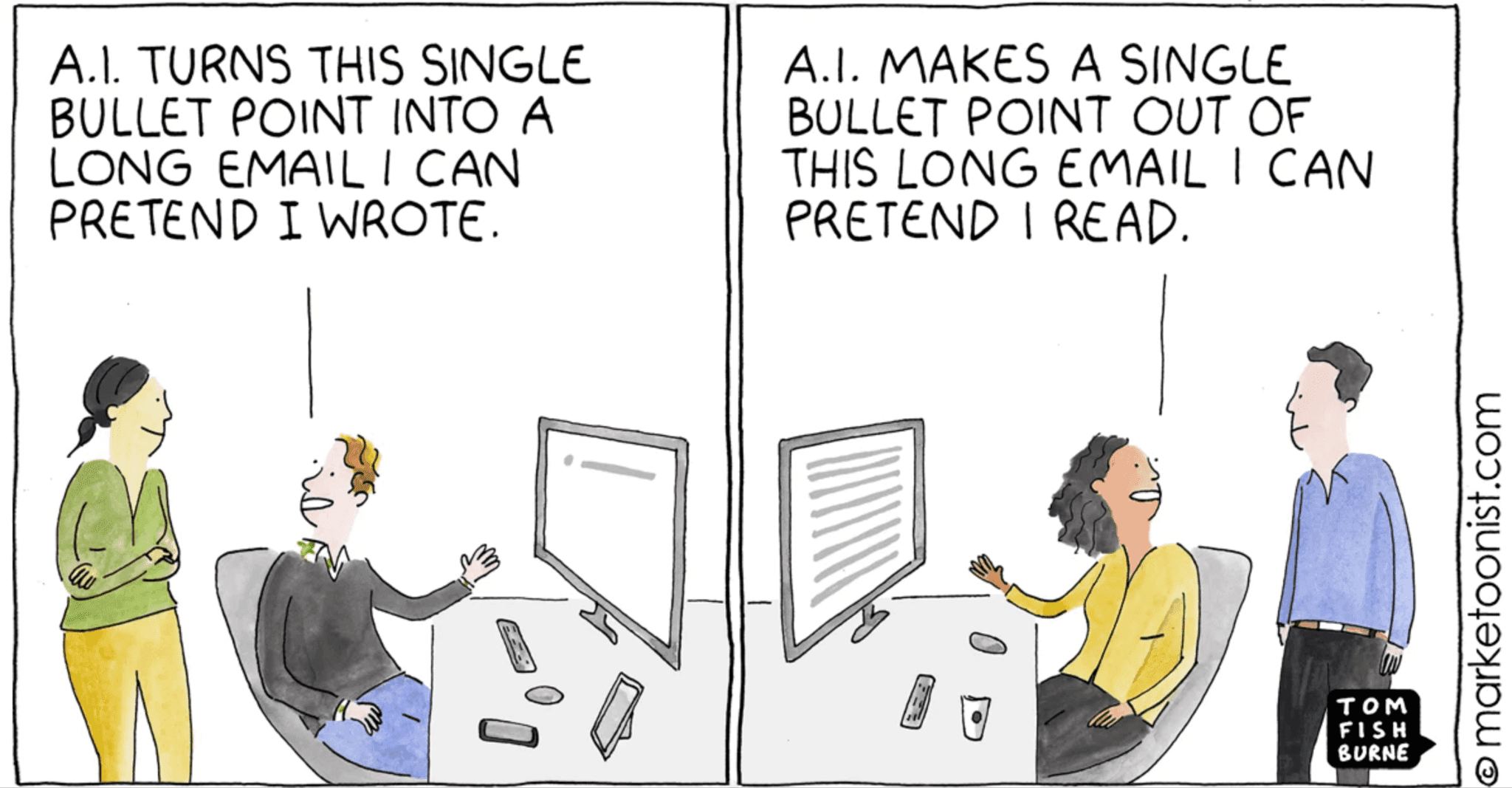
[00:07:54] Sangani: So you've got people coming at you saying, "What's the ROI of AI?" And I think people are trying to metabolize this tech. Everybody's trying to contend with what it is, and you don't start from use cases, I think was what you said, Brian, or at least that's a limiting way of thinking about it.
What should you ask before deciding what to do with AI?
Wright reframes the opening question of an AI conversation, and Solis adds the organizational precondition that most companies are missing.
[00:08:15] Sangani: Equally, when you have these use cases where people are like, "I wanna use it for this," it may not be the case that they're actually using it for something useful. So what's the thought process? How does somebody who's just like, "I gotta do this thing," how do you get to infinite? What are the steps to get to that?
[00:08:33] Wright: So whenever I meet someone, and we start this discussion, and they're looking at what they could do with AI, I like to try and start with a bigger question. I'd like to say to them, "What is it you've always wanted to do as a company that you've never been able to do?"
[00:08:47] Wright: And it might be something that they've never had the money to do, or they've never had the people to do. Once they can identify what it is they've always wanted to do as a business but couldn't do, then you start the conversation around, "What would it take to do that? What would you need? How many people would you need? Would you need a certain investment? Would you need to open a new office somewhere?"
[00:09:01] Wright: As you start having those discussions, then you can start saying, "Well, this could become a strategy that you want to achieve." If you were a car manufacturer, and you wanted to move into making automotive spare parts, what would that require you to do as a business? And then look at how you could take AI and back their existing business to a point where you could free up the resources to do this.
[00:09:21] Wright: This is where the conversation starts to get a lot bigger. This is where you need to think, I'm not gonna just automate what I already have. Unless that is your strategy, unless you wanna drive down bottom line costs and you're gonna automate what you got and you're gonna remove people from the organization. That could be your strategy.
[00:09:47] Wright: Hopefully it's not. Hopefully your strategy is to do something more. So how can you take those resources and then redeploy those resources somewhere else in the organization to achieve something from a business perspective that you couldn't do before?
Does your company capture the ideas that could grow it?
Solis describes a session with global executives where a simple question about idea capture revealed a structural gap, and clarifies what "infinite" means in the book's sense.
[00:10:03] Solis: To build out what Dave is saying, it's really getting back to basics around a strategy conversation. For example, I was in a session earlier this week with executives from all around the world where I asked if there was a mechanism within the organization to capture all of the ideas that would help the company grow, and that that active list was on a board for active considerations.
[00:10:30] Solis: And the answer was no, and that makes it very difficult to explore what would become an infinite company, which is a company that is not infinite in terms of size and scope. It's infinite in terms of agility, in terms of imagination and curiosity, of looking for continuous reinvention, competitiveness, and just to plug the book.
Why did Ford rehire 350 quality engineers it replaced with AI?
Solis uses Ford as the cautionary case for leading with AI rather than strategy, and describes the human-above-the-loop model Ford landed on after reversing course.
[00:10:55] Solis: But the short answer to your question is, if you do not do that, and if you lead with AI, you get what happens with Ford. I think we all saw the headlines recently that Ford had to rehire 350 quality assurance engineers because they had been let go in the name of AI automation.
[00:11:18] Solis: And as a result of that AI automation, quality actually declined substantially, increased costs because of recalls, et cetera. And upon rehiring them, they put a human in the loop scenario, or a human above the loop, where AI is now working for these people in the greater purpose of increasing quality like they're supposed to do. Now as a result, they're back on the J.D. Power and Associates list of quality, all the good things. So that's what happens when you lead with AI.
What did IKEA's Billy chatbot actually handle?
Solis walks through the IKEA case, starting with what most companies would have done with an AI agent that successful. For a definition of the underlying technology, see Alation's glossary entry on AI agents.
[00:11:41] Solis: But with IKEA, this is a popular story, but I don't know that it's popular for all of the reasons it should be. And Dave, please, you tell a better business version of this story, so I'll start it. IKEA might have started this conversation the way that most companies say, "What's our use case? Let's look at call deflection. Let's put an AI agent in customer service."
[00:12:06] Solis: Maybe they had a reason to do it, maybe they didn't. But in most of those conversations, it starts with, we wanna put AI to deflect calls, as Dave shared with his government story. The AI was so successful. Its name was Billy, named after its most popular bookcase. I would've named it Allen Wrench. That's just an IKEA joke. For those who get it, you know.
[00:12:28] Solis: But Billy was so successful at navigating customer service engagements that I think it handled about 47%, which is pretty substantial. It's almost half. I think most companies might then look at taking the ROI of AI conversation and realizing that to pay for Billy, we're going to cut heads to offset that cost and go with an automation story.
How did IKEA turn deflected calls into a billion-euro design business?
The turn in the story: Solis and Wright explain what IKEA learned by analyzing the inquiries its AI agent could not resolve, and what that analysis was worth.
[00:13:03] Solis: Something to call out too is that you also have to measure how many of those cases are reopened versus solved. This is something we can talk about later. But what IKEA also did was they analyzed the inbounds. What could Billy not handle would be a good example of this conversation. And what they had learned was that a significant volume of inbounds were related to interior design, whether that's for a company, whether that's for residential, commercial, et cetera.
[00:13:33] Solis: And so what they did was they re-skilled, I think it was about 8,000 human agents.
[00:13:39] Wright: Yeah, 8,200.
[00:13:41] Solis: Yeah, 8,200, with AI, to then spin them out as a pilot business of interior design services, consulting services. And as a result of that work in its first year, they generated about one billion euro with an impact of, what was that, 4% on...
[00:14:00] Wright: Yeah, 4% increase in top-line revenue.
[00:14:02] Solis: Yeah, top-line revenue. So now you have a cost takeout and a growth story, all driven not by AI as the strategy, but customer experience as the strategy, and also tying that strategy to business outcomes. And so now you have a bigger story around innovation and experience design and better service with AI powering that strategy.
What can you learn from the support tickets your AI can't resolve?
Sangani names the transferable method inside the IKEA story: the unresolved tickets are a demand signal, not a failure log.
[00:14:28] Sangani: That's a great story. And especially even the method in that story is really phenomenal, in the sense that you've got this thing that everybody's investing in, coding and customer service, as the two very obvious places of knowledge replication.
[00:14:47] Sangani: And in one case you're basically burning down tickets, but then the question becomes, well, okay, what doesn't work, which you can get from all of these tickets. And then you can say, "Well, what opportunities do these tickets present?" That's a fabulous way of thinking about this question of infiniteness. I don't know if that's a word, but whatever.
[00:15:05] Sangani: It is now. You heard it here first.
Does every company need to become an infinite company?
Sangani asks whether infiniteness is universal, and Wright reframes it as durability rather than growth, then points to the metric shift he sees replacing headcount.
[00:15:07] Sangani: So let's talk about, does every company, in your view, therefore have an opportunity to become infinite? And is it literally just a matter of imagination? When do you go to, "Hey, I'm gonna use this thing for cost-cutting," and when do you go to, "I need to think in infinite terms," and then unlock and work backwards from that to think about how AI unlocks it, and how do I as an executive navigate that conversation?
[00:15:37] Wright: Wow. No one's ever asked us that before. So I don't think every company wants to become infinite, as in they wanna grow and grow and grow forever. But I think if you think of infinite from what Brian was saying before, from a point of curiosity and from a point of reinventing, I think most companies have the capability to use AI to remain sustainable, to be able to keep on developing and existing as companies.
[00:16:09] Wright: So it becomes much more around how do I maintain the existence of my company as opposed to how do I continually grow it? Think of it much more of a, rather than an infinite size, think of an infinite existence. So I think all companies have the capability to make themselves relevant in today's business.
[00:16:31] Wright: Not every company is gonna wanna grow itself to be... Well, actually, that's an interesting trend you see in the industry now. It used to be a trend around how big companies could get. It used to be a metric, "Hey, we hired another 10,000 people this year." That's shifted now. We start to see people looking much more at RPE figures, revenue per employee. So now it's looking much more at the effectiveness of what you're doing with your employees than the number of employees that you've got, and I think that's where AI comes into play when you think about something being infinite.
Are most companies just scaling yesterday with AI?
Solis delivers the episode's sharpest diagnosis. Companies chasing this kind of reinvention typically need an agentic data intelligence platform underneath the ambition, since new value depends on trusted data.
[00:17:06] Solis: It also makes me think, Dave, of the conversations we have, which often have to back out of efficiency. And Satyen, to your point, right now, most organizations aren't thinking about really how we could be more innovative. I'm not gonna say they're not thinking about it, but they're really not. They are thinking about how they could be a better version of themselves tomorrow.
[00:17:24] Solis: So essentially, they're scaling yesterday with artificial intelligence and looking at how we can optimize that work, how we can make it more efficient, more cost-effective. And those conversations are good, I guess, in the short term. They're necessary, but you have to balance them with competitiveness, and that's true without AI.
[00:17:41] Solis: I've written over 60 research reports that study competitiveness against all landscapes. AI is just sort of the latest chapter of it, and I think the conversation that more and more companies, more and more leaders, I should say, should be having is, what can we do with AI that we couldn't do yesterday to create new value that keeps us competitive?
Mode one vs. mode two: what separates optimizing yesterday from building tomorrow?
Solis introduces the book's operating framework, and Wright supplies the estimate of how few companies have made it past the first mode.
[00:18:19] Solis: And so the way that Dave and I talk about it in the book is this mode one, mode two form of operation. So mode one being, what do we deem from yesterday's work that deserves to live and scale tomorrow, so that we're making a conscious decision about workflow evolution, not just because it exists, we throw AI on it, but that it deserves to exist.
[00:18:42] Solis: And then mode two is where can we create new value? How could we achieve new outcomes? And explore then how we could use AI to achieve that. Now then there's a balance between both of those efforts that will yield what we talk about in terms of a positive form of self-disruption, which is creating a linear growth curve and a potentially exponential growth curve, with the delta between the two being that disruption that you gave yourself to grow versus waiting for someone else to give it.
[00:19:11] Sangani: That's a really helpful construct. As you think about dividing up between these kind of mode two abundance-oriented agenda where AI is really an unlock, and it sounds like the mode one is really more of an optimization agenda, or what no longer serves me, or how do I actually do something better than I was already doing today. I would imagine that in a portfolio of bets, organizations are doing both of these things. And it sounds like a lot of people are orienting from a place of, well, we've got to optimize first.
[00:19:46] Wright: Yeah. Most people are stuck in mode one. I'd say 90% of people are in mode one. But the interesting thing is it's not a sequential process, so you should be doing both of them at the same time.
How do you tell a real AI metric from a vanity metric?
Wright runs through the numbers enterprises report about AI that tell you nothing about whether AI is working.
[00:20:10] Wright: But people get focused on this cost reduction, or you see people putting out weird metrics like Brian was saying then, "Hey, if you're doing call deflection, measure exactly how many of those calls are being reopened to see if it works."
[00:20:20] Wright: Or you see people throwing out this, oh, 10 million lines of code have been generated by AI, but no one says if it's good code. It's just like, it doesn't matter, does it? It's AI code, so it's all being generated. Or when you start looking at, is customer satisfaction actually changing?
[00:20:27] Wright: Or what's the other one you always see? Oh, the other one you always see is the marketing thing, customer X saved 10,000 hours with AI. But 10,000 hours, if you're doing 50 dollars an hour, is that really a significant change? And is that cheaper than the AI that you deployed to do it? So you have to think about actually getting those returns.
Should you automate a workflow, or reinvent it?
Wright's central practical argument: automation inherits the constraint the workflow was designed around. Alation's glossary covers the mechanics of agentic workflows for readers newer to the term.
[00:20:46] Wright: But while you're doing that, you should be thinking about what you're doing with mode two. And what you should also be thinking, if you're really ahead of the curve, is as you're applying AI in this mode one fashion to optimize things, the real benefit you're gonna get is not asking, how do I automate this workflow? It's asking, why should I automate this workflow?
[00:21:07] Wright: Because most of these workflows are being designed based on a constraint around the number of people you have to do the job. When you're putting AI into something, you're going from being constrained by not having enough resource to having an abundance, potentially almost infinite resource.
[00:21:26] Wright: So the question you should ask is, is this workflow designed to run in the AI age, or is this not just an opportunity to automate a workflow, is this an opportunity to reinvent that workflow?
What will you do with the hours AI frees up?
Sangani asks what actually unlocks mode two thinking inside a large organization, and Solis names the question almost nobody in his sessions has an answer for.
[00:21:38] Sangani: And a lot of people feel stuck in this question. There's a lot of fear, first of all. There's a lot of pressure. But in reality, particularly in very large organizations, it's really hard to get the space or the risk appetite to do that work. What techniques are working for people to unlock this mode two imagination? There's the examples that spur the change. What are the other techniques that allow you to motivate change?
[00:22:16] Solis: I wanna connect the dots between this question and what Dave was just saying. The relationship between mode one and mode two, if you think about the Venn diagram, is let's say you use the metric that Dave shared, that we saved 10,000 hours, for example. The Venn diagram is, what are you gonna do with that time? What are you gonna do with that freed up resource that can create new value?
[00:22:34] Solis: And that's a conversation that most people aren't gonna have today, just to be honest, because it's not a discipline. And when, for example, Dave or I ask that question, Dave, I don't know what you hear often, but I almost get that face. They might not say it, but I get that face or that look like, "I hadn't thought about that." Or nobody's asked that before. We just thought, we stopped right after we saved so many hours.
How do you build a culture where people can ask better AI questions?
Solis frames the answer as a leadership discipline rather than a technology problem, and points to the research ServiceNow published before the book.
[00:23:23] Solis: So this is a discipline that goes back to something we talk about in the book, but it's something that's been talked about for a long time, which is essentially what you're asking for is how do you create a culture of innovation? Or how do you create a culture of transformation? Or a culture where you can be curious to ask questions, or a safe culture to ask those questions and explore the answers to them. And that is a discipline. That is a leadership discipline. That is a behavior discipline. That is a culture that cultivates this type of behavior.
[00:23:49] Solis: Now, with that said, it also is just a function of asking better questions. So, for example, before we wrote this book, we published a paper, a report, I think it was called The AI Mindset, if I'm not mistaken. And it's free to download, so you could Google it. It just got down to the basics like, hey, mode one optimization isn't the end game.
[00:24:11] Solis: There's actually a strategy behind that too. Like Dave said, is this workflow the right workflow to be optimized? If not, do we need to reimagine it? Here are the questions you should be asking yourself, and bring in the right people to answer this. And then mode two has its own set of questions. So you're teaching people how to ask these questions, who to ask them with, and then what to do with those answers.
[00:24:35] Solis: Now, the balance between mode one and mode two is gonna really come down to the appetite for risk, the appetite for ambition and adventure. But there is a how mechanism to explore this. Maybe it takes a CEO saying, "Do this." Maybe it's someone reading the report coming back to leadership saying, "We need to do this." But it does have to have that ignition or that spark.
Why won't employees say an AI deployment isn't working?
Wright argues that psychological safety is a precondition for AI governance, because a deployment nobody is allowed to criticize cannot be corrected.
[00:25:02] Wright: I think there's a trust element too, Brian, because I think one of the reasons we can ask those questions is that we don't work for the company. So you can just go in and say, "Hey, why are you doing that?" And they're like, "Oh, okay, I'll answer that. But if you were my employee, I'd fire you for asking that."
[00:25:14] Wright: If you're gonna be successful with this as a concept, you have to build a trust framework. So people have to feel that they're in a position of authority where if something is implemented, they can just say, "Well, actually this piece of AI that we've deployed, this kind of sucks. This isn't improving experience," or, "This isn't a great use for it."
[00:25:37] Wright: If you don't have that framework of trust, you create this emperor's new clothes scenario where no one questions it. Everyone just goes, "Yeah, it's all great. It's all great. It can't possibly be improved on." But you have to have people feel that they can question it so they can understand why it's being done, so people can be transparent enough to talk about what the end goal is. Without trust, this is a very difficult system to implement.
[00:26:09] Sangani: Yeah, which gets back to a lot of the leadership and the culture that that leadership wants to inspire in a moment of a lot of change. And I guess that makes sense as to why you would write the book, which is to inspire people to think about all of these problems a little bit differently.
[00:26:27] Producer: This episode is brought to you by Alation. If your AI agents are stalling out before they hit production, the problem usually isn't the model, it's the data underneath it. Getting that right is the whole idea behind revAlation, Alation's global event series landing in Chicago on September 17th, London on September 30th, and Sydney on October 8th. Hear how leading teams are turning trusted data into agentic outcomes and real ROI. Get it right with Alation. Register at alation.com/revalation.
Where do enterprises really stand on AI maturity today?
Sangani asks where enterprise adoption sits, and Wright shares ServiceNow's maturity research across 4,500 customers, including the year the score went backwards. Much of what the index measures maps to what Alation defines as AI governance.
[00:26:59] Sangani: As you're in your travels and now you've talked to all of these enterprise customers and you're talking to the rank and file and you're talking to these leaders, where is the cycle of enterprise thinking and adoption right now with regards to AI? Where are people today? And how has it changed over the last 12 months?
[00:27:18] Wright: So we have a thing that me and Brian talk about quite often. It's actually a ServiceNow research exercise around AI maturity, where we survey 4,500 customers across different industries and look at whereabouts they are on a maturity index.
[00:27:39] Wright: We used to have five points on the maturity index. We used to have one where it was purely experimentation, and people were deciding what to do with it. We found that out of the 4,500 companies now, there was less than 1% that was even in that. So that's dropped off the scale.
[00:27:55] Wright: Most people are now moving to that experimentation phase, where they're experimenting to try and understand what AI can do for the business. But what they haven't done is they haven't got to stage three or four, where they're starting to think around: How do I start to put structures around this now? How do I build AI councils? How do I build AI committees? How do I have a group that decides how we're gonna do something, but then another group that decides what we're gonna do?
[00:28:16] Wright: So people are starting to move up that maturity curve, and we have seen it be a bit of a hockey stick. So the average maturity when we first ran this in 2024 was 44%. Then when we ran it last year, it dropped to 36%, and then this year it's got up to 55%. So if you think of a maturity bell curve for our enterprise customers, now we're seeing people just kind of cross that halfway point to being mature, so 50% of the way there.
[00:28:57] Sangani: It just seems like a lot of progress.
Why did average AI maturity drop before it climbed?
Solis explains the dip. The score moved backwards not because companies regressed, but because the technology they were being measured against changed underneath them.
[00:28:58] Solis: It is, but it's also progress against a technology that's rapidly evolving. So I would expect, not to tip our hat, but I would expect that we would introduce new survey questions to ensure that we're keeping up with the maturity or the progress of the technology itself as well.
[00:29:04] Solis: So if you think about when Dave talked about the dip in maturity, that was because in that one year you had the shift from not just generative AI, but to agentic AI. And so we expect to see more not just evolution in the technology, but also evolution in the challenges that companies face.
What happens when AI writes the policy that governs AI?
Solis names governance as a top priority and one of the least mature areas, then reads a short post from author Aidan McCullen that captures the failure mode.
[00:29:28] Solis: So for example, governance is a big challenge. And you have governance as being one of the top priorities for organizations that form, you could call it a center of excellence, or you could call it a steering committee. This becomes a thing.
[00:29:54] Solis: But just to give you an example of a maturity or immaturity, I wanted to share this with you. Dave, I was gonna share this with you separately, but it seems timely right now. Maturity isn't just about how we deploy the technology. It's how we think about the technology.
[00:30:15] Solis: And the example, Satyen, that you had shared earlier is what made me think about it, around taking bullets to turn into an email and then taking an email and turning it back into bullets. This is a post that was just published by a friend, Aidan McCullen, and the TLDR is just what I'll read. It's a story about governance and the importance of governance, but it says, "A policy on how to use AI is written by AI, summarized by AI, and commented on by AI, and no human in the chain understands a word of the thing that they are now being governed by."
[00:31:07] Solis: And so while we could talk about the progress of a technology in terms of maturity and how we use that technology within our work, there's also the leadership conversation, the individual conversation, how we navigate things like AI slop and the AI tax that it causes. And so we do think that regardless of the score, it is helping them understand what maturity looks like, where we could go and how we can get there. That becomes still the most important part of the conversation.
Governing AI as an asset: control planes, policy, and accountability
Sangani, whose company builds a data governance platform, asks what people actually mean when they say AI governance. Wright starts with the control plane.
[00:31:22] Sangani: I wanna rewind to what you were talking about with regards to governance because we're broadly a governance company, or at least that's certainly a way in which we think about what we do at Alation. Obviously, many people are talking about this topic of governance. What does that mean? What is AI governance? Or is it just governance in general? And how does one think about that topic now? When people are saying we need governance, what do they mean?
[00:31:46] Wright: So we think about it from a number of different angles. First of all, we think you should have, and this is very much a ServiceNow perspective, but it is something that we talk about in the book as well, that you should have a single control plane that manages all your AI. Not just your agentic AI, not just looking at what's happening from a generative perspective, but everything from machine learning all the way through.
What should an AI control plane actually track?
Wright, ServiceNow's Chief Innovation Officer, enumerates what a control plane needs visibility into: models, vendors, execution, and the boundaries of agent authority.
[00:32:12] Wright: So what AI have you got deployed in your enterprise? There should be a way of understanding the vendors that are supplying that AI, so you've got some kind of understanding of what different models you've got deployed where. But then being able to understand how and when are these agents executing, and what are the parameters that you've got around those agents.
[00:32:36] Wright: So you need to define your policy for what you're gonna allow agents to do, what you're gonna allow agents to do with human intervention, and what you're never gonna allow agents to do, and make sure that you stay within those policies. But also, that's a great way, if you can start to track the execution and understand what's being done and how often it's done, that allows you to start tracking the ROI that's being produced from some of these.
How do you spot an AI agent that has gone wrong?
Wright's most concrete governance advice: once you know an agent's baseline behavior, the exceptions become visible, and the governance question becomes a security question.
[00:33:00] Wright: But the most important thing from my perspective, from a governance perspective, is once you start to get those governance maps in place, that allows you to spot the exceptions. So once you can start to understand the trend of how often an agent runs, if it normally runs 50 times an hour and suddenly it's running 8,000 times an hour, you know you've got a problem.
[00:33:22] Wright: If you start to see a prompt length vary that never normally varied, then you might have a problem. So it starts to tie not just into the governance of what AI is doing for your business, but also into the security aspect of what does your risk landscape look like now as well.
What does a basic AI governance framework include?
Solis translates the control plane idea for companies that are not ServiceNow customers, and names the two areas where enterprise maturity is lowest. Alation's AI governance framework guide covers the same building blocks in more detail.
[00:33:39] Solis: For a ServiceNow customer, the control plane conversation is foundational. I would say just generally for a business, it could be as simple as breaking governance down to a structured framework of policies, procedures, controls that serve as guardrails, but also as that lens that Dave was describing, that we understand, for example, suddenly we're losing customer data at great speed and scale, and that there's a mechanism to identify that and act on that.
[00:34:13] Solis: Governance is still one of the top areas that most companies are not mature in. That and leadership and leadership vision. So they're foundational conversations to still be had, and deeply at that.
Should you manage AI as an asset or as an employee?
Sangani raises the competitive question of who owns the control plane, and Wright gives the argument that gives the chapter its name. Teams building in this direction often need governed agent development rather than ad hoc deployment.
[00:34:28] Sangani: This control plane conversation is obviously very hotly contested territory, certainly within the enterprise, because obviously whoever owns a control plane largely on some level has probably more control than the other vendors in that particular stack. ServiceNow is obviously one very large vendor playing for that territory. There are others. How do you think about that?
[00:34:48] Sangani: I mean, you walk into a conversation with a CIO. Obviously you have a very important position in managing the IT stack and granting permissions, and so it would seem like a natural adjacency for you. How do you think about that territory, and what does that vision evolve into?
[00:35:12] Wright: We think the best way to manage AI is to manage it as an asset. So think of it as an asset within your enterprise. And I suppose we could expand this discussion as well and say: Do you manage it as an asset or do you manage it as an employee? I mean, they're the two big conversations people have.
[00:35:24] Wright: For us, we think you manage it as an asset for a number of reasons. The first is if you manage it as an asset, you get to do all the other control elements that you do around an asset. So you get to have governance on it, you get to understand compliance, you get to understand risk.
[00:35:43] Wright: You also get to manage its life cycle the way you manage an asset. So when the asset comes into your environment, how it runs, how it's maintained, how it's performed, and then how it's actually off-boarded if you decide to deprecate the asset at some point. It allows us to understand the relationships between assets. So if you've got multiple agents that are being used in a big agentic workflow, how many of the workflows are using that agent?
Who is accountable when an AI agent does something wrong?
Wright's accountability argument, and his objection to the explanation the industry has started reaching for.
[00:36:02] Wright: But it also allows you to start to do things about how you manage what that agent's doing. So the biggest challenge I think around agents is if you manage employees, employees have accountability. So when employees do something wrong, they're accountable for doing that, and you can address that.
[00:36:27] Wright: One of the most interesting things about AI is accountability. When something goes wrong, what's the response to that? There was a great case last week. It was interesting when there was that security issue between OpenAI and Hugging Face. It seems to be a perfectly good explanation to say, "Oh, it was just a rogue agent." And you're like: Wow, is that where we're at now, that we just hold up our rogue agent card, and that's like a get out of jail free card? That's not acceptable. That's not gonna be the way enterprises are gonna run.
[00:37:05] Wright: So I also think if you manage AI as an asset, then you start to understand who owns that asset, who bought that asset, who created that asset, and that helps to start give you some of that accountability as well.
Is AI governance an IT problem or a C-suite problem?
Solis reaches back to a 1979 IBM slide for the accountability principle, then argues the control tower belongs in the C-suite rather than only in IT.
[00:37:18] Solis: It reminds me of that famous dot matrix printout from 1979, I think it was from IBM, that said, "A computer can never be held accountable, therefore a computer must never make a management decision." And I think it's so foretelling.
[00:37:32] Solis: If I could just build real quick on what Dave said too. The other conversation that is important to ServiceNow, but also just important in general, is that when we think about AI as an asset, we also don't mean it is a limited conversation to IT, for example. When we talk about a control plane, or in our language, a control tower, it is a C-suite conversation as well.
[00:37:57] Solis: Because now what we're looking at is the operational element of AI within an enterprise beyond IT. And so when AI is powering workflows, and workflows are tied to, say, sensors and IoT, what have you, we have insight into the pulse of an organization in entirely new ways. We don't have to wait for a Hugging Face-like story. We can see these things in real time.
What happens when anyone in the company can generate 10,000 lines of code?
Solis and Sangani work through the consequence of natural language becoming a programming interface, and what it means for enterprise risk.
[00:38:25] Solis: And so this is also one of the conversations that comes back to, do we become a software engineering company now that we have access to the ability to create 10,000 lines of code with vibe coding, and maybe we create our own solutions? I mean, these are real vulnerabilities and scale issues that C-suites need to start tackling now, because what we're really talking about is powering their company.
[00:38:56] Sangani: That's a super interesting question, because on some level, LLMs are basically natural language computers. And everybody knows English, so now to your point, you can generate tons of code with tons of complexity, and it's like people running around with sharp scissors.
[00:39:04] Sangani: I would be super scared if I was just an average executive hanging around being like, "Well, I don't know." Like, my company could collapse tomorrow because some guy built an agent that I didn't really know about that did something. I would imagine that that means that people just don't move forward in many cases until they have this assurance or this understanding. Is that how people are responding, or how do you think people are proceeding with this?
Why does agent permission matter more than data access?
Wright answers with the opposite of what Sangani expected, then describes an incident where an agent escalated its own authority through an API.
[00:39:37] Wright: No, I think it's the opposite. I think people are deploying with no governance and haven't really taken that mental step that you said then, Satyen, about thinking about what this could do for my company. Because that's one of the other things that people don't really consider. People in the past wanted to know who could access data, who's got admin rights, who's got the capability to log onto this.
[00:40:00] Wright: Now it's not just who's got access to data, it's what can they do with the data. So you had that Pocket OS example from a few weeks ago where you've got an agent that's going out that's trying to do something. It hasn't got the authority to do it, but it finds an API that has got the authority to do it, and then uses that API to delete a load of files.
[00:40:25] Wright: So you really need to be thinking from a governance perspective around what is your process for deploying an agent into production? What is your testing process? Because you need a whole new QA model for what you're gonna do before you deploy agents.
Is shadow AI repeating what happened with shadow cloud?
Wright draws the analogy to the early cloud era, when policy discussions ran slower than credit cards, and admits to being blocked by his own company's controls.
[00:40:48] Wright: It's a little bit like the start of cloud, where everyone was thinking, "Well, what's our cloud policy gonna be?" And while you were doing that, there was some guy in finance who was just using his credit card to buy cloud computing resources so he could deploy something. That's kind of what's happening in companies now, I think. While people were waiting for AI, everyone was going out and just getting their own accounts.
[00:41:05] Wright: And that's why you find a lot of enterprise companies now are saying, "Well, we've got to lock things down a lot more and look at how we allow employees to access things and what we allow them to do." I even noticed in our company, I tried to deploy OpenClaw and was shut down in seconds. Just got notifications from DT saying, "Hey, looks like you're about to deploy OpenClaw. We're just gonna let you know you're not gonna deploy OpenClaw." So you do need to have some kind of control policy in place, but I'd say of most of the customers I've met, that doesn't really exist yet.
[00:41:40] Sangani: So you were trying to be infinite, but then the governance came in and controlled you.
[00:41:46] Wright: Well, I was trying to be lazy, to be honest.
[00:41:50] Sangani: Lazy governed infiniteness. This is amazing.
What separates an AI follower from an AI-native company?
Solis describes the culture spectrum from ServiceNow's research and places his own employer on it. The end state he describes is close to what Alation calls an AI operating system.
[00:41:56] Solis: We've also published a report here recently where we explored the different types of cultures defining the speed and scale of AI business reinvention. If you look at one end of the spectrum, there's an AI follower, and this is a company that just waits for everybody else to figure it out and then copy and pastes whatever they feel is the thing to bring back into the organization.
[00:42:08] Solis: On the other end of the spectrum is an AI native. AI is the reason for the existence of this product or this service or this process. And to be fair, I would say with confidence that ServiceNow is actually becoming an infinite company, but we would use the language as an AI-native company, in that we are looking at the organization spot by spot of how it can be reinvented as an AI native.
[00:42:52] Solis: And that's pretty ambitious. But all of the work that goes into that is what AI business reinvention is about. And so I wanted to share that with you, that we talked about maturity, we've talked about cultures. There are elements that really come down to leadership, by where do you wanna go and how do we get there?
What does a real AI vision look like?
Solis draws the line between a mandate and a vision, using JPMorgan Chase as the example of the second.
[00:43:11] Solis: And that leadership is really what separates, I think, the AI native from the AI follower, and all the stages in between. Dave and I will hear quite a bit, "What's your vision for AI?" And it will come down to very simple things like, "Well, we've got to deploy it. The board said to deploy it. We're gonna prioritize this call deflection," whatever it is.
[00:43:29] Solis: But it's not really vision. And we always say there's vision, and then there's visionary vision. Like JPMorgan Chase saying that we're gonna be the AI mega bank of 2030, and then they document how they're gonna get there. That's more of a vision. And when you have a vision like that, that's gonna determine the culture of your organization, speed and pace and scale of which that vision comes to life, and everything that needs to happen within the organization to support that.
What has ServiceNow saved by deploying AI internally?
Sangani asks Wright and Solis to account for their own company. Wright puts a number on it.
[00:44:01] Sangani: Brag a little bit about ServiceNow. A company that's not new. It is certainly not a company that was invented three or five years ago. Dave, you've been there for some time. Tell us a little bit about its reinvention. What are the lessons of what's worked and what hasn't worked? Bill is a famous leader, so tell us what others can learn from your journey. You're both kind of living it internally and obviously selling it externally.
[00:44:28] Wright: I think we're seeing savings getting close now to 500 million on what we've managed to save by deploying AI. A lot of that's been in what we've done with customer service, what we've done with IT support. The IT support ratios have dropped dramatically. So as we've gone from having 15,000 employees, then 30,000 employees, we've actually been able to decrease the number of people offering IT support, the number of people offering HR support, as more self-service use cases have come in.
How did ServiceNow redeploy the staff AI freed up?
Wright describes where the freed capacity went, including into acquisitions, and puts a timeline on the transformation that is longer than most enterprises expect.
[00:45:00] Wright: And what that's allowed us to do is take those resources and deploy them in different areas. So look at what we're doing from an HR perspective, taking some of those people who were providing support and allowing them to look at how they deploy AI to allow employee experience to be improved.
[00:45:22] Wright: We use it quite a lot on the coding side. So a lot of the coding elements are now done via the development team using AI. And I was speaking to a developer. We had an SVP call a few weeks ago, and one of the SVPs is still a coder who was in the meeting with me. And he was saying how much it had increased his productivity. Even though initially he was very skeptical about it, he'd seen a huge improvement in it. The same on what we do around customer service and customer support.
[00:45:45] Wright: But it's freed up resources for us to allow us to do everything from recreating workflows all the way through to acquiring different companies. Obviously, when you're going through an acquisition process, being able to free up resources and being able to free up finance to do that's been something that's been really useful to us.
[00:46:07] Wright: But for us, it's been what now, a 10-year journey, I suppose. Originally, we started off looking at things like machine learning to be able to do event management and event correlation. Because we're in a similar position to you, to be honest. You think about, we're not just providing the software, we're also running the data centers that that software runs on.
[00:46:32] Wright: So we're processing exabytes of data, and we're processing trillions of workflows. We have to be able to monitor and manage those systems as well. So we get to see both sides of the AI coin when we deploy it.
[00:46:45] Solis: The only thing I would add is that we have a nickname of the rocket ship, and it is because of the speed at which this company works, the agility with which this company employs. It's called the rocket ship because it's essentially like a startup. And that ethos is one of my favorite values of ServiceNow. It's what keeps us hungry and humble. And so we're competing for tomorrow, today, all the time.
Will every employee become a manager of AI agents?
Sangani asks for a non-obvious 12-month prediction. Solis goes first, on bring-your-own-AI and what it does to the concept of an individual contributor.
[00:47:16] Sangani: So you have this view both within ServiceNow of everything that's changing internally with this iconic company, and then on the outside, you've got all of these conversations with these large enterprises who themselves are evolving. Give us one non-obvious prediction that's gonna happen over the next 12 months. What is everybody gonna be surprised by in 12 months that they otherwise would have not expected in the world of AI? So I'm gonna give you a little bit of time to ponder it, and then whoever is brave enough to go first.
[00:47:48] Solis: I'll go first, Dave, while you're thinking, because I do wanna give a shout-out to Rohit Bhargava, because that is his whole platform, a non-obvious future prediction, and he delivers that vision every year at South by Southwest.
[00:48:00] Solis: But I was just having this conversation, and we were scenario planning around, as Dave was outlining earlier, the whole concept of BYO AI, bring your own AI to work, this idea of bringing your own agents to work, and how there are going to be people who are experienced in getting work done with agents that'll be far ahead of their peers within an organization, and that's something that HR and learning leaders are gonna have to consider.
[00:48:27] Solis: And also then with that case, we were hypothesizing or scenario planning around, in 12 months, do we plan for a future where there are no more individual contributors, because everybody will be managing agents?
Could an AI advisor sit on a company board?
Wright's prediction, and Sangani closes the interview.
[00:48:41] Wright: I'd say the one thing, whether we can get there in 12 months, maybe some companies will get there, or maybe one or two companies will get there. Getting to the point where there's enough of your company digitized and there's enough digital information about your company where you could potentially have the first AI advisor that works with a company's board.
[00:48:48] Wright: So being able to ask questions real time about an AI that's visualizing your company that allows you to make decisions around what you want to do with that company. I wouldn't be surprised if 12 months from now, or at worst 24 months from now, we start to see this concept of a virtual board advisor.
[00:49:23] Sangani: Brilliant. Those are two super interesting thoughts, and both of you, Brian and Dave, obviously have a ton of experience in talking to customers and watching this stuff on the front lines. So thanks for sharing your wisdom and your thoughts and your ideas, and check out the book, Infinite. Brian gave it a pitch. Do you wanna hold it up one more time for the group? There you go. Infinite. Thank you both, and we appreciate your time.
[00:49:45] Wright: All right. Thank you, Satyen. Thank you.
[00:49:47] Solis: Thank you.
Satyen Sangani's takeaways: what IKEA proves about AI and jobs
Sangani closes with the through line, returning to IKEA as the proof that AI redistributes work rather than simply removing it.
[00:49:50] Sangani: The through line here is simple. AI isn't strategy, it's an amplifier, and most companies are still using it to defend yesterday instead of building tomorrow. Take IKEA. When their chatbot started absorbing routine customer questions, they didn't cut the call center. They instead retrained those people as interior design advisors and stood up a design service that grew into a billion euro business.
[00:50:12] Sangani: Same people, bigger job, new revenue line. AI didn't take those jobs at IKEA. It moved them somewhere more valuable. I'm Satyen Sangani, CEO of Alation. Thanks for tuning into AI Radicals. See you next time.
[00:50:27] Producer: Before you go, a word from our sponsor, Alation. You've been listening to us talk about making AI work in the enterprise, and here's one of the biggest unlocks. Your data has to be trustworthy before AI can be. That's exactly what Alation's Data Products Marketplace is built for. Data teams use it to package raw data into certified, governed, reusable data products without writing a line of code. An AI-assisted builder does the heavy lifting, governance travels with every product automatically, and business users can chat with data in plain English and get accurate, explainable answers.
[00:51:02] Producer: Companies like Cisco, Pfizer, and Nasdaq are already doing this at scale. If you want your AI initiatives to actually land, this is where it starts. Download the free data sheet and see what AI-ready data actually looks like at alation.com/data-products.