

A modern data stack is a cloud-native, modular set of tools that ingests, stores, transforms, governs, and delivers data for analytics and AI. Unlike a legacy stack built on on-premises servers and a single vendor, each layer can be swapped independently, and a governance layer (catalog, lineage, and quality) runs across all of them. In 2026, the stack has a new job: serving AI agents, which need not just data but the meaning and policy context behind it.
The stakes are rising. Gartner's survey of 2,002 CIOs and technology executives found that only 13% report their enterprise has realized significant or transformational value from AI so far, even as funding for AI keeps increasing.¹ Funding for agentic AI alone is expected to grow by an average of 31.8%.² As Gartner analyst Alicia Mullery put it, "Volume is not value."¹ Part of closing the gap is the foundation underneath: Gartner predicts that through 2026, 60% of AI projects lacking AI-ready data will be abandoned.³ AI is only as reliable as the data, definitions, and governance it runs on.
Whether you're a data leader evaluating infrastructure or an executive asking how to accelerate AI, this guide explains the layers, how a modern stack compares to a legacy one, and what changes when AI is the consumer.
Key takeaways
A modern data stack is a cloud-native, modular architecture. Its core layers are ingestion, storage, transformation, orchestration, analytics and activation, and a cross-cutting governance layer.
Compared with legacy stacks, modern stacks deliver faster insights, elastic scale, self-service access, and freedom from vendor lock-in.
AI changes the requirements. A stack built for dashboards makes data available; a stack built for AI also has to make data understandable and governable by machines, through a context layer and a continuous governance feedback loop.
Governance is the foundation. Without a catalog, lineage, and quality signals, flexibility turns into sprawl, and agents act on the wrong data.
What is a modern data stack?
A modern data stack is a thoughtfully assembled collection of cloud-native tools, processes, and architecture that enables enterprises to ingest, store, transform, and analyze data with agility, scale, and governance.
In practice, it moves organizations beyond "data warehousing + BI" to a platform that supports self-service analytics, AI/ML pipelines, and enterprise-wide data products. It aligns infrastructure with business agility, letting teams explore, deliver, and iterate on data assets without legacy bottlenecks. The goal is the "inedible to edible" data journey: raw data becomes actionable insight.
The layers of a modern data stack
Layer | What it does | Example tools |
|---|---|---|
Ingestion and integration | Pulls data from sources into storage using ELT; includes data migration tools | Fivetran, Airbyte, Stitch |
Storage | Holds data in a cloud data warehouse, data lake, or lakehouse | Snowflake, BigQuery, Redshift, Databricks |
Transformation | Cleans and models raw data into trusted, analysis-ready tables | dbt |
Orchestration | Schedules, sequences, and monitors pipelines | Airflow, Dagster |
Analytics and activation | BI for people; reverse ETL pushes data back into operational apps | Tableau, Power BI, Looker; Hightouch, Census |
Governance and observability (cross-cutting) | Cataloging, lineage, quality, and access control across every other layer | A data catalog such as Alation |
Governance is not a seventh box at the end of the pipeline. It is the metadata backbone that lets teams discover, trust, and control what every other layer produces.
Components of a modern data stack
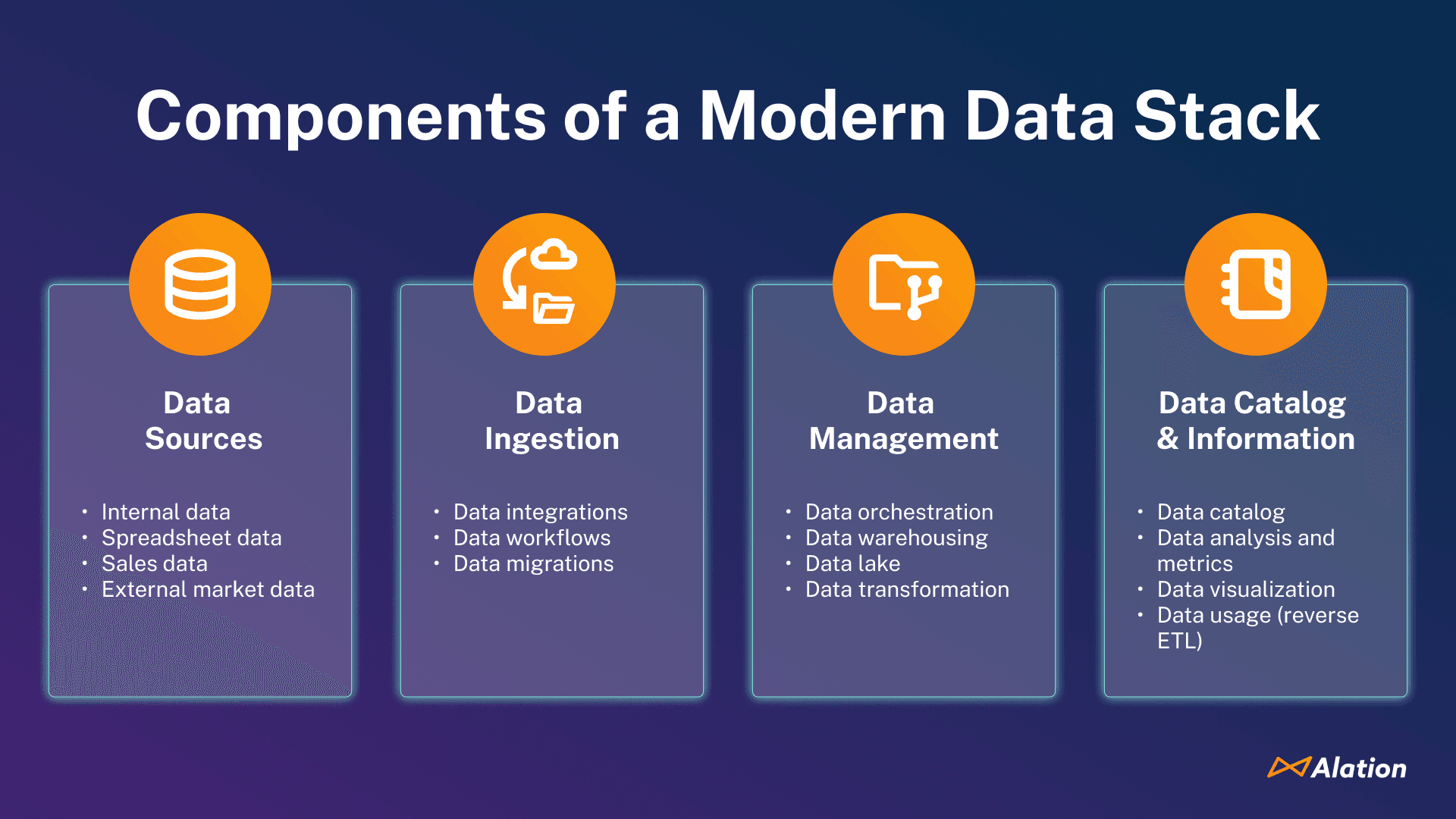
A typical modern data stack consists of the following core components:
Extract, Load, Transform (ELT) tools
Data ingestion/integration services
A data warehouse, data lake, or data lakehouse
Data orchestration tools
Business intelligence (BI) platforms
Reverse ETL tools
These tools are used to manage big data for enterprises. Big data is typically defined as data that is too large or complex to be processed by traditional means, which means you need specialized tools and infrastructures to build your own data stack.
What is a modern data stack for AI?
A modern data stack for AI is a cloud-native data infrastructure designed so that AI models, copilots, and autonomous agents can retrieve, understand, and act on enterprise data with accuracy, governance, and a full audit trail.
It still includes everything a modern data architecture has always needed: ingestion, storage, transformation, orchestration, and analytics. What makes it for AI is the layer on top: the context layer that encodes what your data means, how concepts relate, and what an AI system is allowed to do with them. (For a deeper comparison, see semantic layer vs. ontology vs. enterprise context layer.)
A traditional stack makes data available. A modern data stack for AI makes data understandable and actionable to machines, which is a higher bar, because an AI agent has none of the institutional knowledge a human analyst uses to silently correct for ambiguity.
At Alation, we view the modern data stack as enabling three things at once: visibility (through metadata and discovery), agility (through interoperable tooling), and trust (through governance and lineage). For AI, a fourth requirement joins them: context, the meaning and judgment that lets agents act, not just retrieve.
A worked example. Ask a generic AI assistant for "full-year revenue" on a company whose fiscal year ends in September. If the data is ungoverned and the definition lives only in people's heads, the assistant may calculate a calendar year, present the number with confidence, and be wrong. The pipelines were flawless. The failure was context. A governed definition in the catalog, a semantic layer that standardizes the metric, and a policy that tells the agent which fiscal calendar applies would have prevented it.
How a modern data stack for AI differs from a traditional analytics stack
Three years ago, "modern data stack" meant a cloud warehouse, an ELT pipeline, a transformation tool, and a BI layer. That combination transformed analytics, and for descriptive reporting it still works well.
But AI changed the requirements. When a platform exists only to answer historical questions (what happened, how much, how often), a clean analytics stack is sufficient. The moment the platform has to power recommendations, detect anomalies in real time, or let an agent execute a multi-step workflow, the architecture has to evolve.
Dimension | Traditional analytics stack | Modern data stack for AI |
Primary consumer | Human analysts via dashboards | LLMs, copilots, and autonomous agents |
Core question | "What happened?" | "What should we do, and can we prove why?" |
Data shape | Structured, batch, historical | Structured + unstructured, often real-time |
What it standardizes | Metric calculations | Metrics plus meaning, relationships, and policy |
Failure mode | A wrong number on a dashboard | A confidently wrong action, taken at scale |
Governance model | Review at deployment, then spot-check | Continuous feedback loop on every interaction |
Decisive layer | BI / semantic metrics | Context layer (semantic → ontology → ECL) |
The trap most enterprises fall into is running AI workloads on infrastructure designed for reporting, then wondering why the agent gives plausible, polished, wrong answers.
What does the context layer add?
A modern data stack for AI has two tiers: the foundation (the layers in the table above) and the context layer (what makes it AI-ready).
A semantic layer that standardizes how metrics are calculated and named
An ontology that encodes what entities are and how they relate
An Enterprise Context Layer (ECL) that supplies the policy and judgment an agent needs to act
A governance feedback loop (glossaries, lineage, data quality monitoring, and automated correction) that keeps all of the above current
The foundation is necessary but not sufficient. You can have flawless pipelines and a pristine warehouse and still get unreliable AI, because the model doesn't know that your fiscal year ends in September or that your definition of "active customer" changed twice last quarter. That knowledge lives in the context layer. For how the feedback loop keeps it accurate, see how a self-improving context layer makes AI agents more accurate.
How has the modern data stack evolved into an AI stack?
The stack has transformed over 15 years, driven by cloud computing, changing workflows, and exploding data volumes, and most recently by AI's far higher demands on context.
Early 2010s: Cloud data warehouses emerge. Amazon Redshift becomes generally available in 2013,⁸ introducing scalable cloud data warehousing; organizations discover the cost ceiling of on-premises infrastructure.
Mid-2010s: The ELT revolution. The industry shifts from Extract, Transform, Load (ETL) to Extract, Load, Transform (ELT): load raw data first, transform as needed. BI tools like Looker and Tableau gain wide adoption, and Snowflake's cloud data warehouse reaches general availability in 2015.⁹
Late 2010s: Integration and ecosystem growth. Ingestion tools like Stitch and Fivetran provide seamless connections; alternative stores (MongoDB, Cassandra, Elasticsearch) mature the ecosystem.
Early 2020s: Democratization and real-time. Demand for access drives cloud migration; agile analytics and vendor flexibility become standard; real-time processing expands.
2025–2026: AI-first and context-driven. The stack becomes the backbone of enterprise AI. Data products emerge as the unit of value, and the context layer (semantics, ontology, and policy) becomes the differentiator between a stack that reports and a stack that can act. Adoption of agents is accelerating: Gartner found that 37% of respondents have already deployed AI agents and another 34% plan to within the next 12 months.²
The shift from ETL to ELT let analysts extract insights faster. The shift now underway, from ELT to context-aware data, is what lets AI agents act safely.
How does a modern data stack power AI and machine learning?
AI and machine learning are only as good as the data and context behind them. The stack supplies four things they can't function without:
Scale and speed. Cloud elasticity manages large volumes efficiently, and real-time processing feeds latency-sensitive use cases like fraud detection, personalization, and predictive maintenance.
Quality and governance. High data quality and active governance lead to more accurate predictions and faster, safer integration of new sources.
Context. The semantic, ontological, and policy meaning that lets a model interpret data the way your best employee would.
Auditability. A decision trace (what data the agent saw, what policy governed it, what it did) captured at runtime, not reconstructed after the fact.
As agents multiply, the stack also needs a way to publish, discover, and control them. See governed agent discovery for how enterprises treat agents like data products, and context vs. permissions for why what an agent knows and what it is allowed to do are separate controls.
How the modern data stack powers data products for AI
Data products have become the framework for delivering AI-ready value, and data products and the semantic layer are inseparable in practice.
A data product is a governed, trusted, reusable data asset built for consumption. A well-built one is effectively an integrated semantic layer: it bundles the metric definitions, certified sources, and shared vocabulary that make data trustworthy across teams. If the semantic layer underneath is inconsistent, the data product inherits that inconsistency and distributes it at scale, to every agent that consumes it.
The modern data stack supports a data product operating model through accessibility (self-service discovery), reliability (automated pipelines and quality monitoring), actionability (insight that informs the next step), and scalability (elastic growth from one team to the enterprise). Teams that pair data product thinking with their stack typically target outcomes such as reduced churn via real-time risk scores, optimized supply chains via predictive inventory, and faster time-to-market via instant access to behavioral analytics.
Modern data stack vs. legacy data stack
Understanding the contrast clarifies the value of modernization.
Dimension | Legacy data stack | Modern data stack |
|---|---|---|
Architecture | On-premises servers; traditional RDBMS and SQL | Cloud-native, elastic, modular |
Accessibility | IT bottlenecks; requests queue behind a central team | Democratized data with self-service access |
Flexibility | Tightly coupled, often single-vendor | Mix-and-match tools, consumption-based pricing, no lock-in |
Pipeline pattern | ETL; transform before loading | ELT; load first, transform as needed |
Built for | Reporting | Analytics, ML, and AI agents |
Governance | Manual, after the fact | Catalog, lineage, and quality running across layers |
An RDBMS can still play a role, and SQL remains a popular query language across both. But legacy architectures rarely supply the scale, real-time access, or context AI workloads require.
What are the benefits of a modern data stack for AI?
The customer results below are as reported in each customer’s published story.
1. Scale that keeps pace with AI workloads
Cloud elasticity lets you scale compute up for heavy AI jobs and back down to control cost. But scale only pays off if people can find and trust what’s running on it. Georgia-Pacific has 32,000 employees and facilities in more than 150 locations, and its VP of Data describes the company as manufacturing “decision-making systems” alongside its products.⁶ After building GP Data Pulse, a central data intelligence platform with Alation as a critical component, GP deployed eleven AI agents in 2025 and has more in development.⁶
2. Flexibility: tools that plug into how people already work
A flexible stack meets users inside the tools they already use. Lipton Teas and Infusions runs a data lake architecture and uses Alation as its central metadata hub. It feeds Alation’s context (data sources, refresh schedules, key metrics) into the front page of its Power BI reports.⁷ Its finance team, one of its most engaged users, publishes complex accounting manuals in Alation in one accessible place.⁷
3. Efficiency that compresses time-to-insight
At Georgia-Pacific, duplicate spare-parts inventory sat across plants while sites bought new. Thirty data sources held the answer, but users had stopped trusting the numbers. After the team fixed data quality and surfaced it in context, GP reports about $25 million worth of intercompany transfers in 2025, enabled in part by Alation.⁶ At Ciena, Curation Automation curated roughly 6,000 assets in about two weeks, against a manual rollout scoped at 1.5–2 years. Catalog users grew from roughly 300–400 to over 1,100. Ciena provided these figures, and its story notes the comparison isn’t apples-to-apples.⁸
4. A data culture that makes AI adoption stick
Usable tools strengthen data culture across discovery, literacy, and governance. At Brambles, the Executive Leadership Team serves as data owners, with 31 VPs responsible for data stewardship beneath them. The company focuses governance on its Critical Data Elements rather than governing all data equally.⁹
How do you build a modern data stack for AI?
The market trains organizations to choose technology first and define outcomes second. That sequence is backward. Start with the outcome, then build the layer that delivers it.
Step 1: Name the business problem before the technology
Three diagnostic questions guide the sequence:
Where does our data break down most often? If different teams get different numbers for the same question, your first investment is the semantic layer.
Where do our AI systems make factually wrong inferences? If agents fail because they don't understand domain relationships or operational sequences, you need an ontology.
Where do our agents fail on complex, multi-step workflows? If agents can't handle the judgment, policy, and situational dimensions of a decision, or you can't audit their reasoning, you need an Enterprise Context Layer.
Step 2: Assess the foundation you actually have
Before any layer, take an honest inventory. Is your underlying data trusted, cataloged, and governed? Do you have business glossaries the organization has actually agreed on? Do you have data lineage visibility (see what's new in Alation Lineage)? Do you have a mechanism to capture agent errors and feed corrections back? If the answer is no, the most important investment is foundational governance, not an ontology or an ECL.
Step 3: Deploy the foundation (warehouse, ingestion, transformation, BI)
Choose a cloud data warehouse or lakehouse sized to your data (Snowflake, BigQuery, Redshift, Databricks). Connect sources with ingestion tools like Fivetran, Airbyte, or Stitch. Clean and model with a transformation tool such as dbt. Add BI for human consumers and reverse ETL (Hightouch, Census) to push data back into operational apps. Pair all of it with a data catalog as the metadata backbone.
Step 4: Build the context layer
Layer the semantic definitions, ontology, and ECL on top of the governed foundation, in the sequence your maturity demands (see the table below). This is what turns an analytics stack into a modern data stack for AI.
Step 5: Build the feedback loop in from the start
In our experience, the failures that hurt most aren't technical. Context drifts as the business changes and nothing keeps it current. Every layer needs a governance feedback loop: when a metric definition changes, who owns the update and how fast does it propagate? When a policy changes or an agent surfaces an error, does that signal flow automatically back into the catalog, ontology, and ECL, or sit in a ticket queue? An ECL without automated feedback requires a permanent maintenance team. An ECL with it compounds accuracy over time.
Step 6: Enable the organization
Train teams, document the stack, and create champions. The stack only delivers value when people, and now agents, actually use it.
How to sequence the investment by AI maturity
The right first investment depends on where you are, not where you want to be:
AI maturity stage | Primary investment | Business outcome target |
Descriptive analytics & BI | Semantic layer | Consistent metrics; fewer reporting disputes; faster decisions |
Predictive models & rule-based automation | Ontology | Compressed decision latency; reasoning over complex domains |
Autonomous agents & agentic workflows | Enterprise Context Layer + governance | Scalable judgment; auditable, policy-compliant AI at scale |
Governance: the foundation that keeps an AI data stack trustworthy
All three context layers can decay. The semantic layer drifts when definitions change and tables aren't updated. The ontology goes stale when processes evolve faster than the model. The ECL degrades every time a policy changes or a table is deprecated and nobody updates the context.
The most dangerous governance model for agentic AI is the checkpoint model: review before deployment, then monitor intermittently. With agents making decisions at scale, by the time a checkpoint catches a problem, it has already propagated through thousands of decisions. The right model treats governance as a continuous feedback loop, where the governance infrastructure does four things:
Provides authoritative vocabulary. Business glossaries of agreed definitions (Customer, Product, Revenue, Active) that ontology builders draw from and ECL systems reference.
Maps the landscape. Automated data lineage tracing how data flows and transforms across systems.
Establishes trust signals. Data quality monitoring and certification that validate freshness and conformance before any agent consumes the data.
Closes the feedback loop. Mechanisms that capture agent errors and corrections automatically and flow them back into the catalog, ontology, and ECL.
This is where cumulative accuracy comes from. Each feedback cycle doesn't just fix an error; it adds to a growing body of institutional knowledge about how your business actually works, making each successive AI use case less risky than the last. That's the real goal of AI transformation: not more output faster, but a system where every agent interaction makes the next decision more accurate, more governed, and more defensible.
What challenges come with adopting a modern data stack for AI?
Tool sprawl. Specialized tools accumulate fast. Set evaluation criteria, favor multi-capability platforms, and use a data catalog as the central inventory.
High and unpredictable costs. Consumption pricing surprises teams as volumes grow. Implement cost monitoring, automated scaling, and data lifecycle policies early.
Talent gaps. Modern stacks need specialized skills. Upskill existing staff, create learning paths, and choose tools with strong documentation and intuitive interfaces.
Governance gaps. Flexibility without controls risks quality, security, and compliance failures, magnified when agents act on the data. Gartner found that 73% of enterprises have no plans to set ownership rules for technology costs and solutions, even as AI-driven development spreads beyond central IT.² Implement a catalog early, define ownership, and build lineage and feedback in from the start.
Slow adoption. Involve end users in selection, create departmental champions, demonstrate quick wins, and make the new stack genuinely easier than the legacy one.
Who needs a modern data stack for AI?
Any organization deploying AI on enterprise data benefits, but it's essential for those with multiple data teams, regulated data, or autonomous agents in production. Beneficiaries include data and business analysts, data scientists, software and cloud engineers, data engineers, and the business leaders who depend on AI outputs to make decisions. Increasingly, even small and mid-sized businesses manage data landscapes large enough, and AI ambitions serious enough, to justify the investment.
Getting started with a modern data stack for AI
The market will keep selling you technology. Your job as a leader is to anchor every technology conversation in a specific business outcome — not "we need a semantic layer" but "we need reporting arguments to stop so leadership decides faster"; not "we need an ECL" but "we need our agents to act with the judgment and policy awareness of our best employees, at scale, with a full audit trail."
Then work backward: from the outcome, to the layer that addresses it, to the governance that keeps it current, to the organizational alignment that makes it real. Many successful organizations start with a single high-value use case, prove value, and expand.
Start with the outcome. Build the layer. Govern the system. That's how a modern data stack for AI becomes business value rather than technology theater.
Curious how a data catalog and active governance can anchor your modern data stack for AI? Book a demo to see for yourself.
Sources & notes
Every external claim on this page is independently verifiable. The public sources are listed here.
Only 13% of CIOs report their enterprise has realized significant or transformational value from AI so far; funding for AI is increasing; Alicia Mullery quote (“Volume is not value.”). Gartner 2027 CIO and Technology Executive Agenda survey of 2,002 CIOs and technology executives, fielded May to July 2026. Gartner press release, Orlando, Fla., October 19, 2026.
Funding for agentic AI expected to increase by an average of 31.8%; 37% of respondents have deployed AI agents and another 34% plan to within 12 months; 73% of enterprises have no plans to develop rules for ownership of technology costs and solutions. Gartner, “CIO Planning for 2027: Close the AI Ambition Gap,” August 31, 2026.
Gartner predicts that through 2026, organizations will abandon 60% of AI projects unsupported by AI-ready data. Gartner, “Lack of AI-Ready Data Puts AI Projects at Risk” (Q&A with Roxane Edjlali), Stamford, Conn., February 26, 2025.
Amazon Redshift made available to all customers, February 14, 2013. AWS, “Amazon Redshift Now Available to All Customers.”
https://aws.amazon.com/about-aws/whats-new/2013/02/14/amazon-redshift-available-to-all-customers
Snowflake’s cloud data warehouse reached general availability June 23, 2015.
Provisional:
this is a CRN article reprinted on Snowflake’s site; Snowflake’s own announcement still needs to be located. CRN, “Snowflake Offers General Availability For Its Datawarehouse-as-a-Service,” June 23, 2015.
Georgia-Pacific: 32,000 employees, facilities in over 150 locations; “decision-making systems” quote from Matt Robuck, VP of Data; 30 data sources; about $25 million worth of intercompany transfers “last year,” enabled in part by Alation; eleven AI agents deployed “last year.” Customer-reported. Alation, “The $25 Million Reason Georgia-Pacific Rebuilt Its Data Foundation,” April 6, 2026.
https://www.alation.com/blog/georgia-pacific-data-transformation-matt-robuck/
Lipton Teas and Infusions: data lake architecture; Alation as central metadata hub; Alation-fed front page on Power BI reports; finance publishing accounting manuals in Alation. Customer-reported. Alation, “How Lipton Is Brewing a Smarter Supply Chain with Alation,” November 24, 2025.
https://www.alation.com/blog/lipton-smarter-supply-chain-with-alation/
Ciena: roughly 6,000 assets curated in about two weeks versus a rollout scoped at 1.5–2 years; users grew from roughly 300–400 to over 1,100. Figures provided by Ciena from its internal reporting; the story notes the comparison is not apples-to-apples. Alation customer story (undated; text places the work in 2025).
Brambles: Executive Leadership Team serves as data owners, with 31 VPs responsible for data stewardship; governance focused on Critical Data Elements. From the revAlation London 2025 session with Alistair Griffin, Global Data Governance Lead. Alation, “How Brambles Uses CDEs to Govern Its Global Supply-Chain Data.”
https://www.alation.com/blog/how-brambles-uses-cdes-to-govern-supply-chain-data/
ANALYST ATTRIBUTIONS & DISCLAIMERS
Gartner, Gartner Survey Finds Only 13% of CIOs Say Their Enterprise Has Realized Significant or Transformational Value from AI, press release, October 19, 2026. Gartner, CIO Planning for 2027: Close the AI Ambition Gap, August 31, 2026. Gartner, Lack of AI-Ready Data Puts AI Projects at Risk, February 26, 2025.
Gartner does not endorse any vendor, product or service depicted in its research publications and does not advise technology users to select only those vendors with the highest ratings or other designation. Gartner research publications consist of the opinions of Gartner's research organization and should not be construed as statements of fact. Gartner disclaims all warranties, expressed or implied, with respect to this research, including any warranties of merchantability or fitness for a particular purpose. GARTNER and Magic Quadrant are registered trademarks and service marks of Gartner, Inc. and/or its affiliates in the U.S. and internationally and are used herein with permission. All rights reserved.
- Data Culture
- Data Intelligence
- AI
- Cloud Transformation
- Data Catalog
- Enterprise Data Catalog
- Modern Data Stack
- Self-Service Business Intelligence
- Active Data Governance
- Data Quality
- Data Products
- Data Governance
Keep reading
More from the data desk