
Curation Automation
Alation Cloud Service Applies to Alation Cloud Service instances of Alation
Overview
Applies from Alation version 2026.2.1.0
Alation’s Curation Automation is an AI-powered curation capability that automates governance rather than relying on manual processes. Curation Automation enables Catalog Admins and Server Admins to define rules that curate large volumes of data assets from a central hub. This approach shifts the data management focus from manual, individual edits to a standardized rule-based system. Admins can now define governance standards centrally, rather than editing assets individually. These standards are automatically and consistently applied to all current and future assets that match the rules.
Catalog admins can now define and apply standards, monitor, and scale metadata automatically across the catalog lifecycle, enabling faster adoption of trusted data products, measurable regulatory compliance, and AI agents that run on curated, reliable data. Additionally, admins can preview AI recommendations before applying them, and rely on audit logs for complete transparency.
Before you create a curation rule, familiarize yourself with the key concepts in Curation Automation and understand the various building blocks that make a rule:
Key Concepts in Curation Automation
Understand some of the key concepts of Curation Automation to help you get started with creating your first rule.
Curation Rule
A Rule is a saved set of instructions defining a specific curation task:
Purpose: Explains why the rule exists.
Scope: Identifies which assets are affected.
Fields: Specifies which metadata fields to populate.
Value Source: Determines whether values are Deterministic (fixed) or AI-generated (with required confidence).
Reporting and Audit: Measures the rule’s impact on alignment with standards.
Scope
The Scope is a flexible selection of RDBMS data source objects, allowing assets to be included or excluded by:
Schema
Table
Column
Value Sources
Value Sources define how the metadata values are derived:
Manual or Fixed - You provide exact, fixed values. For example, Set the Steward field to the value <user/group>. Recommended for ownership or stewardship.
AI-generated - Curation agents generate values using catalog context (objects, tags, source comments). Results include a confidence score. Recommended descriptions and classifications with clear instructions.
AI Agents
In Alation Curation Automation, AI Agents act as your automated stewards. They act as specialized automation components that take your specific curation knowledge, such as how to describe a table or how to flag sensitive data, and transform it into a repeatable, auditable, and explainable capability. While you establish the governing logic through AI instructions, the AI Agents execute these standards by automatically populating and maintaining metadata across your entire catalog at scale
AI Actions and Consumption Units
Curation Automation tracks AI usage against one of two entitlement models, depending on what your tenant is provisioned with:
AI actions (curation pack) - For tenants with a purchased Curation Automation pack. An AI action is defined as an Alation AI Agent filling an AI-generated value for a single field in a single object in a rule.
Alation Consumption Units (ACU) - For tenants on the centralized ACU pool. Curation Automation draws from your shared ACU pool, alongside other ACU-metered Alation products. For details on the ACU model, the metered rate for Curation Automation, and the ACU dashboard, see Alation Consumption Unit (ACU) Usage.
Curation Automation detects your entitlement type automatically and displays the corresponding labels and balances throughout the rule preview and execution flow.
Before running a rule, based on the defined object scope and the number of empty fields within that scope, Curation Automation approximately calculates and displays the maximum estimated cost on the Preview screen:
For AI actions tenants, this appears as the estimated number of AI actions and the estimated actions remaining after the run.
For ACU tenants, this appears as the estimated number of AI fields, the estimated ACU consumption for the run, and the estimated ACU balance remaining after the run.
After the rule completes successfully, the actual usage is calculated based on the number of fields successfully updated by AI, and the remaining balance is displayed.
Alation does not count manually curated fields towards your AI action or ACU usage. Fields that you populate using fixed value sources do not consume from your AI action allotment or ACU pool. You can create rules that combine both AI-generated and manual fields; only the successfully updated AI-generated fields are deducted. If a rule fails mid-run, only completed updates are counted.
Get Started with Curation Automation
Curation Automation is available in the New User Experience on Alation Cloud Service instances starting with version 2026.2.1.0.
The Curation Automation option is enabled by default.
Note
If you do not see this feature, contact Alation Support to enable it.
Important
The available balance depends on your tenant’s entitlement type:
AI actions tenants: Each tenant is provided with 100,000 free AI Actions and Consumption Units, meaning the first 100,000 are free, and Alation will charge for each AI action thereafter. To replenish your AI action balance, contact your Alation Account Manager.
ACU tenants: Curation Automation consumes from your tenant’s shared ACU pool. To increase your ACU allocation, contact your Alation Account Manager. For pool size, consumption, and notification thresholds, see Alation Consumption Unit (ACU) Usage.
For more information on pricing details, contact your Alation Account Manager.
If you don’t have enough AI actions or ACU to run a curation rule, Alation prevents you from executing the rule and displays a message with the amount required versus your available balance. The message title is Insufficient AI Actions for AI actions tenants and Insufficient ACU Balance for ACU tenants. You can still create, edit, save, and preview curation rules; however, you cannot execute rules that require AI-generated curation until you replenish your balance. Rules that use only manual curation methods are not affected, and you can still execute those rules.
Access Curation Automation
To access Curation Automation:
Click the Curate and Govern icon from the left-side navigation panel of Alation user interface to open the Governance page.

Select the Curation Automation option from the Curate section.
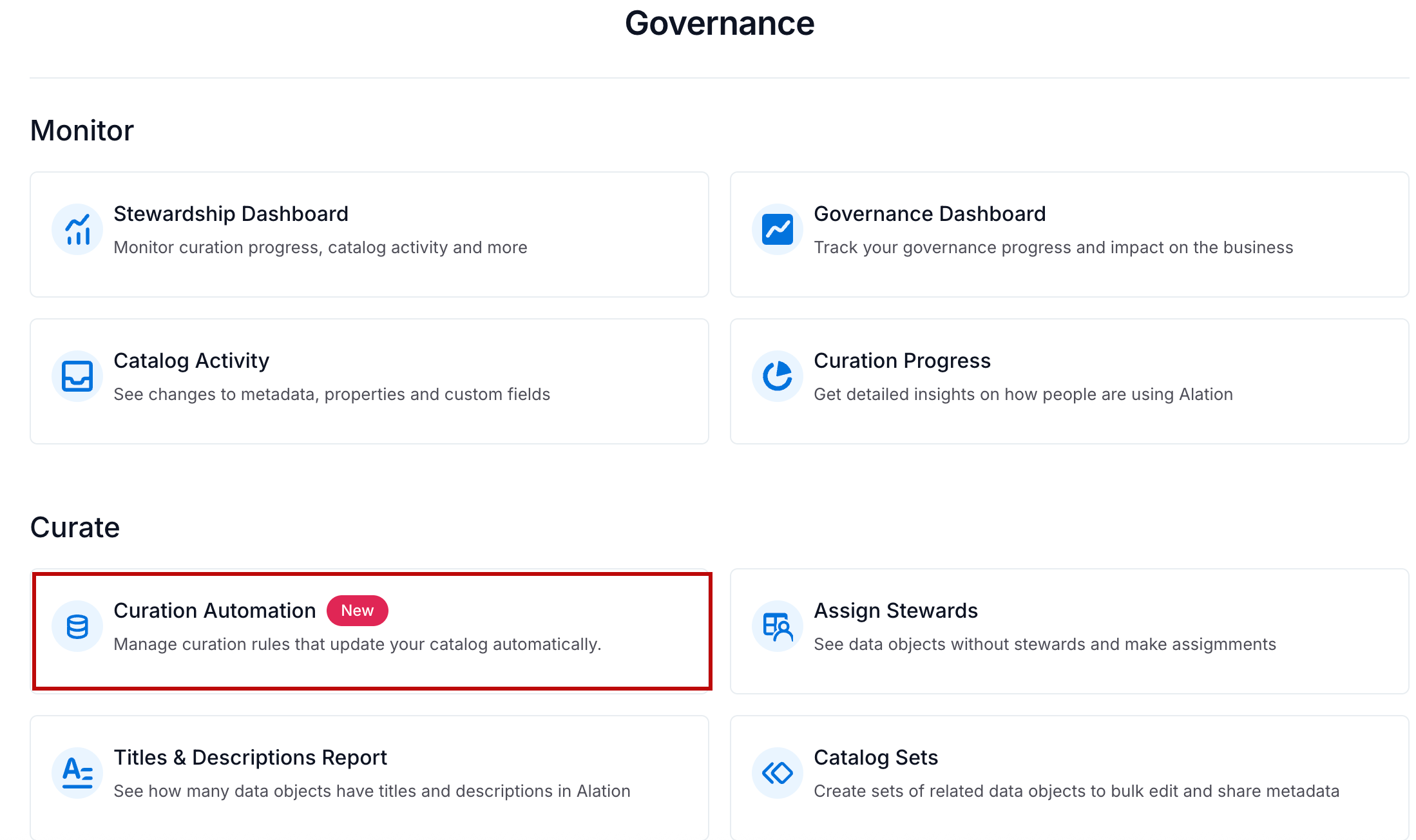
The Curation Automation page opens.
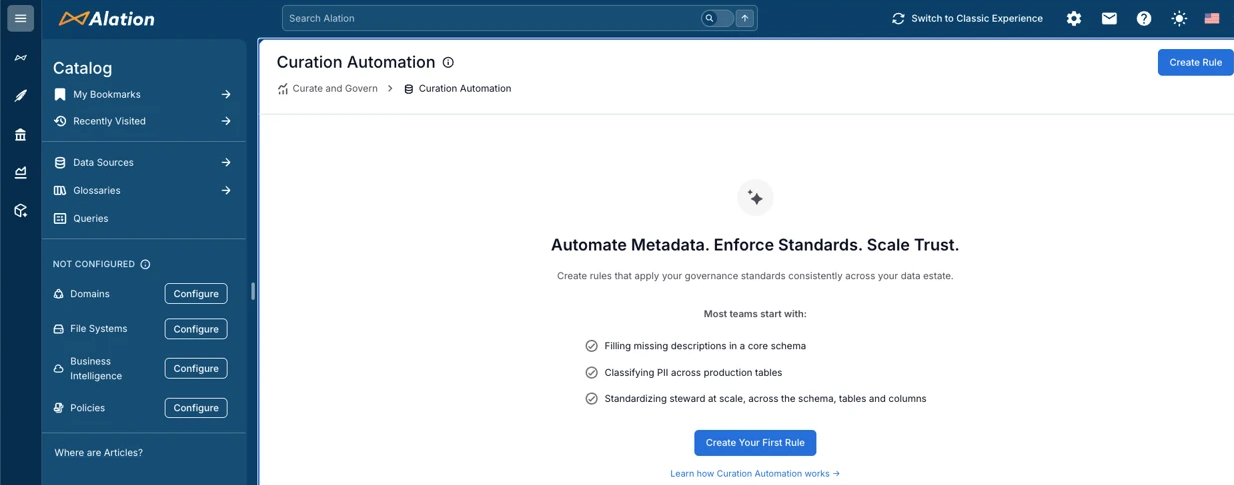
Overview Dashboard
When you have at least one curation rule, the Curation Automation page displays the following tabs:
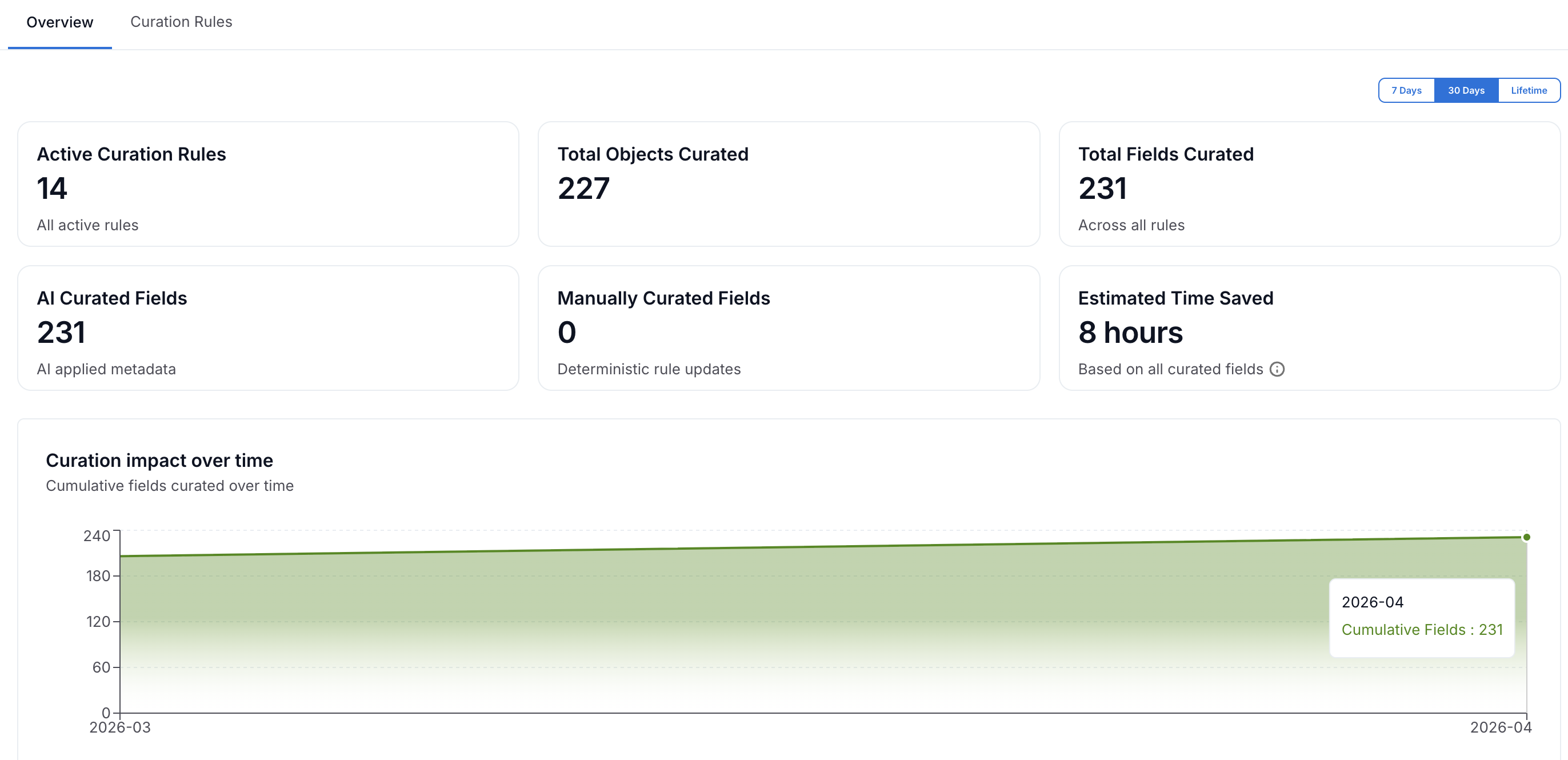
Overview - Provides a high-level metrics (Summary Metrics) dashboard and a visual representation of the aggregate impact of your curation rules (Curation Impact Chart). This is the default view.
Curation Rules - Displays a list of all existing rules and lets you manage them. For details, see Manage Curation Automation.
Summary Metrics
The Overview tab displays real-time metrics that show the impact of your automation. You can filter these metrics by 7 Days, 30 Days (default), or Lifetime using the date filter.
Metric |
Description |
|---|---|
Active Curation Rules |
The number of active rules in the Alation’s Curation Automation. |
Total Objects Curated |
The number of data objects (schemas, tables, and columns) with at least one field updated by curation rules. |
Total Fields Curated |
The number of objects successfully processed by curation rules. If any field in a rule is skipped due to low confidence, the object is not included in this count. |
AI Curated Fields |
The number of fields populated using AI-generated values. |
Manually Curated Fields |
The number of fields populated using fixed values. |
Estimated Time Saved |
Estimated time saved through automated curation compared to manual metadata updates (assumes two minutes per field). |
Curation Impact Chart
The Curation impact over time chart visualizes the growth of curated fields versus the timeline selected in your date filter. As your automation rules run, the trend line reflects the cumulative increase in metadata updates. You can hover over any data point on the line to see the specific total number of fields curated for that date.