

Data powers every modern enterprise. Yet as data volumes, sources, and use cases multiply, so do the challenges of managing it effectively. Studies show that cloud-native architectures now dominate—with 71% of organizations deploying them—and businesses leveraging cloud-based data pipelines are realizing 3.7× ROI and significant performance gains.
The foundation of that success? Robust, well-governed data pipelines that ensure data flows seamlessly from source to insight. Modern data pipelines are more than infrastructure—they’re the circulatory system that fuels analytics, machine learning (ML), and intelligent decision-making.
Let’s explore how to design, implement, and scale data pipelines that deliver trusted, business-ready data.
Key takeaways
Data pipelines are the foundation of modern analytics and AI, ensuring reliable, real-time access to business-ready data.
Automation, governance, and scalability are essential to building resilient, future-proof pipelines.
Modular, cloud-native architectures ensure flexibility as data ecosystems evolve.
Data catalogs bring visibility and control, aligning pipelines with compliance, data quality, and trust.
With robust data pipelines, enterprises can accelerate AI adoption and drive smarter decisions across the organization.
What is a data pipeline?
A data pipeline is a series of processes that move data from its source to its destination—typically a data warehouse, lake, or analytics platform.
Along the way, data is ingested, transformed, validated, and enriched to ensure it’s usable for downstream analysis and AI applications.
Each step in the pipeline produces an output that becomes the input for the next stage. A single failure can disrupt the entire flow—making reliability, observability, and governance essential.
What are the different types of data pipelines?
Different business goals require different types of data pipelines. Here are the most common models:
Batch pipelines: Process data in scheduled batches (e.g., nightly or weekly) for predictable, high-volume workloads.
Streaming pipelines: Capture and process real-time data from sources like IoT sensors, clickstreams, or financial transactions.
ETL (Extract, Transform, Load): Traditional model where data is transformed before being loaded into storage.
ELT (Extract, Load, Transform): A modern approach where data is loaded first, then transformed using the compute power of cloud data warehouses like Snowflake or Databricks.
Streaming ETL: Combines the best of both worlds—continuous ingestion with near-real-time transformation.
The right pipeline architecture depends on your data velocity, governance requirements, and the sophistication of your analytics or AI workloads.
What are some common data pipeline use cases?
Data pipelines underpin almost every data-driven activity. Below are key examples of how organizations use them to create value.
Preparing data for visualization
Before dashboards can illuminate insights, the data behind them must be transformed, standardized, and filtered. Pipelines ensure that metrics are clean, current, and consistent across BI tools like Tableau or Power BI—so every team works from the same trusted data.
Integrating data across systems
Today’s enterprises generate data from CRM systems, ERP platforms, cloud applications, and external APIs. Data pipelines bring these disparate datasets together, creating a unified, consistent foundation for analytics, operations, and decision-making.
For AI initiatives, this integration is especially critical. By consolidating diverse, well-governed data into a single view, pipelines ensure that AI models are trained and operated on accurate, representative, and up-to-date information—reducing the risk of bias, drift, and unreliable predictions.
Powering machine learning
Machine learning models are only as good as the data they’re trained on. Pipelines automate the flow of labeled, cleaned, and enriched data to ML frameworks—ensuring continuous learning and retraining cycles.
In more advanced architectures, pipelines handle feature engineering, versioning, and orchestration across the ML lifecycle. They connect to feature stores, manage metadata for reproducibility, and streamline collaboration between data scientists and engineers—ensuring that every model is trained on the most reliable, up-to-date, and compliant data available.
Improving data quality
Every stage of a data pipeline presents an opportunity to improve data quality—through validation rules, schema enforcement, deduplication, anomaly detection, and automated data profiling. These checks ensure that data is accurate, consistent, and complete before it’s used downstream.
Reliable pipelines don’t just move data; they actively curate and standardize it, transforming raw inputs into trusted, high-fidelity assets. The result is greater confidence in analytics, smoother AI performance, and more reliable business decisions.
What are the components of modern data pipeline architecture?
Modern data pipelines are modular systems, designed for scalability, resilience, and governance. They connect various sources of structured and unstructured data, supporting workloads that range from traditional business intelligence to advanced data science and AI. The key components include:
Data sources
Data originates from many places: transactional databases, SaaS applications, sensors, logs, and open-source or third-party datasets. Each source system has unique structures, refresh frequencies, and latency requirements that shape pipeline design and influence downstream performance.
Data collection
Also known as data ingestion, this stage extracts data from multiple origins and moves it into the pipeline using APIs, message queues, or replication frameworks. Depending on business needs, data engineers may implement batch processing for scheduled updates or streaming data ingestion for real-time analytics. Tools like Apache Kafka, Fivetran, or integrations with AWS, Snowflake, and Databricks often power this layer.
Data processing
Processing converts raw inputs into transformed data ready for analytics or machine learning. Using ETL, ELT, or SQL-based transformations, teams perform standardization, normalization, validation, and enrichment. Modern data engineering practices increasingly favor “transform-in-place” on scalable cloud compute, reducing latency and optimizing performance.
Data storage
Processed data lands in repositories such as data warehouses, data lakes, or hybrid lakehouses, depending on data type and use case. Warehouses are ideal for structured analytics and SQL queries; lakes excel at storing semi-structured and unstructured data at scale. The lakehouse model merges both—offering flexibility and cost efficiency for modern workloads.
Data consumption
The consumption layer operationalizes data for decision-making. Through dashboards, APIs, and machine learning pipelines, it connects high-quality data to business intelligence and AI systems. Self-service discovery is critical: when teams can easily find and query trusted data, adoption and data-driven impact increase.
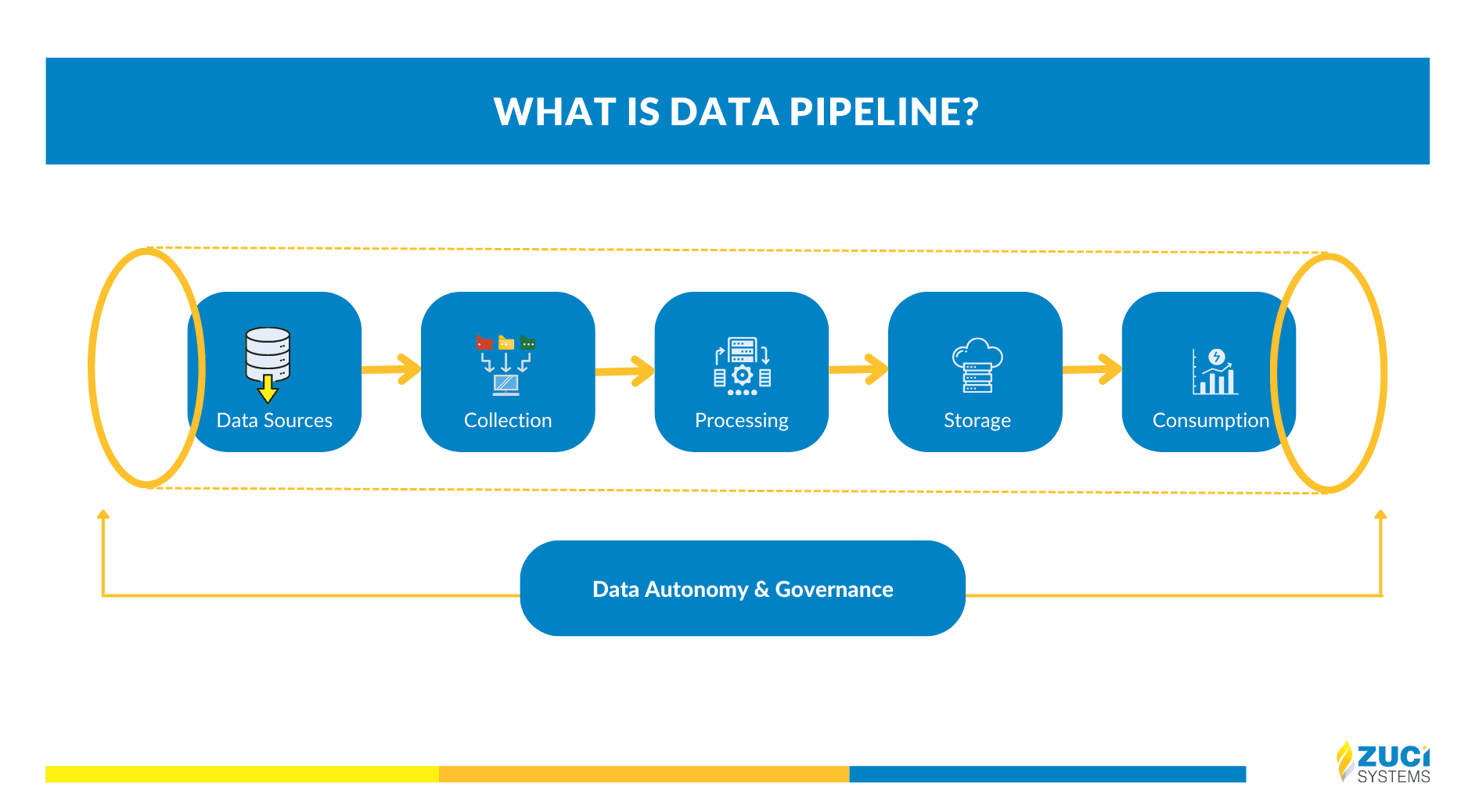
Data security and governance
Security and governance protect data throughout its journey. This includes encryption, access control, auditing, lineage tracking, and compliance monitoring. In mature organizations, these guardrails are automated and integrated through a data catalog—which centralizes governance and visibility across the pipeline.
Together, these components form the backbone of a modern data ecosystem. But architecture alone isn’t enough. Building a pipeline that performs consistently, scales intelligently, and remains resilient under pressure requires thoughtful design and proven best practices. Let’s look at how to build a robust data pipeline—and how to address the most common challenges along the way.
How do you build a robust data pipeline?
Building a resilient, high-performing data pipeline requires both solid architecture and strategic planning. Below are nine best practices to guide your design and implementation.
1. Set clear goals
Define measurable outcomes before building. Are you supporting batch analytics, near-real-time data integration, or AI workloads? Clear objectives guide architectural choices and align technical teams with business outcomes.
2. Choose the right data sources
Select reliable source data aligned to your use case. Evaluate each system’s format, latency, and data quality. Metadata-driven discovery tools—like those in Alation—help identify trusted, well-documented sources for consistent ingestion.
3. Set a data ingestion strategy
Determine how data will flow into the pipeline. Batch ingestion works for predictable loads; streaming ingestion supports continuous updates. Techniques like Change Data Capture (CDC) minimize overhead while keeping datasets synchronized with evolving source systems.
4. Have a data processing plan
Plan how to clean, transform, and optimize your data. Implement SQL-based transformations or open-source frameworks to deduplicate, standardize, and validate records. Modern ELT tools leverage cloud compute—like AWS Glue or Databricks—to efficiently transform data where it resides.
5. Set up data storage
Choose the right storage layer—warehouses for analytics or lakehouses for flexible workloads. Ensure the environment supports both structured and unstructured data at scale, integrates with your analytical tools, and maintains low latency for querying.
6. Plan your data workflow
Design a logical flow between each pipeline stage. Use orchestration tools like Airflow or dbt to sequence dependencies and automate execution. Parallelize tasks where possible to accelerate throughput and improve reliability.
Implement a strong data governance framework
Governance keeps your data ecosystem healthy and sustainable. It involves continuous monitoring, clear ownership, and proactive policy enforcement to ensure compliance and data quality.
Plan the data consumption layer
Think about how end users—data analysts, scientists, or business leaders—will interact with the data. Make outputs accessible, well-documented, and easy to integrate with downstream systems to support consistent decision-making.
Ensure flexibility and scalability
Modern data environments are dynamic. Build for agility with cloud-native tools and containerized workloads that can grow with your organization. By prioritizing scalability, you future-proof your pipelines and sustain performance as data demands evolve.
What are the challenges of building data pipelines—and how can they be overcome?
Even the best-designed pipelines face obstacles. Here are some common challenges and practical ways to address them:
Low data quality: Automate validation and cleansing at multiple stages. Implement data quality checks within the pipeline and monitor results through your catalog.
Schema drift: Use schema registry tools or automatic schema detection to prevent pipeline failures when data formats evolve.
Data silos: Integrate metadata management and API-based sharing to break down silos and promote reuse.
Operational complexity: Adopt orchestration frameworks and observability tools for end-to-end visibility.
Governance gaps: Embed governance policies into pipelines, leveraging automation to enforce data access, lineage, and compliance.
These challenges highlight the importance of visibility and control across every stage of the data lifecycle. To overcome them, organizations need a unified layer that connects governance, quality, and discovery—one that empowers teams to understand data in context and act quickly when issues arise. That’s where a data catalog becomes indispensable.
How does a data catalog support effective data pipelines?
A data catalog is the connective tissue that brings transparency and control to complex data ecosystems. It helps teams:
Discover and understand trusted data sources to feed pipelines.
Automate documentation of data lineage, ensuring teams understand how data flows from source to destination.
Monitor data quality and usage in real time.
Enable AI and ML pipelines by ensuring only compliant, high-quality data is used for model training and inference.
Support impact analysis and cost optimization: A data catalog enables teams to trace data flows and transformations across pipelines, revealing redundant upstream processes, unused datasets, and compliance risks—so data engineering teams can reduce wasted resources, lower data-infrastructure costs, and proactively prevent downstream failures.
For enterprises scaling AI, the synergy between the data catalog and data pipeline is indispensable. Together, they enable governed automation—delivering trusted data faster, safer, and at scale.
Building robust data pipelines
A robust data pipeline doesn’t just move information—it creates trust, intelligence, and velocity across the enterprise. By integrating strong governance, automation, and discoverability from the start, businesses can unlock data’s full potential and accelerate innovation.
When built on a foundation of transparency and collaboration, data pipelines empower every part of the organization—from analysts to data scientists—to work smarter and faster, with confidence in every decision.
Curious to learn how a data catalog can support your data pipelines? Book a demo today.
- Data Culture
- Data Intelligence
- Data Catalog
- Modern Data Stack
- Data Governance
- Cloud Transformation
- Engineering
Keep reading
More from the data desk