




The risks of data migration are not to be taken lightly. Moving data between systems can expose organizations to serious issues like data corruption and compliance gaps if migrations aren’t planned carefully. In large enterprises especially, even small missteps can cascade across interconnected systems. In turn, this can disrupt business operations and erode teams’ trust in data. Unfortunately, cost overruns and significant project delays are also common when migrations outpace governance or readiness. Despite these very real possibilities, a well-planned data migration can be worth the effort. Case in point: In a 2025 survey, 71% of enterprises reported measurable revenue gains within a year of modernizing their data environments. With this in mind, how can you be among the organizations that enjoy such benefits, while also avoiding costly setbacks when migrating? The key lies in being educated about the top data migration risks and how to mitigate them. This post will explore both.
Key takeaways
Cloud migration offers agility and scalability. However, without proper planning, it can expose organizations to data loss, compliance failures, and other serious risks.
If you don’t work to prevent them proactively, the top five risks of data migration—including disruption, cost overruns, and low adoption—can all derail business value.
Addressing migration risks requires using best practices, ranging from data profiling and lineage mapping to continuous validation.
AI and ML reduce migration risks by predicting downstream impacts and validating data quality post-migration. They help teams scale these tasks efficiently through automation while also ensuring proper validation.
Key performance indicators, such as data quality improvements and cost and time savings, indicate a successful migration.
What are the top data migration risks?
Every migration introduces uncertainty, but large-scale, enterprise data migration projects are inherently more risky. Understanding the most common pitfalls is the first step toward avoiding them, however.
Below are the top risks that enterprises face during data migration and why they matter:
1. Data loss and corruption during transfer
Data is the lifeblood of the enterprise, and losing it even temporarily can be catastrophic. Without proper controls, migration teams may corrupt data in transit or duplicate records incorrectly. In more serious cases, incomplete or failed loads can lead to the loss of business-critical datasets—erasing valuable history and disrupting downstream systems that depend on that information.
Beyond these incidental risks, corruption can also be systemic. For instance, corruption may arise from partial loads, retries, or mismatched encoding across systems. Teams must also guard against loss of metadata and breaks in referential integrity, which can silently compromise data relationships and trust.
The impact of such failures can be severe. For instance, one of the most notable examples is TSB Bank’s attempt to migrate 1.3 billion customer records from a legacy system to a new core banking platform. This led to a massive IT failure. The new system locked millions of customers out of online and mobile banking for weeks, and there were also intermittent service disruptions across its 550 branches.
In total, the bank faced nearly 225,000 complaints and lost thousands of customers. To make matters worse, it received £48.65 million in fines from UK regulators and incurred millions more in compensation and remediation costs overall.
2. Poorly planned or mismanaged downtime
Downtime is an inevitable part of even the most carefully planned migration. Systems must pause or operate at reduced capacity while data moves and processes realign. However, the real risk lies not in downtime itself, but in how it’s managed. Poor coordination—such as failing to communicate maintenance windows or not having a fallback plan—can amplify the impact across business functions.
When downtime is unplanned or poorly managed, enterprises can experience either of the following:
Hard outages: These are complete system stoppages that halt operations entirely.
Soft outages: These are instances of degraded performance or data refresh delays that force your team to rely on outdated information.
With either type, though, there’s a risk of disruptions rippling beyond IT. If not addressed quickly enough, they may bottleneck critical workflows, strain supply chains, and even frustrate customers. For example, if a retailer’s inventory system goes offline unexpectedly, its stores may be unable to process transactions or restock shelves, resulting in lost sales and eroded trust.
Transparent communication and phased execution are invaluable for turning an operational inevitability into a controlled event. Done right, thoughtfully planned downtime can maintain business continuity and safeguard productivity and reputation.
3. Compliance and security failures
Migrations expose sensitive data to potential breaches if teams fail to apply strong governance and oversight. Without these safeguards, your migration team may mishandle personal information, violating regulations such as GDPR or HIPAA and triggering costly audits.
To illustrate, if a healthcare provider migrates patient records without encryption or access controls, it could unintentionally expose PHI data. This could then lead to HIPAA penalties and cause patients to lose confidence in the provider.
Additionally, migrations risk breaking audit trails that prove data integrity and access history. Losing those records can cause compliance gaps under frameworks such as SOX or even FTC guidelines on fair and transparent business practices. Incomplete or missing audit data introduces the risk of failing future audits or being unable to verify that sensitive information was handled appropriately. In effect, the organization has created new regulatory and reputational risks, even without an actual data breach.
4. Cost overruns and scope creep
Cloud migration is often a significant expense, but uninformed planning often pushes costs even higher. For example, because some teams underestimate infrastructure needs, they may provision too few servers or not secure enough data storage. This miscalculation can then force expensive emergency upgrades.
Others overlook hidden fees that can quietly inflate monthly bills and complicate long-term budgeting. Data egress charges are one such example—these are the costs cloud providers apply when data moves out of their environment. They can accumulate quickly when large volumes of data are transferred between regions, platforms, or back on-premises systems.
Beyond infrastructure, remediation work can also expand costs and timelines. Failed data validations, mismapped fields, and unplanned ETL rewrites all add unbudgeted labor and testing cycles. When these issues compound, teams often need to adjust migration priorities or re-sequence work, which can widen the project scope even further. For example, adding new datasets or compliance requirements can strain resources and delay delivery if you don’t account for them in your data migration strategy.
5. Low or slow adoption
Even when a migration technically succeeds, it can still fail if employees don’t use the data.
There are several reasons why they may be reluctant. Perhaps your datasets are inconsistent or incomplete, making them unreliable for decision-making. Alternatively, maybe your datasets are consistent and complete but lack sufficient documentation. This would leave employees unsure how to interpret or use data.
When such uncertainty persists, employees may revert to familiar, legacy systems if they haven’t yet been fully deprecated. This scenario would create compliance exposure because those older environments may still hold sensitive data under outdated privacy or security controls.
In any of the above situations, the lack of adoption would undermine your entire initiative. In addition to a lower ROI than expected, your organization’s progress toward a modern, data-driven culture would stall.
With these risks in mind, how can you avoid falling victim to them as you undertake a migration project?
How do you mitigate data migration risks?
Mitigating risks requires a mix of strategic data migration planning and governance. Technology also plays an increasingly important role, especially as it relates to automation.
Here are five data migration best practices that map to and prevent each risk:
Migration risk | Primary solution |
Data loss and corruption during transfer | Test and validate continuously with automated quality checks. |
Downtime and business disruption | Prioritize critical data domains to migrate first. |
Compliance and security failures | Establish governance guardrails for compliance and access. |
Cost overruns and scope creep | Conduct data profiling and assessment. |
Low or slow adoption | Use metadata to map lineage and dependencies. |
Below, you’ll learn why these best practices are so important and how to implement them:
Establish governance guardrails for compliance and access
Every migration puts sensitive data at risk. So your team must enforce clear policies around access, retention, and usage. Otherwise, you’ll be more likely to run into compliance violations and security gaps. Below are three guardrails that can protect regulated data throughout the migration process and help you demonstrate accountability during an audit:
Access control: It’s wise to limit who can view or move sensitive datasets during migration. Beyond traditional role-based access control (RBAC), you can use attribute- or policy-based models (ABAC/PBAC) to enforce rules dynamically based on user attributes or contextual factors such as location.
Encryption and masking policies: You’ll need to protect personal or regulated information both in transit and at rest. Apply field-level encryption and dynamic data masking to ensure only authorized users can view sensitive values, even when data moves through staging or testing environments.
Automated policy enforcement: Manual policy oversight often leaves unwanted gaps in enforcement. Automation is essential to prevent this and ensure the consistent application of compliance rules.
The challenge many enterprises face is maintaining these controls across diverse systems and large volumes of data. That’s where a modern governance platform like Alation helps, making compliance continuous rather than manual. Take the Policy Center, for example.
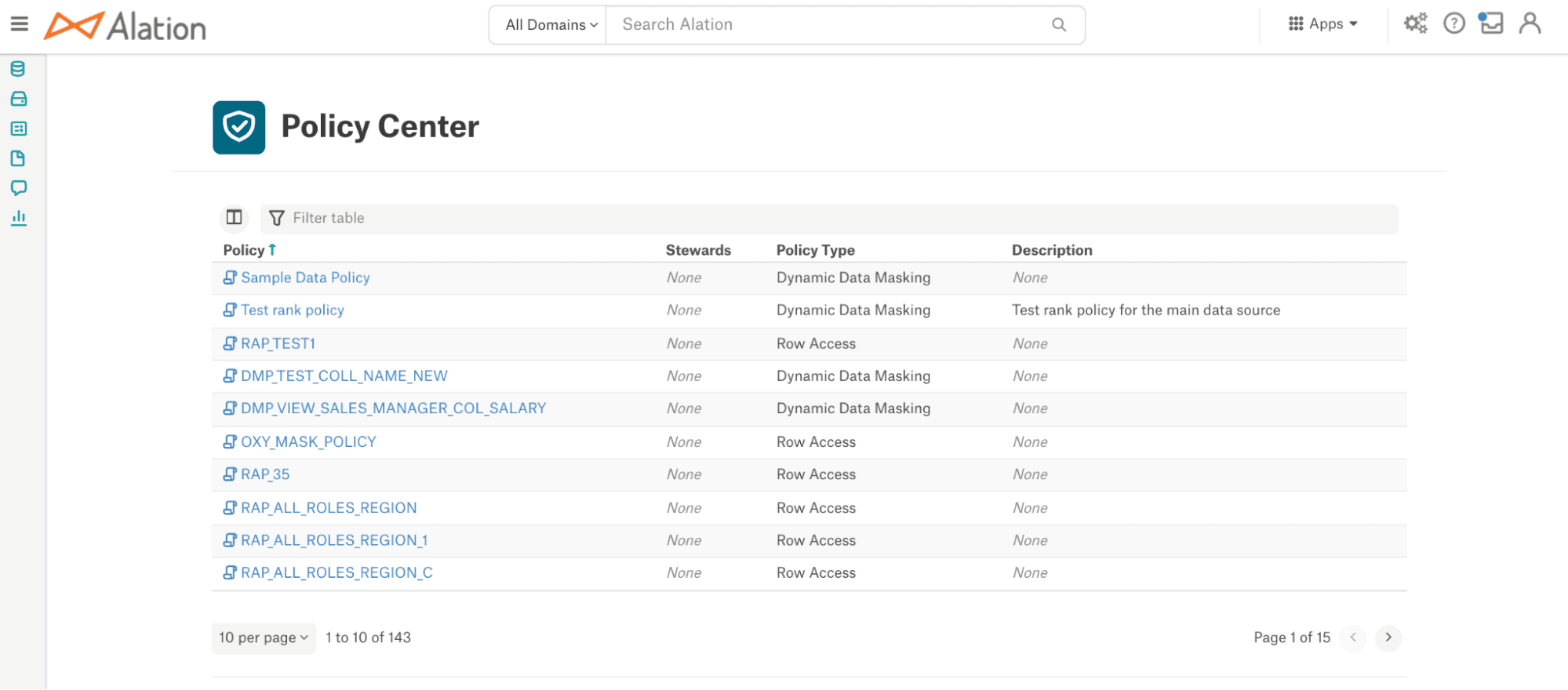
Alation’s Policy Center lets teams define data access, retention, and masking rules once and apply them automatically across all connected systems. Its automated stewardship features use metadata intelligence to surface policy violations or missing owners in real time, helping teams correct issues before they escalate.
By embedding governance into daily workflows, Alation ensures policies stay consistent—even as data scales or moves between environments.
Prioritize critical data domains to migrate first
Not all data is equally important, so not all of it is worth migrating immediately. In fact, attempting to move everything at once creates unnecessary strain on teams and systems. In turn, that strain boosts the likelihood of downtime, disruptions, and cost overruns.
It’s better to take a phased approach that prioritizes high-value or business-critical domains first. This includes not only datasets that drive key decisions but also those with high regulatory exposure or elevated risk—where errors or delays could have compliance consequences. Starting with these areas allows teams to secure early wins from your migration initiative. Plus, it will help build stakeholder trust and create momentum for subsequent phases.
Yet, you may find it challenging to determine which data assets are most critical and which ones can wait. To come to the right conclusions, you’ll need concrete evidence about how people use data within your organization. Alation Analytics surfaces insights into data popularity, usage frequency, and sensitivity levels. This visibility can help ensure your migration priorities reflect both operational value and regulatory accountability.
Conduct data profiling and assessment
Data profiling is another helpful practice as it uncovers duplicates, inconsistencies, and sensitive fields before they cause problems downstream. (While profiling examines the data itself, observability focuses on monitoring data flows and system performance. Both are essential to maintaining data quality—profiling at the granular level of records and fields, and observability at the broader level of pipelines and processes.)
In any case, surfacing any issues early reduces the risk of data loss or corruption during transfer. You’ll also be able to set realistic project scopes from the start, which helps you avoid cost overruns and scope creep.
But where should you start with data profiling? You’ll need to combine these two elements:
Automated scans of data assets: Data profiling tools make automatic scans possible, enabling you to quickly identify issues and high-risk data types at scale.
Business context from stakeholders: Input from data owners and business leaders clarifies which datasets are mission-critical. As a result, your team won’t waste time or budget on low-value data.
A platform like Alation can then strengthen this process by providing metadata-driven visibility and automated data quality insights. These capabilities will help you identify trusted datasets and understand dependencies. From there, you’ll be able to align the project scope to your business needs. In the end, you’ll enjoy a more predictable migration with fewer surprises and tighter cost control.
Use metadata to map lineage and dependencies
Complex data dependencies are a reality in any large organization. Systems, reports, and business processes rarely operate in isolation—they’re all interconnected. Without a clear map of these relationships, pipelines are more likely to break during a migration. This is a common cause of problems such as downtime and loss of trust in data.
To avoid these issues, implement lineage mapping as part of a metadata-driven migration strategy. This approach will make dependencies visible before the process begins. In addition to seeing which reports draw from a dataset, you’ll also get visibility into which upstream systems feed it and who depends on it downstream.
This foresight also strengthens compliance and data security by clarifying how sensitive or regulated data moves across systems. With this visibility, teams can apply the right controls where they matter most and verify that data handling aligns with policy. More importantly, it empowers migration teams to plan confidently, minimize surprises, and maintain business continuity throughout the process.
Test and validate continuously with automated quality checks
Testing shouldn’t happen only at the end of a migration. Without ongoing validation, errors linger until they cause significant damage—whether that’s data loss, corruption, or a breakdown of user trust. In contrast, continuous validation enables teams to detect potential issues early and correct them quickly to keep confidence high.
However, maintaining this level of vigilance at enterprise scale is challenging. Large data environments involve thousands of assets across multiple systems. Plus, testing must be bidirectional—verifying not just anomalies but reconciling source and target data counts, metadata consistency, and lineage accuracy. Overall, it’s time-consuming to perform the necessary quality checks manually.
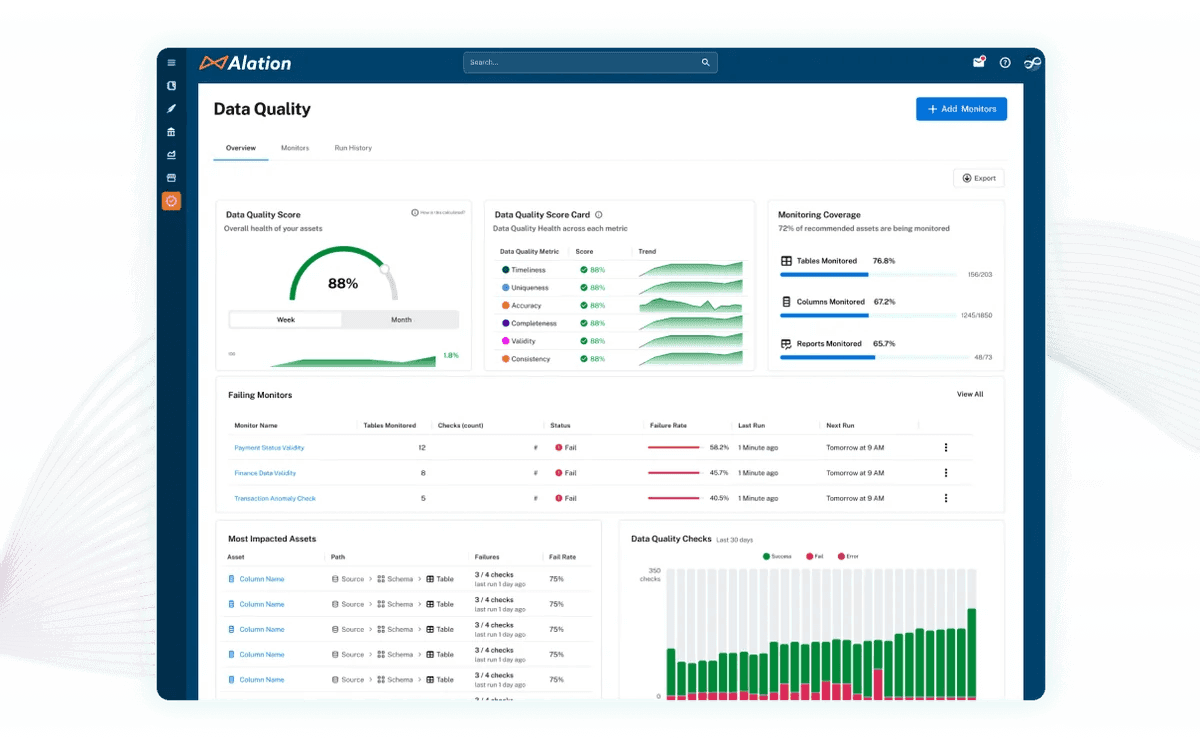
Automation is critical. A data catalog like Alation integrates automated data quality monitoring that scales alongside your data environment. With it, teams can track key quality metrics, set thresholds, and receive real-time alerts on anomalies—all tied directly to the business context of each dataset.
How can AI help reduce migration risks?
Implementing best practices, such as lineage mapping, plays a crucial role in the success of cloud data migrations. However, relying on manual processes has significant downsides in terms of accuracy and efficiency, especially for enterprises.
AI and machine learning (ML) have proven instrumental in transforming how organizations approach data migrations. These technologies don’t replace governance controls or data quality management. Rather, AI and ML augment them by handling routine tasks to surface insights faster and improve accuracy at scale.
These are some common AI and ML use cases for data migration:
AI-driven data profiling: ML models can scan vast datasets to identify anomalies or sensitive information. This capability helps teams prioritize high-value data assets and address data quality issues early.
Predictive risk detection: AI can analyze lineage and usage patterns to flag potential downstream impacts, such as broken dependencies or compliance gaps, before they happen.
Automated validation post-migration: After the migration, AI can confirm that business-critical information migrated properly. Then, it can continuously monitor data quality and compare source vs. target environments to verify accuracy.
User adoption insights: AI can surface usage patterns that highlight whether employees are actually trusting and leveraging the new environment. This insight can help leaders take corrective action if adoption lags.
Together, these capabilities turn migration from a reactive process into a proactive, intelligence-driven effort that reduces risk and enables you to enjoy all of the benefits of a data migration.
How do you measure success after a data migration?
Completing a data migration is only the beginning. The real test of success comes after the cutover, when it’s time to prove that the new environment delivers value. At this stage, perception becomes as important as performance—stakeholders need clear evidence that the migration achieved its goals. Tracking the right metrics is essential for data leaders to build trust now and refine processes for future migrations.
Here are a couple of key performance indicators to monitor:
Time and cost savings
Efficiency is a core benefit of a successful cloud migration, but it doesn’t happen automatically. When workloads move to a more scalable and automated environment, teams can optimize compute and storage usage, reduce manual maintenance, and access data faster—all of which translate directly into operational gains. You can then gauge that efficiency through tangible outcomes such as reduced infrastructure spend and shorter time-to-insight.
Ultimately, tracking KPIs like cost savings validates the business case for migration and helps teams justify ongoing investment.
User adoption and trust in migrated data
No matter how well you execute it, your migration will succeed only if employees use the migrated data. To understand whether end users are embracing the new environment, track metrics such as query volumes and catalog searches.
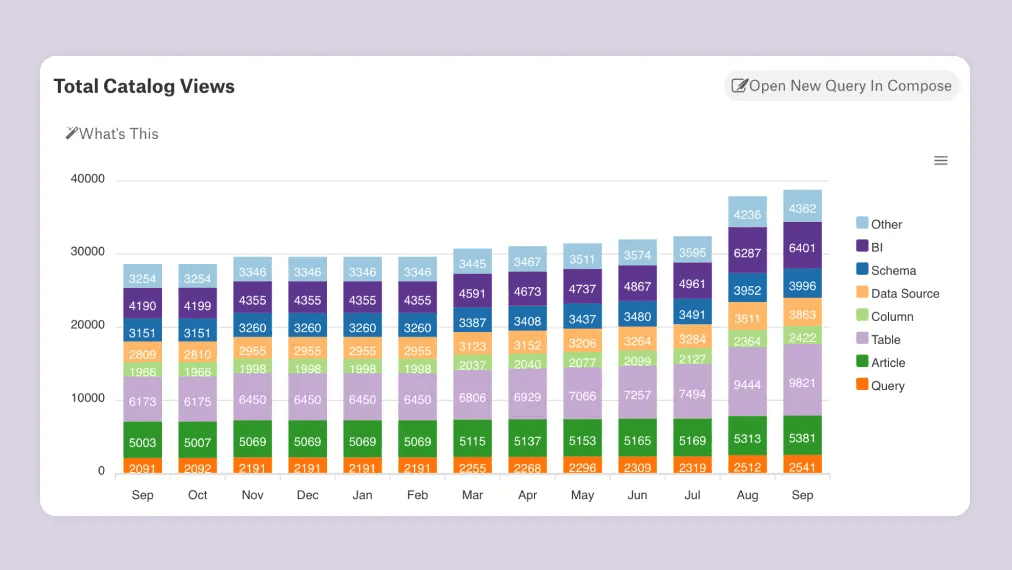
Beyond the performance indicators above, surveys and feedback loops can capture sentiment around trust, usability, and satisfaction. Taken together, both will help you clearly understand long-term ROI.
What are the benefits of using a data migration tool or service?
Even the best-prepared teams need technology to support the execution of their migration plans. In particular, specialized data migration tools offer a level of repeatability, audit tracing, and scalability that manual processing can’t sustain.
Such solutions also help project leaders manage timelines and consistently enforce governance policies. By automating key validation and approval steps, they reduce manual error and embed governance guardrails directly into migration workflows. Just as importantly, they make success measurable by tracking quality, cost, and adoption from start to finish.
The challenge, however, is that many tools focus narrowly on data transfer while overlooking the context that makes data meaningful to the business. But that’s where Alation stands apart. The platform integrates metadata intelligence, governance, and collaboration in one unified environment. It gives teams full visibility and control throughout the migration process, providing a clear view of how data moves and which policies apply.
To see what this looks like in practice, watch the on-demand cloud data migration webinar. You’ll learn how organizations are successfully transforming legacy data landscapes into scalable, modern platforms.
Ready to jump in? Book a demo today.
- Key takeaways
- What are the top data migration risks?
- How do you mitigate data migration risks?
- How can AI help reduce migration risks?
- How do you measure success after a data migration?
- What are the benefits of using a data migration tool or service?
Contents
FAQs
Why is a data migration risk assessment important for data quality and compliance?


A solid risk assessment helps you spot problems before they happen. It highlights where data might get lost, corrupted, or mishandled during a migration—and flags sensitive datasets or tricky dependencies that need extra protection. When teams understand these risks upfront, they’re far better equipped to keep data accurate, complete, and compliant.
But not all risk assessments are created equal. The best ones rely on real metrics, not tribal knowledge or guesswork. That means using tools that show true lineage, data flows, and data quality scores. With measurable indicators, organizations get a clear, objective picture of what could go wrong. This approach makes it much easier to maintain compliance with regulations like GDPR and HIPAA—and helps everyone trust the data once the migration is complete.
How are data migration challenges different when moving to the cloud vs. staying on-prem?
Migrating to the cloud usually comes with bigger, more dynamic challenges. Cloud environments scale automatically, which is great for flexibility—but it also means costs can spike if usage isn’t closely watched. Cloud platforms also spread data across multiple regions and services, so security and compliance controls need to work consistently everywhere, which adds complexity.
On-premises migrations tend to be more focused on fixed constraints, such as hardware limits, storage capacity, and system compatibility. Both approaches require careful planning, but cloud migrations demand more attention to governance, cost management, visibility into data movement, and maintaining compliance across distributed systems.
How does a structured data migration process prevent surprises?
A structured migration approach creates order in a process that can otherwise feel chaotic. When teams define scope early, break the migration into clear phases, and validate data quality throughout, they’re far less likely to run into unexpected delays or errors.
Governance plays a big role here, too. Built-in access controls, auditability, and automated validation checks help catch issues before they escalate. For organizations expanding their analytics capabilities, this structure ensures the migrated data is trustworthy and ready to use. That translates into faster insights, higher adoption, and a much stronger return on your migration investment.
Tagged with
Loading...