




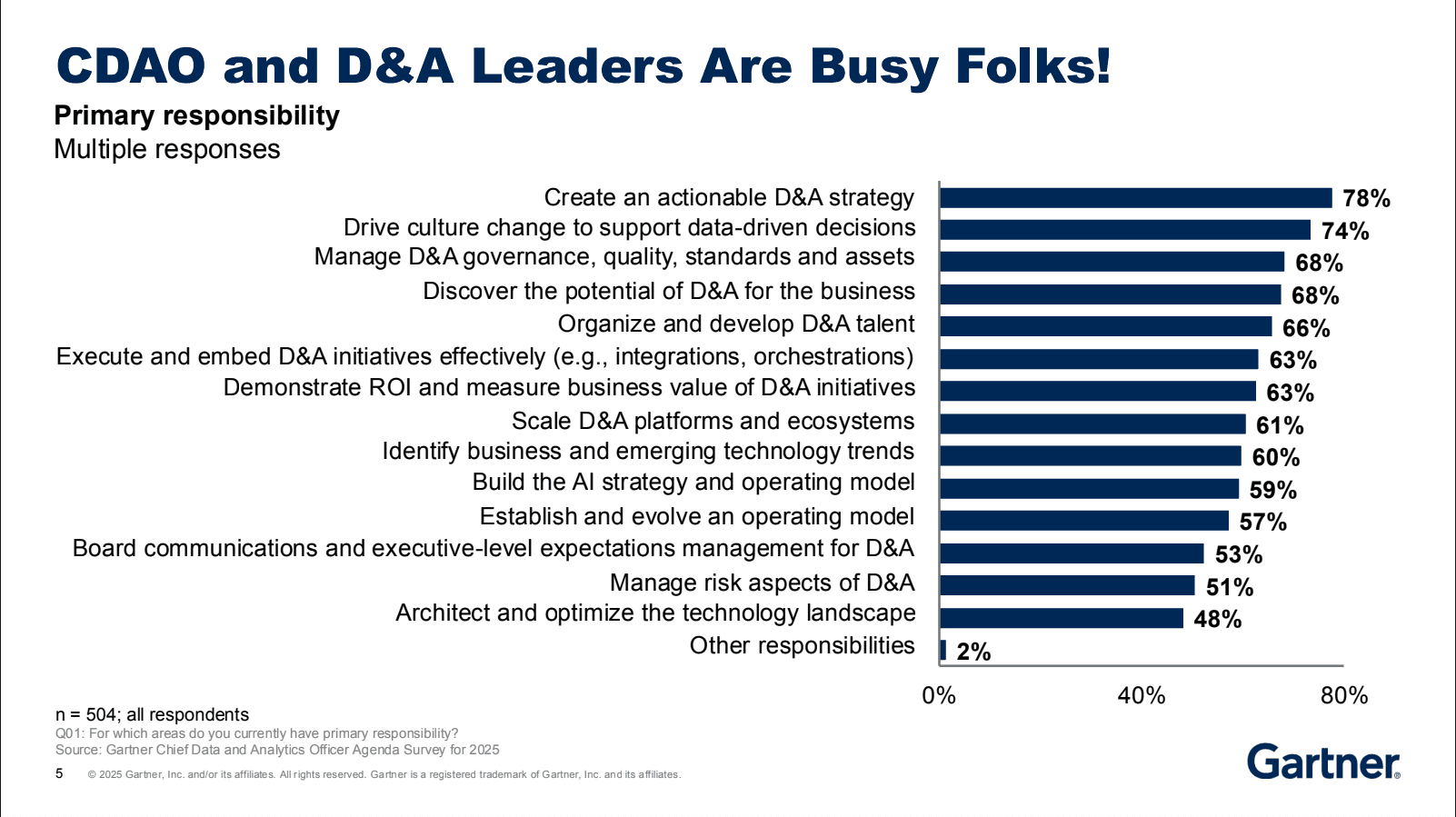
According to Gartner, 68% of chief data and analytics officers list managing data and analytics governance, quality, standards, and assets as a top responsibility. It’s a clear signal that data leaders see quality not as an isolated task, but as the foundation for reliable analytics and trusted decision-making. After all, without high-quality data, even the most sophisticated models and insights lose their value.
However, various risks threaten your organization’s ability to generate trustworthy insights. Common data quality challenges—such as inconsistent sources or missing context—can easily erode confidence and undermine enterprise data initiatives.
To avoid such undesirable outcomes, you need a cohesive data quality strategy. Here, you’ll learn how to build one step by step. By the end, you’ll understand how to align people, processes, and platforms to prevent errors rather than just fixing them reactively. As a result, you’ll be that much closer to having trusted, business-ready data that fuels sharper insights and measurable business value.
Key takeaways
A strong data quality strategy transforms reactive data cleanup into a proactive, organization-wide framework for trust and continuous improvement.
Clear ownership, measurable standards, and transparent governance keep data quality sustainable as systems and priorities evolve.
Automated monitoring, metadata, and lineage provide the visibility necessary to catch data issues early and maintain compliance at scale.
Embedding data quality into daily workflows—and using automation and AI—helps teams build the foundation for reliable analytics, faster innovation, and AI readiness.
What is a data quality strategy?
A data quality strategy is a structured plan for ensuring data accuracy, completeness, consistency, and fitness for purpose across the organization.
It defines how your organization will measure and improve data quality dimensions across every system, business unit, and process that depends on data.
At its core, a data quality strategy provides a framework for trust. It also turns data quality from an occasional clean-up effort into a sustained, organization-wide practice. Clear ownership and well-documented policies ensure consistency and transparency in the work. With the right strategy in place, even a small team can scale data quality into a shared program that benefits every function. As more people rely on and contribute to that framework, the cycle strengthens, creating a continuous flywheel of improvement.
An effective strategy typically covers the following:
Standards and definitions: You must establish what “good” data looks like, so you can then accurately evaluate the quality of your datasets.
Roles and accountability: To prevent confusion or gaps in accountability, define who is responsible for monitoring and improving data quality.
Processes and tools: It’s wise to implement technologies, such as data catalogs and automated rules, that enable continuous validation and flag data quality issues quickly.
Measurement and feedback loops: Tracking data quality KPIs and using insights is key to drive ongoing data quality improvement.
Combined, these elements will help your team trust data at first use. This capability means they’ll spend much less time validating reports or reconciling inconsistencies, and they can focus on higher-impact work. Yet, these benefits only scratch the surface of the benefits of a robust strategy.
What are the top benefits of developing a strong data quality strategy?
A strong data quality strategy delivers measurable business value in several distinct ways. Here are a few of them:
Increased trust in enterprise data: Teams rely on accurate, complete data to make informed business decisions. Part of making sure that data is trustworthy is clearly defining ownership and quality rules. (Lineage, auditability, and other factors also play a role.)
Stronger compliance and risk management: Defined policies and continuous monitoring help organizations meet data governance, privacy, and security standards while reducing the risk of regulatory penalties.
Improved operational efficiency: Automated validation and feedback loops reduce manual data cleanup. That way, teams can spend more time analyzing data and less time fixing it. Less rework then translates to significant cost savings.
Increased business agility: Reliable data gives leaders the confidence they need to act quickly. They can identify trends and adjust strategies without second-guessing the numbers.
Accelerated analytics and AI initiatives: Clean, reliable data shortens the path from collection to insight. Not only do high-quality inputs improve model performance, but they also enable you to deploy AI and analytics use cases faster.
A strong data quality strategy does more than fix bad data. It also creates a culture of accountability and trust, where every decision and innovation builds on a dependable data foundation.
How can you build a comprehensive data quality strategy?
Building a data quality strategy requires both a consistent structure and ongoing collaboration. There are two primary reasons for this:
Your strategy needs the right inputs (data) to produce the right outputs (business outcomes).
You must connect business priorities with technical execution. This task demands cross-functional collaboration.
A well-thought-out strategy that covers both of those bases will ensure every dataset serves a clear purpose and meets measurable standards. Below, you’ll learn step by step how to build a cohesive strategy that does just that. You’ll also see an example of what the process might look like in a realistic scenario.
Let’s use the example of a global retail company that’s enhancing its product and customer data to support improved forecasting, personalization, and analytics. Ultimately, this will help you gain a better understanding of how to apply the overarching principles of each step.
1. Identify data requirements and sources
First things first, you need a clear understanding of what data supports your business goals most directly. Review existing KPI reports to gather objective intel about which datasets are essential for current analytics or compliance initiatives, for example. Then, document how teams currently use that data so you can later see how those use cases map to your larger objectives.
Next, flesh out the information you’ve gathered by interviewing key stakeholders to uncover their most important data needs. This process will provide helpful insights into how you can extract more value from your data and streamline workflows for your team.
From there, you can move on to cataloging critical data elements (CDEs). CDEs are the specific fields or attributes most essential to your organization’s operations, reporting, and compliance. These elements typically represent the “must-have” data that drives core business processes, such as customer IDs, transaction amounts, or supplier records.
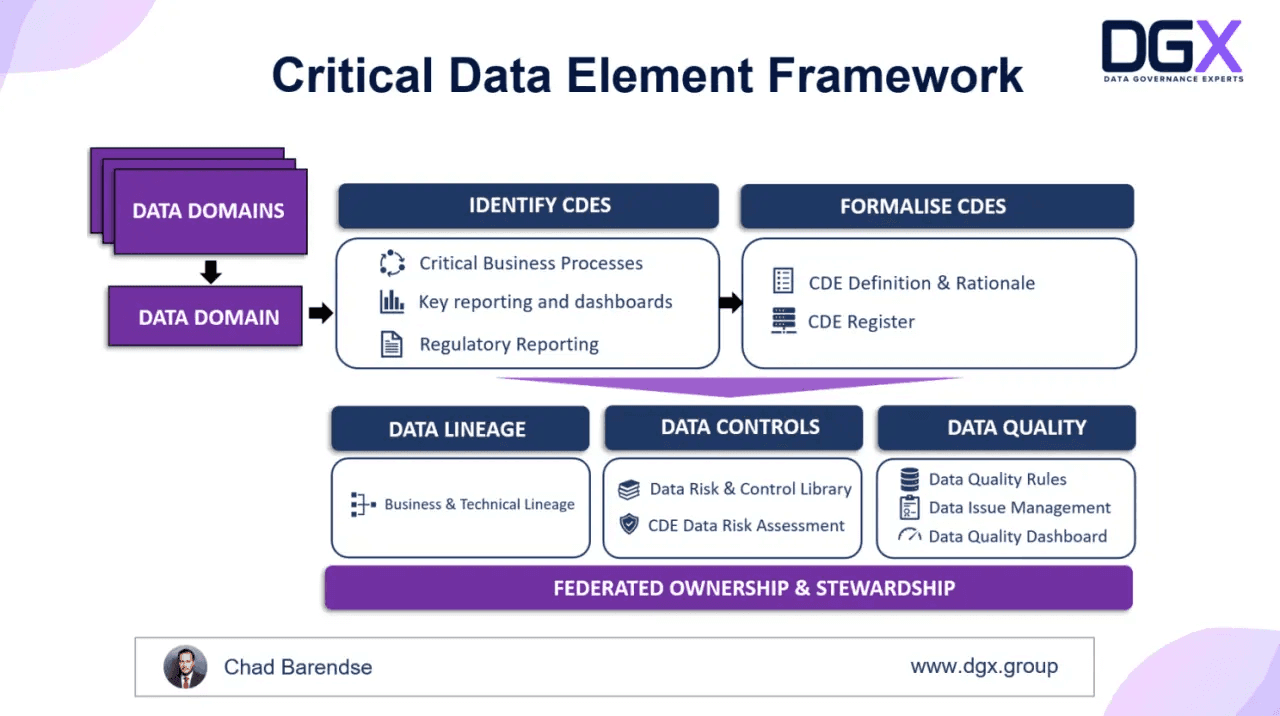
By documenting CDEs in a central repository, as shown above, and linking each one to clear business objectives, teams can trace every data point back to its purpose. This visibility allows them to assign ownership, define quality rules, and prioritize monitoring where it matters most.
Similarly, data products—reusable datasets or services built for specific business uses—extend this same principle. Just as CDEs clarify what data is critical, data products package that data into trusted, governed assets for decision-making and initiatives like AI. Together, they form a bridge between governance and usability: CDEs define what must be right, while data products ensure that trusted data is consistently delivered to those who need it.
Example: Imagine a global retailer reviewing the accuracy of its product catalog. The company finds that accuracy directly impacts its inventory forecasts and promotions. Mapping these dependencies would help the company focus its data quality management efforts where they matter most.
2. Understand the seven dimensions of data quality
Without an internal consensus on what high-quality data is, it’ll be impossible to accurately judge if you’ve met your quality standards. Therefore, the second step is evaluating your data through the lens of core data quality dimensions. Besides accuracy and completeness, these include more nuanced categories such as validity, timeliness, and integrity. In any case, the dimensions form a shared framework to define what “good data” means for your organization.
For example, in financial reporting, accuracy and integrity take precedence since an error in a single transaction record could materially affect compliance or investor confidence. By contrast, for real-time customer engagement or fraud detection, timeliness may outweigh perfect accuracy, as insights must be acted on within seconds to retain value. This illustrates why establishing clear definitions and priorities for each dimension—based on specific use cases—is essential to creating an organization-wide framework for assessing data quality.
From there, it’s critical to drill down further and establish data quality metrics. These are how you will measure your progress within each dimension. With acceptable error rates, latency targets, and data freshness expectations in mind, you can then check your current baseline and track improvement over time via automated rules and sampling. For instance, your data catalog may offer dashboards that provide real-time data quality scoring.
Example: At this stage, the retail company may test for completeness by confirming that every SKU record includes a product name, price, and supplier ID. In this case, the company’s completeness metric is the percentage of records that contain all mandatory attributes, with a target of 100%.
The company may also measure against dimensions like validity. For instance, they could do this by setting a threshold that no more than 1% of prices fall outside acceptable ranges.
3. Assess the current state across domains
Next, you’ll want to conduct data profiling across key domains such as customer, product, finance, or operations. This step involves quantifying error rates, duplicates, and missing fields, and then prioritizing the fixes.
Initially, it might seem sensible to invest the most resources where you have the highest volume of quality problems. However, it’s actually best to consider the business impact of each error or issue. A well-defined set of CDEs or packaged data products will reveal the data that truly matters. It will also help you direct your remediation efforts to target the errors that most directly affect revenue, compliance, or customer satisfaction.
Modern data quality tools can help with all of the tasks above. In fact, your organization will need them to effectively and efficiently scan large datasets. Such tools are also invaluable for automated anomaly detection and highlighting recurring issues. They can compare results across systems and regions to uncover patterns that may indicate process or integration gaps. Plus, many can visualize issues by severity, enabling your team to prioritize accordingly.
Lineage and cross-domain visibility are also critical here. Together, they help teams trace root causes across systems and understand how a single data issue can ripple through multiple business processes or reports.
Example: Imagine that the retailer discovers duplicate records across e-commerce and loyalty systems, which causes inflated marketing counts and poor personalization. Addressing this would be a high-priority issue because it would yield an immediate ROI. In addition to improving customer targeting accuracy, it would also reduce wasted marketing spend.
4. Establish ownership and accountability
The next step is to assign roles for data owners, stewards, and custodians. Who will monitor, approve, and remediate issues? What are the appropriate escalation paths when problems arise? Answering these questions is essential so you can enforce responsibilities and avoid problems stalling in silos.
Once you define roles, document the key responsibilities and connect them to the relevant data domains in your catalog or governance platform. Even a lightweight framework for ownership helps clarify who’s responsible for maintaining data quality. Today, many organizations are augmenting this process with AI- and ML-driven capabilities that automate parts of stewardship—such as automated quality checks and the ability to suggest or assign stewards based on usage patterns. These tools reduce the manual effort required to sustain ownership over time, so teams of all sizes can stay aligned on quality expectations.
Example: Each of the retailer’s business units may own its core data domain, while a central governance team oversees policy compliance. In such a case, those closest to the data are responsible for maintaining its accuracy. However, the governance team would provide helpful oversight and facilitate consistency across the enterprise.
5. Develop policies and procedures
Policies and procedures are key for defining how quality should be measured, ensuring consistency, and maintaining trust in how data is managed. To put policies into practice, map your existing workflows and identify where informal habits have replaced formal rules. From there, collaborate with your governance and compliance teams to standardize these processes and align different business units.
Once the framework is in place, automation can sustain it. Modern data catalogs now capture much of this information automatically—tracking metadata, version history, and usage logs in the background. This reduces manual oversight while also strengthening compliance and audit readiness.
Example: At this point, the retailer may realize that key product information is often missing when new supplier files enter production systems. In response, it may create a product data onboarding checklist to verify that mandatory fields are complete up front.
6. Perform data cleansing, validation, and enrichment
The next step is to define clear criteria for what qualifies as an error or gap within your data. This approach will help you raise data quality to a more consistent level when doing data validation, cleansing, and enrichment.
It’s best to schedule data quality checks within your pipelines, as shown below, to make sure they’re done consistently. These validations and integrity checks should also be mapped to your data architecture, which will enable teams to detect and correct errors in real time—ideally at the point of ingestion—to prevent downstream replication. Then review any exception reports to identify patterns that may require upstream process fixes.
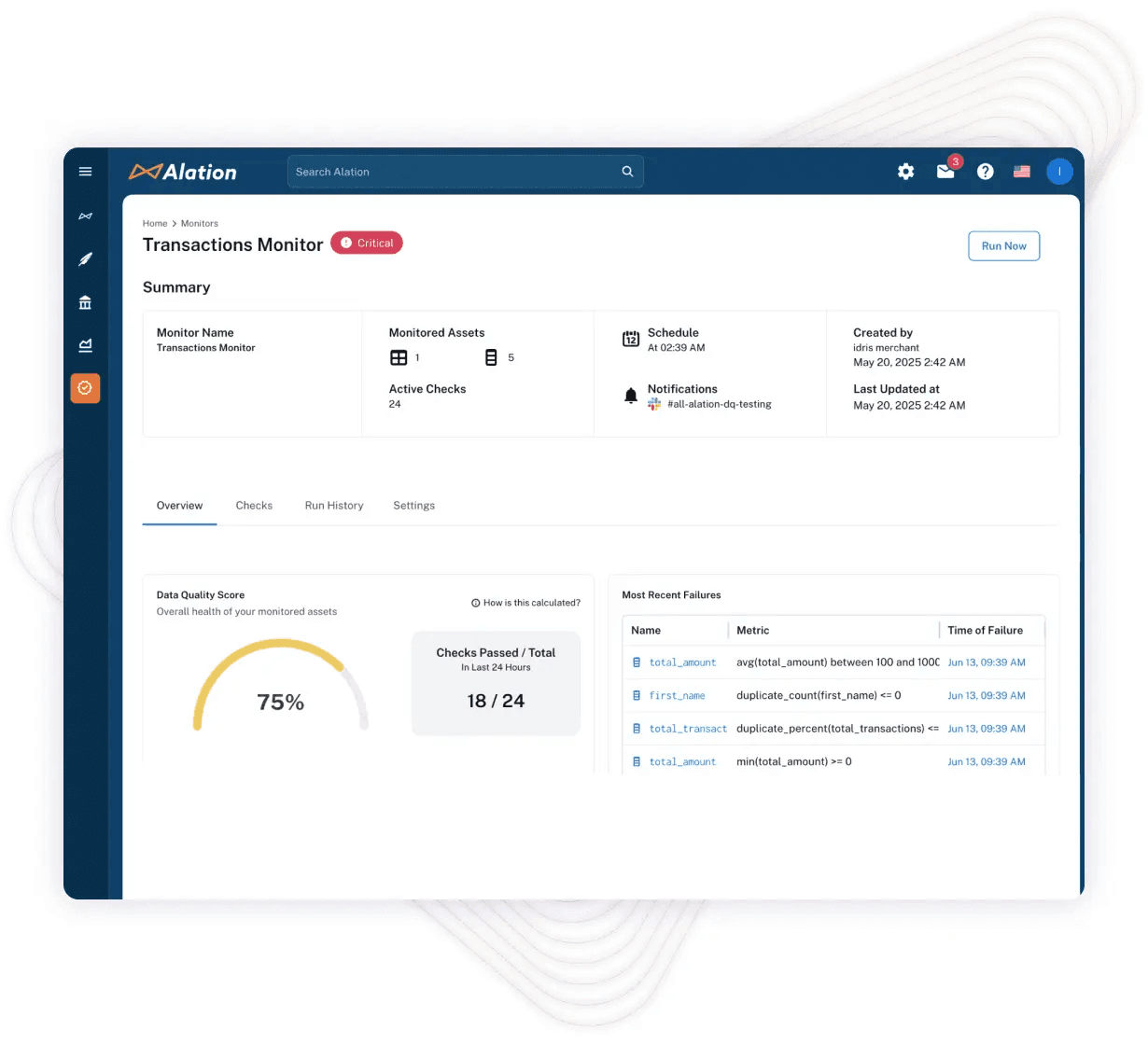
When enriching data, the same principles apply: consistency, traceability, and verification. External data sources should be reputable and integrated in ways that maintain synchronization and data lineage. If they are, enrichment will enhance overall quality and reliability rather than undermining it.
Example: To improve trust and traceability, the retailer may validate addresses against postal APIs and enrich product data with supplier certifications. This approach offers several benefits. It would facilitate more accurate customer communications, faster shipping, and fewer failed deliveries. Plus, it would boost compliance confidence and yield more credible analytics data.
8. Train stakeholders and foster a data quality culture
You can set thoughtful goals and quality standards. You can create detailed policies. You can even deem certain people accountable for certain datasets. But lasting progress depends on more than structure alone. To sustain data quality, everyone who works with data needs to understand its value and feel motivated to maintain it. This means encouraging shared responsibility and curiosity across teams.
Educate team members about how their work affects data quality and business results, either by organizing trainings yourself or leveraging resources such as Dataversity. In particular, role-based training offers an effective approach. It helps team members better understand nuances of quality as they relate to their specific responsibilities—whether they’re data stewards or analysts, customer service reps, or cashiers.
In addition to dedicated training, reinforce good habits by integrating data quality checkpoints into daily workflows, such as dashboards or review meetings. Overall, the more you showcase quality metrics and celebrate improvements, the better.
Example: The retailer could hold short monthly sessions where data owners review improvements in completeness or accuracy scores. This approach would reinforce shared accountability and give teams opportunities to learn from one another.
9. Implement automated monitoring and feedback
Monitoring data quality without automated checks is extremely time-consuming, especially at enterprise scale. Human error can also cause data quality issues to go undetected. That’s why it’s so valuable to implement automated quality checks and anomaly detection. Particularly when paired with robust lineage tracking, they give your data engineers and stewards faster visibility into root causes.
How should you go about the implementation, though? Ideally, you embed monitoring into existing data pipelines rather than running it as a separate process. This approach will enable you to surface results in dashboards or data catalogs where users already work. Plus, your data engineers can respond to upstream breaks faster.
It’s also wise to set clear, real-time alert thresholds. These help distinguish minor fluctuations from true quality risks and assign each alert to an accountable data steward. Ultimately, automated alerts will empower your data stewards to act fast while providing executives with visibility into overall data health.
Example: Say that the retailer identifies an upstream system that introduces blank product descriptions. If the company has set up automated data quality monitoring, automated rules would flag the error and alert the responsible steward. This capability would ultimately prevent any impacts on reporting.
10. Drive continuous improvement and adaptation
Of course, you’ll need to monitor quality metrics on an ongoing basis and adjust them as business goals or market conditions evolve. Additionally, as issues surface, you’ll have to drill down to their root causes and refine your data standards as necessary.
Conduct reviews at a regular cadence to identify recurring issues and opportunities to automate or simplify controls. Treat these reviews as feedback loops and use them as opportunities to work with data owners and governance leads. Based on feedback from various team members, update rules to close process gaps or realign priorities as data environments change.
Be sure to document all lessons and findings so future initiatives start from a stronger foundation.
Example: As a final step, the retailer might choose to integrate quarterly quality audits into its governance calendar. This step would help ensure that data quality evolves alongside new AI and analytics initiatives.
Overall, a comprehensive data quality strategy does more than fix errors—it also institutionalizes trust. By embedding automation and ongoing accountability into daily workflows, you can transform data quality from an IT function into a shared responsibility that fuels business decision-making and innovation.
How does data governance support your data quality strategy?
Data governance provides the structure that sustains a data quality strategy over time. It defines how quality policies are applied, who is responsible for maintaining them, and how exceptions are handled.
Strong governance transforms one-off quality fixes into consistent practices by embedding accountability and transparency into daily workflows. When business and technical teams share this framework, governance ensures data remains reliable and compliant. This fosters a culture of trust and continuous improvement across the organization.
To scale your governance efforts, consider which of these three data governance models will work best for your organization:
Centralized governance establishes a single authority, such as a chief data officer role, to set enterprise-wide rules. It also ensures consistency and compliance, but it can slow responsiveness.
Decentralized governance empowers individual business units to define and manage their own standards. It also supports agility but risks fragmentation and duplicated effort.
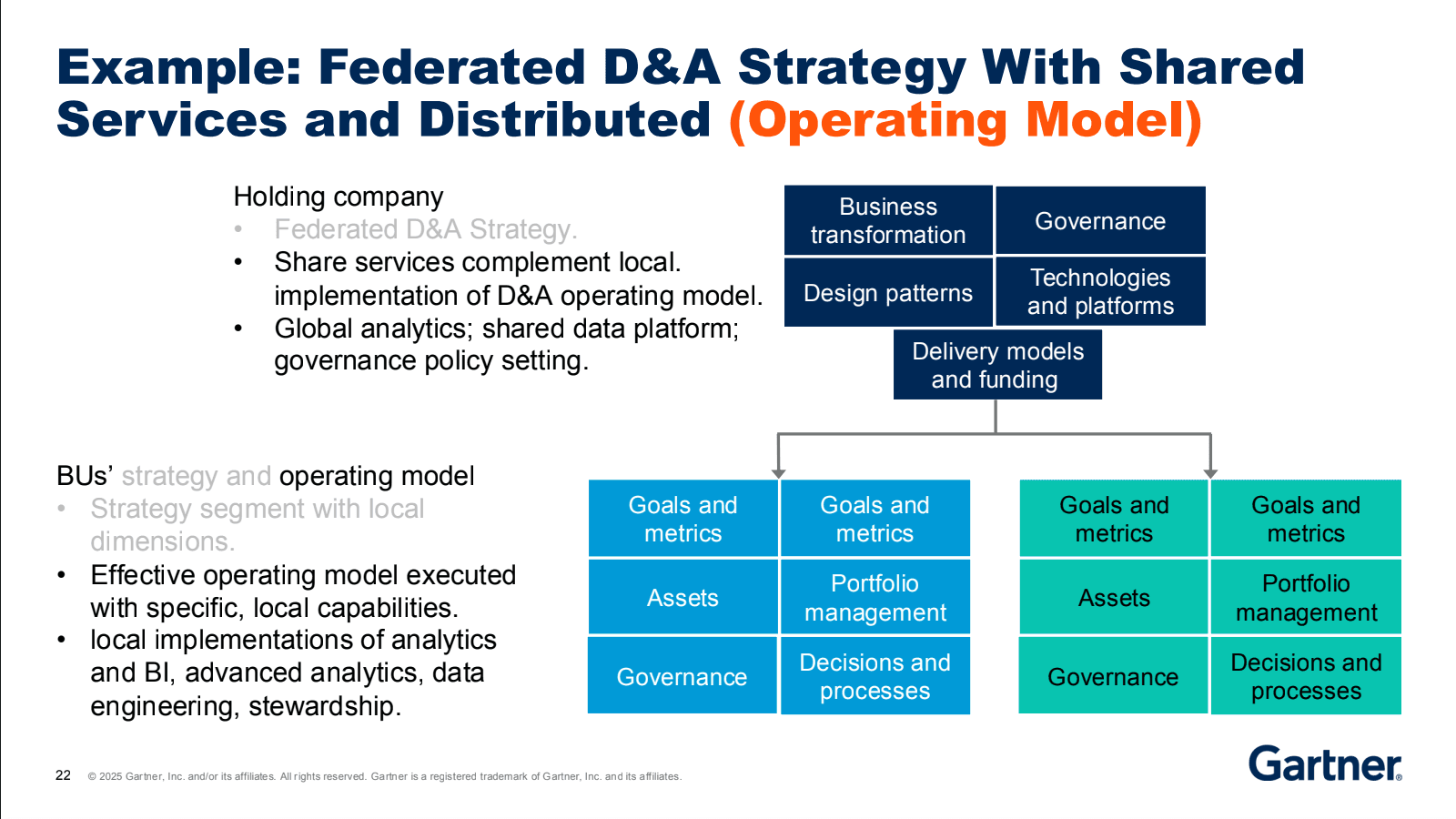
Federated governance balances both of the previous aspects. In this model, a central team defines universal policies and tools, while domain experts adapt them locally. As you can see below, Gartner’s Chief Data and Analytics Officer Agenda Survey for 2025 alludes to this model as a practical way for large enterprises to balance the complexity of global standards with local autonomy.
Regardless of which model you choose, governance only supports data quality when it’s built on a foundation of metadata and lineage. Metadata captures the data’s owners, definitions, and use, while lineage traces the origin of the data and how it moves and transforms over time. Together, they proactively surface quality issues and provide the audit trail needed for compliance.
Modern data catalogs simplify this work by linking governance policies directly to metadata and automating many quality checks. This automation ensures only trusted, verified data flows into analytics or AI models. In short, effective data governance turns quality management from a reactive cleanup exercise into a proactive, scalable discipline.
Strengthen your data quality strategy
A strong data quality strategy is never static. Instead, it evolves alongside the organization itself. Sustaining it requires more than governance—it depends on the organization’s capacity to adapt. As business priorities, regulations, and data sources shift, teams must be willing to revisit assumptions and refine their metrics and standards to reflect new realities.
As organizations expand their use of AI and advanced analytics, sustaining data quality becomes less about fixing issues and more about building lasting trust. With automation now central to many modern quality programs, the focus shifts to refinement. In other words, continuously improving how governance, lineage, and monitoring work together to keep data reliable at scale.
If your team is still grappling with manual processes or disconnected tools, it may be time to modernize. Download our free white paper to explore how leading organizations use AI to automate quality checks, strengthen governance, and turn data reliability into a competitive advantage.
- Key takeaways
- What is a data quality strategy?
- What are the top benefits of developing a strong data quality strategy?
- How can you build a comprehensive data quality strategy?
- How does data governance support your data quality strategy?
- Strengthen your data quality strategy
Contents
FAQs
Why are data quality standards important for managing large and complex data sets?


Data quality standards matter because they create consistency across complex, distributed data environments. Large organizations often integrate data from dozens of systems, but without shared definitions and validation rules, errors can multiply quickly.
Clear standards for completeness and other data quality dimensions enable teams to compare and combine data confidently. These abilities accelerate analytics and AI initiatives while reducing the risk of misleading results.
How does regular data quality monitoring reduce compliance risks and improve decision-making?
Regular data quality analysis reduces compliance risk by detecting anomalies and policy violations before they affect reporting or regulatory submissions.
By continuously monitoring accuracy and completeness, organizations can document compliance and prove data integrity during an audit. This capability is especially critical for sensitive or personally identifiable information (PII), where improper tagging, incomplete data subject records, or missing access controls can directly expose the business to compliance breaches.
At the same time, consistent analysis provides leaders with more reliable insights, enabling them to make fast, evidence-based decisions.
How can data quality as a service (DQaaS) speed up digital transformation and build trusted data?
Yes, data quality as a service (DQaaS) enables businesses to scale trust quickly by centralizing validation, cleansing, and monitoring in the cloud. DQaaS platforms also automate routine quality checks and integrate with governance tools. As a result, multiple departments can access standardized, verified data. This approach reduces IT overhead and shortens transformation timelines. Plus, it ensures that new digital systems operate on clean, reliable information from day one.
Tagged with
Loading...