




Modern businesses create massive volumes of data every day — and the demand to make that data usable is growing fast. The global data integration market, which includes ETL and ELT tools, was valued at $7.63 billion in 2024 and is projected to surpass $29 billion by 2029 (Integrate.io). This rapid growth underscores how essential it has become for data teams to integrate, transform, and analyze information from multiple sources. A robust ETL pipeline now stands as the backbone of modern data infrastructure — turning raw, scattered data into trusted, actionable insights.
Key takeaways
An ETL pipeline systematically extracts data from multiple systems, transforms it to meet business and technical requirements, then loads data into a target database or warehouse for analysis.
The three core stages — Extract, Transform, Load — work together to drive data quality, consistency, and accessibility across an organization.
ETL differs from ELT primarily in when and where transformation happens: ETL transforms before loading; ELT loads raw data first and transforms afterward.
Use cases for ETL/ELT span data warehousing, business intelligence, compliance, migration, machine learning and real-time processing.
Building robust ETL data pipelines demands attention to pipeline complexity, data cleaning for unstructured and semi-structured data, performance bottlenecks, cost management, and change management — and benefits from workflow automation and tooling.
What is an ETL pipeline?
An ETL pipeline is a defined workflow that extracts data from source systems, transforms it to conform to business requirements, and loads it into a centralized target.
What does this look like in practice? An ETL pipeline typically pulls data from a range of sources — including relational and NoSQL databases, SaaS apps, flat files, APIs, and cloud platforms — then cleanses and enriches that data, handles various types of data (structured, semi-structured, unstructured), and finally loads the refined data into a target repository such as a data warehouse or data lake.
This backbone supports modern data operations by enabling data teams to streamline data processing across different systems. Instead of manually moving data between spreadsheets and databases, the ETL process embeds automation into the workflow — whether the pipeline runs on a batch-schedule (hourly, daily) or supports near-real-time processing. Once set up, the ETL jobs load data continuously into the target database so analytics and BI tools can deliver insights faster and more reliably.
What’s the difference between ETL and ELT?
While both ETL and ELT ingest and integrate data from multiple sources, they diverge in the timing and placement of the transformation step.
ETL (Extract, Transform, Load): In a classic ETL process, data is extracted from source systems, then transformed — cleansed, normalized, deduplicated, filtered, aggregated — before being loaded into the target. This approach ensures strong data quality and structure prior to loading, making it ideal when you have complex transformation logic, strict compliance requirements, or source systems with limited capabilities.
ELT (Extract, Load, Transform): With ELT, data is first extracted and loaded in its raw form into the destination (for example, a cloud data warehouse such as Google BigQuery or an Amazon Web Services (AWS) data warehouse), and then transformations happen inside the warehouse. This takes advantage of the scale and processing power of modern cloud platforms, supports agile analytics, and allows you to store data from various sources (including unstructured or semi-structured data) for future transformation and analysis.
Originally, ETL emerged when organizations primarily dealt with on-premises systems and had limited storage and compute in target systems, so it made sense to transform before loading.
As big data, cloud storage, and high-performance data warehouses matured, the ELT pattern grew in popularity. Data volumes from social media, IoT, and SaaS apps exploded, and organizations needed to load vast amounts of raw data (including log files, clickstreams, and unstructured data) quickly and then apply transformation at scale. As a result, many modern enterprises operate hybrid data pipelines, using ETL for some critical workflows, and ELT for others, often orchestrated via workflow engines or no-code/low-code pipeline tools.
Ultimately, the choice between ETL and ELT depends on your data pipeline architecture, data volume, types of data, team skillsets, compliance/regulatory constraints, and long-term data strategy. Many organizations support both patterns to meet different use cases in their ecosystem.
How does an ETL pipeline work?
An ETL process is defined by three stages — Extract, Transform, Load — but the real value comes from how these stages integrate into the broader data processing workflow, how they handle various data types and sources, and how they enable timely, actionable insights.
Extract
Extraction involves pulling data from multiple source systems: legacy relational databases (e.g., SQL Server, Oracle, PostgreSQL), NoSQL stores (MongoDB, Cassandra), CRM and ERP SaaS applications (Salesforce, SAP), flat files (CSV, XML, JSON), APIs, cloud storage buckets, and even mainframe systems.
During extraction, the pipeline must handle different connection protocols, schedule full loads or incremental loads (capturing only changed data), or employ change data capture (CDC) to support real-time or micro-batch processing. The process also needs to manage data in various formats and structures — structured tables, semi-structured JSON logs, unstructured social media posts — while minimizing impact on operational systems.
Transform
Transformation converts raw extracted data into business-ready information. This phase often carries the bulk of the workload: data cleaning (removing duplicates, correcting malformed values, filling nulls), standardization (unifying region codes, date/time formats), validation (ensuring records meet business rules), enrichment (joining with reference data), aggregation (summarizing granular events into higher-level metrics), and joining data from multiple sources.
Transformation logic can include encryption or data-masking for compliance, feature-engineering for machine learning pipelines, handling unstructured text data from social media or logs, and reshaping data to fit star or Snowflake schemas in a data warehouse. The goal is to ensure that downstream analytics, reporting, and machine learning workflows receive data that is consistent, accurate, and aligned with enterprise requirements.
Load
The final phase inserts the transformed data into the target: often a data warehouse, a data mart for a specific department, or a data lake that holds raw/processed data. Loading strategies vary: you may perform a full load (replacing all existing data), an incremental load (adding only new/changed records), or upserts (update existing records or insert new ones).
In modern workflows, you also see micro-batch or streaming loads for near-real-time availability. The load step must manage referential integrity, handle failures and rollback logic, update indices/statistics in the target database, and log the load operations for audit trails. Performance tuning — bulk inserts, parallel loading, staging areas — becomes especially important as data volumes and velocity increase.
Common ETL pipeline use cases
ETL pipelines support a wide range of data workflows across analytics, operations, compliance, and AI. Below are prime examples where building reliable data pipelines pays dividends.
Data warehousing
Data warehousing remains the classic use case. Teams build ETL data pipelines that extract from transactional systems, SaaS apps, flat files and various sources, transform data into dimensional models (star schemas, snowflake schemas) optimized for analytical query loads, and load into a central repository. Having a consolidated repository makes it possible for BI teams to query historical data, monitor trends, and execute enterprise reporting.
Business intelligence
In BI applications, pipelines feed dashboards, ad-hoc analysis and reporting tools (such as Tableau, Power BI, Looker). The ETL pipelines pre-compute metrics, unify data from different systems, cleanse and enrich it — enabling business users to gain timely insights rather than wrestling with fragmented data. When data arrives on schedule and with known structure, dashboards refresh automatically, and analysts spend more time on interpretation, less time on wrangling.
Data migration
When organizations upgrade platforms, merge after acquisitions, or move to the cloud (for example, migrating legacy systems into AWS or Google BigQuery), ETL workflows provide the disciplined, auditable method for transferring data. Pipelines extract data from legacy systems, transform it to match new schemas/business rules, validate quality, and load into the new target system — minimizing risk and enabling rollout of new analytics capabilities.
Machine learning and AI
Machine learning and AI initiatives depend on high-quality training data. ETL pipelines support feature engineering: extracting raw data from operational systems, data lakes, external APIs; transforming it (normalizing, encoding, deriving time-based features, handling missing values); and loading it into a feature store or training dataset. This pipeline approach ensures data consistency and repeatability for ML workflows, enabling data teams to focus on modeling rather than data wrangling.
Compliance and auditing
In industries like financial services, healthcare, and telecommunications, compliance regulations require tight control over data.
ETL pipelines support compliance by implementing data lineage tracking (so you know where data came from and how it was transformed), applying data classification and masking, enforcing retention policies, and generating audit-friendly logs of transformations and loads. Having a documented, repeatable ETL workflow gives organizations confidence in regulatory scenarios.
Benefits of ETL pipelines
When designed and implemented properly, ETL pipelines pay off with improved data quality, faster insights, and centralized access.
Improved data quality
Operational systems often prioritize transaction speed and may produce data with duplicates, inconsistent formats, null or invalid values. ETL pipelines apply systematic data‐cleaning, standardization, and validation rules so that by the time the data reaches the target, it's trustworthy. This improves reporting, analytics, downstream machine learning, and business decision-making.
Faster insights
By automating the workflow of extraction, transformation, and loading, ETL pipelines dramatically reduce the time between data generation and analysis. Data teams no longer waste hours doing manual extracts — instead, the pipeline loads data into the warehouse (or cloud system) on schedule or in near-real-time, so business users access fresh data and act on it faster. Analytics becomes proactive rather than reactive.
Centralized data access
ETL workflows consolidate data from different systems into unified storage — for example, multiple SaaS applications, legacy systems, API data feeds, and social media streams. Broken silos give way to one version of the truth.
Moreover, when paired with a data catalog — the front door for data — metadata, lineage and data-asset context become visible, helping newcomers and analysts alike to navigate the data environment. A well-documented catalog accelerates onboarding, fosters self-service analytics, and elevates data literacy across the organization.
Common ETL pipeline challenges (and solutions)
Even the best-intentioned ETL jobs stumble if not built with care. The following are common pitfalls and how to address them with purpose.
Pipeline complexity
As organizations ingest data from more and more sources — including apps, social media feeds, IoT devices, and log systems — the data pipeline workflow grows complex. You might have one pipeline extracting from 20+ sources, applying hundreds of transformation rules, and distributing to several downstream systems. Complexity raises the risk of errors, hidden dependencies, and difficult maintenance.
Solution: Use modular pipeline design, implement naming conventions, version control, and automated lineage/reporting. Many modern platforms embed AI/ML capabilities to help identify transformation patterns, auto-suggest data cleaning rules, and detect anomalies across pipelines.
Data quality issues
Even with cleansing logic, pipelines still face bad input: nulls, invalid formats, schema drift, upstream system changes, unstructured or semi-structured data. Pipeline failures can stem from source changes or schema updates.
Solution: Build validation at multiple points in the workflow (extraction, transformation, pre-load), create dashboards that monitor data quality metrics, route problematic records to quarantine rather than failing the entire pipeline.
Performance bottlenecks
As data volumes grow and you move into real-time or near-real-time processing, extraction from sources, transformation logic, and loading into target systems can all slow down and miss processing windows.
Solution: Monitor performance across the data pipeline, implement incremental loads or change data capture instead of full batch loads, push transformations where possible into the database or cloud engine (e.g., Google BigQuery or AWS data warehouse), use bulk loads or parallel processing in the load phase, and consider streaming or micro-batch options for near-real-time delivery.
Cost management
ETL infrastructure consumes compute resources (for transformation), storage (for staging and target systems), network bandwidth (between systems), and tool licenses. When pipelines grow, costs can escalate.
Solution: Track resource usage per pipeline, identify seldom-used datasets, optimize storage by archiving old data, schedule heavy workloads during off-peak hours when compute costs are lower, and choose cost-effective platforms (cloud elastically scales, no-code tools may reduce development effort).
Change management
Business requirements evolve, new apps/sources appear (including social media, SaaS systems, streaming feeds), and target systems upgrade (e.g., moving to AWS, or migrating to Google BigQuery). But changes to production ETL pipelines can break downstream analytics if not managed carefully.
Solution: Maintain development/testing/production environments, version control all pipeline definitions, run unit/integration/regression tests when you update logic, implement pipeline change workflows and documentation. That way, you reduce risk and preserve trustworthy data flows.
Tips for building a robust ETL pipeline
To ensure your ETL pipeline architecture delivers value and supports future growth, follow these best practices.
Start small and iterate: Focus on your highest-value data flows first — for example, extracting from a core SaaS app or CRM, doing essential transformations and loading into a data warehouse. Prove value early, streamline workflow, then expand to additional sources, types of data (e.g., unstructured social media, log streams) and broader analytics.
Design modular architectures: Structure your pipeline as a collection of reusable components — modules for extraction (SQL, API, flat files), transformation (data cleaning, standardization), loading (to AWS Redshift, Google BigQuery, data lake) — rather than a monolithic, bespoke process. This simplifies maintenance, supports reuse and standardizes development.
Centralize documentation: Keep a living catalog of all data sources, connection details, transformation logic, data quality rules, pipeline schedules, logging, owners and downstream dependencies. A data catalog serves as a “front door” into your data ecosystem, making it easier for analysts and new data team members to discover and use data with confidence.
Monitor and alert proactively: Set up end-to-end pipeline monitoring — track execution status, data freshness/latency, transformation success/failure, resource consumption, and data quality metrics. Configure alerts to notify the team when a pipeline fails, runs slow, or produces unexpected results.
Establish data governance roles: Assign data stewards or owners for each major domain of data. These stewards validate lineage, resolve conflicting metrics ("who owns the canonical customer record?"), approve pipeline logic changes, manage escalation paths for data-quality issues, and ensure feedback loops between data quality issues and source-system owners.
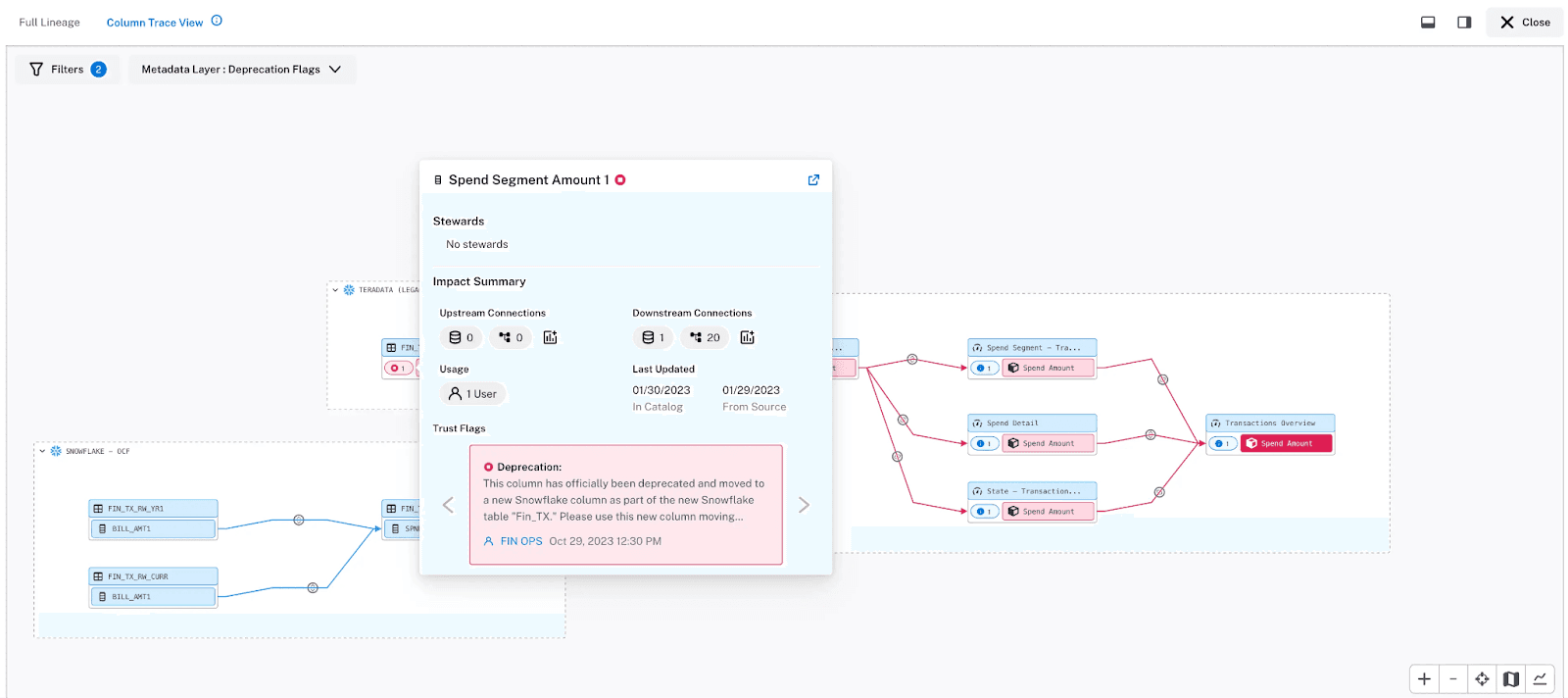
Some data catalogs offer business lineage, so business teams can glean insights into how data transforms between systems.
Conclusion
In today’s era of exploding data, the role of a well-architected ETL pipeline has never been more critical. By implementing structured workflows for data extraction, transformation, and loading, organizations ensure that downstream analytics, reporting, and machine learning systems receive high-quality, timely data from various sources, enabling actionable insights and business value.
Equally important is complementary tooling around metadata, lineage, and workflow automation. A modern data catalog not only stores data asset metadata but also exposes the lineage of ETL data pipelines, helps data teams understand how different systems and workflows connect, and integrates with workflow automation to orchestrate batch, micro-batch, or real-time processing. As your data environment scales and evolves, investing in both the pipeline infrastructure and the metadata/workflow layer ensures you maintain agility, transparency, and trust in your data ecosystem.
Curious to see how it works? Book a demo with us today.
- What is an ETL pipeline?
- What’s the difference between ETL and ELT?
- How does an ETL pipeline work?
- Common ETL pipeline use cases
- Benefits of ETL pipelines
- Common ETL pipeline challenges (and solutions)
- Tips for building a robust ETL pipeline
- Conclusion
Contents
Tagged with
Loading...