




TL;DR
Brambles, a global leader in the circular economy, uses Alation to govern Critical Data Elements (CDEs) across its massive pallet and container network. This focus on data intelligence allows them to track asset movements with high precision, improving sustainability and operational efficiency. By governing their supply chain data, Brambles ensures they have the "trusted data" required to fuel advanced analytics and AI.
Key takeaways from Alation's revAlation London 2025 session featuring Alistair Griffin, Global Data Governance Lead at Brambles.
In an era where enterprises are drowning in data yet starving for insights, the challenge isn't collecting more information; it's knowing which data truly matters. At Alation's revAlation London 2025 conference, Alistair Griffin, Global Data Governance Lead at Brambles, shared how his organisation is tackling this challenge head-on through a focused approach to Critical Data Elements (CDEs) and automated data governance.
The scale challenge: Billions of data points across a global supply chain
Brambles operates at a staggering scale that most organisations can barely fathom. As one of the world's largest providers of reusable pallets and containers, the company manages a third of a billion platforms moving across ~60 countries, with 750 service centres and 12,000 employees.
"More fast-moving goods move around the world on our platforms than any other company," Griffin explained. "We're one of those huge companies that nobody's really heard of, but we form the backbone of global supply chains."
The complexity extends far beyond physical logistics. With IoT devices attached to platforms tracking location and a range of other clever metrics, Brambles generates billions of data points. The organisation manages 10 data domains, 31 subdomains, and approximately 323 sub-subdomains, creating a governance challenge that would overwhelm traditional manual approaches.
Why data trustworthiness requires strategic focus
When facing this volume of data, the instinct might be to govern everything equally. Griffin's team is taking the opposite approach: radical prioritisation.
"Trust for us is absolutely critical," Griffin noted. "We all talk about trust in data; that's helpful from the organisational and culture perspective, we need to have trust in our data, but, from a data governance perspective, the data needs to be worthy of that trust, and trustworthiness is a really difficult thing to achieve. We are achieving this by concentrating our efforts on the data that matters the most in the organisation."
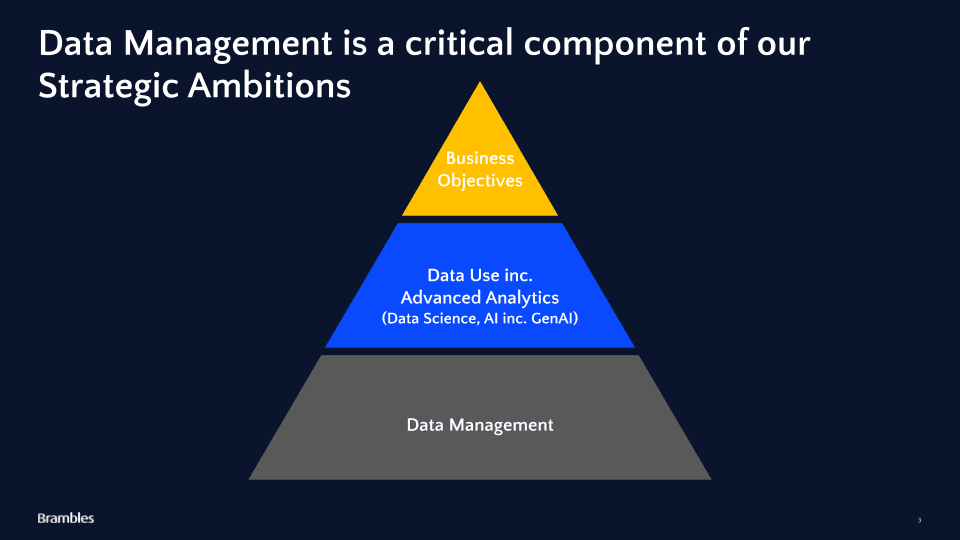
This philosophy manifests in what Griffin and his team humorously call their "pyramids approach" to data management.
The first pyramid explains the relationship between data management and the business’s objectives. At the top sit business objectives, supported by data usage (AI and advanced analytics), which in turn rests on a foundation of data management. Griffin emphasised that removing any layer causes the entire structure to collapse. The higher ‘blocks’ sit on top of the blocks below, often blocks that are less visible but just as critical to achieving business outcomes.
Economics of data governance: Effort vs. value
Luke McLaughlan from Alation highlighted a crucial reality: "Putting controls in place costs money, quite frankly, so you need to make sure you're putting those controls in place where there is the most risk."
Griffin illustrated this with a compelling framework: imagine a pyramid where the horizontal axis represents the volume of data and the vertical axis represents the effort (and cost) applied to data management. At the base sit vast quantities of data requiring minimal governance. At the apex reside the critical data elements, the data worth significant investment.
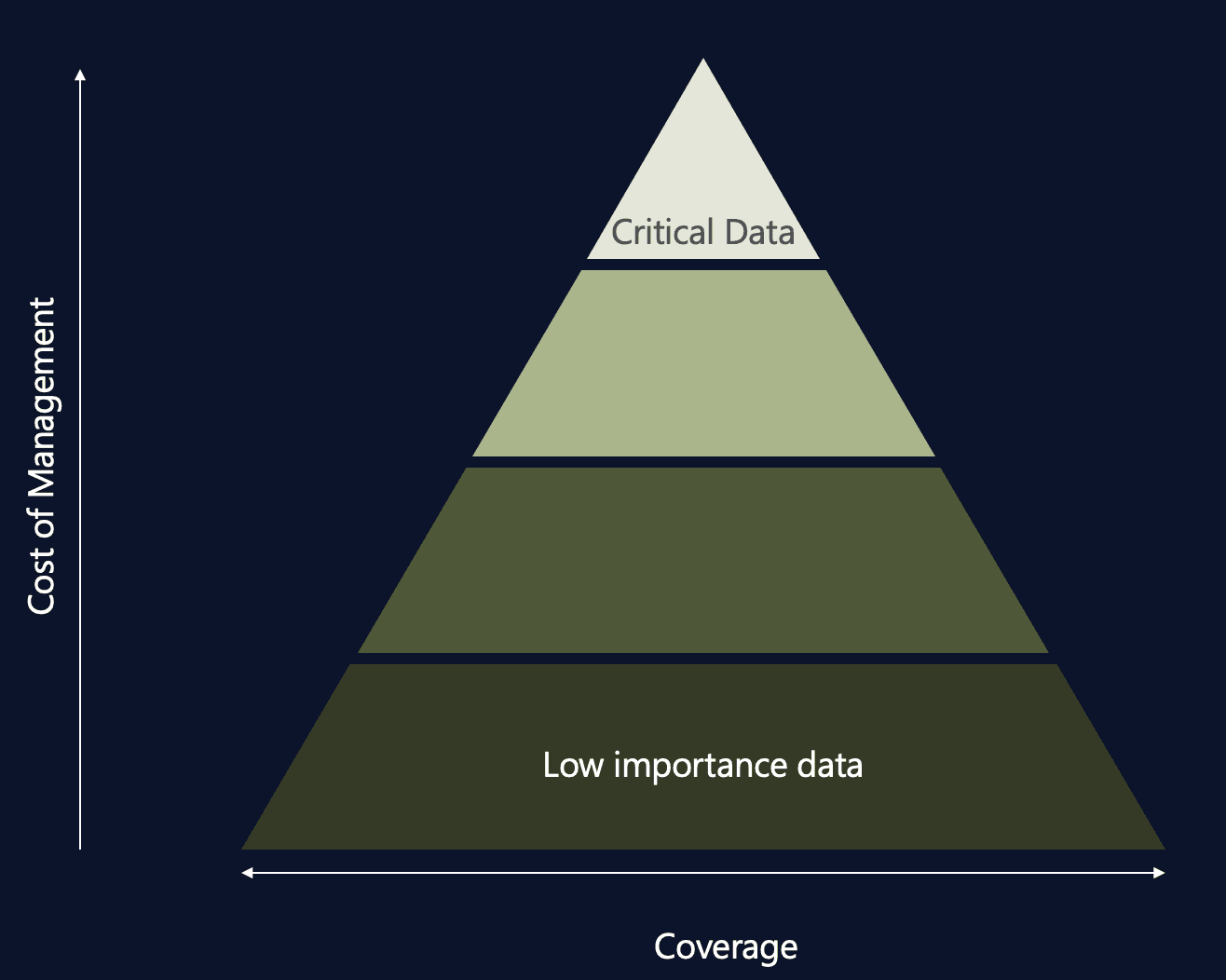
"At the top of that, you've got where the most valuable data is by value," Griffin explained. "By this I mean it's either going to reduce serious risk, it's going to produce new income, or it's going to be connected to something you absolutely have to do to function as a business, such as regulation."
This economic lens provided the breakthrough moment for executive sponsorship. "We said, basically, the concept is not all data is equal", Griffin recalled. "That moment it stuck with me as the room realised that we can spend more on different areas of the data than others; that was an amazing moment."
Securing executive sponsorship: The foundation for scale
One of the most critical success factors in Brambles' governance journey has been securing buy-in from the top. Griffin's team achieved this by helping executives understand the strategic value of focused data governance.
The validation came in an unexpected moment: "The CEO was talking at a town hall meeting where he was asked what the biggest things were that were going to set us apart from our competitors over the next few years. It blew me away that one of the two things he stated was data governance.”
This executive sponsorship translated into structural accountability. Brambles' Executive Leadership Team serves as the data owners, with 31 VPs responsible for data stewardship underneath them. This top-down mandate has provided the authority needed to drive governance initiatives across a complex, global organisation.
The manual CDE problem: Why traditional approaches don't scale
Even with executive support and a clear framework, Brambles faced the universal challenge of CDE programs: the manual effort required is simply unsustainable.
McLaughlan outlined the core issues: "The current ways of doing things is very manual and resource-intensive; it just takes a lot of humans a lot of time to sit down and manually document critical data elements today. And then that just inherently makes it a very hard problem to scale."
The challenge intensifies with federated governance models. Different departments may define "criticality" differently based on their local context rather than enterprise-wide impact. "When you ask the HR team, what's critical to you? They may think this is the most critical thing ever to me in my role, but does that mean it rises to the level of criticality to Brambles as an organisation?" McLaughlan asked.
Additionally, CDEs aren't a one-time exercise. Organisations must reassess them at least annually, creating an ongoing burden on already-stretched data stewards.
Enter automation: Alation's CDE Manager
The breakthrough for Brambles came with Alation's release of CDE Manager, a next-generation solution designed to automate and scale CDE management.
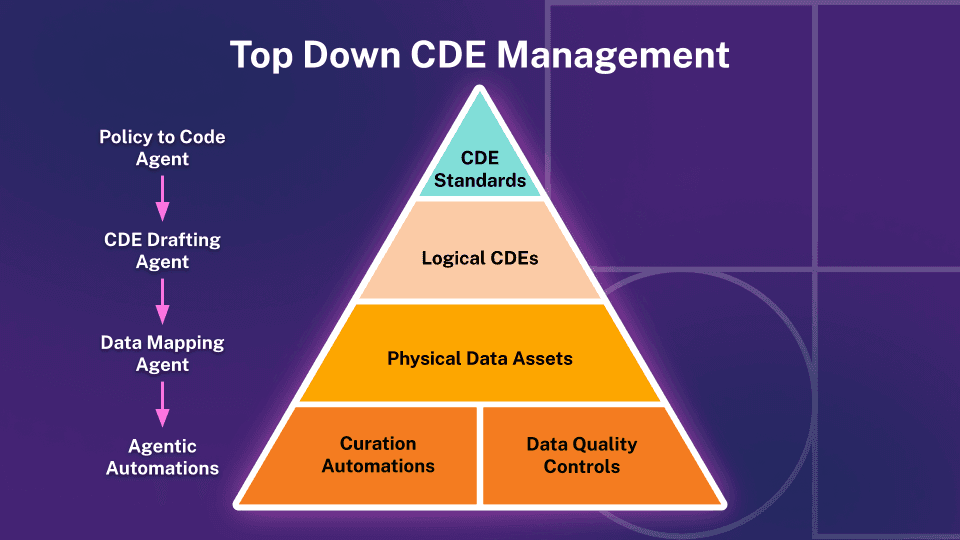
"One of the things I was most excited about when we heard about this module and then started looking at it was this idea that it fits into our strategy so well," Griffin shared. "It's helping us to identify what it is we're looking for. It takes the knowledge we codified in the form of Word documents in people's heads into the AI and helps with that automation."
The solution addresses three critical needs:
1. Codifying standards consistently
CDE Manager allows organisations to transform governance policies into codified standards that can be applied uniformly across all domains, eliminating the inconsistency problem inherent in federated approaches.
2. Automating the discovery and connection process
Perhaps the most powerful capability is the platform's ability to automatically discover and connect CDEs across the data landscape. Griffin described a telling example: "The other day we connected our ERP solution and 300,000 objects came flooding in, I would bet a good amount of money that that is duplicate information."
Rather than manually reviewing hundreds of thousands of objects, CDE Manager's AI agents can identify which objects represent critical data elements and automatically establish connections between glossary entries and catalog entries.
3. Eliminating manual grind
"By working with a CDE module and this idea that we identify what we conceptually think of as the critical data elements and allowing the automation to go and find all those connectors for us and link them across to us, that is hours and hours, hundreds of hours probably, of time saved,” Griffin noted.
The path forward: From burden to business value
The convergence of strategic focus, executive sponsorship, and intelligent automation creates a new paradigm for data governance, one that delivers business value rather than consuming resources in bureaucratic overhead.
For organisations looking to replicate Brambles' success, the key lessons are clear:
Start with business outcomes and work backward to identify truly critical data
Secure executive sponsorship by demonstrating the economic value of focused governance
Implement structural accountability with clear data ownership at senior levels
Leverage automation to scale governance without scaling headcount proportionally
Focus on trustworthiness rather than trying to govern all data equally
As Griffin's team continues to roll out CDE Manager across their global data landscape, they're transforming data governance from a cost centre into a strategic enabler – one that allows Brambles to maintain the data trustworthiness required to support digital and AI initiatives, ensure regulatory compliance and drive business innovation at scale.
For enterprises struggling with similar challenges, the message is clear: the future of data governance isn't about working harder manually – it's about working smarter with AI-powered automation focused on what truly matters.
To learn more about Alation CDE Manager and how it can transform your data governance program, book a demo with us today.
- The scale challenge: Billions of data points across a global supply chain
- Why data trustworthiness requires strategic focus
- Economics of data governance: Effort vs. value
- Securing executive sponsorship: The foundation for scale
- The manual CDE problem: Why traditional approaches don't scale
- Enter automation: Alation's CDE Manager
- The path forward: From burden to business value
Contents
Tagged with
Loading...