




Knowledge Layer
The Knowledge Layer is a unified, metadata-driven foundation that enables AI agents to access, understand, and act on enterprise data and knowledge with accuracy, accountability, and trust.
Unlike traditional data catalogs or analytics tools, the Knowledge Layer unlocks a wealth of institutional intelligence so people, AI agents, and data products can deliver accurate outcomes with accountability.
In today’s enterprise, most critical decision-making relies on structured data. Large language models (LLMs), however, excel at working with unstructured data, and they can easily misinterpret structured data schemas, joins, metrics, and relationships. This gap creates significant risks: hallucinations, inaccurate SQL generation, privacy and compliance issues, and unreliable analytics. The Knowledge Layer fills this gap by grounding AI in contextual metadata, governance policies, and more—ensuring that AI agents can deliver accurate, compliant, production-ready insights instead of misleading approximations.
Simply put: without the Knowledge Layer, enterprise AI offers outcomes that seem to be correct, but often aren’t. With the Knowledge Layer, AI becomes reliable, explainable, and aligned to business outcomes.
Core components of the Knowledge Layer
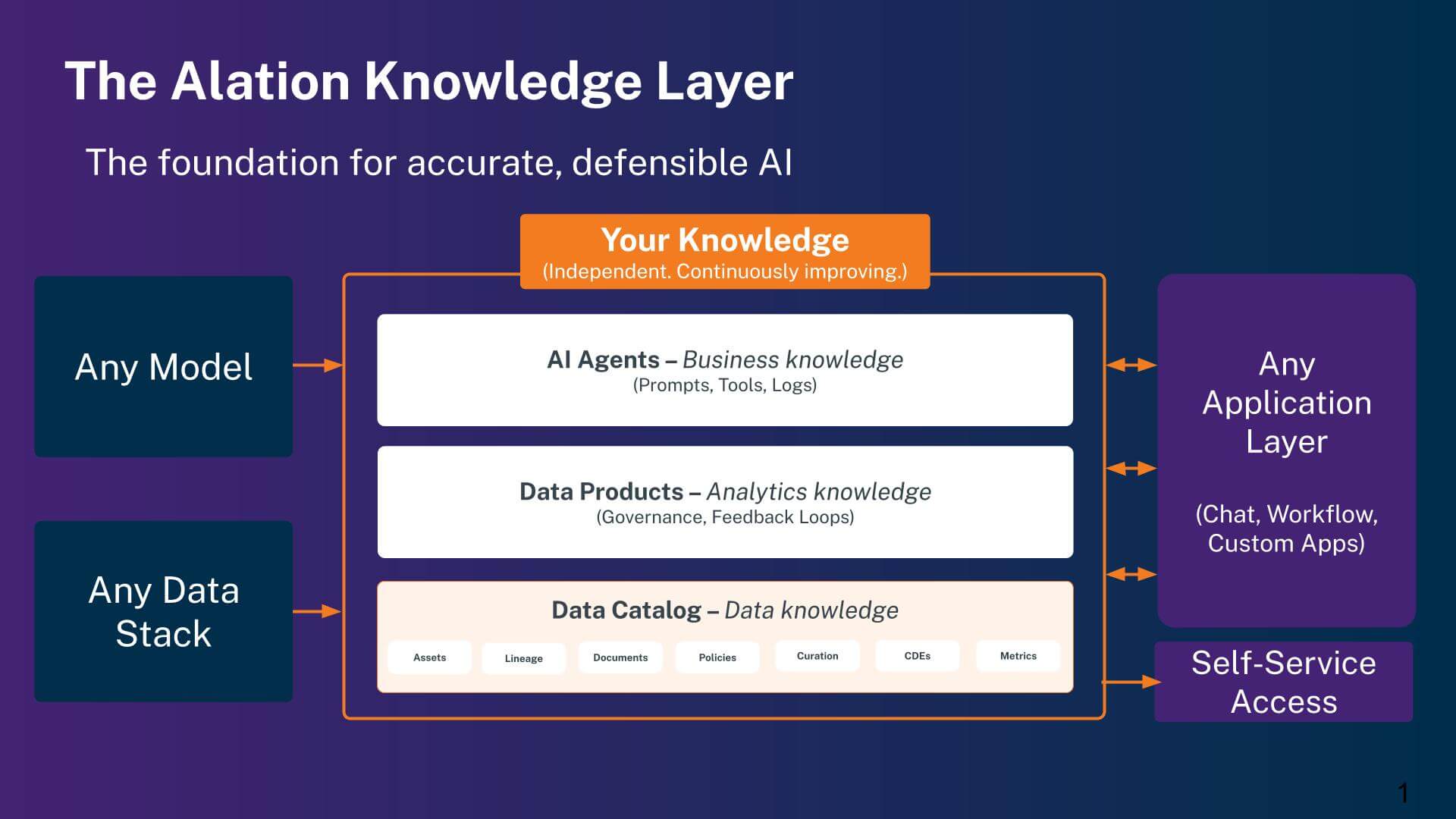
The Knowledge Layer integrates several elements essential to agentic success at scale:
AI agents and tools
Agents are the execution layer—autonomous or semi-autonomous systems that query data, generate insights, and automate tasks. In an enterprise setting, agents must be governed, precise, and customizable. They need context to understand business-specific rules, policies, and metrics.
Data products
AI agents are only as powerful as the data that fuels them. Data products are designed to address specific business questions while leveraging metadata, governance guardrails, and other enterprise knowledge. These curated, high-quality datasets, packaged for reuse, power both chat interfaces and specialized agents. By turning data into products, organizations can provide reliable building blocks for analytics, forecasting, and operational automation.
Data catalog and metadata
As the foundation, metadata provides the semantic context agents need to interpret data correctly. It describes schema, relationships, lineage, joins, and meaning. With metadata leveraged from a data catalog, agents stop guessing and start executing queries with accuracy. Experiments show a 25–30% lift in Text2SQL accuracy when enterprise AI is grounded in metadata.
Embedded governance
For AI to be trusted, data governance must be declarative and automated. Policies should not be applied manually but instead embedded into the Knowledge Layer so that agents inherit rules by default. This ensures compliance, reduces risk, and accelerates time-to-insight.
Benefits of the Knowledge Layer
Because the Knowledge Layer supports Alation’s Agent Studio, these capabilities are:
Accurate: Grounded in governed metadata and business context. Built-in testing, evaluation sets, and custom judges ensure 90% or greater accuracy for production, with explainable, trusted outputs.
Integrated: Works seamlessly with 100+ data sources like Snowflake, Databricks, Tableau, Power BI, and more. Fully vendor-neutral and ready to evolve with any data stack.
Customizable: Use popular models like Claude, GPT, Gemini—or use a custom model. Start with prebuilt agents (Query, Catalog Search, Deep Research, Dashboard Agents) and extend with tools for querying, charting, and curation.
Enterprise-ready: Deploy anywhere via MCP or API. Embed into workflows or white-label for customers. Security, governance, and lineage come built in and extend through deployment.
Additional benefits include:
Accuracy: Agents generate accurate outputs when guided by metadata.
Adaptability: Organizations can adapt the Knowledge Layer to their unique business logic and evolve it with their tech stack as new use cases and tools arise, and without the risk of vendor lock-in.
Knowledge sovereignty: Knowledge stays within the enterprise, ensuring vendors don’t control intellectual property, customer, or other critical or sensitive data.
How different teams benefit from the Knowledge Layer
The Knowledge Layer sits at the intersection of data management, analytics, and AI engineering teams.
For data management leaders
Democratize governed, trusted data through data catalogs, governance, and quality controls.
Standardize and enrich metadata and business context to eliminate silos and extend interoperability.
Ensure compliance and lineage across systems.
For business analysts
Deliver insights and business-facing data products through a Data Products Marketplace.
Use Agent Studio to interact naturally with governed datasets, extracting trusted insights that drive innovation and data-driven decision making.
Build repeatable, production-ready dashboards and metrics.
For AI builders and engineers
Use the Agent Studio SDK to create precision data agents that operate on enterprise data.
Leverage LLMs, open-source models like Llama, and proprietary AI systems.
Deploy AI agents that are reliable, customizable, and compliant.
Together, these capabilities empower every team to work smarter, faster, and with greater trust in AI-driven insights.
Technical foundation
The Knowledge Layer is powered by a metadata lakehouse that connects with 100+ systems across cloud warehouses, BI platforms, and machine learning environments. This unified foundation enables AI agents and tools to access contextualized enterprise knowledge without friction.
The Knowledge Layer scales trusted AI
Alation uniquely enables the Knowledge Layer by combining:
Data catalog: Centralized metadata and governance.
Data governance: Automated, declarative policies.
Data quality: Integrity checks and automated lineage tracking.
AI-ready integrations: 100+ connectors, metadata lakehouse, and agent SDKs.
Agentic development: Custom-build accurate and governed agents, developed anywhere or without code in Alation.
With Alation, enterprises can unlock their Knowledge Layer to make AI accurate, explainable, and trusted—transforming metadata into a competitive advantage.