



How to Build SQL Agents That Actually Work: Why Evaluations Matter

By David Kucher
Published on March 10, 2026
TL;DR
Real accuracy isn't a feature you configure once — it's a property you measure and improve continuously. Alation builds evaluations directly into the agent creation workflow, creating a closed loop: build an agent, connect it to a data product, define what "correct" looks like, test it, improve the metadata, and test again. In a live example, this cycle took a SQL agent from 60% to 100% accuracy in two iterations — with full human oversight of every change.
In the world of software, we don't ship code without unit tests. Yet, in the rush to deploy Generative AI, many teams are still "vibe-checking" their way to production.
We’ve all been there: You’re demoing a new AI assistant to stakeholders. You ask, “Show me our revenue trends for Q3.” The agent searches your BI tools, finds the right dashboard, and everything looks perfect. Then comes the follow-up: “How much of that came from new vs. returning customers?” The agent attempts a SQL query and... Error. A column name is slightly off, or the agent lacks the context to join two specific tables. The room goes quiet. The "aha" moment is replaced by a "look into it" explanation.
This is the reliability gap. And it doesn't just hurt demos. It delays the revenue lift, cost reduction, and risk control that actually justify AI investments.
To bridge this gap, we need more than better prompts; we need Evaluations. These are structured tests that define what an AI agent should do, how it should do it, and what a correct outcome looks like. They serve as a repeatable way to measure agent performance against real business expectations, rather than relying on one-off demos or subjective judgment. They are the mechanism that turns theoretical accuracy into a proven, improving agent grounded in your specific data and business questions.
Why data products are the foundation of reliable agents
To build a trustworthy SQL agent, you first need a data product. In Alation, a data product acts as the "knowledge layer"—a curated guide that describes your data to the agent. It provides the necessary context, like table definitions, column descriptions, and business logic, that the agent uses to write SQL queries.
However, a data product is only as good as the instructions it provides, and a knowledge layer is only as good as the feedback loop keeping it current. Data evolves. Business questions change. With real enterprise workloads, a static knowledge layer is a knowledge layer. We’ve learned that the only way to maintain and improve accuracy is to test continuously.
This is where evaluations come in. Evaluations allow you to explicitly define what the agent must accomplish, creating a feedback loop that ensures your knowledge layer is actually doing its job. This is also why Alation builds evaluations directly into the agent creation workflow. The loop looks like this:
Build Agent → Connect to Data Products → Define Evaluations → Test Accuracy → Improve Metadata → Test Again
This isn't a one-time benchmark. It's a continuous improvement system that makes accuracy a measurable, living property of your agents.
Defining the gold standard with evaluation cases
Every agent built in Alation’s Agent Studio includes an Evaluations feature. This allows you to define a set of "evaluation cases" that serve as the foundation for improvement. These cases represent the "gold standard"—how an agent should respond when faced with specific business questions.
An evaluation case typically includes:
Input: A natural language request (e.g., "How many unique customers placed orders last month?").
Expected output: The desired result — a specific executable SQL query, a set of expected search artifacts, or summarization guidelines
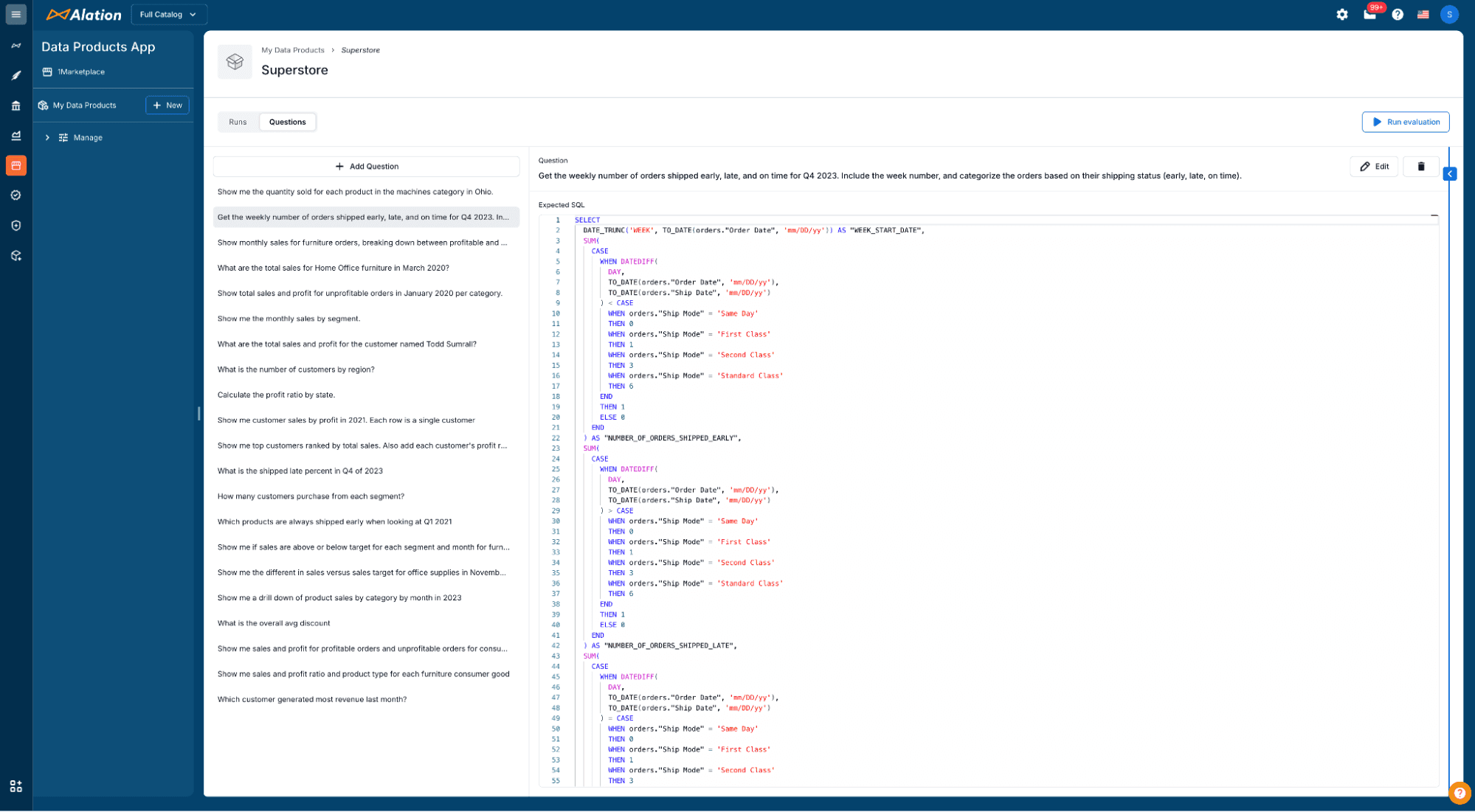
Alation makes it easy to define these cases manually in the UI, via file upload, or even with the help of an agent to audit and update cases. When you run an evaluation, Alation simulates a fresh chat for every case, comparing the agent's output against your defined standards to identify exactly where the logic breaks down.
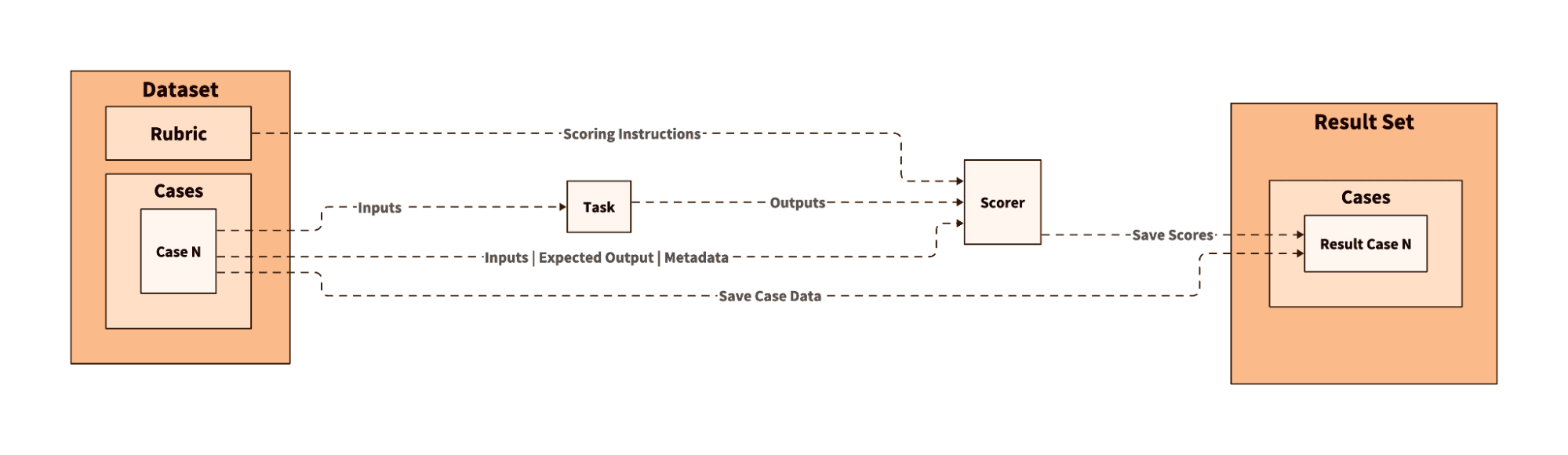
This matters because accuracy isn't abstract; it's specific to your data, your schema, your business terminology. An eval suite built against your actual questions is worth far more than any generic benchmark.
Case study: Optimizing a SQL agent from scratch
To see this in practice, we looked at a common customer goal: enabling automated question-answering across a sales dataset (orders, products, customers, and locations).
We started with a "naked" data product—one that contained only raw table and column definitions with no metadata or descriptions.
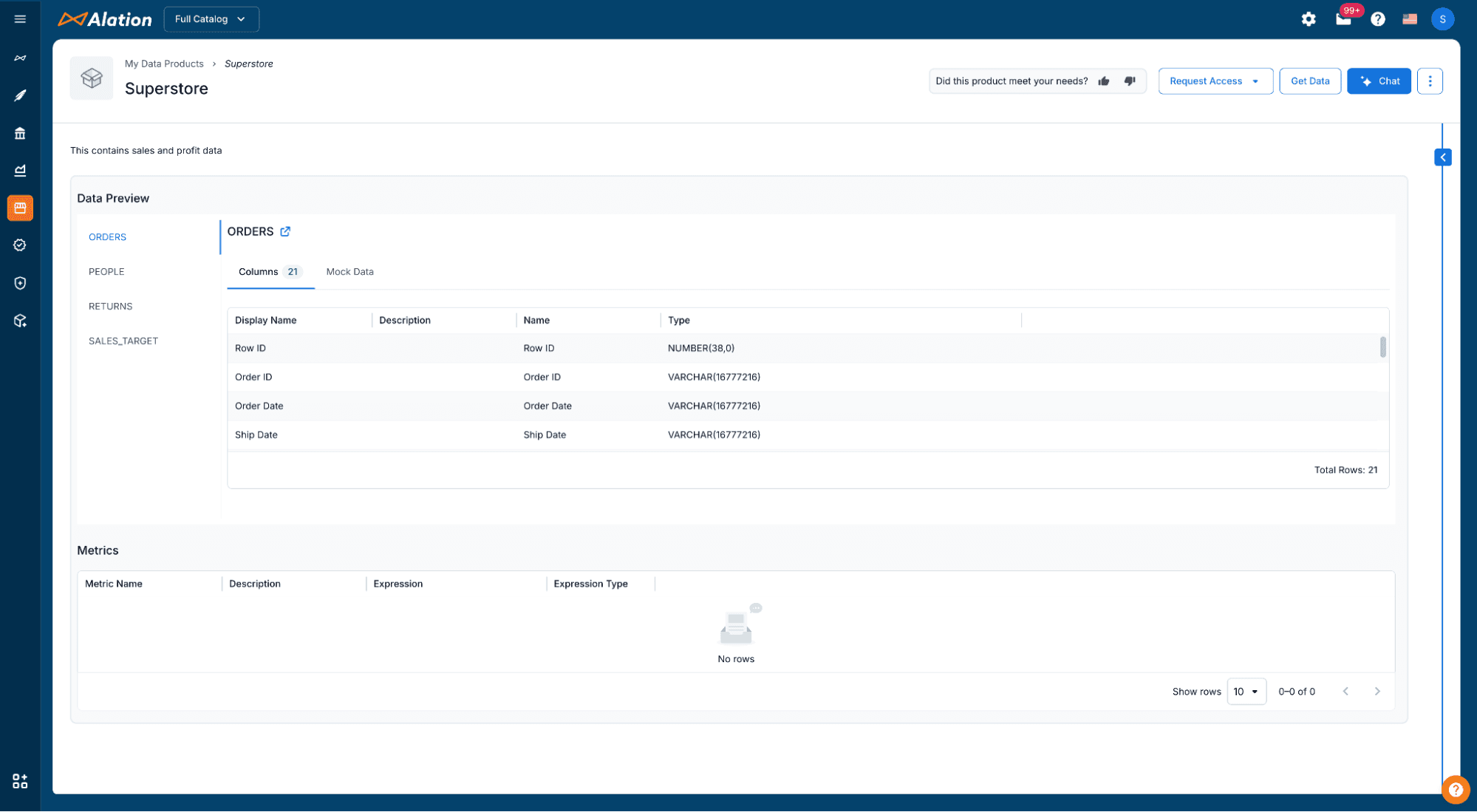
The baseline run
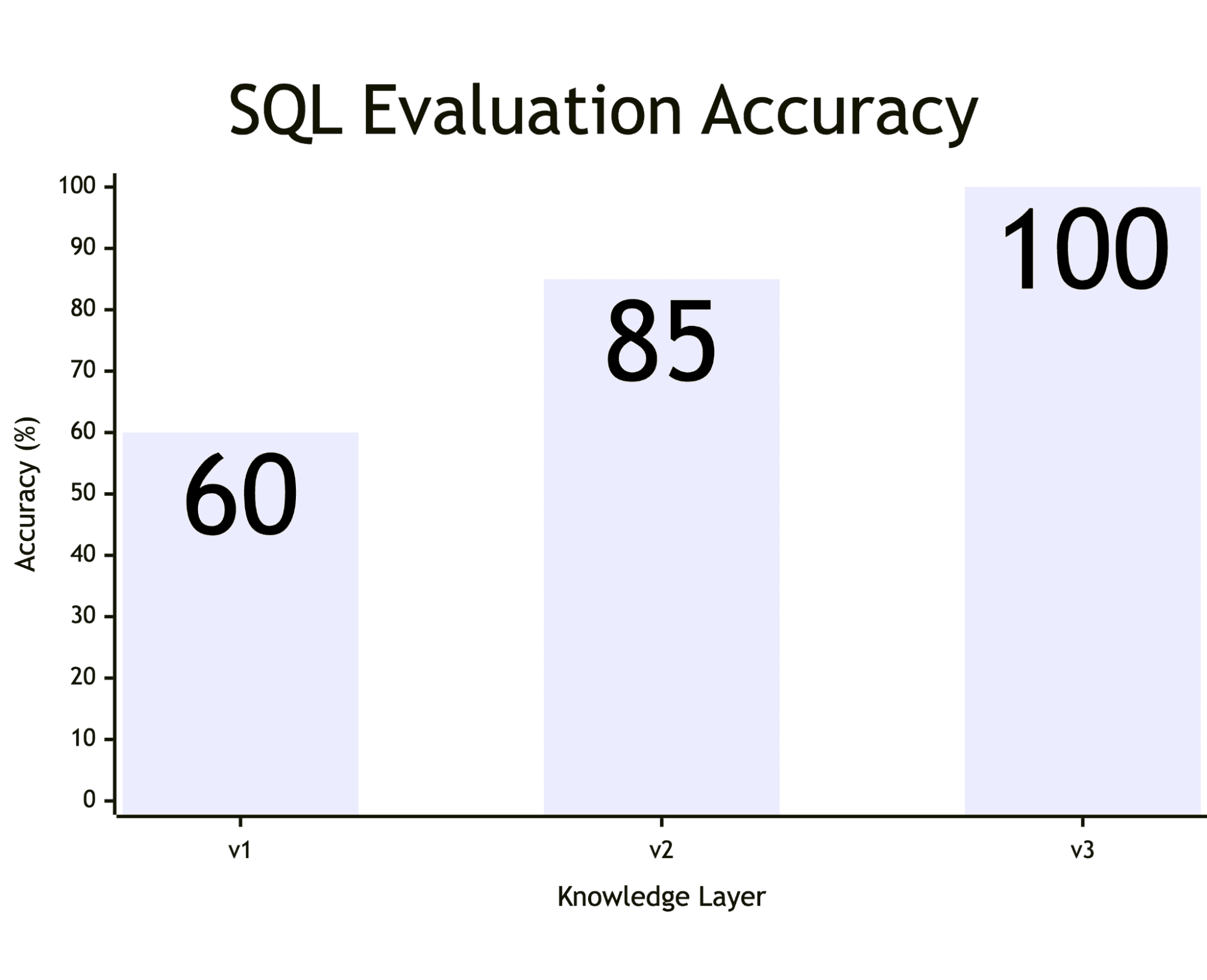
We uploaded 20 question-SQL pairs to benchmark our starting point. The query agent, relying solely on raw metadata, managed a 60% accuracy rate (12 out of 20 correct). It struggled with nuance, like understanding specific date-filtering logic and table granularity.
The power of "Suggest Improvements"
Because evaluations provide a consistent baseline, we can use the Suggest Improvements feature to automate the "tuning" process.
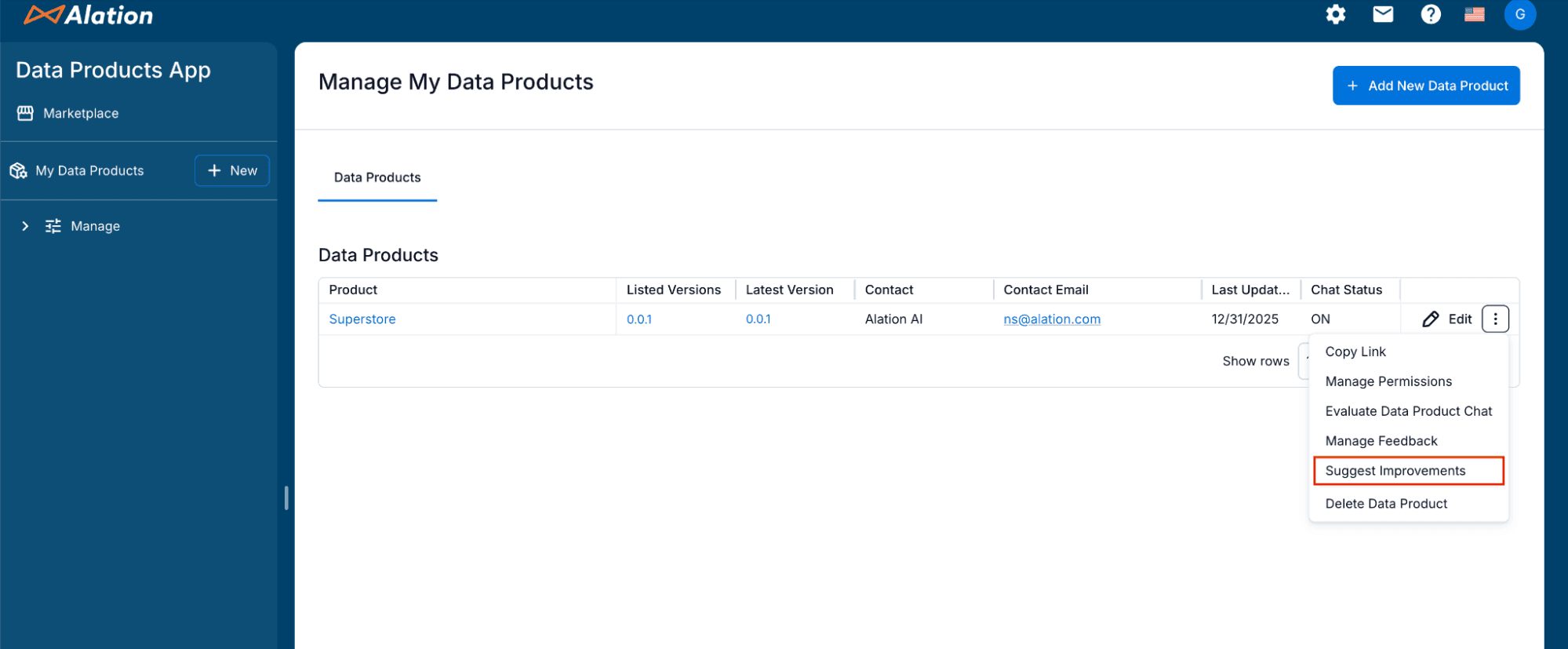
This feature analyzes the failed evaluation runs and suggests specific changes to the data product—such as better descriptions or specific SQL instructions—to resolve those failures. The transformation to 100% accuracy took just two automated iterations:
Iteration 1: The agent analyzed the failures and suggested updated descriptions and guidance on how to filter date fields correctly. This resulted in 5 additional correct answers.
Iteration 2: With 3 failures remaining, the agent noticed the SQL agent failed to understand the tables’ granularity. It updated the knowledge layer’s descriptions to show how rows should be aggregated correctly.
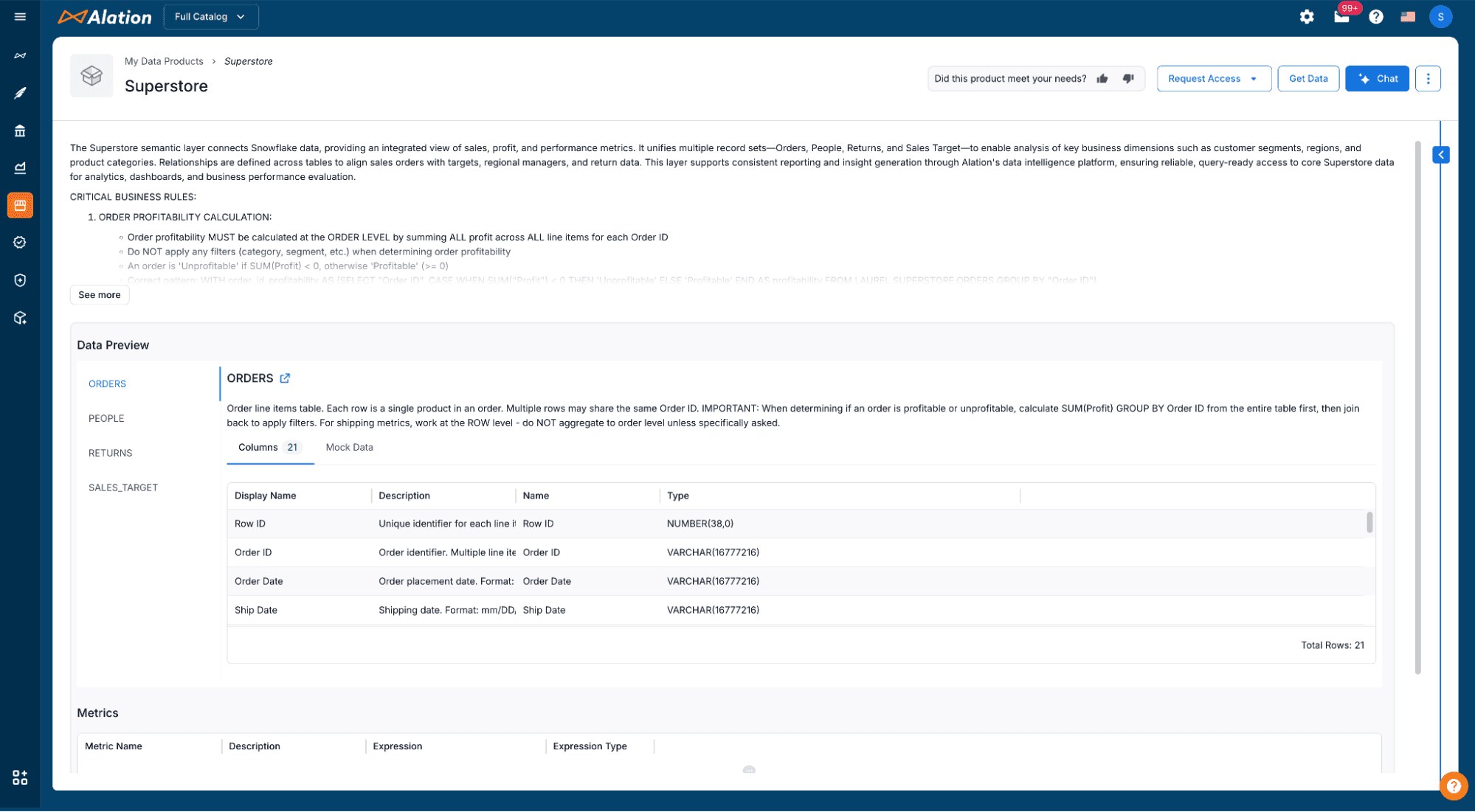
The result: 100% accuracy, confirmed across two consecutive evaluation runs.
Critically, this process doesn't happen in a black box. Alation surfaces the exact changes made to the data product for human review and approval. You remain in control of the knowledge layer… and you have an audit trail that makes your AI's behavior explainable and defensible.
Because evaluations are consistent, we can run them repeatedly, comparing result sets like snapshots in time as we make updates to the data product. The Suggest Improvements feature begins with a baseline score from the evaluation run, then analyzes the failures and makes adjustments to the data product so that the query agent can answer correctly in the future. Those changes are then validated by running a SQL evaluation again, and the cycle continues.
Accuracy is a process, not a promise
There's an important distinction worth making: accuracy that comes from a built-in evaluation and improvement cycle is fundamentally different from accuracy claimed without one.
When agents are built outside the knowledge platform (assembled in external workflow tools disconnected from your metadata), there's no closed loop. You can assert that a context layer makes AI "more accurate," but without the ability to measure it against your actual questions, tune it based on real failures, and improve it over time, that claim is theoretical at best.
True accuracy improvement requires:
A system to measure agent performance against real business questions
A mechanism to diagnose failures at the metadata level
A workflow to update the knowledge layer and re-test
Human oversight of what changed and why
Alation provides all four, built into the same platform where agents are created and deployed. That's what makes accuracy something you can report on, not just claim.
Building agentic products that stakeholders actually trust
Evaluations are no replacement for human feedback, but they are a great starting point. Just like test-driven development, you won't define every case up front. As users ask new questions and your data evolves, your evaluation sets must grow with them. This prevents your agents from drifting out of alignment with the business, the silent failure mode that turns promising AI pilots into abandoned projects.
The real business case for evaluations isn't technical. It's this: enterprise stakeholders fund AI initiatives that can demonstrate measurable outcomes: revenue lift, cost reduction, risk control. Evaluations are how you build the evidence base that keeps the investment case alive. They turn "our AI is accurate" from a talking point into a provable, improving fact.
Ready to see how Evaluations can bridge the reliability gap for your team? Book a demo today!
- Why data products are the foundation of reliable agents
- Defining the gold standard with evaluation cases
- Case study: Optimizing a SQL agent from scratch
- Accuracy is a process, not a promise
- Building agentic products that stakeholders actually trust
Contents
FAQs
What is an AI agent evaluation, and why does it matter?


An AI agent evaluation is a structured test that measures whether an agent produces the correct output for a given input. Rather than relying on demos or gut feel, evaluations give teams a repeatable, objective baseline — so you can track whether your agent is getting better or worse as your data and business questions evolve. Without them, accuracy is an assumption, not a fact.
How does Alation's evaluation feature work?
Inside Alation's Agent Studio, you define "evaluation cases" — pairs of natural language inputs and expected outputs (SQL queries, search results, or summaries). When you run an evaluation, Alation simulates a fresh conversation for each case and compares the agent's response against your defined standard, surfacing exactly where and why failures occur.
What is the "Suggest Improvements" feature?
Suggest Improvements analyzes failed evaluation runs and automatically recommends specific changes to the underlying data product — better column descriptions, clearer business logic, updated aggregation guidance. Each suggested change is surfaced for human review before being applied, so your team stays in control of the knowledge layer.
Why is it important that evaluations are built into the agent creation workflow?
When agent-building and evaluation happen in separate tools, there's no closed feedback loop. Improvements made in an external workflow don't automatically flow back into the knowledge layer that the agent relies on. Alation keeps the full cycle — build, test, improve, re-test — in one place, which is what makes accuracy measurable and improvable rather than theoretical.
What's the difference between a context layer and a knowledge layer with built-in evals?
A context layer provides an agent with metadata at the time of a query. That's necessary, but not sufficient. Without a system to test whether that context actually produces correct answers — and to improve it when it doesn't — you have no way to know if it's working. Alation's knowledge layer is designed to be tested, tuned, and validated against real business questions on an ongoing basis.
How quickly can evaluations improve agent accuracy?
Results vary by data complexity, but in Alation's own case study, a SQL agent went from 60% to 100% accuracy in just two automated improvement iterations — starting from a data product with no metadata at all. The key is that each iteration is targeted: the system diagnoses specific failure types and makes precise changes, rather than broad guesswork.
How do evaluations connect to business outcomes?
Enterprise AI initiatives are funded based on demonstrable results — revenue lift, cost reduction, risk control. Evaluations create the audit trail that makes those results defensible. When a stakeholder asks "How do we know the AI is working?", an eval history gives you a concrete, evolving answer.
Tagged with
Loading...