




The $25 million problem no spreadsheet can solve
Tier one banks average 1,000 critical data elements (CDEs) at the logical level. Each one maps to dozens (sometimes hundreds) of physical data instances spread across on-premises systems, cloud data lakes, analytics platforms, and reporting pipelines. Organizations often invest tens of thousands of dollars annually to manage and govern a single Critical Data Element, depending on complexity and regulatory requirements. Much of that is consumed by manual effort: spreadsheets, email chains, audit prep binders, and hours spent chasing down the right data steward.
BCBS 239, the Basel Committee's principles for effective risk data aggregation and risk reporting, was designed to solve a systemic problem: financial institutions couldn't reliably produce accurate, complete, and timely risk data during periods of stress. The framework works. But the way most banks implement it — through manual documentation, disconnected governance tools, and periodic audit scrambles — creates a compliance program that is expensive to maintain, difficult to scale, and almost impossible to keep current as data environments evolve.
There is a better model. And it starts by rethinking what governance is actually for.
What BCBS 239 actually requires
BCBS 239 comprises 11 principles organized across four areas: overarching governance and infrastructure, risk data aggregation capabilities, risk reporting practices, and supervisory review. For data and risk teams, the most operationally demanding principles are:
Principle 2 — Data Architecture and IT Infrastructure: Banks must design and build data architecture and IT infrastructure that fully supports risk data aggregation and risk reporting capabilities, not only in normal times but also during times of stress.
Principle 3 — Accuracy and Integrity: A bank should be able to generate accurate and reliable risk data to meet normal and stress reporting requirements. Data should be aggregated on a largely automated basis with minimal manual intervention.
Principle 4 — Completeness: A bank should be able to capture and aggregate all material risk data across the banking group.
Principle 5 — Timeliness: A bank should be able to generate aggregate and up-to-date risk data in a timely manner while meeting the principles relating to accuracy and integrity.
Principle 6 — Adaptability: A bank should be able to generate aggregate risk data to meet a broad range of on-demand reporting requests.
Taken together, these principles make a clear demand: every critical data element that feeds risk reporting must have documented ownership, verifiable data quality, traceable lineage, and automated controls — and it must be audit-ready at any time, not just before a regulatory filing.
That's a fundamentally different challenge from building a data dictionary or populating a metadata catalog. It requires a system that continuously governs CDEs across the entire data ecosystem — one that can keep up with the pace at which new data is created, used, and retired.
Why manual governance breaks down at scale
The traditional approach to BCBS 239 governance treats compliance as a checklist. Teams catalog CDEs in spreadsheets, assign ownership through organizational structures, document business definitions in Word documents, and measure data quality through manual sampling. Every audit cycle triggers a scramble to collect evidence, reconcile versions, and produce documentation that satisfies regulators.
This approach has three structural weaknesses.
First, it doesn't scale. In today's environment, new data elements are being created continuously, through machine learning pipelines, third-party data integrations, and agentic AI workflows. Each new element that touches a CDE creates a new governance obligation. Manual processes cannot keep pace.
Second, it governs by procedure rather than by outcome. Teams spend time completing governance tasks: filling in metadata fields, running one-off quality checks, updating policy documents — without a clear line of sight to whether the underlying compliance objective is actually being met. The checklist gets checked; the risk doesn't necessarily go down.
Third, it creates fragmentation between business, risk, and data teams. The business defines what a critical data element means. The risk team defines what controls it needs to satisfy. The data engineering team builds and maintains the physical data assets. Without a shared system connecting these three groups, compliance requires constant, expensive coordination — and creates gaps that auditors find.
A new model: Governing by outcome
The more effective approach is to govern by outcome rather than by procedure. Instead of asking, "Did we complete the BCBS 239 documentation checklist?" ask, "Is every physical instance of this CDE within the defined bounds of acceptance, right now, and provably so?"
This shift requires a platform capable of three things: declaring standards and policies as machine-readable intent, automatically translating that intent into controls across the data ecosystem, and delivering continuous proof of compliance from a single source of truth.
This is the architecture behind Alation's CDE Manager, purpose-built for organizations managing critical data under regulatory frameworks like BCBS 239, CCAR, CECL, and SOX.
How Alation CDE Manager maps to BCBS 239 compliance
Principle 2 — Data architecture: declare your standards
CDE Manager enables risk and data teams to ingest a BCBS 239 policy document — including all 11 principles — directly into the platform. From that policy, AI agents automatically derive the corresponding data management controls. A policy that describes requirements around risk data governance, architecture, accuracy, and timeliness becomes a set of operational controls that can be assigned to specific CDEs, monitored continuously, and demonstrated to auditors on demand.
Standards are customizable but consistent. Teams can start from built-in best-practice templates — including baseline metadata standards, curation score standards, and risk assessment frameworks — and adapt them to reflect their internal policies and regulatory obligations. Once a standard is declared, it propagates automatically to every CDE it governs. Define the standard once; the platform enforces it everywhere.
Principle 3 — Accuracy and integrity: automated quality controls at the logical level
One of the most technically demanding aspects of BCBS 239 compliance is ensuring that the same data quality rules apply to a CDE wherever it physically appears in the organization. A customer ID should have a fixed length. It should be numeric. It should pass referential integrity checks. In most organizations, enforcing those rules consistently across production databases, reporting layers, analytics platforms, and ML pipelines requires custom engineering for every system.
Alation addresses this at the logical level. When a CDE is defined — say, "customer ID" — the platform's AI agent uses semantic mapping to identify every physical data element in the ecosystem that represents that CDE. Data quality rules defined at the logical level are then propagated to every physical instance. The result is consistent accuracy enforcement across the data ecosystem without manual re-implementation at each endpoint.
For BCBS 239 specifically, this is what Principle 3 requires: data quality maintained on a largely automated basis, with minimal manual intervention.
Principle 4 — Completeness: Semantic CDE discovery
CDE Manager uses AI-driven semantic mapping — combining natural language terms, regular expressions, and business context — to surface physical data elements that are likely instances of a defined CDE. The process is human-in-the-loop: data stewards can review suggested matches, accept or exclude them, and classify each physical element as a control point or related point. Control points represent the authoritative source (in a medallion architecture, this is typically the bronze layer); related points track downstream usage.
This approach addresses completeness proactively rather than reactively. Rather than waiting for an audit to reveal ungoverned instances of a CDE, the platform continuously discovers and surfaces them for review.
Principles 5 and 6 — Timeliness and adaptability: A living compliance view
Every certified CDE in Alation carries a real-time compliance dashboard: curation completeness scores, data quality scores, physical data element counts, control status across all applicable standards (BCBS 239, GDPR, and others simultaneously), lineage tracing the data from source to consumption, and a full ownership and stewardship record. This is not a point-in-time snapshot — it reflects the current state of the data, updated continuously.
When an auditor asks for evidence of compliance with a specific BCBS 239 principle, the answer is already assembled. There is no sprint to collect documentation. The proof is the system.
What leading financial institutions are doing
Aware Super, one of Australia's largest superannuation funds, manages more than AUD $200 billion in assets for over one million members across equities, property, infrastructure, and private markets. As a regulated entity under the Australian Prudential Regulation Authority (APRA), the organization needed more than governance policies — it needed provable control over its most critical data. Following a major merger that left the organization with disparate systems and inconsistent data definitions, Aware Super used Alation to operationalize CDE governance at scale.
"CDEs are the most important data assets your organization relies on to operate, make decisions, and stay compliant," explains Natalie Hogan, Senior Manager of Data Quality and Enablement at Aware Super. "They've got to be business critical, they've got to be high impact — very select — the most sensitive, most important bits of data."
The team built a five-step framework to bring each data domain under governance: establishing accountability through named data owners and stewards, enabling discoverability by documenting CDEs in Alation, mapping risks and controls throughout the data lifecycle, tracing lineage from source to consumption, and implementing continuous data quality monitoring. Domains were prioritized using APRA risk appetite statements — starting with those where the organization had zero tolerance for error, such as member data. The result: a governance program that is both audit-ready for APRA oversight and directly connected to financial reporting accuracy. As Hogan notes, "We found that starting with Critical Data Elements was the logical way to break governance into manageable pieces, and it gave us something tangible to work with as we operationalised data governance across the business."
The CDE prioritization lesson extends beyond financial services. Brambles, a global leader in supply chain logistics managing a third of a billion platforms across 60 countries, faced an analogous challenge: billions of data points, 10 data domains, and a governance program that risked collapsing under its own weight if applied uniformly.
Alistair Griffin, Global Data Governance Lead at Brambles, articulates the breakthrough insight: "The concept is not all data is equal — we can spend more on different areas of the data than others." By using Alation CDE Manager to focus intensive governance on the data elements with the highest risk, revenue, or regulatory impact, Brambles saved hundreds of hours of manual CDE mapping and secured CEO-level sponsorship for the program. The approach works because it reframes governance not as overhead, but as a focused investment in the data that matters most.
For regulated financial institutions operating under BCBS 239, CCAR, APRA prudential standards, or equivalent frameworks, the lesson from both organizations is the same: the institutions that reduce their compliance burden the fastest are those that stop trying to govern everything equally and build a CDE-first operating model instead — one that concentrates automated controls, lineage, and quality enforcement precisely where regulatory and business risk is highest.
The business case for automating BCBS 239 compliance
The economics are straightforward. A tier one bank managing 1,000 CDEs at the logical level, each costing on average $25,000 per year to govern manually, carries approximately $25 million in annual CDE governance costs. A 50% reduction in manual effort — a conservative target; Alation customers regularly achieve 70% — represents $12.5 million in recovered capacity per year.
That capacity doesn't disappear. It redirects toward proactive risk monitoring, new CDE onboarding, AI governance programs, and the kind of continuous compliance posture that regulators increasingly expect. Instead of preparing for BCBS 239 audits, organizations can be permanently ready for them.
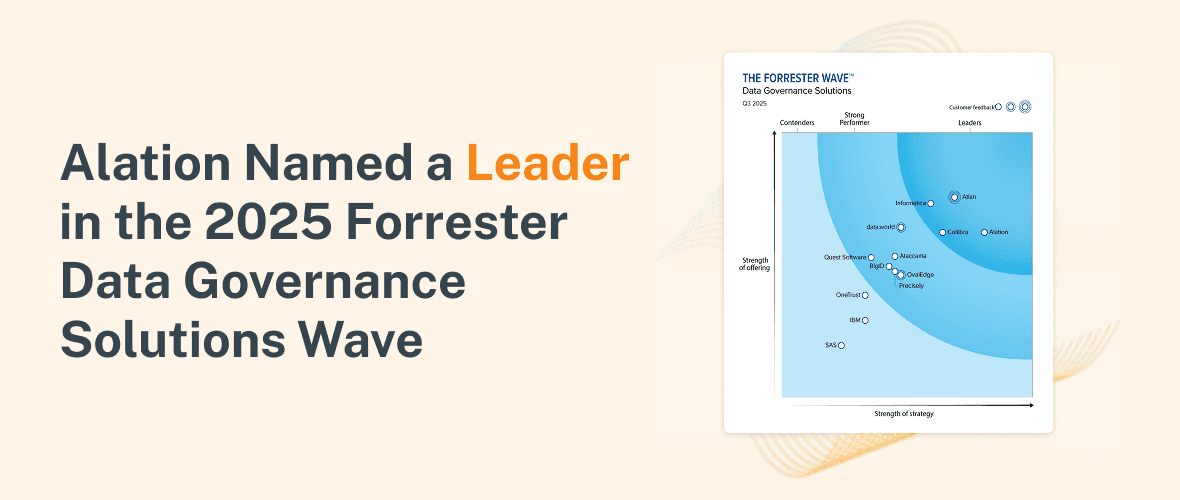
Alation is recognized as a Leader in the Forrester Wave for Data Governance Solutions (2025), reflecting both the depth of the platform's governance capabilities and the strength of its financial services customer base.
Evaluating a Data Intelligence Platform for BCBS 239: What to look for
When assessing platforms for BCBS 239 compliance automation, financial institutions should evaluate against five criteria:
Policy ingestion and control derivation — Can the platform ingest your existing BCBS 239 or internal risk policy and automatically derive operational controls, or does your team have to manually translate policy intent into system configuration?
Semantic CDE discovery — Does the platform automatically identify physical instances of a CDE across heterogeneous data environments, including cloud and on-premises systems?
Logical-level quality rule propagation — Can data quality rules be defined once at the CDE level and enforced consistently across all physical instances, without custom engineering per data source?
Audit-ready evidence generation — Does the platform produce a continuous, real-time compliance view that can be presented to auditors on demand — not assembled from multiple systems at filing time?
Cross-team alignment — Does the platform create a shared system of record that connects the business, risk, and data teams who each own a piece of CDE governance?
Alation's CDE Manager was designed to satisfy all five. It is the only purpose-built agentic CDE governance solution embedded within a full-stack data intelligence platform — combining data catalog, data lineage, business glossary, data quality, and workflow automation in a single system.
Getting started
BCBS 239 compliance is not a project that ends at the next regulatory filing. It is an operational capability that financial institutions need to build, maintain, and scale — especially as AI-generated data, third-party data feeds, and continuous analytics pipelines create new CDEs faster than manual governance programs can track them.
The organizations that reduce their compliance burden the most are those that shift from governing by checklist to governing by outcome — with a platform that continuously translates policy intent into data controls, monitors every critical data element in real time, and delivers proof of compliance from a single, authoritative source.
Alation's CDE Manager makes that shift possible. Request a demo to see how financial institutions are using it to automate BCBS 239 compliance and reduce CDE governance costs by up to 70%.
Explore a demo of CDE Manager here:
- The $25 million problem no spreadsheet can solve
- What BCBS 239 actually requires
- Why manual governance breaks down at scale
- A new model: Governing by outcome
- How Alation CDE Manager maps to BCBS 239 compliance
- What leading financial institutions are doing
- The business case for automating BCBS 239 compliance
- Evaluating a Data Intelligence Platform for BCBS 239: What to look for
- Getting started
Contents
FAQs
What is BCBS 239 and why does it matter for data governance teams?


BCBS 239 is the Basel Committee on Banking Supervision's set of principles for effective risk data aggregation and risk reporting, first issued in 2013 and applicable to global and domestically systemically important banks. It requires financial institutions to demonstrate that their risk data is accurate, complete, timely, and traceable — and that reliable risk reports can be produced on demand, including under stress conditions. For data governance teams, BCBS 239 makes CDE governance a regulatory obligation rather than a best practice: every critical data element feeding risk reporting must have documented ownership, verifiable data quality controls, and auditable lineage.
What are Critical Data Elements (CDEs) and how do they relate to BCBS 239 compliance?
Critical Data Elements are the specific data attributes — such as account ID, customer identifier, or credit exposure — essential to an organization's operations, financial reporting, and regulatory compliance. Under BCBS 239, CDEs are the unit of governance: banks must demonstrate that each CDE feeding risk data aggregation and reporting is accurate (Principle 3), complete (Principle 4), timely (Principle 5), and traceable from source to consumption. A bank managing approximately 1,000 CDEs at the logical level must maintain ongoing evidence of compliance for each one — which is precisely what makes manual CDE governance programs unsustainable at scale.
How does Alation CDE Manager automate BCBS 239 compliance?
Alation CDE Manager ingests a bank's BCBS 239 policy document and uses AI agents to automatically derive the corresponding data controls from the policy's 11 principles. For each CDE, the platform semantically maps all physical data instances across the data ecosystem, propagates data quality rules from the logical level to every physical element, and maintains a continuous, real-time compliance dashboard showing curation scores, data quality scores, lineage, ownership, and control status — all in a single audit-ready view. This eliminates the need to manually assemble compliance evidence at filing time and reduces average CDE governance costs by 70%, with an average time savings of 7 days per CDE onboarded.
What is the difference between governing CDEs by checklist vs. governing by outcome?
Checklist-based CDE governance asks: "Have we completed the required documentation steps?" Outcome-based governance asks: "Is every physical instance of this CDE within its defined acceptance bounds right now, and can we prove it?" The practical difference is significant. Checklist governance creates audit-ready documentation only at filing time, through intensive manual effort. Outcome-based governance — enabled by Alation CDE Manager — continuously enforces data quality rules, monitors CDE health in real time, and maintains a permanent auditable compliance record. Under BCBS 239, regulators are increasingly expecting the latter.
How do financial institutions prove BCBS 239 compliance to regulators and auditors?
Demonstrating BCBS 239 compliance requires producing evidence that each CDE meets accuracy, completeness, timeliness, and lineage requirements — on an ongoing basis, not just at examination time. Alation's CDE Manager provides a single audit-ready view of each CDE's health: curation completeness score, data quality scores across all physical instances, full lineage from source to consumption, documented ownership and stewardship, and the status of all BCBS 239 controls derived from the bank's internal policy. Because this evidence is maintained continuously, audit preparation time is dramatically reduced.
What does the end-to-end CDE onboarding process look like in Alation for BCBS 239 compliance?
A data governance lead adds a new CDE — for example, "customer ID" — to the CDE Manager registry. The platform's risk assessment framework evaluates the element against the organization's risk criteria and assigns a risk score with a rationale: high risk, because customer ID is used across credit decisioning, fraud detection, and regulatory reporting. The AI agent identifies BCBS 239 as the applicable standard and automatically derives the relevant controls from the ingested policy. The steward reviews and refines the semantic mapping results — accepting the physical elements that genuinely represent customer ID across the data estate, and flagging any that require quality remediation. Data quality rules are set at the logical level and propagated to all accepted physical elements. The CDE is submitted for review and approval, establishing a documented chain of accountability. Upon certification, the CDE becomes a governed, audit-ready asset with full lineage, ownership, quality scores, and control documentation visible in a single view. For organizations managing approximately 1,000 CDEs at the logical level, this workflow applied at scale reduces CDE governance costs by 70% and saves an average of seven days per CDE onboarded, according to Alation customer data.
How should a financial institution get started with BCBS 239 compliance automation?
The most effective starting point is identifying your highest-risk CDEs — those where your organization has the lowest tolerance for data quality failures — and building your initial governance program around them rather than attempting to govern all data equally. From there: ingest your BCBS 239 or internal risk policy into Alation's CDE Manager, let the platform derive the corresponding controls, run semantic mapping to surface all physical instances of each priority CDE, establish data quality rules at the logical level, and configure a continuous compliance view for audit readiness. To see how regulated financial institutions — including those already operating under APRA, BCBS 239, and equivalent frameworks — have implemented this approach, visit the Alation CDE Manager product page or request a demo. Supplementary reading on specific customer implementations is available via the Aware Super and Brambles case studies linked throughout this article.
Tagged with
Loading...