




Gartner predicts that by 2027, more than half of data analytics leaders will invest in data literacy programs as organizations struggle to extract real value from AI. This shift underscores a clear reality: Technology cannot deliver outcomes without people who understand it. That understanding forms the core of a truly data culture—one built on literate people who turn data into progress.
Data literacy is the force that converts information into insight and insight into action. When teams know how to interpret and apply data in context, they accelerate decisions and drive measurable impact. Without that capability, even the most advanced platforms fall short.
Key takeaways
Strong data literacy helps teams make faster, more confident decisions that translate information into measurable business outcomes.
Embedding learning into workflows, mentorships, and data product design builds durable literacy and shared understanding across teams.
Measuring progress through baselines, surveys, and catalog analytics ensures ongoing improvement and visible impact.
Platforms like Alation strengthen these efforts by connecting people to shared definitions and collaborative learning opportunities.
What is data literacy?
Data literacy helps people identify, understand, interpret, and act on data within a business context to influence business value or outcomes.
According to Gartner, data literacy is:
“… the ability to read, write and communicate data in context, including an understanding of data sources and constructs, analytical methods and techniques applied, and the ability to describe the use case, application, and resulting value.”
Naturally, different roles require different levels of data literacy. Raising baseline literacy levels across your workforce fuels these critical capabilities:
Data dexterity, which Gartner defines as the ability and desire to use existing and emerging technology to drive better business outcomes
Data democratization, which makes digital information accessible to more non-technical users of information systems—without requiring IT involvement
Greater collaboration when different stakeholders use a common vernacular to discuss data
Self-service analytics, because understanding data is as important as having quick access to it
These benefits prove the vital role that data literacy plays in building a data culture. It empowers people to find the data they need and trust to make smart decisions.
What's the impact of poor data literacy?
Poor data literacy disrupts how teams understand information and act on it. Plus, it limits the return on analytics investments. According to Alation’s 2023 State of Data Culture Maturity Report, fewer than a quarter of respondents have achieved broad data literacy adoption, and only about one in four report mature governance programs—leaving most unable to turn analytics into consistent business value. This skills gap leads to inaccurate or delayed decisions and lower confidence in data-driven outcomes.
The impact of poor data literacy shows up across day-to-day work in the following ways:
Incomplete analyses: Teams rely on partial or misinterpreted data analysis, which results in weak conclusions.
Department-level gaps: For example, marketing misreads customer groups and targets the wrong segments. Operations misinterprets throughput metrics and changes processes that don’t need fixing.
Inefficient collaboration: Definitions vary, KPIs conflict across dashboards, and meetings turn into debates about numbers.
Underused technology: Powerful analytics tools sit idle because users lack the confidence to explore or document assets.
Missed opportunities: Teams overlook patterns and delay actions that create value.
When organizations close these literacy gaps, teams use data more confidently and collaborate with greater clarity. They make faster, more accurate decisions and see measurable gains in performance and innovation.
How to improve data literacy: 9 recommendations to try
Improving data literacy doesn’t have to mean major investments or lengthy programs. Instead, you can start by building consistent reinforcement and visible leadership support into the tools employees already use.
Here are nine ways to strengthen literacy across teams without adding unnecessary complexity:
1. Add data literacy training materials in your self-service catalog onboarding articles
It sounds obvious, but the best place to include information about data literacy is where people access the data—and link the information directly from your catalog homepage.
To make learning more engaging, use a mix of formats, such as articles, visuals, and short lessons. Videos offer an engaging way for people to learn. If you lack the budget to create your own, many videos already exist within the public domain, including a 16-episode data literacy 101 series from Arizona State University.
You can supplement general data literacy videos with articles featuring examples specific to your organization. Applying these concepts directly to your organization—and linking them to terms, metrics, reports, and data assets in your catalog—can add life to your data literacy training.
Additionally, you can make training videos a prerequisite for each of your catalog training sessions. Consider incentives and rewards for those who can prove their progress.
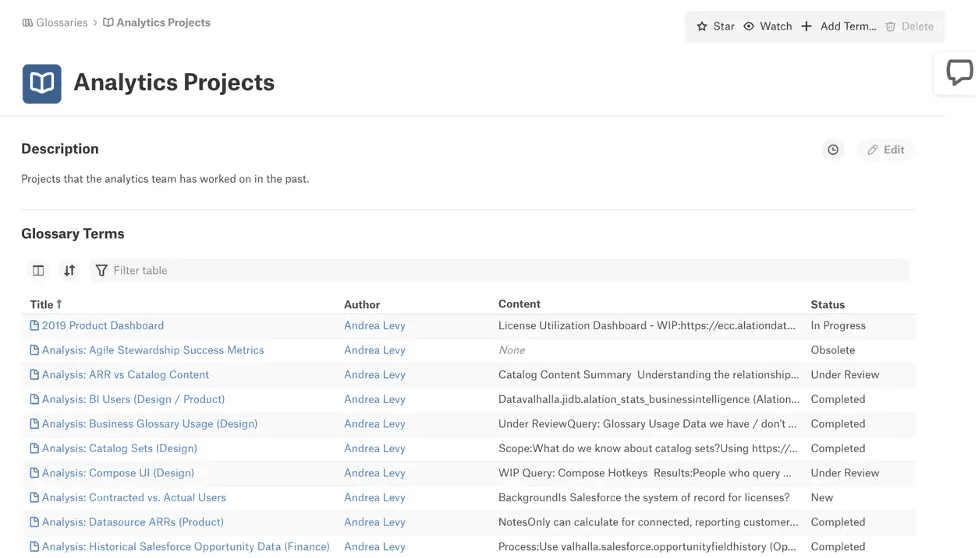
Did you know? Platforms like Alation make data literacy training more effective by combining documentation, glossaries, and contextual insights in one place. When users can view definitions and data context directly alongside the assets they work with, learning becomes part of everyday exploration. This approach helps employees build confidence and understanding without leaving the tools they already use.
The image below shows how Alation organizes glossary terms and project documentation in one central view, helping teams connect definitions with real work examples.
2. Ask data literacy questions in recurring surveys of your community
You should start by measuring data literacy to understand how effectively employees can use and apply data in their daily work. This visibility helps identify skill gaps and track improvement over time. Even if you rely on third-party materials and don’t require every employee to complete training, it’s worth collecting these insights regularly.
Add a few data literacy questions to your recurring catalog survey to ask participants to self-rate their comfort and skills across key areas. Then, review and compare results by role or department to pinpoint where additional support will have the most impact.
For example, you might ask:
How confident are you in interpreting data visualizations or dashboards?
Can you explain the source or context behind the metrics you use most often?
When you find conflicting numbers, how do you decide which to trust?
Questions can also vary by department:
Marketing: Can you describe how campaign performance data informs your next strategy?
Operations: How often do you validate process efficiency data before taking action?
Finance: Do you verify assumptions in financial models against real-time data?
These responses reveal both perceived and actual understanding, giving leaders a clear picture of where literacy training will produce the greatest value.
3. Hold an annual data literacy awareness month
With management support and friendly competition, you can see which groups have the most training participants and who scores highest on quizzes you create in apps like Google Forms. The right incentive—or simple pride—will have teams sending their people through the catalog to complete the training.
4. Include a data literacy campaign tagline in email signatures and presentation title slides
Email signatures and presentation title slides offer an easy way to continually drive training awareness without requiring a dedicated budget.
To make it more engaging, choose a memorable tagline that resonates with your organization's culture. “Data or datum? Get data literate!” works for some environments, while others might prefer “Turn data into your superpower” or “Ask better questions, get better answers.” When seen repeatedly, these small reminders normalize data-driven thinking.
5. Host regular data hackathons or challenges to encourage experiential learning
Hands-on problem-solving accelerates comprehension and builds confidence in applying data skills to real scenarios. For this, you can organize quarterly or bi-annual hackathons where cross-functional teams tackle these real-life business challenges:
Customer behavior analysis: Challenge marketing and sales to identify the top three factors that influence customer churn. Then, recommend retention strategies based on that analysis.
Operational efficiency: Ask operations to analyze supply chain data and propose inventory optimization approaches.
Product insights: Have product managers explore user behavior patterns to identify which features correlate most strongly with engagement.
Revenue opportunities: Challenge finance and sales to segment customers by profitability and growth potential.
Additionally, keep events time-boxed to four to eight hours with clear success criteria. The competitive element will drive engagement, while the collaborative format will help participants learn from peers with different skill levels.
6. Create peer-to-peer mentorship programs that focus on practical data problem-solving
The best learning often happens informally, where people feel comfortable exploring new ideas. Peer mentorship builds on that dynamic by giving employees a safe space to ask questions, share discoveries, and practice new skills.
Here’s how to make it work:
Identify experienced data coaches within each department.
Pair them with small groups or individuals for weekly check-ins.
Focus on real problems, such as interpreting dashboards or documenting assets.
These mentorship circles foster trust and make literacy continuous, not confined to one-time workshops.
7. Share weekly “data story” highlights to illustrate real-world data use cases
People connect more easily with stories than with statistics. Sharing weekly or biweekly “data stories” builds on that connection by showing how actionable insights lead to real results. For instance, “How the HR team used retention analytics to lower turnover by 10%” or “How the Sales Ops team identified its top-performing regions with catalog dashboards.”
Keep stories short—150 words or fewer—and distribute them in newsletters or Slack. Consider adding links to the catalog assets so readers can explore further. Over time, these examples will shape your teams’ understanding of what “good data use” looks like across the company.
8. Integrate data literacy goals into performance reviews and development plans
What gets measured gets prioritized. When you embed data literacy expectations into performance management, you signal that these skills matter for career progression.
To put this into practice, first define role-appropriate literacy competencies for different functions. Then set specific, achievable goals in development plans. Here are some examples of measurable goals:
Complete a foundational literacy course or assessment.
Document one dataset or dashboard per quarter.
Lead a short demo on how your team applies data to its goals.
Contribute to a department-wide data glossary or standardization project.
Managers can then discuss these goals during performance reviews and track progress in development plans. This approach ties literacy to accountability and professional upskilling.
9. Launch a data ambassador or champion network to evangelize best practices
A network of data ambassadors across departments extends the reach of your literacy program beyond what a central team can accomplish. To make this effective, select employees who are confident with data and eager to help others. These ambassadors gain credibility through peer trust and practical understanding, which makes them natural advocates for better data use.
Ambassadors can do the following:
Host short “Data Q&A” or office-hour sessions, where colleagues can ask for help interpreting or applying data.
Review metadata for accuracy and completeness.
Highlight effective data documentation examples.
Partner with the data office to share updates and feedback.
To motivate people to serve as ambassadors, consider recognizing their contributions in newsletters or meetings.
What role do data products play in fostering data literacy?
Data products are curated, documented, and governed datasets or analytical outputs that turn raw information into understandable, usable assets. Unlike raw data sitting in a warehouse, data products come with context: clear definitions, ownership, lineage, and quality indicators that make them ready for consumption.
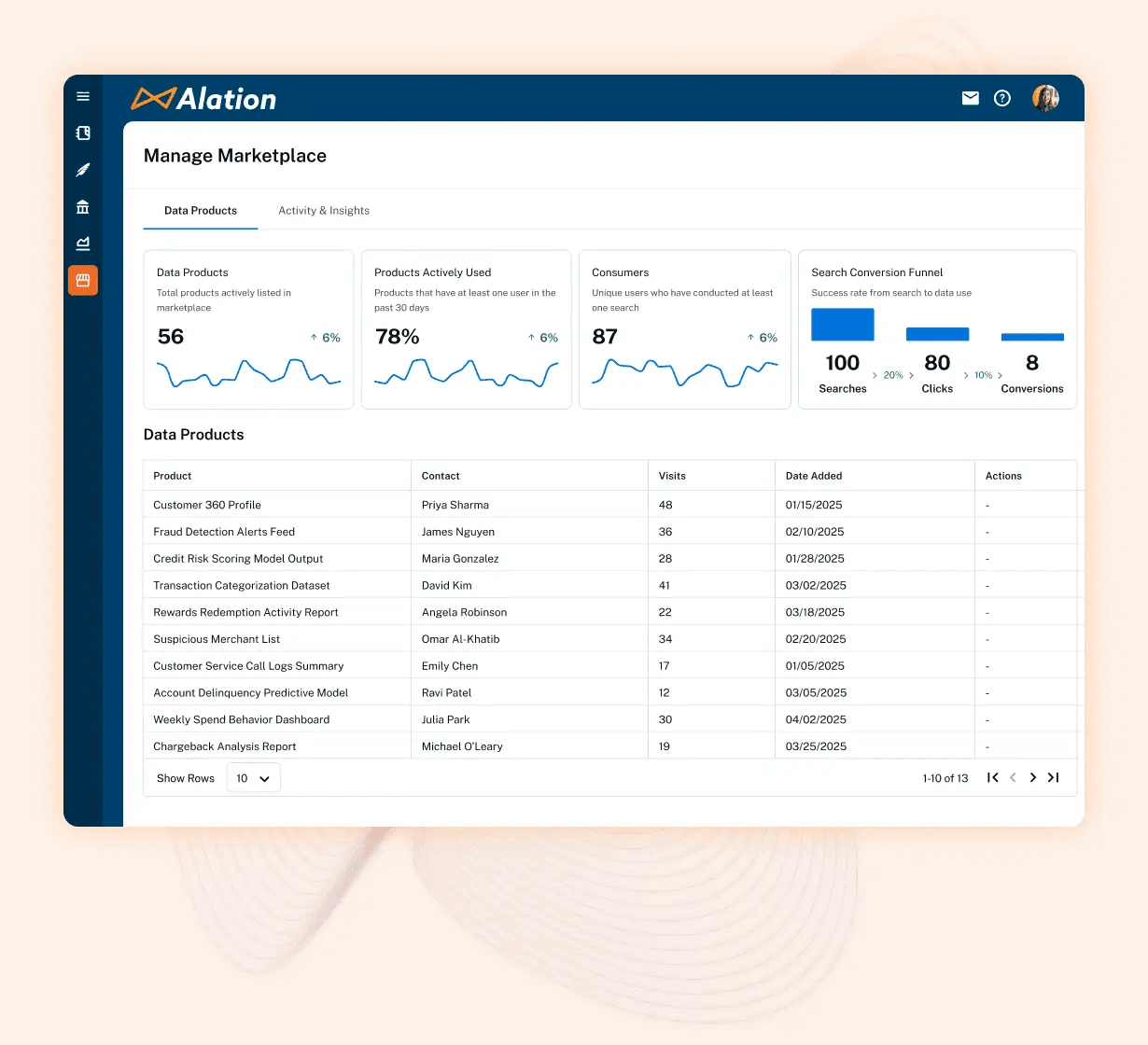
Building these products is itself an exercise in data literacy. Data product managers translate between technical teams and business stakeholders to align everyone on fundamental concepts like what "revenue" means or how "customer churn" should be calculated. Through this collaboration, participants develop practical skills in interpreting data.
The resulting products become the foundation for analytics and AI use cases:
Analytics: Solutions like Alation's Chat with Your Data enable employees to have natural language conversations with enterprise data while seeing the critical context behind each response, including metadata, governance policies, and user feedback.
AI applications: Well-structured data products provide the reliable, documented inputs that machine learning models need to generate accurate predictions.
Here's how data products strengthen literacy across an organization:
Structured context lowers barriers to understanding. Each product includes metadata that explains what the data means, who owns it, and how to use it correctly. This documentation helps non-technical users interpret and apply data confidently instead of facing overwhelming raw tables.
Standardized terminology creates consistency. Data products embed agreed-upon business terms within their metadata, helping teams avoid conflicting definitions across departments. This shared vocabulary builds trust through transparent documentation and normalizes fluency throughout the organization.
Catalog-driven exploration enables independent learning. A mature data product ecosystem empowers employees to search, preview, and understand datasets without heavy reliance on specialists. Users can trace lineage, view usage examples, and access documentation that builds literacy as they learn by doing.
Business context connects data to decisions. Data products link directly to processes and key performance indicators, allowing users to see how information informs action. A customer segmentation product drives marketing personalization, while a supplier risk product helps procurement understand exposure.
Clear ownership fosters collective responsibility. When every product has defined stewards and consumers, it creates transparency that supports a data-literate culture. Teams learn to care for data quality and governance, which strengthens trust and reduces reliance on specialists.
Organizations that adopt a data product operating model create sustainable structures where domain experts collaborate with technical teams to deliver reliable, contextual data that serves the entire enterprise.
➜ To explore how mature data culture translates into business value, see Alation’s Data Culture Maturity Model.
What are the top data literacy skills your teams need?
Strong data literacy takes different forms across teams, but every role benefits from a shared foundation. Technical experts apply this foundation by explaining data clearly and aligning terminology. Business users build on it by interpreting insights within context before making decisions. When both groups communicate fluently, they reinforce one another, ensuring business decisions remain accurate and consistent across departments.
Here are some data literacy skills your teams need:
Core skills for all employees:
Data interpretation: Understanding what data represents and how teams derive these figures
Critical thinking: Knowing when to question data sources, as well as how to identify bias and assess reliability
Data communication: Summarizing findings clearly and tailoring explanations to non-technical audiences
Ethical awareness: Recognizing the limits of data use and handling sensitive information responsibly
For analysts and data science professionals:
Data modeling and curation: Structuring datasets for reuse and transparency
Metadata management: Maintaining clear definitions and context in the catalog
Visualization design: Presenting insights in ways that highlight accuracy and reduce misinterpretation
Stakeholder alignment: Translating technical insights into data-backed conclusions and recommendations that drive decisions
For business and operational teams:
Metric literacy: Understanding key performance indicators and how they relate to organizational goals
Tool proficiency: Navigating Excel, SQL, dashboards, filters, and reports with confidence
Data storytelling: Using evidence to support recommendations and share results persuasively
These skills reinforce one another. As teams strengthen both technical fluency and communication ability, they create a culture where insights travel easily across functions and data becomes part of everyday problem-solving.
Set data literacy baselines and measure improvements periodically
Measuring literacy turns awareness into progress by showing how people interact with data in real situations. A clear baseline builds upon that understanding by revealing where teams feel confident and where they need guidance. With this visibility, leaders can then target support effectively. Plus, teams gain a shared foundation for learning and long-term growth.
Building on that foundation, effective measurement connects behavior with perception to show how literacy evolves in practice. Surveys reveal confidence levels, while catalog engagement data shows how employees actually use and interpret information. Together, these insights provide a fuller picture of both learning and application.
Here are some useful metrics to track:
Training participation: Measure course completions or workshop attendance to assess the reach of your literacy programs.
Confidence levels: Evaluate employees’ ability to locate, interpret, and apply data confidently in their daily work.
Decision quality: Assess how often verified sources support business recommendations, signaling stronger data-informed decisions.
Catalogs like Alation make these patterns visible by tracking searches and glossary engagement. This capability helps teams see literacy evolve in daily work. Over time, steady gains in these areas signal a stronger, more data-aware culture where knowledge translates into consistent, informed decisions.
Start enjoying the benefits of improved data literacy
A data-literate workforce makes faster and more confident decisions, but confidence creates value only when data quality supports it. Without trustworthy information, even skilled teams can act on errors and draw the wrong conclusions. When literacy and quality improve together, organizations strengthen accuracy, accelerate decision-making, and uncover opportunities for innovation.
Yet many organizations struggle to maintain that balance. Training often fades after initial success, and governance efforts can feel disconnected from daily work. Alation helps bridge these gaps by integrating data literacy into the tools employees already use. Through contextual guidance, shared definitions, and clear data lineage, teams learn as they work and build confidence grounded in reliable data.
To explore how this approach scales, download Alation’s free white paper on a four-step process to launch a self-service data intelligence and help your workforce grow more data literate every day.
- What is data literacy?
- How to improve data literacy: 9 recommendations to try
- What role do data products play in fostering data literacy?
- What are the top data literacy skills your teams need?
- Set data literacy baselines and measure improvements periodically
- Start enjoying the benefits of improved data literacy
Contents
FAQs
How can businesses create a data literacy framework that supports analytics and AI success?


Businesses build sustainable data literacy by aligning training with strategic goals and embedding learning into daily work. They then connect employees through practical data tasks that strengthen shared understanding. As teams apply insights, leaders reinforce progress by encouraging informed decisions and celebrating results. To sustain momentum, companies refine tools, measure outcomes, and share lessons openly. This continuous cycle drives lasting analytics and AI success.
How can leaders foster a culture that encourages all employees to become more data literate?
Leaders play a central role in shaping how teams engage with data. When they demonstrate curiosity, transparency, and accountability, employees see data literacy as part of how work gets done—not as an extra task. Over time, this mindset helps create a culture where learning and using data feel natural. The following actions help leaders strengthen that foundation:
Lead by example and use data in visible decisions
Recognize employees who apply insights effectively
Encourage open discussions about challenges and learnings
Provide easy access to trusted, well-documented data
Link literacy goals to growth and development plans
When leaders show curiosity and confidence, employees will feel empowered to do the same.
How does data literacy impact the ability compliance and data governance goals?
Improving data literacy strengthens compliance because employees learn to use and document data correctly. When teams understand where information originates and how to classify it, they’ll reduce the risk of errors and unauthorized access. Strong literacy also supports governance by promoting consistent definitions and reliable documentation. As understanding deepens across departments, compliance then turns into a shared practice that builds lasting trust in organizational data.
Tagged with
Loading...