
Here is the uncomfortable reality behind the enterprise AI surge: Per Gartner, at least 30% of generative AI projects were abandoned after proof of concept by the end of 2025, not because the models failed, but because the data underneath them did. The average enterprise scrapped 46% of AI pilots before they reached production, with the most common reason being that teams selected a use case before verifying that the data, governance, and infrastructure requirements were in place.
This is the context in which data fabric and data mesh have quietly become the most consequential architectural conversations in enterprise technology. Not as abstract design debates, but as the foundational infrastructure layer that determines whether an organization's AI ambitions survive contact with reality.
Both paradigms are maturing. Both are evolving. And while early debates framed them as rivals competing for the same budget line, the rise of agentic AI has shifted the story: data fabric and data mesh are complementary (not competing), approaches that solve different classes of problems. Data fabric provides the automated, metadata-driven connective tissue that makes data discoverable and trustworthy across complex hybrid environments. Data mesh provides the organizational model that puts domain ownership, data quality, and accountability where they belong: with the people closest to the data.
Understanding when and how to apply each (and increasingly, how to use them together) is now core to building an AI-ready data strategy that delivers on its promises.
Key takeaways
Data fabric automates data discovery, integration, governance, and metadata activation across hybrid and multi-cloud environments. It is a technology-forward, metadata-driven architectural pattern that supports a more unified view of data and policies.
Data mesh decentralizes data ownership and management across business domains, empowering teams to deliver data as a product. It is a people- and process-centric operating model built around domain ownership, distributed decision-making, and a decentralized approach.
The biggest differences lie in ownership models, governance, architecture, integration patterns, and implementation focus—not in whether one is “better.”
Most enterprises in 2026 are adopting hybrid approaches, blending data fabric automation with the domain-oriented data mesh architecture to scale analytics and AI responsibly.
A successful implementation of either model depends on foundational practices: cataloging, lineage, SLAs, federated governance, designed workflows, and continuous measurement of trust, adoption, and business outcomes.
Data fabric vs. data mesh: What are they?
At their core, data fabric and data mesh differ in orientation: data mesh is a decentralized, domain-oriented operating model, while data fabric is a technology-centric architectural pattern that automates and unifies data management and governance. Data mesh distributes responsibility; data fabric centralizes intelligence.
Both rely heavily on metadata—but for different reasons.
Metadata is foundational to every data strategy today. It fuels data intelligence use cases ranging from data search and discovery to governance, lineage, data access control, and cross-domain data sharing.
Metadata captures the who, what, where, when, and how of every data asset—context that helps people (and increasingly AI agents) understand its meaning and appropriate use. But metadata is notoriously difficult to wrangle: it lives everywhere across ETL pipelines, microservices, databases, ERP systems, SaaS tools, cloud platforms like Snowflake, and even new data created via APIs or streaming platforms such as Amazon or Databricks.
Because humans cannot realistically interpret and maintain this volume of metadata, the data fabric uses technology—automation, active metadata, inference, and AI—to discover, analyze, and reuse it.
Against this backdrop, let’s turn to clear, practitioner-aligned definitions for each concept.
What is a data fabric?
A data fabric is an architectural design concept that uses active metadata, augmented intelligence, and automation to support integrated, reusable, and well-governed data across all environments—including hybrid, multi-cloud, and edge. It creates an intelligent, metadata-driven layer that unifies disparate systems and enforces consistent governance.
Gartner emphasizes that a data fabric is not a single product. It is a composable architecture made up of interoperable technologies connected by continuous metadata collection, analysis, and action.
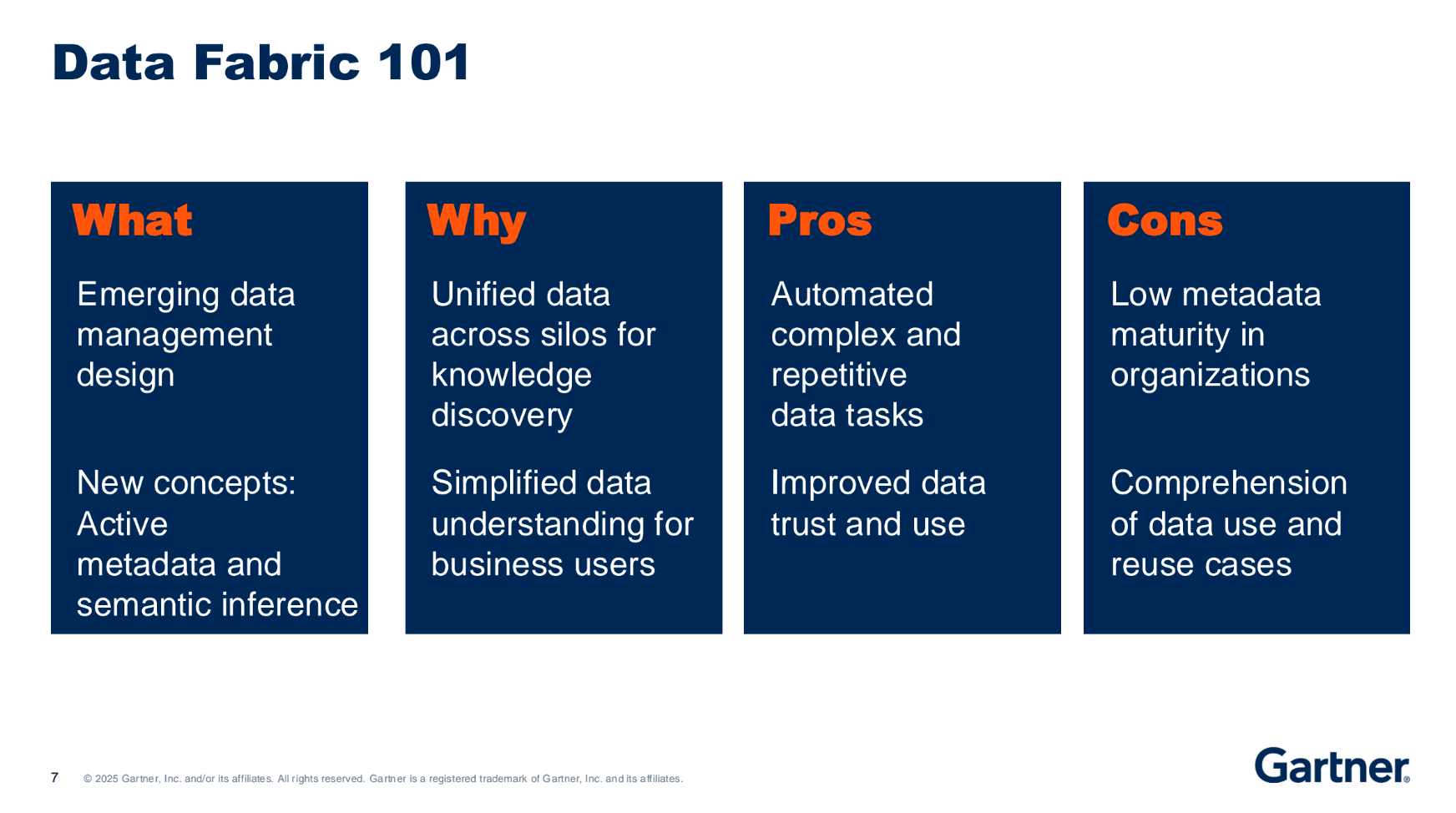
A data fabric automates and augments manual data management by applying analytics and AI to metadata spanning technical, operational, and business contexts. This enables a “smart” data layer that improves data quality, strengthens data security and compliance, and accelerates both human and machine-driven consumption.
Key characteristics of a data fabric include:
Active metadata ingestion and inference
Automated integration and transformation
Policy-aware access management
Unified governance across on-prem and cloud
Recommendation engines and metadata-driven intelligence
Support for human users and machine consumers, such as AI agents
Ultimately, a data fabric exists to make trusted, reusable data accessible at scale, regardless of its source or format.
What is a data mesh?
A data mesh is a decentralized data architecture and operating model in which domain teams own, manage, and deliver data as a product. Created by Zhamak Dehghani at Thoughtworks, data mesh is not a technology stack—it is an organizational paradigm grounded in domain-driven design and federated governance.
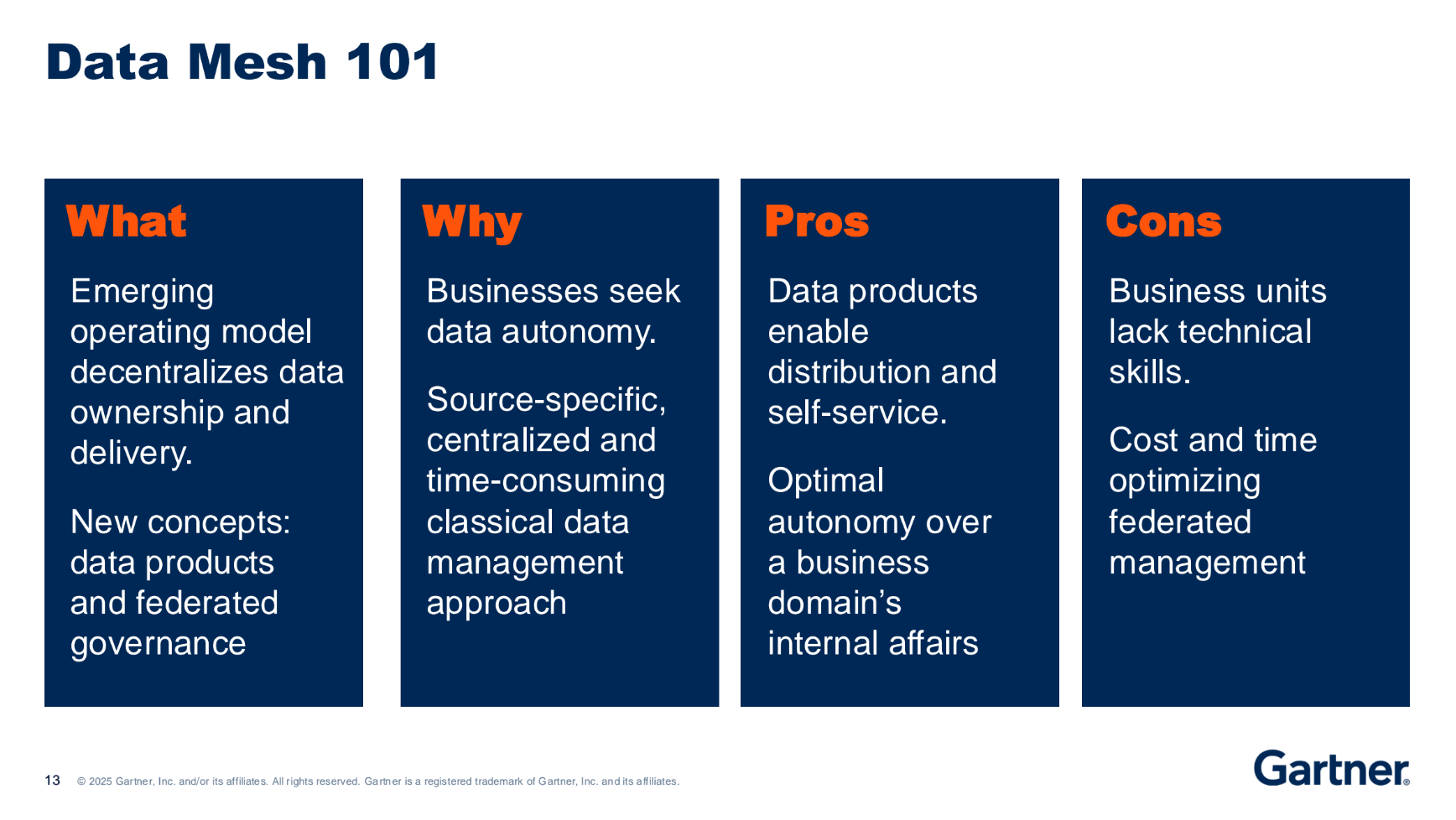
While data fabric unifies and automates, the data mesh approach scales by decentralizing responsibility across different domains.
Data mesh rests on four foundational principles:
Domain-oriented, decentralized ownership
Data as a product
Self-serve data infrastructure
Federated computational governance
In a mesh, producers closest to the business context—not a distant centralized team—take responsibility for the quality, definition, documentation, and reliability of the data products they publish. They own SLAs and are evaluated based on downstream consumption success, not just upstream delivery.
This approach addresses long-standing bottlenecks created by centralized data lake, data warehouse, or monolithic ETL teams. Such teams lack domain context and often create delays that impede analytics, AI model development, or real-time decision-making.
Data mesh is fundamentally about people, shifting responsibilities, and empowering domain teams to deliver high-quality data to consumers more efficiently and reliably.
Organizations adopting a data mesh architecture increasingly embrace a data product operating model—a structured approach to defining, governing, and measuring data as a product. This model clarifies ownership, standardizes metadata expectations, and ties data products to real business value.
Data mesh is ultimately a people-and-process paradigm, supported by technology but not defined by it.
What are the main differences between data fabric and data mesh?
Although complementary, the two approaches differ significantly in ownership, governance, architecture, and how they operationalize data management.
Dimension | Data fabric | Data mesh |
Primary focus | Automating data integration and governance through active metadata | Decentralizing ownership; managing data as a product |
Orientation | Technology- and automation-centric | Organizational- and process-centric |
Data ownership | Typically centralized or shared central services | Domain-owned with federated governance |
Governance model | Centralized policies with automated enforcement | Federated governance with domain accountability |
Architecture | Metadata-driven fabric unifying distributed systems | Distributed, domain-oriented architecture |
Implementation driver | Metadata management, AI readiness, hybrid/multi-cloud unification | Eliminating bottlenecks, improving data quality at the source |
Key enabler | Augmented data catalog and metadata intelligence | Self-serve data platform and governance standards |
Outcomes | Faster integration, automated governance, trusted data pipelines | Higher-quality domain data, agility, scalable delivery of data products |
Many organizations adopt one as a starting point and incorporate elements of the other as they mature.
Why do you need a data fabric?
As enterprise architectures sprawl across different systems, clouds, APIs, formats, and data-producing applications, organizations require automation to make sense of metadata and deliver trusted data for analytics, machine learning, and decision-making. A data fabric solves this through continuous metadata-driven intelligence.
Here’s why organizations adopt a data fabric:
1. Unify hybrid and multi-cloud data
Enterprises increasingly operate across clouds like AWS, Snowflake, and Databricks while still running critical systems on-premises. A data fabric provides a unified governance and metadata layer across all environments—critical for secure data access and sharing.
2. Automate manual data management
Metadata sprawls across ETL pipelines, integration tools, BI platforms, and microservices. A fabric uses automation and AI to ingest, analyze, and act on metadata, reducing manual effort and operational risk.
3. Improve data quality and trust
Continuous inference and anomaly detection help organizations identify trusted data assets, surface best practices, and enforce consistent data governance across business domains.
4. Accelerate discovery and reuse
Users can quickly find curated data products, understand lineage, and reuse established pipelines or workflows rather than reinventing them.
5. Enable AI with high-integrity data
Modern AI and LLM-driven applications require trusted, context-rich data. The data fabric provides the active metadata backbone that supports explainability, lineage, and policy-compliant data access.
6. Reduce operational complexity
By unifying governance and metadata intelligence, the fabric streamlines workflows and increases efficiency for data engineers, analysts, and autonomous systems.
Data fabrics are not a single tool—they are composable architectures that weave together automation, intelligence, and governance to handle today’s complex data workloads.
A data fabric utilizes continuous analytics over existing, discoverable and inferenced metadata assets to support the design, deployment and utilization of integrated and reusable data across all environments, including hybrid and multi-cloud platforms.
Why do you need a data mesh?
Data lakes and centralized teams once seemed sufficient to manage enterprise data. But as volumes grew and demands expanded across different domains, centralization produced bottlenecks and low-quality outputs. Data mesh responds to these challenges with a decentralized approach.
Data mesh is all about people. It shifts responsibility to domain experts who understand the data best, ensuring higher-quality data reaches consumers faster and more efficiently.
Organizations are increasingly adopting a data product operating model, derived from the data mesh paradigm. This model formalizes the design, management, governance, and measurement of data products, each tied to tangible business value and strategic decision-making.
Below are the top reasons organizations adopt data mesh.
1. Eliminate centralized bottlenecks
Centralized teams cannot scale to meet diverse data needs across the enterprise. Mesh distributes ownership to domain experts who can deliver with greater speed and accuracy.
2. Increase data quality at the source
Domain teams understand how data is generated and used. When they manage data as a product, they naturally improve its quality, documentation, and utility.
3. Improve agility and time-to-insight
Data products become discoverable, well-documented, and ready for immediate consumption—without long engineering queues.
4. Establish accountability through SLAs
Producers own freshness, access, privacy, lineage, and consumer satisfaction, driving better alignment with the business.
5. Create a scalable operating model
Distribution enables parallel development, helping the organization adapt to new data, new domains, and new use cases faster.
6. Prepare for AI through domain context
AI models require domain-specific semantics to produce meaningful results.
When those closest to the data manage its quality and context, they provide the lineage, business rules, and semantic definitions that make data more intelligible and more powerful—both for humans and AI systems.
Data mesh empowers people and distributes responsibility, supported by modern infrastructure and governance.
Can data fabric and data mesh work together?
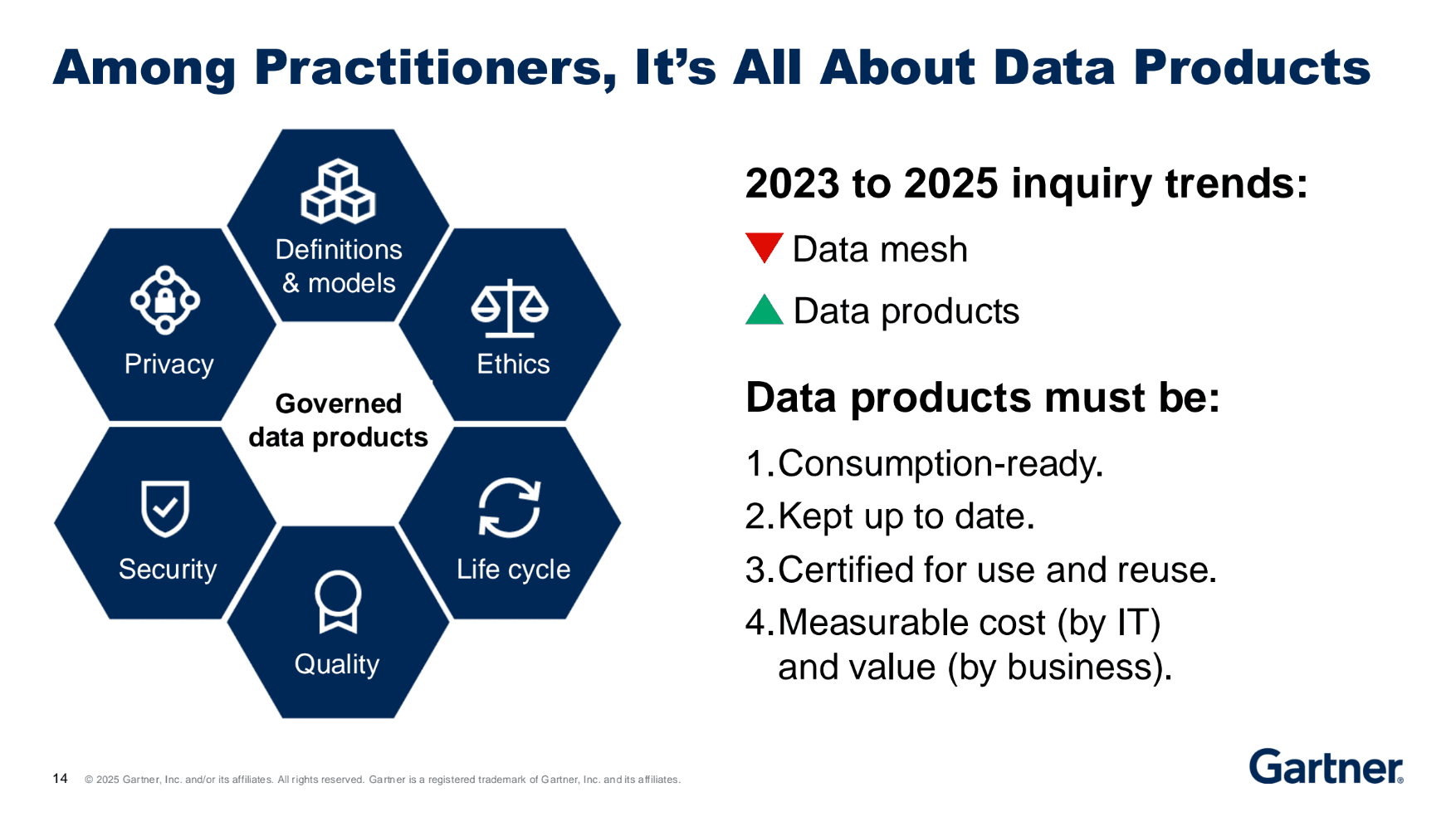
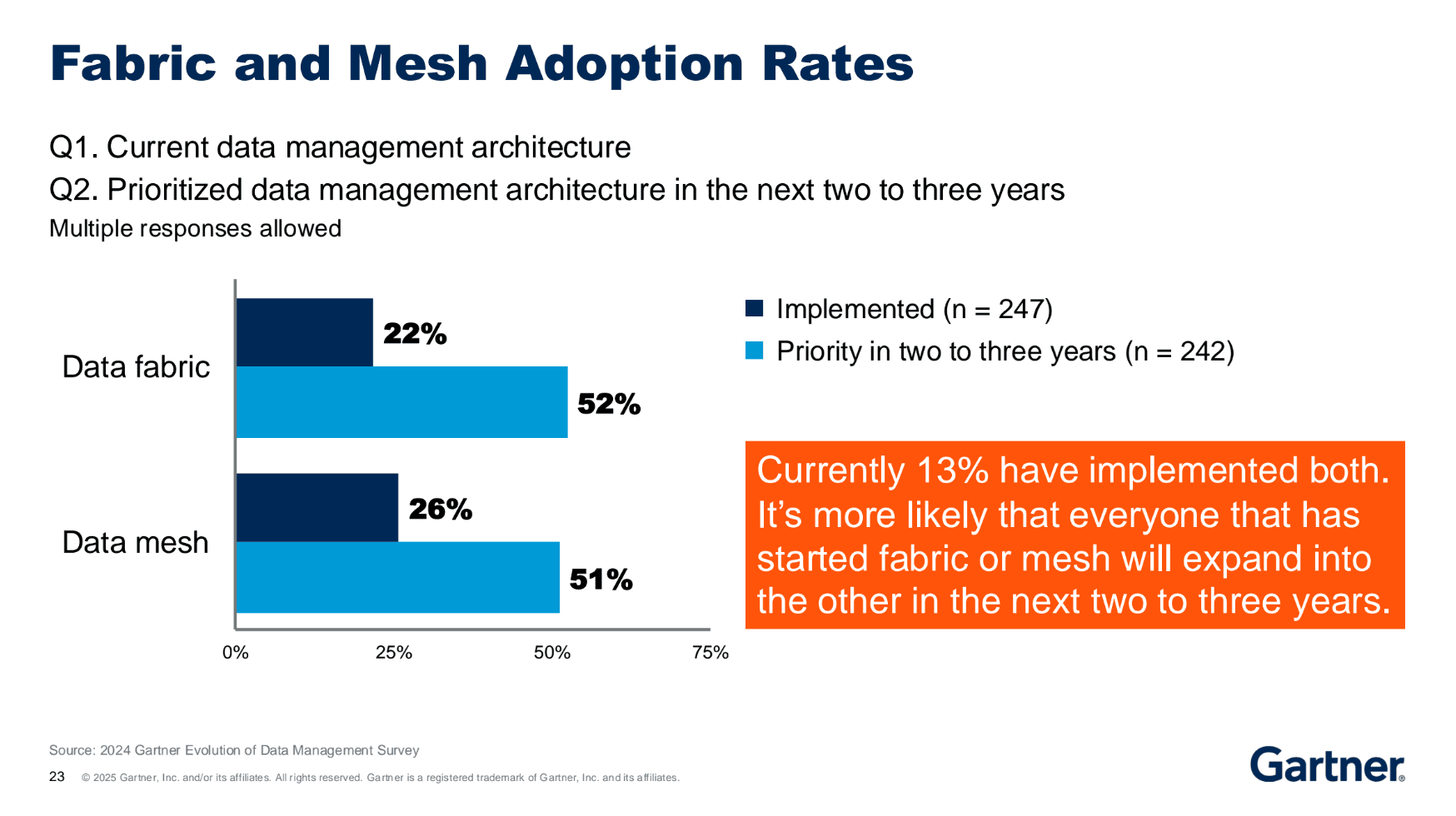
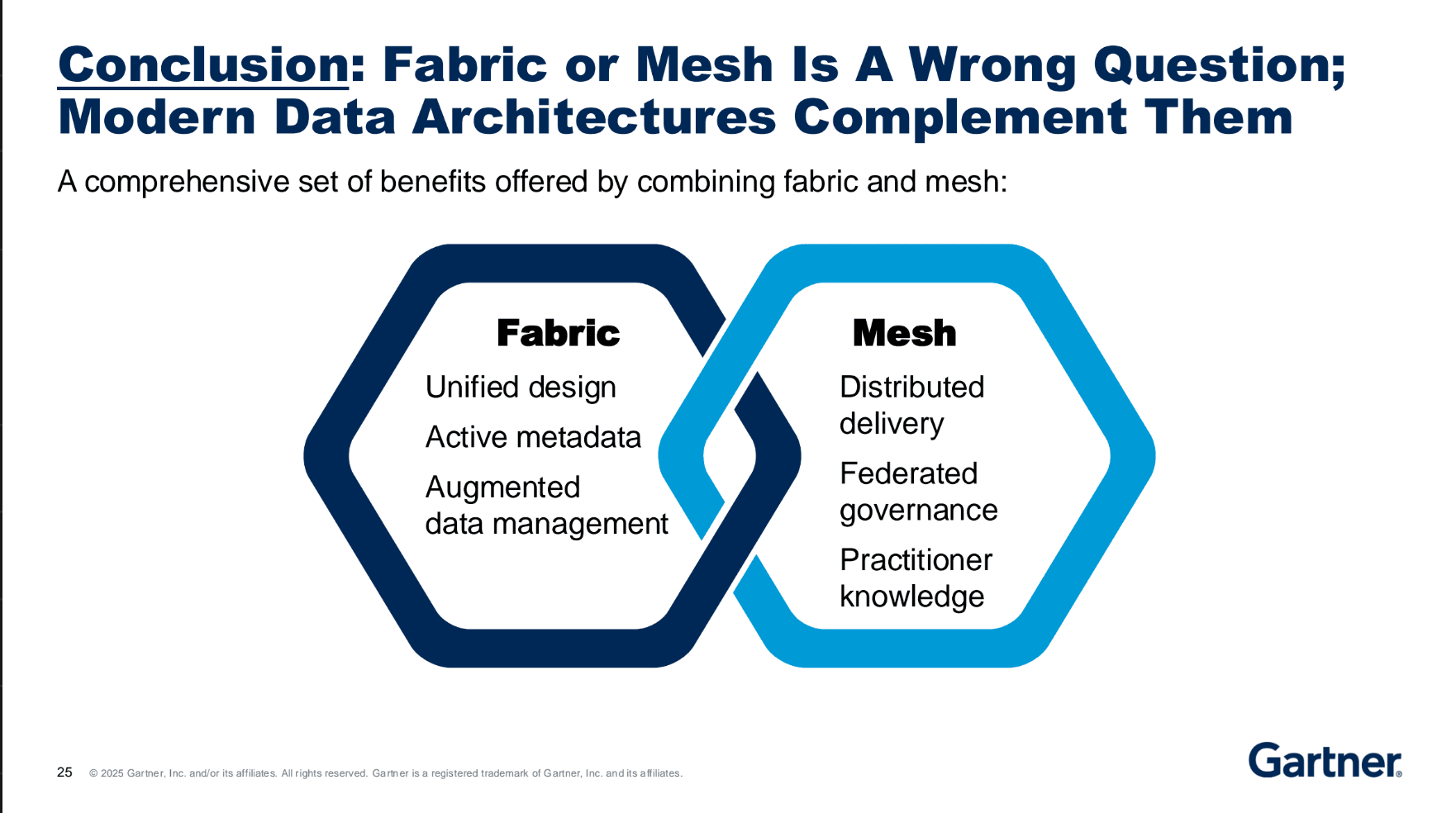
Not only can data fabric and mesh coexist, but they work best when implemented together. Most successful enterprises do not choose one over the other. Instead, they combine the automation and unified view of the data fabric with the domain ownership and data product mindset of the mesh. Gartner predicts that firms who have one will adopt the other within the next 2 to 3 years:
A hybrid approach typically includes:
The data fabric: providing metadata intelligence, automation, and a unified governance layer
The data mesh: enabling decentralized ownership, high-quality domain data products, and federated decision-making
Together, these capabilities enable:
Faster, automated data integration and transformation
Clear ownership, accountability, and domain expertise
Seamless data access and sharing across systems, clouds, and workloads
Standardization without heavy centralization
AI-ready metadata enriched with business semantics
Scalable value creation through reusable data products
Today’s organizations increasingly adopt a data product operating model atop a metadata-driven fabric, providing both the structural and technological foundation for responsible AI, streamlined workflows, and consistent governance.
How leaders are using data mesh and fabric for enterprise AI
The architectural theory is settling. What's emerging now — through field reports, analyst research, and practitioner case studies — is a clearer picture of how leading organizations are deploying these frameworks to achieve specific AI outcomes. Three patterns stand out.
1. Data mesh as the trust layer for AI agents
McKinsey's research finds that while nearly two-thirds of enterprises have experimented with AI agents, fewer than 10% have successfully scaled them, and eight in ten cite data limitations as the primary bottleneck. The agents aren't the problem. The data is.
AI agents making real decisions (routing exceptions, flagging fraud, summarizing patient records) need data that is owned, governed, semantically defined, and provably current. Data mesh provides exactly those properties. When a domain team publishes a data product with a clear quality SLA, a defined schema contract, and documented ownership, that product becomes something an AI system can reliably consume. Without it, the agent is reasoning over data that may be stale, ambiguous, undocumented, or owned by no one.
Thoughtworks' 2026 field report describes this shift explicitly: data mesh principles — clean, owned, product-based data with clear contracts — are "the essential foundation for success with trustworthy, production-grade AI." The report introduces the concept of dual-use data products: data products designed to serve both human analysts and AI systems as consumers, with output ports that include not just SQL endpoints and APIs but machine-context interfaces that agents can query directly. In this model, a well-implemented data mesh isn't just an analytics architecture; it's an AI operating layer.
Thoughtworks also notes the anti-pattern to avoid: organizations that "rebadge" IT teams as data domains without genuine business accountability. When domain ownership is lip service, data contracts are unenforceable, quality SLOs are aspirational, and any AI system built on top of that data inherits the same unreliability. Governance orphans — datasets in decentralized architectures that no domain claims — are a liability to analytics context and a risk to AI.
2. Data fabric as the grounding layer for LLMs and RAG
The most persistent failure mode in enterprise generative AI is hallucination: confidently wrong outputs generated when a model is asked to reason beyond its training data without access to current, domain-specific context. The dominant solution is Retrieval-Augmented Generation (RAG): augmenting model prompts with fresh, authoritative context retrieved at inference time from internal knowledge stores. Gartner identifies RAG as the primary mechanism for grounding enterprise LLMs on proprietary data.
Data fabric is what makes RAG work at enterprise scale. An LLM-powered assistant — whether for customer support, compliance review, or analyst workflows — needs to reach across dozens of source systems at inference time: a CRM, a data warehouse, a document repository, a product database. Data fabric's metadata-driven integration layer creates the unified access plane that makes those queries possible without requiring a rip-and-replace of existing infrastructure.
The results are measurable. LinkedIn's implementation of a knowledge graph-backed RAG system (a data fabric pattern) reduced ticket resolution time from 40 hours to 15 hours, a 63% improvement in operational efficiency. The system works by giving support agents an AI assistant that retrieves precise, current answers from across LinkedIn's internal knowledge base, rather than relying on model memorization.
3. The emerging "agentic mesh": the next architectural layer
As agentic AI matures, the complementary relationship between mesh and fabric is evolving into something new. Practitioners and analysts are beginning to describe an "AI Mesh" or "Agentic Mesh": an extension of data mesh principles to AI systems themselves.
In this model, just as data domains publish data products with defined quality guarantees and contracts, AI agent networks are governed by similar principles: discoverable, composable, with defined capabilities, accountability, and governance constraints. An agent that needs to check inventory availability, verify a compliance rule, and draft a customer response needs a data infrastructure that can tell it which data product to query, in what form, under what access policies, in milliseconds.
This is where data mesh and data fabric become mutually reinforcing at a new level of sophistication. The mesh provides the trusted, well-governed data products that agents consume. The fabric provides the unified discovery and integration layer that lets agents find and access those products efficiently. Together, they form the infrastructure for AI systems that are not just capable, but auditable and trustworthy.
McKinsey describes this as "data productization acceleration", one of the core foundations organizations must build to operate effectively in the agentic era. Organizations that invested in data mesh and data fabric before the AI mandate arrived are the ones now scaling agents into production. Those playing catch-up are discovering that trust and governance cannot be retrofitted onto an AI system after the fact.
Tips for implementing data fabric and data mesh
Successful implementation depends on strong foundations—both technical and organizational. Here are a few key steps to launching your own “meshy fabric”:
Establish a data catalog and business glossary
A data catalog is indispensable for modern data-driven firms. It provides:
A unified metadata repository
Automated discovery across systems and clouds
Visibility into lineage, ownership, and usage
A business glossary that standardizes key definitions
A user-friendly interface for self-service analytics
For data fabric, the catalog supplies the active metadata backbone. For data mesh, it provides the discovery and transparency layer necessary for data products.
Both are essential for creating an Agentic Knowledge Layer and enabling accurate AI models, domain-aware decision-making, and consistent data access and security.
Implement lineage and policy management
Organizations today need transparency, control, and trust. Lineage and policy management deliver these outcomes by making metadata actionable and enforceable.
High-quality lineage supports:
Auditability
Regulatory compliance
Root-cause analysis
Explainable AI
Faster onboarding and better BI workflows
Organizations require:
Column-level, table-level, and cross-system lineage
Policy-based access controls tailored to data sensitivity
Automated enforcement using metadata and AI
Comprehensive audit trails for compliance
These capabilities reduce operational risk, strengthen data security, and build trust with regulators, consumers, and executives. Together, they form the connective tissue enabling the next stage: designing and governing data products.
Define data product standards and SLAs
In a mesh, a data product is more than a dataset—it is a curated package of data with purpose, context, policies, and defined value, designed around a specific business problem or workflow.
Organizations should establish:
A clear, organization-wide definition of “data product” tied to measurable business value
Required metadata fields that ensure consistency across domains
Quality, freshness, and uptime SLAs
Versioning policies and consumption standards
Clearly assigned ownership and accountability
Standardization enables autonomy without chaos. It allows each domain to innovate while ensuring data products remain reliable, discoverable, and aligned with enterprise priorities.
Set up federated governance
Historically, regulated industries favored top-down, centralized governance, while less regulated verticals preferred non-invasive or decentralized models. Today, organizations of all types are converging on a federated “hub-and-spoke” governance model—balancing enterprise consistency with domain flexibility.
Federated governance includes:
Enterprise guardrails for privacy, classification, data security, and lifecycle management
Domain-specific policies for operational decisions
Automated policy application through the data fabric
Cross-domain governance bodies to maintain alignment
The goal is not rigid control but harmonized, collaborative governance, where automation enforces policies and teams can deliver high-quality data products efficiently.
Measure adoption and trust
Data infrastructure succeeds only when people use it. Organizations should track:
Data product usage and satisfaction, tied directly to business outcomes such as reduced cycle times, improved decision-making, or increased revenue
Time-to-discovery and time-to-consumption, critical indicators of friction
Policy violations and access friction, which signal risk exposure and potential savings from avoiding audit failures or fines
Trust signals like quality scores, endorsements, lineage completeness, and usage diversity
AI model performance, which depends fundamentally on the integrity and context of the underlying data
Adoption is the ultimate indicator of architectural health. High adoption reflects trust, usability, and alignment with the organization’s strategic goals.
How Kroger blends data mesh and data fabric to unlock value
Kroger’s data transformation offers a practical example of how enterprises can blend data mesh and data fabric to deliver value at scale.
Working through its analytics subsidiary 84.51°, Kroger reorganized around business domains and adopted a data mesh architecture so that domain teams could own and manage their data assets as products, with clear SLAs and accountability for quality.
At the same time, Kroger implemented a data fabric “connective tissue”—powered by Databricks’ Unity Catalog and Alation—to standardize governance, automate data profiling and classification, and enable governed data access and sharing across domains.
The result is a more unified view of data, stronger data security controls, and a common language for data that supports faster, more confident decision-making across the enterprise.
How the data catalog enables data products: A real-world example
The NBA’s data transformation journey offers a compelling illustration of how a data catalog supports the shift to a data product operating model. As detailed in the NBA case study, the league sought to deliver trusted, high-quality data to internal teams, media partners, and fans—while modernizing its architecture across Snowflake, Databricks, APIs, and cloud-native workloads.
The organization adopted a data product mindset, defining clear ownership, metadata expectations, and SLAs for each data asset. But operationalizing this model required more than intent—it required visibility, lineage, and standardized definitions across multiple business domains.
The data catalog became the connective layer, enabling:
Discovery of data products across domains
Clear lineage to support trust and explainability
Standardized business definitions across formats and systems
Federated governance aligned to both central policy and domain autonomy
Faster onboarding for analysts, data scientists, and AI developers
With catalog-driven intelligence, the NBA built a scalable operating model rooted in reusable, well-governed data products—demonstrating how data fabric capabilities and data mesh principles come together in real enterprise environments.
Conclusion
Data fabric and data mesh are no longer competing ideologies. They represent complementary approaches to managing modern data complexity. Data fabric provides the automated, intelligent infrastructure for consistent governance and data unification. Data mesh provides the people, processes, and accountability needed to scale data management across domains.
Together, they create the foundation for trusted AI, seamless data sharing, domain-driven workflows, and high-impact business intelligence.
To learn more about how a data catalog supports both paradigms—or to see how your organization can build a scalable data product operating model—request a demo to speak with our team today.
- Data Culture
- Data Intelligence
- AI
- Data Catalog
- Data Governance
- Data Products
- Digital Transformation
- Modern Data Stack
- Active Data Governance
Keep reading
More from the data desk