

As enterprises accelerate their AI initiatives in 2026, metadata management has emerged as the critical foundation for success. As of 2024, the metadata-management tools market is estimated at USD 11.69 billion and is projected to grow to USD 36.44 billion by 2030 (20.9% CAGR) — illustrating strong demand as organizations try to govern increasingly complex data.
As data volumes surge, organizations can no longer rely on manual processes to manage their data assets. Whether you're building production AI systems, ensuring regulatory compliance, or simply trying to make sense of your data landscape, implementing robust metadata management practices is no longer optional—it's essential for competitive advantage.
Key takeaways
Metadata management is experiencing rapid market growth, driven by AI adoption, regulatory requirements, and the explosion of enterprise data
Modern metadata management encompasses five critical types: business, technical, compliance, operational, and behavioral metadata
Successful implementation requires dedicated teams, clear strategies, standardized frameworks, and automated workflows
Organizations face common challenges, including siloed tools, manual processes, scaling issues, and balancing security with accessibility
Leading enterprises are investing in metadata management platforms to achieve AI readiness, improve data governance, and accelerate decision-making
What types of metadata require management?
Not all metadata is created equal. To build an effective metadata management strategy, organizations must understand and manage five distinct types of metadata, each serving different users and use cases:
Business metadata
Business metadata defines the business meaning of data in human language. This includes business glossary terms (such as "Customer" or "Active Subscriber"), metric and KPI definitions with calculation logic, domain ownership and stewardship information, and data product descriptions with service-level objectives. Business metadata is primarily used by business analysts, product owners, and leaders who need to understand what terms mean, who owns specific metrics, and which version is authoritative for decision-making. By aligning on key term definitions in a Business Glossary, organizations ensure all teams speak the same language.
Technical metadata
Technical metadata describes the structure and processing details of data in machine-readable form. This encompasses schemas, data types, constraints, partitions, and file formats, as well as data lineage showing column-to-column transformations across pipelines. It also includes orchestration details, such as job names, dependencies, schedules, and information about indexes, materializations, and caching strategies. Data engineers, analytics engineers, and data scientists rely on technical metadata to understand where data originated, how fresh tables are, and what constitutes safe joins versus known anti-patterns.
Compliance metadata
Compliance metadata encodes regulatory and policy context, enabling the enforcement and auditing of compliant behavior as it relates to data storage and analysis. This type of metadata includes data classifications (PII, PHI, PCI, confidential, public), applicable regulations (GDPR, CCPA, HIPAA, SOX) and their respective jurisdictions, retention schedules, and legal hold flags, as well as data handling instructions covering masking rules and consent states. The average cost of a data breach reached $4.88 million in 2024, making proactive governance through compliance metadata essential for privacy officers, security teams, and anyone handling regulated data.
Operational metadata
Operational metadata exposes the runtime state and performance of data pipelines and products. It captures data freshness, latencies, SLA adherence, throughput, table volumes, error rates, and incident tickets. It also tracks cost telemetry, including warehouse credits, storage costs, and deployment history. Over 90% of mid-size and large enterprises report that one hour of downtime costs more than $300,000, making operational metadata critical for platform engineering teams, site reliability engineers, and anyone responsible for maintaining data quality and availability.
Behavioral metadata
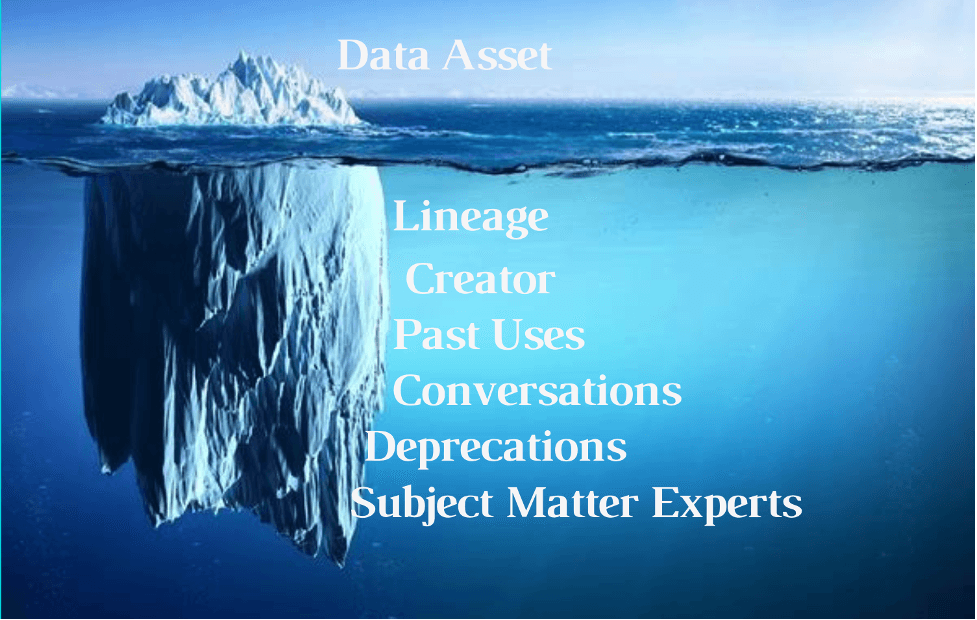
Behavioral metadata captures how humans and systems actually use data, enabling organizations to prioritize, promote, and protect what matters most. This includes query and dashboard usage patterns, asset popularity, endorsements, comments, and approval flows. It also encompasses query join graphs, filter patterns, agent and copilot interactions, and data sharing events. Data product managers and governance leads use behavioral metadata to identify which datasets power critical decisions, who the subject-matter experts are for specific domains, and where to focus documentation and incident response efforts.
What are the top metadata management best practies?
Implementing effective metadata management requires a systematic approach. Here are six best practices that can enable sustainable and beneficial use of metadata across your enterprise:
1. Recognize a metadata team
The reality for most organizations is that data teams are already overstretched, juggling competing priorities and limited resources. Rather than assigning new responsibilities and adding to already full workloads, forward-thinking leaders are taking a different approach: recognizing the informal metadata governance that's already happening within their organizations.
Modern data catalogs can identify who is already contributing to metadata quality—documenting datasets, answering questions, curating definitions, and maintaining data dictionaries. These individuals are the natural stewards who informally govern data because they understand its value. By using software that surfaces these behavioral patterns, leaders can identify their ideal metadata team members based on actual contributions rather than job titles.
This represents what data governance expert Robert Seiner calls the "Non-Invasive Data Governance" approach. Rather than telling people they must govern data (the "Command and Control" approach) or hoping they will govern it (the "Traditional" approach), non-invasive governance recognizes that people are already governing data informally. The goal is to formalize and optimize what they're already doing, making their contributions more visible, valued, and efficient.
This approach naturally encourages people to continue and expand their stewardship activities because it acknowledges their existing expertise and contributions. It creates a virtuous cycle where recognition leads to more engagement, which leads to better metadata quality across the ecosystem. The metadata administration team that emerges becomes a center of excellence for metadata practices, ensuring consistency and continuous improvement across the enterprise—but they do so by building on existing behaviors rather than creating entirely new workflows.
2. Define a metadata strategy
Defining a metadata strategy requires organizations to consider their data goals carefully. Leadership may wish to enable faster and more accurate decision making, identify Critical Data Elements (CDEs) for tracking and auditing, or make data AI-ready for enterprise production.
The metadata strategy should take those goals into account and provide clear direction for achieving them effectively. Key considerations include:
The metadata required: Which types of metadata (business, technical, compliance, operational, behavioral) are most critical for your use cases?
Current location: Where does this metadata currently reside across your technology stack?
Technical hurdles: What infrastructure or integration challenges must be overcome?
Acquisition and access: How will metadata be captured, both initially and on an ongoing basis?
Storage and architecture: Where will consolidated metadata be stored and how will it be organized?
Ongoing maintenance: Who will be responsible for keeping metadata current and accurate?
A well-defined strategy ensures metadata management efforts align with business objectives rather than becoming a purely technical exercise. Increasingly, leaders are embracing data products, which integrate metadata into trusted, reusable assets, to support broader business goals with data.
3. Adopt metadata standards
Every organization should adopt a set of metadata standards to ensure uniformity across systems and teams. Standardization serves as the foundation for effective metadata management processes.
There are commonly accepted metadata standards organizations can leverage, such as the Dublin Core Metadata Element Set and the related ISO 15836 standard, which establish core properties for describing metadata resources. For data warehousing environments, the Common Warehouse Metamodel (CWM) from the Object Management Group provides a meta-model describing sources, transformations, and storage. For organizations publishing or consuming data across organizational boundaries, the W3C's Data Catalog Vocabulary (DCAT) offers a standard for describing datasets and catalogs.
Beyond formal standards, organizations should establish internal conventions for naming, tagging, and classifying data assets. This includes defining required versus optional metadata fields, establishing naming conventions, and creating controlled vocabularies for common classifications.
4. Deploy a metadata management tool
A dedicated metadata management tool allows organizations to collect, store, search, and utilize metadata effectively. Modern solutions typically take the form of data catalogs with advanced capabilities powered by artificial intelligence and machine learning, including Intelligent SQL Editors like Compose that enhance usability and productivity.
These platforms can automatically capture and categorize metadata from diverse sources, eliminating much of the manual burden. Advanced metadata management tools offer comprehensive capabilities covering metadata management processes, policies, data governance, data lineage visualization, and collaborative features that enable data stewardship across the organization.
When selecting a tool, organizations should evaluate capabilities for active metadata management—the continuous analysis and automation of metadata to drive real-time insights and actions. Gartner evaluated 12 metadata management solution providers in their 2025 Magic Quadrant, recognizing leaders who demonstrate strong execution and vision in this rapidly evolving market.
5. Expand the metadata management strategy
Once the foundational metadata management practices are in place, it's time to roll the strategy out to the entire organization. This expansion can take a phased approach, covering specific organizational departments, business units, or types of data incrementally.
A common best practice is to bring industry experts and domain specialists into the process early to help ensure the underlying metadata management strategy is well-designed and sustainable for their specific use cases. It's equally important to establish feedback loops and continuously improve, adjust, and update the metadata management strategy, processes, policies, and standards based on real-world usage and changing business needs.
Change management and training are critical during expansion. Users need to understand not just how to use metadata management tools, but why metadata matters for their daily work and decision-making.
6. Automate your metadata workflows
As data volumes continue to explode, manual metadata management becomes increasingly unsustainable. The shift from manual processes to automated, AI-driven metadata management represents one of the most significant trends in the industry. What Gartner terms "active metadata" signals this evolution toward intelligent, automated systems.
Organizations should automate several key workflows:
Metadata extraction: Use AI to automatically summarize schemas and queries into human-readable descriptions, infer business terms from column names and sample values, and generate documentation for undocumented assets.
Classification and tagging: Implement automated classification to identify and tag sensitive data (PII, PHI, PCI) using entity recognition, detect sensitive content in free text fields, and classify data by domain and business function.
Lineage and impact analysis: Automatically reconstruct column-level lineage from SQL and notebook code, even across heterogeneous systems. Map dependencies so teams can instantly assess the blast radius of changes or incidents.
Quality monitoring: Deploy automated quality detection to flag anomalies in distributions, null rates, and freshness. Propose validation tests based on observed data patterns and historical quality metrics.
Trust scoring: Calculate composite trust scores based on multiple signals including usage popularity, reliability metrics, quality evidence, expert endorsements, and business impact. Use these scores to surface the most trusted assets in search results and guide users toward certified data sources.
While automation dramatically improves efficiency, organizations should maintain human-in-the-loop governance. Present AI-generated suggestions with confidence scores, allow stewards to review and approve changes in bulk, and require explicit approval for high-risk modifications such as reclassifying sensitive data.
What are common metadata management challenges?
Even with best practices in place, organizations encounter predictable challenges when implementing metadata management. Understanding these obstacles and their solutions helps teams prepare for and overcome common pitfalls.
Siloed tools and inconsistent definitions
One of the most pervasive challenges is the proliferation of disconnected tools and inconsistent terminology across the organization. Different departments may use different business intelligence platforms, maintain separate glossaries, or define the same terms differently, leading to confusion and conflicting insights.
The solution: Implement a centralized metadata management platform that serves as a single source of truth. This platform should integrate with all major data sources, BI tools, and analytics platforms through robust APIs and connectors. Establish enterprise-wide governance for business glossary terms, requiring approval workflows for new definitions and changes. Create clear data stewardship roles with accountability for maintaining consistency within specific domains. The metadata administration team should regularly audit for duplicate or conflicting definitions and consolidate them through a transparent resolution process.
Manual processes and low adoption
Many organizations struggle with low adoption of metadata management initiatives when processes are too manual or cumbersome. If documenting data requires extensive effort with little perceived benefit, users will simply skip it, leaving critical assets undocumented.
The solution: Prioritize automation to reduce the documentation burden, as outlined in best practice #6. Make metadata creation a natural byproduct of existing workflows rather than a separate task; automatically capture metadata when data pipelines are deployed, when BI reports are published, or when queries are executed. Implement smart defaults and suggestions to minimize manual input. Data-asset descriptions, for example, can today be automatically generated with AI, with human stewards called upon to merely modify for accuracy (rather than starting from a blank page).
Most importantly, ensure metadata provides immediate value to contributors—make it easy to find well-documented data, surface trust signals prominently, and recognize teams that maintain high-quality metadata. When users see clear benefits, adoption follows naturally.
Scaling in enterprise environments
As organizations grow and data volumes increase, metadata management strategies that worked at a smaller scale often break down. The sheer volume of data assets, the complexity of cross-system lineage, and the speed of change can overwhelm manual processes and even basic automation.
The solution: Design for scale from the beginning by choosing cloud-native or cloud-compatible metadata management platforms that can grow with your data estate. Implement automated metadata harvesting and continuous scanning rather than periodic manual updates. Use incremental processing and change-data-capture techniques to update metadata efficiently as systems evolve. Establish clear metadata hierarchies and federation models so different business units can manage their domains while maintaining enterprise-wide consistency. Leverage distributed stewardship where domain experts manage metadata for their areas rather than centralizing all responsibility. Finally, implement performance optimization strategies like caching, indexing, and materialized views to keep search and discovery fast even as the catalog grows.
Balancing security with accessibility
Organizations must walk a fine line between making data easily discoverable and protecting sensitive information. Overly restrictive access controls hinder productivity and slow decision-making, while insufficient security creates compliance risks and potential data breaches.
The solution: Implement policy-based access control that ties metadata classifications directly to enforcement mechanisms. Use role-based access control (RBAC) and attribute-based access control (ABAC) to grant appropriate permissions based on job function, data sensitivity, and business need. Enable data access request workflows within the metadata catalog so users can discover what data exists and request access through governed channels, creating a complete audit trail. Apply dynamic data masking and tokenization to allow users to work with data while protecting sensitive elements.
Provide clear visibility in the catalog about why access is restricted and what steps are needed to obtain it. This transparency reduces frustration while maintaining security. Finally, implement regular access reviews and recertification to ensure permissions remain appropriate as roles and responsibilities change.
What's the best way to stay up to date on metadat best practices?
The metadata management landscape evolves rapidly as new technologies emerge and industry practices mature. Staying informed about the latest trends, vendor capabilities, and implementation strategies is essential for maintaining competitive advantage.
One of the most authoritative sources for metadata management guidance is the Gartner Magic Quadrant for Metadata Management Solutions. Published in November 2025, this research document describes the market evolution and provides deep analysis of leading solution vendors. Gartner evaluates vendors on their ability to execute and completeness of vision, categorizing them as Leaders, Challengers, Visionaries, or Niche Players.
The 2025 report marks a significant milestone—Gartner had paused this Magic Quadrant in 2021, folding it into data governance research. Its return as a standalone category underscores how critical metadata management has become for AI readiness and modern data operations. The report emphasizes that metadata management solutions are evolving from augmented data catalogs to "metadata anywhere" orchestration platforms that act as technology enablers across the entire data stack.
Alation has been named a Leader in the Gartner Magic Quadrant for Metadata Management Solutions for the fifth time, having previously been recognized as a Leader from 2017 through 2020, and again in 2025. This consistent recognition reflects sustained innovation in active metadata management, strong customer satisfaction, and proven ability to help organizations achieve AI readiness through trusted, governed data.
Beyond the Gartner Magic Quadrant, organizations should monitor several other resources to stay current:
Industry analyst research from firms like Forrester, IDC, and Constellation Research, which provide complementary perspectives on market trends and vendor capabilities
User communities and peer networks where practitioners share implementation experiences, lessons learned, and emerging best practices
Vendor roadmaps and release notes to understand how leading platforms are evolving their capabilities in response to market needs
Industry conferences and events focused on data management, data governance, and AI, which offer opportunities to learn from peers and experts
Academic and technical publications that explore the theoretical foundations and cutting-edge research in metadata management and knowledge representation
How Alation helps you manage metadata
Alation provides a comprehensive platform for implementing metadata management best practices, addressing the challenges outlined above while enabling organizations to realize measurable business value. Customers consistently praise Alation for its ease of use, intuitive UI, and fast time to value—often measured in weeks rather than months. Here's how Alation's capabilities support the metadata management practices that power data-driven success:
Centralized metadata repository
The Alation Data Catalog serves as a unified repository for metadata across enterprise information sources, integrating seamlessly with a wide range of SaaS applications, cloud platforms, and on-premises systems. From data warehouses like Snowflake and Databricks to BI tools like Tableau and Power BI, and from databases to API endpoints, Alation consolidates metadata that was previously scattered across disconnected tools. This multi-source connectivity eliminates silos and provides a single source of truth for data discovery and understanding, making it a true one-stop shop for discovery needs.
Active metadata management
Rather than treating metadata as static documentation, Alation pioneered the concept of active metadata—continuously analyzing usage patterns, data quality signals, and system interactions to automatically enrich and maintain metadata. The platform's Active Metadata Graph processes behavioral insights, identifying popular data assets, common join patterns, trusted experts, and potential quality issues without requiring manual input. This automation dramatically reduces the burden on data teams while keeping metadata current and relevant.
Workflow Automation capabilities further streamline governance tasks, using specialized bots to automate completeness checks, compliance enforcement, and metadata quality monitoring. Teams can create customized workflows with multi-step approval processes, bulk operations, and integration with enterprise tools like ServiceNow, Jira, Slack, and Microsoft Teams. This collaborative intelligence captures valuable tribal knowledge that would otherwise remain undocumented, making it accessible to everyone who needs it through social features like endorsements, comments, and conversations.
AI-powered search and discovery
Advanced search capabilities powered by machine learning help users find the right data quickly, even when they don't know the exact table or column names. Natural language search understands business terminology and maps it to technical assets. Trust indicators and popularity signals surface the most reliable, frequently-used datasets first.
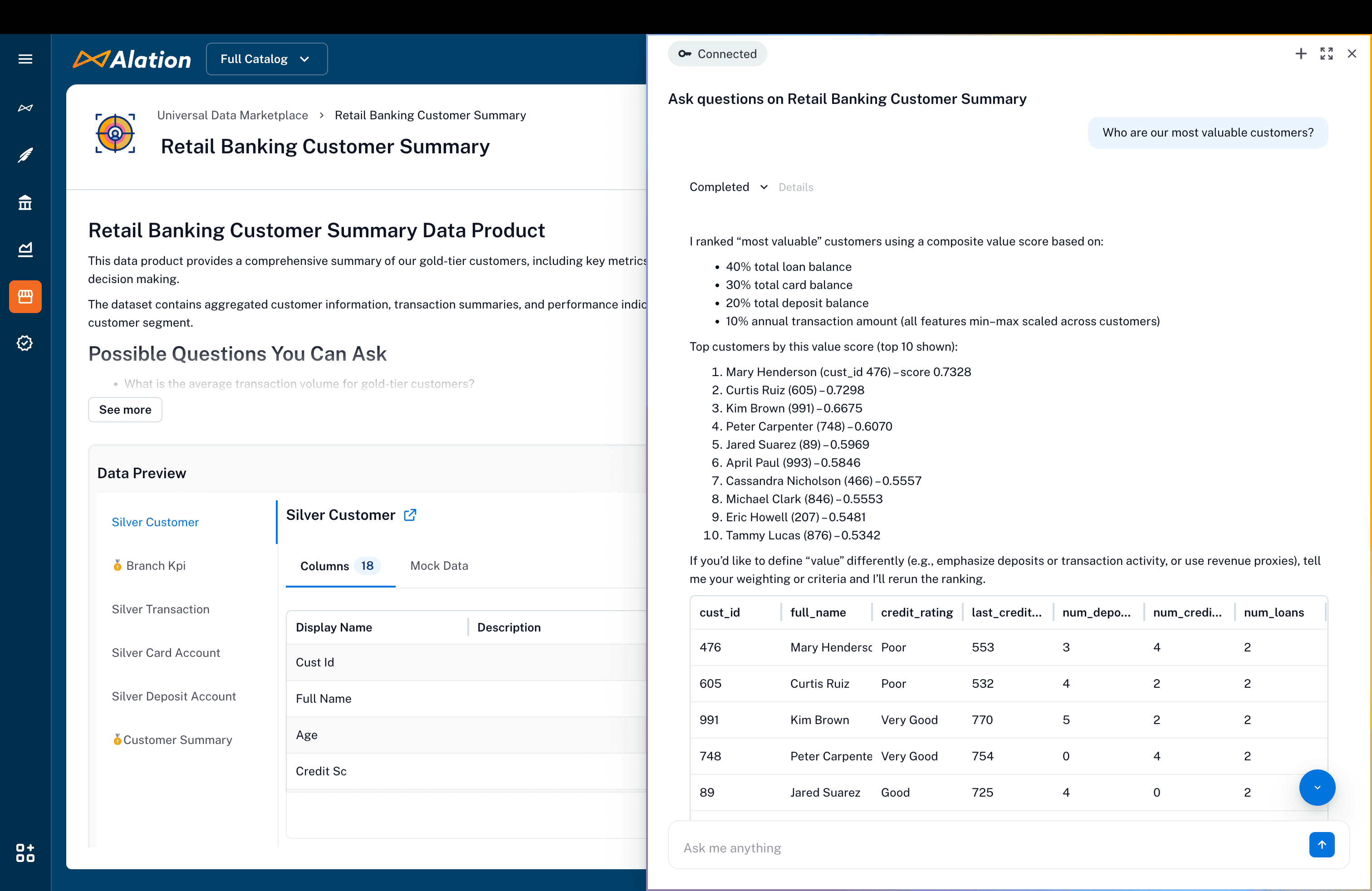
Chat with Your Data takes this further, enabling users to query and understand data using conversational AI while maintaining governance and trust. Built on a knowledge layer of trusted data products, it delivers answers with 30 to 60% more accuracy than generic AI tools by leveraging metadata-aware agents. Users can ask questions in plain English, and the Query Agent generates SQL or Python behind the scenes, understanding joins, metrics, and business definitions automatically. Every response is transparent, showing the SQL, data sources, and business definitions used—ensuring decisions are explainable, auditable, and aligned with organizational policies.
Automated data lineage and quality
Alation automatically constructs end-to-end data lineage by parsing SQL, ETL workflows, and notebook code. This lineage visualization helps teams understand data provenance, assess the impact of changes, and troubleshoot issues quickly. When a pipeline fails or data quality degrades, lineage immediately shows which downstream reports, dashboards, and machine learning models are affected.
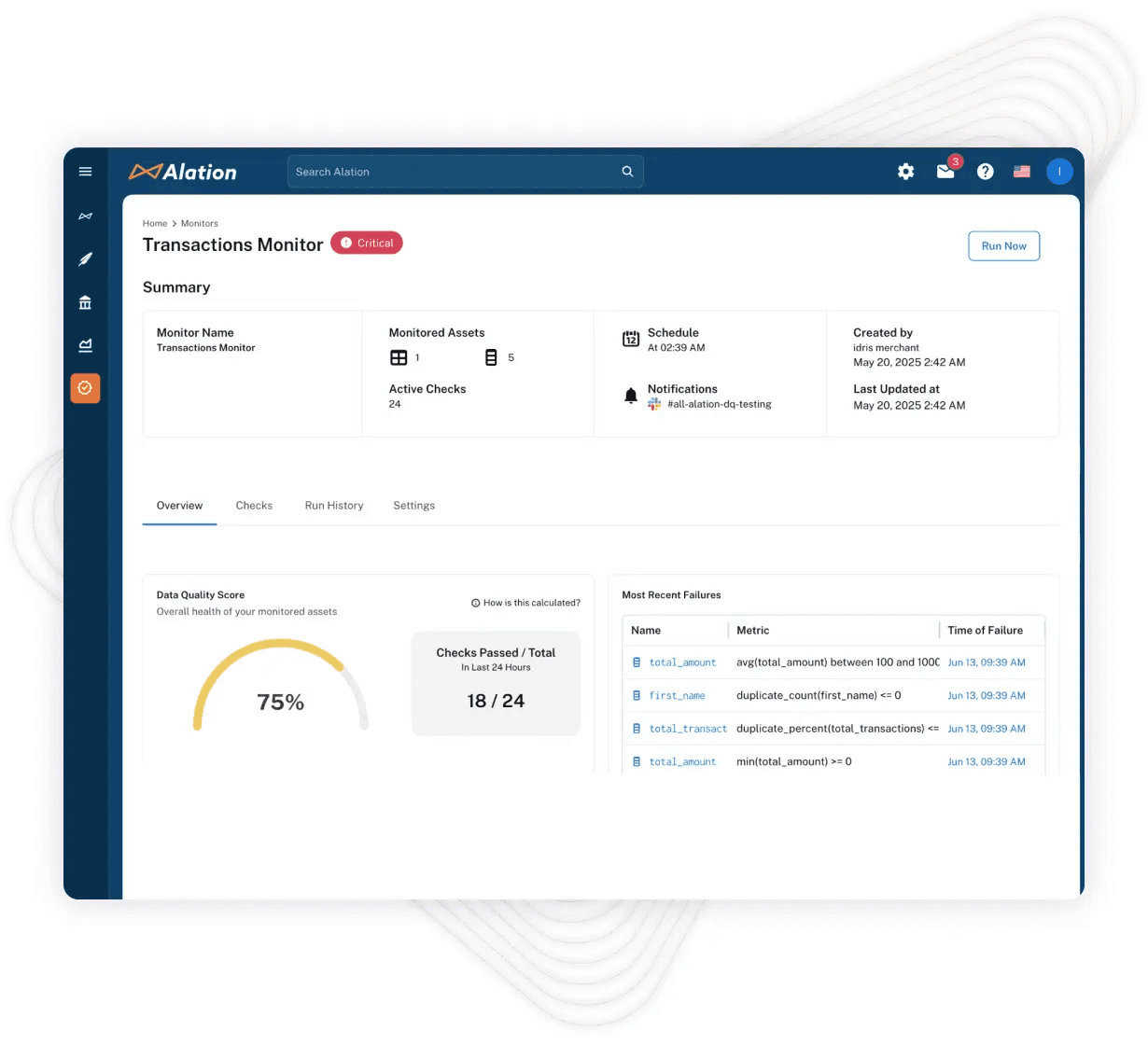
The Data Quality Agent leverages AI and metadata to proactively identify high-impact data assets and automatically generate tailored quality rules. Rather than requiring manual rule-writing, the agent learns from query patterns and usage metrics to suggest and apply checks where they matter most. Data quality issues are surfaced directly in the catalog with alerts sent to Slack, Teams, email, or BI tools, enabling fast resolution without context switching.
Comprehensive data governance
Built-in governance capabilities support policy management, data stewardship workflows, access requests, and compliance documentation. The CDE Manager provides purpose-built AI agents for identifying and governing Critical Data Elements, translating regulatory requirements into measurable data management standards. Organizations can classify sensitive data, define retention policies, track regulatory obligations, and generate audit reports—all within a single platform.
Strong governance workflows with approval loops enable stewards to maintain control while automating routine tasks. Governance policies can be enforced across connected systems, ensuring rules follow data wherever it's used.
Collaborative data intelligence
Alation enables crowdsourced collaboration where domain experts, analysts, and data engineers can contribute knowledge, ask questions, and share insights directly within the catalog. This collaboration captures valuable tribal knowledge that would otherwise remain undocumented, making it accessible to everyone who needs it. Social features like endorsements, comments, and conversations create a community around data assets.
Enterprise-ready scalability
Alation's architecture scales to support the largest enterprise data estates, with customers managing hundreds of thousands of data assets and supporting thousands of concurrent users. Cloud-native deployment options, robust APIs valued by technical personas, and extensive integration capabilities ensure Alation can grow alongside your data infrastructure.
Making enterprise AI trustworthy demands high-quality metadata. Studies have found that enterprise AI produces 30 to 60% more accurate outputs when given the context of proper metadata. Agent Studio enables organizations to build custom, governed AI agents grounded in trusted metadata from the Agentic Knowledge Layer. These agents inherit access controls, policies, and permissions automatically, ensuring security and compliance are built in from day one.
Proven business impact
Organizations using Alation report significant measurable outcomes, including dramatically reduced time-to-insight as analysts find trusted data faster, fewer data quality incidents due to better visibility and monitoring, accelerated cloud migrations through metadata-driven approaches, improved regulatory compliance with complete audit trails, and increased analytics adoption as data becomes more accessible and understandable. Real-world customer examples demonstrate these benefits across diverse industries—from healthcare organizations improving patient outcomes to manufacturing firms improving supply chain management.
The platform's excellent customer support and true partnership approach ensure organizations maximize their investment. With strong extensibility through APIs and integrations, Alation adapts to unique organizational needs while maintaining the governance and trust essential for modern data operations.
Ready to transform your metadata management strategy? Schedule a demo to see how Alation's comprehensive platform can help you achieve AI readiness, strengthen data governance, and accelerate time-to-insight across your organization.
- Digital Transformation
- Data Catalog
- Active Data Governance
- Data Governance
- Data Intelligence
- Data Products
- Data Quality
- Modern Data Stack
- AI

Jason Rushin